The Future of Protestantism


Last year, Peter Leithart wrote a provocative piece entitled ‘The End of Protestantism‘, which provoked considerable discussion in many quarters. A couple of evenings ago, the Torrey Honors Institute, First Things, and the Davenant Trust collaborated to arrange a debate between Peter Leithart, Fred Sanders, and Carl Trueman about the future of Protestantism, moderated by The Calvinist International‘s Peter Escalante. I don’t think anyone familiar with this blog and my personal interest in the work of a number of the persons and parties mentioned above should be surprised that I believe this is well worth your time.

Posted in Controversies, Lectures, On the web, The Church, Theological, Video, What I'm Watching | 7 Comments

What’s a Good Question?

I’ve already linked to this post on my Delicious account (you can see the latest five links in the sidebar, or follow the Twitter account where I post my links). However, as it is such a superb post, I wanted to recommend it here. Within it, Fred Sanders discusses how to ask a good question and lists a number of dichotomies that can help us to do just that. Here are a few:

Low level questions only require students to repeat information, perhaps to rephrase it. But High level questions require analysis, synthesis, and evaluation of the information (I’m using “low” and “high” loosely, but see Bloom’s Taxonomy of Cognitive Objectivesfor a widespread definition).

Information retrieval questions get short, factual answers (“Who is Athena’s mother?”). Information evaluation questions presuppose information retrieval, and usually get the short, factual answer thrown in as the student hurries on to the evaluative task (“Is Athena like her mother?”). Info-retrieval questions are usually best used in a series that are leading somewhere.

Convergent questions imply one right answer (“What is the main idea of this book?”); Divergent questions suggest a range of possibilities (“What are some of the most important things in this book?”).

Unstructured questions do not indicate what form the answer should take (“What did you think of Paradise Lost?”); Structured questions dictate the right form of response (“What is a new idea you got from Milton?” “What makes you mad in Paradise Lost?”)

Multiple questions offer many questions at once, so the real question is “Which of my questions do you want to use?” (“Why does God choose certain people for his purposes?Was he not dealing with individuals before Genesis 11? What’s special about Abraham?Does the text say why Abraham was chosen by God?”) Singular questions present a sheer cliff by comparison (“Why did God choose Abraham?”). Singular questions usually produce some silence from students. Multiple questions are a way for the tutor to fill up gaps in the conversation, to seed the clouds, and to check several prospects at once.

These are just the first few. Take the time to read the rest of his post, especially if you are an educator. It is exceptionally helpful.

Asking a good question is an underappreciated skill. As we so often take our questions for granted, we are unaware of how the questions that we ask shape our thought. The art of asking good questions demands deep and sustained attentiveness to the reality that we are questioning. While the wrong question forces reality into an obscuring framework, the right question can beautifully unfold it.

Several years ago, I consciously changed the way that I approached Scripture. In my earlier approach, I had brought what I presumed to be natural questions to the text and had expected the text to answer them. I stopped doing this and started to practice attentiveness to the text instead. Rather than just looking to the Scriptures for the answers to my questions, I began also to look to the Scriptures for the questions that I should be asking. One of the first things that dawned upon my awareness as I took this approach was just how bad, misleading, and wrong many of the questions I had previously depended upon were.

A good exercise to stop us from taking our questions for granted is to devote an hour to thinking about the best questions that arise from a particular biblical text. This exercise requires a very different kind of attentiveness to the text than answer-based study does.

I’ve written on the subject of questioning here, among other places. I would also recommend my friend Matt Lee Anderson’s book, The End of Our Exploring.

Posted in Links, Quotations, The Blogosphere, Theological | 6 Comments

The Value of Arguing Without Changing Our Minds

Derek Rishmawy just posted a great Oliver O’Donovan quotation over on his blog (from the superb Self, World, and Time: Ethics as Theology Volume 1, which I have also been enjoying lately), within which O’Donovan observes the benefits of arguing even when neither side changes their minds. The rest of Derek’s remarks are worth reading, but I will shamelessly swipe the O’Donovan quotation and repost it here:

Let us suppose that I disapprove of the death penalty, and take up the cudgels against someone who defends it. As our discussion proceeds, certain things will become clear. One is that there are various reasons for disapproving of the death penalty, some of which may plausibly claim a perennial moral truth, while others are more circumstantial. If my opponent forces me to think hard, I shall understand better what social and historical conditions have made the death penalty appear reasonable to past generations, and I shall have to ask if those conditions could ever recur. I shall come to see that my view of the matter is part and parcel of a wider philosophy of penal justice and governmental responsibility, and I shall be forced to elucidate that philosophy more fully and to test its capacity to shed illumination on other questions, too. None of this could I have gained from talking to those who agreed with me. What it amounts to is that if at the end of the argument I still say, “ I disapprove of the death penalty!” I know much better than before what I mean by it.

–Oliver O’Donovan, Self, World, and Time: Ethics as Theology Volume 1, pg. 46

Another superb quotation of O’Donovan’s on this subject comes from A Conversation Waiting to Begin, in which he observes:

Disagreements are no more unnegotiable natural forces than deliveries of the mistaken conscience are. They are openings for those who share a common faith to explore and resolve important tensions within the context of communion.

This kind of proposal is, of course, easy to mishear. It can be taken to mean that parties to disagreements must be less than wholly convinced of their position, ready to make room for possible accommodation. When really serious issues are at stake and talk of a status stantis aut cadentis ecclesiae begins to rumble like thunder, urging the search for resolution can seem like an invitation to capitulate, to concede essential points before beginning. It can seem as though Scripture is deemed to be inconclusive and ambiguous, so that either side is free to concede the possible right of the other’s interpretation. It can seem as though what is needed is an indefinite irresolution about everything important, in which there is no need for, and no possibility of, a decisive closure. But that is all a trick of the light. None of this is implied in the search for agreement. The only thing I concede in committing myself to such a process is that if I could discuss the matter through with an opponent sincerely committed to the church’s authorities, Scripture chief among them, the Holy Spirit would open up perspectives that are not immediately apparent, and that patient and scrupulous pursuit of these could lead at least to giving the problem a different shape—a shape I presume will be compatible with, though not precisely identical to, the views I now hold, but which may also be compatible with some of the views my opponent now holds, even if I cannot yet see how. I do not have to think I may be mistaken about the cardinal points of which I am convinced. The only thing I have to think—and this, surely, is not difficult on such a subject!—is that there are things still to be learned by one who is determined to be taught by Scripture how to read the age in which we live.

–Oliver O’Donovan, A Conversation Waiting to Begin, 32-33

To all of which I give a hearty Amen!

Posted in Controversies, My Reading, Quotations, The Blogosphere, Theological | 15 Comments

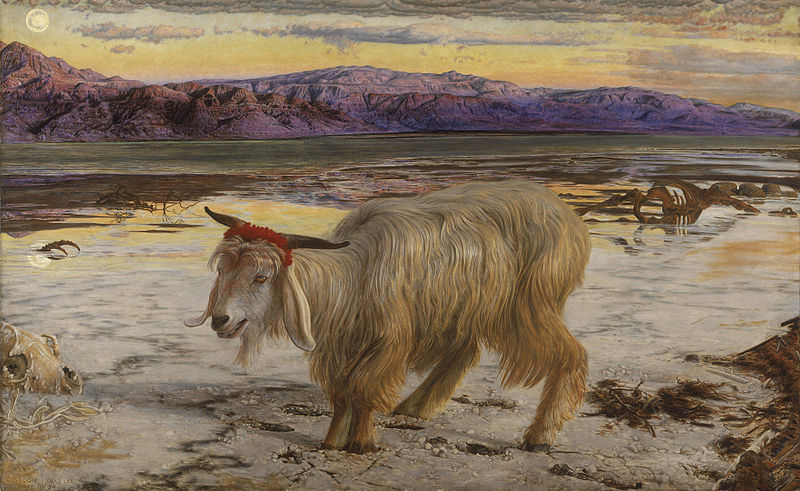
Jesus, the Goat for Azazel

William Holman Hunt - The Scapegoat

William Holman Hunt – The Scapegoat

The following is a long excursus from my previous post on the meaning of Mark’s account of Jesus’ time in the wilderness. As it grew longer, I decided to remove it from that piece and post it separately. Joey Cochran suggested another connection within the Markan account to me: that this is an allusion to the scapegoat. I think that this is exactly correct and it is one that helps to align a broader constellation of allusions and echoes. As yet, I don’t know exactly how to fit all of the data together as the theme is one that undergoes unusual developments. In the remarks that follow, I will lay out some of the relevant biblical details and suggest some theories that account for certain dimensions. I will leave it to you to propose further ways of filling out the picture in the comments.

The Day of Atonement or Day of Coverings ritual (Leviticus 16) involved a goat being sacrificed as a sin offering for the congregation of Israel (v.15) and another goat being sent away into the wilderness by the hand of a suitable person (vv.20-22). A lot is cast between the two of them to determine which will do which: one is for YHWH and the other is for Azazel. One of the goats—the goat for YHWH—is killed for the nation as a sin offering (along with a bull for the High Priest) and its blood is used to sprinkle on and before the mercy seat and the golden altar of incense, releasing them from their defilement and removing any judgment resting upon the world order that they symbolized. The High Priest confesses the iniquities of the nation over the other goat—the goat for Azazel—and sends it off into the wilderness by the hands of a suitable person. This goat, to prevent its return, would typically be thrown over a precipice. After this had been done, the fat of the goat and bull of the sin offering for the people and the High Priest would be burnt on the altar. Then the flesh of the sin offering, its skin, and offal would be burnt in a clean place outside of the camp and no one would eat any of it. Through the Day of Atonement, the world would be cleansed and the nation would be released from their sins as they were confessed over the scapegoat.

The scapegoat is literally described as being ‘for Azazel’, a word that only occurs four times in the whole Bible, all within Leviticus 16 (vv.8, 10, 26). Various suggestions have been given for the meaning of this. It is interesting that the name ‘Azazel’ appears as the name of a chief demon condemned to the wilderness in the book of Enoch (Enoch 8:1; 9:6; 10:4-8; 13:1-2; 54:5; 55:4; 69:2). More generally, demons are associated with goats (Leviticus 17:7; Isaiah 13:21; 34:13-14; 2 Chronicles 11:15) and with the wilderness (Luke 11:24; Revelation 18:2).

As a symbolic and sacrificial animal, the goat is related to the ruler of the people (Leviticus 4:22-24) and presumably also to the congregation as a whole as a civil polity. The common symbolic root that accounts for this meaning and also for the demonic connotations of the goat is that of governmental authority and power. The word `attuwd, for instance, means both he-goat and leader (cf. Isaiah 14:9; Zechariah 10:3; Daniel 8:5, 8, 21). A word for ram, ‘ayil, has a similar double meaning.

There is a Day of Atonement pattern at work as Ishmael is sent by Abraham, playing the role of the High Priest, into the wilderness by the hand of Hagar (Genesis 21:8-21). In a passage that closely echoes the passage concerning Ishmael, Abraham them offers up Isaac (Genesis 22). I’ve discussed the connections between those two accounts and the Day of Atonement a little here. Ishmael is the goat sent into the wilderness; Isaac is like the goat of the sin offering.

A more complex pattern occurs in the story of Esau and Jacob, which I discussed in connection with the Day of Atonement here. There is a wordplay on the description of Esau as a ‘hairy’ (sa`iyr) man, hair that is connected with the goat skin that is used to ‘cover’ up Jacob so that he can receive the blessing (note the strong sacrificial themes that I discussed in my post). The word sa`iyr also means he-goat, both the goat used for sacrifice and the demonic ‘goats’. Esau’s land was Seir (Se`iyr—Genesis 32:3).

Rebekah instructs Jacob to get two kids of the goats for her (Genesis 27:9). She makes a meal from them and dresses Jacob in the goats’ skins, so that he can be like his hairy brother. On account of the failure of her husband to favour Jacob as he ought to have done, Rebekah plays the role of the priest here, the two kids being related to her two sons. Esau is already like a goat and Jacob is dressed up in the skin of one.

Esau represents a crisis for the covenant. He is unfaithful to the covenant, despising his covenant birthright (25:29-34) and compromising the holiness of the covenant people by marrying Hittite women (26:34-35). If this weren’t bad enough, Isaac is happy to give the covenant blessing to the wicked son. Through her shrewd trickery, Rebekah ensures that faithful Jacob is the one who gets the blessing, as Isaac smells the pleasing aroma of the food and his son. The offering of Jacob to his father leads to blessing upon the land as Isaac is pleased with the food representing the fat of Jacob (27:27-29). However, the other kid, Esau, is told that his dwelling place shall be ‘away from the fatness of the earth and away from the dew of heaven above’ (27:39-40). The covenant order is restored as Esau is expelled from the scope of the covenant blessing, going to Seir.

Jacob, having symbolically offered his fat to his father, and being well received, then has to go ‘outside of the camp’. He comes to a place where he lays his head on a stone for the night. He has a dream of a ladder reaching to heaven, with angels ascending and descending, and YHWH above it. Later he calls the place Bethel and pours oil on the stone. Thus Jacob is like the goat of the sin offering.

Themes of competing heirs and goat themes also occur with Joseph and Judah. Joseph and Judah are competing for the covenant birthright (cf. 1 Chronicles 5:1-2). Both sons are represented by a kid of the goats. The tunic of many colours covered with the blood of Joseph—which is really the blood of a kid that has been killed—is presented to Jacob as false evidence of his beloved son’s death (Genesis 37:31-33). In the following chapter, Judah sends a goat by his friend’s hand to the supposed prostitute he had slept with in exchange for his signet and cord, evidences of his identity (38:17-23). Judah’s sexual iniquity contrasts with Joseph’s faithfulness in resisting Potiphar’s wife’s advances in the following chapter. Joseph, taken outside of the camp, is raised up and blessed, while Judah loses the birthright and is symbolically sent into the wilderness. As all of the heirs of Judah are bastards (Genesis 38), they cannot enter into the ruling congregation for ten generations (Deuteronomy 23:2; cf. Ruth 4:18-22).

David is the one who brings the tenth generation (according to Ruth’s genealogy). David is expelled from Saul’s court and spends time in the wilderness. My suggestion is that David is playing the part of the goat for Azazel, fulfilling the destiny of Judah. David is associated with goats at various points of the story. He is first found among the flocks (1 Samuel 16:11). He is described as ‘ruddy’, language that is only elsewhere used of Esau (1 Samuel 16:12; cf. Genesis 25:25). He is sent to Saul with a kid (1 Samuel 16:20). Michal, David’s wife, uses goats’ hair as a means to create an image of David to abet his escape (19:13). Saul later seeks for David in the Rocks of the Wild Goats (24:2).

The nation is under condemnation on account of the actions of Saul. David takes the identity of the nation upon himself as the anointed one and bears it into the wilderness. He faces off with the demonically-driven Saul and with the wild beasts of the Gentile rulers. He dwells in caves and wildernesses, places of death and demon possession. While doing this, he resists the various temptations he faces to grab the kingdom by force before it is given to him. By submitting himself to expulsion from the land, David bears its judgment, so that one day he can bring it blessing.

What might this mean for our reading of the baptism and testing of Jesus? We must recall that John was baptizing with a baptism of repentance for the remission of sins. Confession of sins was an essential part of John’s baptism (Matthew 3:6; Mark 1:5), as it was on the Day of Atonement (Leviticus 16:21). John the Baptist—who, lest we forget, was from the priestly line—was playing a role analogous to that of the High Priest. Jesus here is the kid of the goats of Azazel who bears away the sin of the people (not quite the same ring as ‘the Lamb of God who takes away the sin of the world’, but there you go). In being baptized by the hands of the priest, Jesus takes upon himself the judgment lying over the confessing multitudes.

The blessing that Jesus receives at his baptism has Davidic resonances. God spoke of David’s line as his sons (2 Samuel 7:14; Psalm 89:26-29). David’s name likely means ‘beloved’. As the Father declares his Jesus to be his ‘beloved Son’, perhaps we can hear hints of David’s own identity. Jesus is the one who will inherit the throne of his father David (Luke 1:32). As with David, God drives his beloved Son into the wilderness.

Being ‘driven out’ into the wilderness by the Spirit, Jesus was being treated like a demon, being exorcised into their realm (cf. Luke 11:24), and sent to Azazel, the prince of the demons. He was receiving the condemnation of exile due to the sins that the multitudes were confessing. The encounter with the devil can be understood in light of this, as perhaps can the references to being cast down from high precipices. Jesus goes into the wilderness to the realm of Azazel, bearing the sins and judgment of exile due to the people. He passes through the period of trial and then returns victorious as the leader of a restored people. As he has borne the judgment due on the people, he can proclaim delivery to the captives.

Jesus later acts as the goat of the sin offering, his blood cleansing the world and the judgment it pronounces against humanity, and opening the way into communion with heaven. His body is offered outside of the camp (Hebrews 13:10-13). The flesh of the sin offerings contracted the defilement of the things that they cleansed. This defilement could only be removed by fire. The lesser sin offerings could be purged by cooking (cf. Leviticus 6:24-30), but could only be eaten by holy persons. However, the sin offerings for the Holy Place could never be eaten. Jesus bears the defilement of the Holy Place and exhausts it, bringing it to complete destruction, suffering outside of the city. As a result, as we feed on him, we enjoy an exalted priestly status. I suspect that there the notion of such a ‘two stage’ atonement might be worth exploring.

Thoughts?

Posted in #Luke2Acts, 1 Samuel, Bible, Genesis, Leviticus, Luke, Mark, Matthew, NT, NT Theology, OT, OT Theology, The Atonement, Theological | 25 Comments

#Luke2Acts – Some Notes on Luke 3 and 4

Michael the Archangel by Guido Reni

Michael the Archangel by Guido Reni

The following are an extensive list of thoughts on Luke 3 to 4, arising from the Twitter Bible study, #Luke2Acts. I hadn’t originally planned to post this. However, as I got rather absorbed into these two chapters, I thought that some of the readers of this blog might appreciate if I shared a few of my reflections. As usual, take these suggestions with a pinch of salt and exercise caution when running with any of the possibilities here. That said, I get the distinct feeling that there is a great deal in these passages that we haven’t yet discovered.

I would love to hear any further thoughts that my readers might have in the comments. Also, if you find any of this interesting, you should join the discussion on Twitter. I have no current plans to continue posting on the subject here.

***

Once again, Luke sets the scene within the context of the wider world and its rulers and empires. A new ruler is coming onto the world stage and, from this time onwards, the nations and their rulers must reckon with him.

While the other gospels don’t mention Pontius Pilate until the time of Jesus’ trial, Luke introduces him as a character here. He also speaks of the surrounding regions, establishing a more cosmopolitan context.

Seven historical figures are mentioned—Tiberius Caesar, Pontius Pilate, Herod, Philip, Lysanias, Annas and Caiaphas—rooting the narrative in a clear historical context too. It is easy for us to forget that history is measured relative to persons, rather than according to an abstract metric. To enter into history is to take up a position in the world of human affairs. ‘In the 2014th year of our Lord, and the 53rd year of the reign of HM Queen Elizabeth II, Barack Obama being president of the United States…’

***

‘The word of God came to John the son of Zacharias’—this is a familiar formula for the word of YHWH coming to the prophet. Note the fact that many of the prophets’ books are introduced with a similar expression. This formula is often contextualized by mentioning the reign of particular kings or rulers—often foreign—along with the name of the prophet and his father (Hosea 1:1; Amos 1:1; Micah 1:1, Zephaniah 1:1, Haggai 1:1; Zechariah 1:1; etc.). The prophets operate within an international context, speaking as God’s representatives to kings and rulers of nations. Unsurprisingly, John the Baptist is later imprisoned for speaking out against Herod (Luke 3:19-20).

***

‘Baptism of repentance for the remission of sins’—as N.T. Wright observes, the ‘remission of sins’ refers to God’s restoration of sinful Israel. The baptism was an act of national, not just private, repentance. This baptism occurred in the wilderness on the far side of the Jordan. Those who came to be baptized by John had symbolically to leave the land and reenter it by washing. John is one preparing the way for the returning king in the wilderness. He baptizes in the wilderness so that people can be brought into the land by Jesus (Joshua). John was from a priestly family and his actions should be understood in light of this. Baptism wasn’t something that arose out of the blue, but something related to rites of the Levitical system.

***

John the Baptist here raises the question of who the true children of Abraham are, a question that is central to Romans and Galatians. In using the expression ‘brood of vipers’ he is effectively declaring that the multitudes coming to him are the seed of the serpent (cf. Genesis 3:15) as opposed to the children of Abraham.

‘God can raise up children to Abraham from these stones’—God later raises up Christ from the stone grave as Abraham’s true heir. Abraham himself is described as a rock in Isaiah 51:1-3. Israel is raised up from the rock and God can do the same thing again.

***

‘The ax is laid to the root of the trees’—The trees are going to be chopped down at their very roots, not just at the trunk. Once again, the image comes from Isaiah (10:33-34). Those who know the Isaiah reference will recognize that what comes next is a rod growing from the ‘stem of Jesse.’ The kingdom is cut down beyond even David and a new David will arise, like life from the dead. The image of the ax and the trees is also reminiscent of Psalm 74:1-7, where the trees are associated with the temple. The nation and its temple will be cut down by the ax of the Romans in AD70 and burned.

***

Jesus is ‘mightier’ than John. Here Jesus is presented as a powerful warrior. Once again, we are in the world of Isaiah allusions here. Jesus is like the depiction of the Lord as a mighty warrior, singlehandedly working salvation, treading out the winepress in the day of his vengeance in Isaiah 63:1-6. John the Baptist isn’t worthy to loose Christ’s sandals for this treading. The references to strength are significant. The Hebrew meaning of Gabriel’s name also refers to might and strength. The scene is being set for a showdown with the strong man who holds the world in bondage (cf. 11:21-22). More on this later.

***

I discuss the possible meaning of the threshing floor here:

Our first introduction to Christ in the New Testament through the testimony of John the Baptist is as the one who winnows at the threshing floor (Matthew 3:11-12):

“I indeed baptize you with water unto repentance, but He who is coming after me is mightier than I, whose sandals I am not worthy to carry. He will baptize you with the Holy Spirit and fire. His winnowing fan is in His hand, and He will thoroughly clean out His threshing floor, and gather His wheat into the barn; but He will burn up the chaff with unquenchable fire.”

Christ is the one who works the threshing floor, much as he is the one who treads out the grapes and the winepress in Isaiah 63:1-6 and Revelation 14:14-20 (where he also reaps the wheat). In our worship we meet with Christ our kinsman redeemer on the threshing floor where the wheat and the chaff are separated by the Word of God.

Only a fairly dull ear would miss the heavy allusion to Malachi 3:1-3:

“Behold, I send My messenger, and he will prepare the way before Me. And the Lord, whom you seek, will suddenly come to His temple, even the Messenger of the covenant, in whom you delight. Behold, He is coming,” Says the LORD of hosts. But who can endure the day of His coming? And who can stand when He appears? For He is like a refiner’s fire and like launderer’s soap. He will sit as a refiner and a purifier of silver; He will purify the sons of Levi, and purge them as gold and silver, that they may offer to the LORD an offering in righteousness.

The temple of Malachi 3 is replaced with the threshing floor in Matthew 3. Christ, however, is the one who purges both the temple and the nation of Israel. He is the one who separates wheat from chaff, burning the latter and gathering the former.

Given our previous observations about the significance of the removal of sandals, I would be surprised if it were accidental that John the Baptist consistently mentions the fact that he is unworthy to carry or to loose the sandals of Christ (Matthew 3:11; Mark 1:7; Luke 3:16; John 1:27). The impression given is that Christ’s sandals are being removed for some reason. I suggest that this removal of the sandals has to do with Christ’s treading out of the grain in the holy place.

***

Herod the tetrarch persecutes John the Baptist at the instigation of his wife, Herodias. The parallel to Jezebel’s instigation of Ahab’s persecution of Elijah (in whose spirit and power John came—1:17) should be clear.

***

Jesus is baptized when all of the people have been baptized, presumably suggesting that it was not just as one of the crowd. Is the suggestion that Jesus is the one who completes the full number? I am not sure whether Luke intends this, but the Flood account is brought to my mind here. When all have entered the ark, God closes the door. Then the heavens are opened. The Holy Spirit later descends upon Jesus like a dove, like the dove descended on the new earth after the Flood (I think that Luke intends this much, though doubt that he intends a wider set of Flood allusions). Father, Son, and Spirit are all seen within a single event.

The Spirit hovering over Jesus as he comes out of the water also recalls the Spirit’s presence at the first creation of the world. Notice the way that Isaiah 63:11-14 brings together the themes of creation with the event of the Red Sea crossing—‘brought out of sea’ as the land was raised up on the third day; ‘put Holy Spirit within them’, like breathing the breath of life into Adam; ‘dividing the water’, like the waters above and below on the second day; ‘through the deep’, like the deep of the original creation; ‘causes him to rest’, the creation Sabbath. The original creation was created out of water. The world after the Flood was created out of the waters. Israel was formed out of the waters of the Red Sea and Exodus. In Jesus’ baptism we see that the new creation is formed out of the waters too.

***

Why is Jesus baptized by John? Various reasons can be given and different gospels emphasize different things. It creates continuity between the ministry of John the Baptist and Jesus. Just as Moses and Joshua (Joshua 1) and Elijah and Elisha (2 Kings 2) passed the baton of ministry on the far side of the Jordan, so John passes the baton of ministry to Jesus at the same place. Jesus has same name as Joshua and leads us into the Promised Land. His ministry is compared to that of Elisha at various points in the gospel of Luke. Before Jesus, Elisha was the most prominent miracle-worker in the land.

In being baptized with the rest of the people, Jesus identifies with them and identifies them with him. He is the one who will lead them into the Promised Land. As the leader of the people he also takes their state upon himself, along with all of their history. He enacts the repentance of the nation that he represents by being baptized with John’s baptism.

At his baptism, Jesus is set apart as a priest. Jesus began his ministry at around thirty years of age, which is the age that the priests began. As Leithart observes in detail (and in even more detail in his superb book, The Priesthood of the Plebs), Jesus’ baptism was a baptism into priesthood (cf. Exodus 40:12). The fact that a genealogy follows should be related to the fact that Jesus is entering into priestly ministry at this point. The genealogy marks him out as qualified for priesthood.

The baptism is a confirmation both to Jesus and to John of Jesus’ status as the Son of God. In John’s gospel, the descent of the Spirit upon Jesus is that which manifests Jesus to John as the Son of God (John 1:29-34). This marks the definitive beginning of Christ’s ministry, but also demonstrates that John’s ministry has achieved its purpose. It is important to remember that a qualification for the Twelve was having been there since baptism of John (Acts 1:22). Each of the gospels starts with the witness of John.

By being baptized in the waters of the Jordan, Jesus also sanctifies the waters of Baptism as the means of his new creation, just as it had been the primary means of previous creations. Jesus takes up the natural element of water and glorifies it in using to form his kingdom. Tertullian’s approach to these themes is worth revisiting here. In being baptized, Jesus also sets the example for all of us to follow in his steps.

***

Jesus’ story is a story of three baptisms: his baptism of anointing and manifestation in the Jordan; the baptism of his death; and the baptism of the Spirit that he performs at Pentecost. In Jesus’ baptism he gathers up the story of all of the great ‘baptisms’ of the Old Testament (the creation, the Flood, Red Sea, baptism into priesthood, the ritual washings, Elijah crossing the Jordan, etc.) into his story. He takes up the baton from the last great Old Testament prophet—John the Baptist. He identifies with a sinful people and then, out of their broken history he forges a new one.

Our baptism is how we are plugged into his Baptism—we are baptized into him as Israel was into Moses, the one drawn from the water. We are baptized with him in Jordan, anointed with his Spirit for ministry and declared to be God’s beloved children. We are baptized with him in his death, dying and rising again to new life. We are baptized with his baptism of Pentecost, clothed with the mantle of the ascended Christ’s Spirit and made one body in him. The story of all things is gathered together and summed up in the baptized Christ and we in him.

***

The descent of the Spirit upon Jesus in his Baptism should be related to the later descent of the Spirit upon the Church at Pentecost. As Christ ascends into heaven, his Spirit descends upon the Church, like the mantle of Elijah fell to Elisha and Elijah received the firstborn portion of Elijah’s Spirit when Elijah ascended in 2 Kings 2. Elijah’s ascension is Elisha’s pentecost.

***

The genealogy has 77—7×11—names. We have already seen that Anna is a widow of 84—7×12—years. Jesus brings in the twelfth seven and comes as the kinsman redeemer to his widowed people.

***

The genealogy moves in the opposite direction from most lengthy biblical genealogies. I’m not sure what to make of this. By presenting Jesus at the start, is Luke highlighting the convergence of all upon him? While genealogies usually branch out and the last person within them is merely one twig in a larger tree, here Jesus is the rod from which the rest of the tree is ordered. While he may be descended from many, many previous generations, he is the new root.

***

While Matthew’s genealogy starts with Abraham, Luke’s traces Jesus’ line back to Adam and God. While Abraham represents Israel, Adam represents the entire human race. The fact that Jesus is the Son of God is underlined in these earlier chapters of Luke (1:35; 2:49; 3:22, 38; 4:3).

***

Different language surrounding Jesus’ entry into the wilderness in gospels is fascinating, as each sets up different echoes.

Matthew:led up to the wilderness by the Spirit.’ The allusion here seems to be to Israel’s being ‘led up’ out of Egypt into the wilderness by the Spirit (the pillar of cloud and fire) in the Exodus.

Mark: ‘the Spirit drove him out into the wilderness.’ This is reminiscent of David being driven out from Saul’s court into the wildernesses (1 Samuel 23:14-15, 24-25; 24:1; 25:1; 26:2-3). While in the wildernesses, David lived with the wild beasts (the Gentiles), and resisted the temptation to snatch the kingdom for himself before it was time (I might post more on Mark’s account in a separate post).

Luke: ‘Jesus, being filled with the Holy Spirit … was brought in the Spirit into the wilderness.’ This is the language of the prophet caught up and transported by the Spirit (cf. Ezekiel 3:14). Note the similarities with Luke 2:27, where Simeon comes by the Spirit into the temple. Another interesting parallel can be seen in Revelation 17:3, where the seer John is carried away in the Spirit into the wilderness, where he encounters the Whore of Babylon on the Beast.

There is a priest (Exodus) to king (kingdom era) to prophet (later history of Israel and Judah) pattern in the Synoptic gospels and this be seen as one instance of it.

***

Perhaps there is a subtle allusion to the hand of the Lord coming upon Ezekiel and carrying him in the Spirit into the wilderness valley of dry bones (Ezekiel 37:1). There is a pattern in Ezekiel. Ezekiel is first transported by the Spirit into the wilderness (37:1), then to a very high mountain (40:2), then to various extremities of the temple (40:17, 24, 28, 32, 41:1; 42:1; 43:1; 44:1, 4). This visionary journey is mirrored in Revelation: wilderness (17:3), mountain (21:10), temple (21:22ff.), the mountain and the temple being closely related, as in Ezekiel. The devil gives Jesus a false ‘apocalypse,’ a twisted alternative to the visions of God’s future received by the prophets.

***

The parallels between Jesus and Ezekiel are significant. Ezekiel is about thirty years of age (Ezekiel 1:1). He sees the heavens opened and visions of God (1:1). He hears a voice of one speaking (1:28). He is addressed as ‘Son of man’ (2:1) and the Spirit comes upon him (2:2). He is then fed by the word of God (3:1-3) and brought on a visionary journey (3:14, etc.). In 2:9, Ezekiel is handed the scroll of prophecy, the word of God, which he then eats. The prophets were fed by the Word of YHWH. Ezekiel eats the scroll in Ezekiel 3:1-3, as does John in Revelation 10:8-11. He receives the word of God into his mouth, which he will then speak forth. In Luke 4:17, Jesus is handed the scroll of prophecy. He then proceeds to speak the word of prophecy as a word that he incarnates. The people marvel at the ‘gracious words which proceeded out of his mouth’, alluding to the concluding words of Deuteronomy 8:3, which Jesus didn’t quote in verse 4.

***

There is possibly an Exodus pattern here: after the water crossing/baptism (Red Sea), there is a period in the wilderness associated with miraculous bread (manna), coming to the mountain (Sinai), and then the temple (tabernacle).

***

Notice also the pattern in the story of Elijah. During the drought the Spirit leads Elijah out of the land, where he miraculously ‘makes bread’ from pottery (1 Kings 17:8-16). Later Elijah is fed with miraculous bread baked on ‘hot stones’ (19:5-8), which gives him strength to go without food for forty days and nights. Both of these events are accompanied by the word of YHWH. He then goes to the mountain of Sinai, where he is given a vision and commission for the future of the kingdom.

***

Refusing to eat of the food of the land bearing the curse, the prophet is fed by heavenly bread. The Israelites rejected the old leaven and ate manna—bread from heaven. Moses went without bread for forty days on the mountain, receiving tablets of ‘stone’ from God. David ate the holy bread of the tabernacle (1 Samuel 21:1-6). Elijah is fed by the ravens, then by the miraculous bowl and jar, then by the bread from the angel. The devil wants Jesus to produce bread from his curse-bearing territory, rather than relying by faith upon God’s bread. The wilderness becomes the source of a feast both in Ezekiel (39:17-20) and in Revelation (19:17-21), after the great victory has been won.

***

Luke has already mentioned a miraculous transformation of stones in 3:8. Also notice that in Luke the devil calls Jesus to produce bread from a single stone (v.3), rather than from many (Matthew 4:3). I am not sure what to make of this. Should the stone be connected with the stone of Jesus’ tomb, Jesus’ body being the bread? From the (grave)stones, as in Ezekiel 37:12, God will raise up a new loaf, the true children of Abraham.

***

Christ has been connected with Adam in the verse immediately before the temptation account. He is then described as being filled with the Spirit (the breath) of God. Like Adam, he is tempted by the devil to eat forbidden food and to jump the gun on God’s kingdom plans. Like the serpent in the Garden, the devil seeks to twist God’s word. The last Adam resists in the hunger of the wilderness, what the first Adam failed to resist in the plenitude of the Garden. As Peter Leithart observes, the role played by the Spirit in this narrative should be related to that of Eve. The Spirit is the ‘helper’ of Christ.

Is there a way that we could give more substance to this suggestion? Perhaps. Consider the association between the dove and the beloved in Song of Solomon. ‘Dove’ is the King’s ‘pet name’ for his Bride (1:15; 2:14; 4:1; 5:2; 6:9). The dove is also associated with love, the time of love (2:12), and with the eyes of both the King (5:12) and his Beloved (1:15; 4:1). The dove is a messenger of love and the eyes of the lover are like those of fiery doves (note the connection between the mode of the Spirit’s appearance at Jesus’ baptism and at Pentecost). Coming as a dove, the Spirit is the ‘bodily form’ of the Father’s love for his Son. The Spirit is the personal gift of the Father’s love.

The Spirit, however, is also associated with the Bride (cf. Revelation 22:17). The Spirit forms a Bride for the Son. Even when spoken of using masculine pronouns, the Spirit is associated with feminine themes, hovering over the womb of the original creation (Genesis 1:2), being like an eagle hovering over its young (Deuteronomy 32:11), and overshadowing the womb of Mary (Luke 1:35). In Revelation we see the Bride, the Lamb’s wife, descending out of heaven, having the glory of God (Revelation 21:2, 9-11). This is a glorified form of the descent of the Spirit upon Christ at his Baptism. The Church, as the Bride of Christ formed in and by the Spirit by the will of Father is the expression of the Father’s love for his Son. Given the Spirit’s relationship to the Bride, the symbolic connections between the dove and the Beloved, the baptismal descent of the Spirit and the eschatological descent of the Bride, and the Adamic themes within the passage, I believe that we are justified in associating the Spirit with Eve here.

***

Seeing all of the kingdoms in a moment in time might be like the visions in Daniel of the different successive empires.

The devil is the ruler of the wider empire, making him the direct adversary of Gabriel, who has appeared earlier to announce the births of John and Jesus. John’s baptism of the mightier Jesus leads to this conflict, as Jesus fights on Gabriel’s behalf against his great adversary. Keep in mind the points that I made earlier about the emphasis upon ‘might’.

This should be related to the role of Michael—the heavenly prince of Israel—in supporting Gabriel against the opposing kings in Daniel 10:13, 21. Michael is connected with the Angel of YHWH (Zechariah 3; cf. Jude 9). In turn the Angel of YHWH or the ‘Angel of the Covenant’ is connected with Christ (I comment on the Angel of YHWH here and here). Malachi 3:1 is a key verse here, as it relates the coming of the Angel (or Messenger) of the Covenant to the ministry of John the Baptist and Christ:

“Behold, I send My messenger,
And he will prepare the way before Me.
And the Lord, whom you seek,
Will suddenly come to His temple,
Even the Messenger of the covenant,
In whom you delight.
Behold, He is coming,”
Says the Lord of hosts.

The Lord, the Messenger of the covenant, is Christ. Once this has been appreciated, a very interesting picture starts to emerge. Gabriel tells Daniel that Michael will stand up at some point in the future (Daniel 12:1). Luke presents us with the coming of the mighty champion who will equip Gabriel to defeat the devil and his princes. John speaks of Michael and his angels fighting against the dragon (the fully grown serpent) in Revelation 12:7-9.

***

The references to angelic rulers, the heavenly army, and conflict with the devil in these early chapters of Luke should make clear that there is a battle of spiritual powers occurring throughout the gospel and that we shouldn’t merely focus upon the surface events. The devil’s second temptation is an invitation to Jesus to rule under and with him, rather than under the Father. This temptation would be a way for Jesus to avoid the great battle of the cross.

***

When Jesus resists his second temptation, the devil tempts Jesus to throw himself down from the pinnacle of the Temple, to cast himself out of the realm of God’s presence, assuring him that the angels will protect him, much as Shadrach, Meshach, and Abednego were protected in the fiery furnace. If Jesus won’t rule alongside the devil on the devil’s terms, the devil assures Jesus that God will protect him if he exiles himself. Rather than plundering the strong man and resisting the devil’s claims over God’s house (we should recall Ezekiel’s visions of the Temple as a place of idolatrous devil-worship in Ezekiel 8-11), Jesus would be protected if he abandoned the house to the devil. It would be so much easier for Jesus if he just cast himself away from Israel.

***

All of Jesus’ responses to the devil involve quotations from the book of Deuteronomy (8:3; 6:13; 10:20; 6:16) and all refer to the testing of Israel in the wilderness.

***

The devil departs from Jesus ‘until an opportune time’, presumably Gethsemane. Observe the emphasis upon trial (a more appropriate word than ‘temptation’) in the Garden of Gethsemane (Luke 22:39-46—the same word for ‘trial’ is used here as in 4:13). Perhaps this should be related to the ‘time of trouble’ spoken of in Daniel 12:1. Perhaps there is also some relationship between the trials in the wilderness and the ‘trials’ leading up to and upon the cross.

Here is one possibility. The first trial is in the Garden of Gethsemane. Jesus must live by every word of the Father. The Father’s word takes the form of a ‘cup’ that he must drink (22:42). While Jesus could reject the cup of his Father and eat the portion of the devil, he chooses to live by the word of his Father. The second trial relates to his claims of kingship while before Pilate and Herod (22:6—23:12). The kingdoms of this world cast their judgment on Christ, ridiculing and condemning him. Jesus could assert his reign in a demonic fashion, but he accepts the crown of thorns and is raised up on the cross. The third and final trial occurs while Jesus is on the cross. Those watching the crucifixion, the rulers among them, the soldiers, and even one of the criminals crucified with him call him to save himself (23:35-39), to cast himself down from the cross and to abandon the temple and his mission. As Jesus perseveres with his mission through this trial, the veil of the temple is torn in two (23:45) and the strong man is decisively defeated.

***

Jesus’ reading from Isaiah brings together Isaiah 61:1-2 with 58:6. The acceptable year of the Lord might be a reference to the Jubilee (Leviticus 25:8-17), which would fit well within Luke’s emphasis upon economic themes. Jesus is bringing the release of all debts. It would also relate to the Sabbath and true fast spoken of in Isaiah 58. Jesus doesn’t quote the end of Isaiah 61:2, with its reference to the ‘day of vengeance’. His current ministry is one of blessing and restoration. The day of vengeance comes later for Israel in AD70 and, unsurprisingly, the expression occurs in that context later in Luke 21:22. Jesus’ proclamation of liberty should be related to his defeat of the devil’s power over the land, restoring the land to its original owners.

****

Jesus stands up to read and then sits down to teach. How would this posture shape the way that we regard the place of the preacher? It is also interesting to observe that Jesus seems to be a regular reader at the synagogue. Jesus may have been one of a handful of members of the synagogue who were literate.

***

The people of Nazareth point out that Jesus is Joseph’s son. With this they attempt to exert some authoritative claim upon Jesus. ‘Physician, heal yourself!’—the people of Nazareth believe that Jesus owes them special treatment on the miracle front. He should recognize the greater duty that he has towards his own country, literally his ‘fatherland’ (v.23). Jesus challenges this claim with the examples of Elijah and Elisha.

***

I have already suggested that verse 22 should be related to Jesus’ rejection of the first temptation in verse 4. Jesus is ‘fed’ by the scroll of the prophet and bears those words on his mouth. Jesus is the one by whom the true bread of God’s Word is given, rather than the bread of the devil. I believe that the attempt to throw Jesus over the brow of the hill in verse 29 should be related with the third temptation. Jesus’ own people seek to ‘cast him down from the Temple’, but he does not allow Israel to cast him away, which would have been the easy way out of the situation. This leaves us with the question of whether the second temptation is alluded to between these two. I believe that it is. Specifically, Jesus rejects the attempts of his own people to get him to serve them, serving God alone. Rather than seeking demonic mastery over the world, he chooses to minister deliverance to Gentiles, as Elijah and Elisha did.

***

The reference to Elijah and Elisha here is significant, and not merely on account of the numerous allusions that have already been made to them in the book so far. As Leithart’s chiasm make clear, in the corresponding passage in the chiasm, there are healings that are reminiscent of Elijah and Elisha. The healing of the centurion’s son (7:1-10)—a miracle done at a distance for a military man of a foreign power—can be related to Elisha’s healing of Naaman the Syrian, another foreign military man, which Jesus mentioned in verse 27 (cf. 2 Kings 5:1-19). The raising of the dead son of the widow of Nain (7:11-17) relates to Elijah’s raising of the widow of Zarephath’s son (1 Kings 17:17-24). The widow of Zarephath is mentioned in verse 26.

***

Having faced the devil in the wilderness, Jesus now faces demons in the synagogue (verse 33). The devil’s forces are occupying the heart of Israel’s places of worship, threatening to render it a desolate place. We don’t see demons much in the Old Testament. They are largely associated with the wilderness and abandoned locations (Isaiah 13:21; 34:13-14; Luke 11:24). Widespread demonic possession isn’t the norm. However, Jesus performs exorcisms wherever he goes. Perhaps we should relate this to the story of David and Saul. After David has been anointed by God’s Spirit, a distressing spirit troubles Saul and David has to minister to him (1 Samuel 16). As Christ is anointed by the Spirit, he will play a similar role for Israel, causing the distressing spirits to depart from the people.

***

We find a reference to Simon here, without any previous introduction. Luke seems to presume that Simon will be known to his readers (cf. 1:4). What other knowledge does he presume along the way? Also notice that Simon’s wife is spoken of here, even if only to mention that she has a mother. In light of Luke 18:28-30, should we presume that Peter left his wife behind to follow Jesus around? Was she one of the women who helped to fund Jesus’ ministry (8:1-3)? She later accompanies Peter as a fellow worker in 1 Corinthians 9:5.

***

Simon’s mother-in-law’s fever is spoken of like a form of possession. It ‘afflicts’ her, Jesus ‘rebukes’ it, and it ‘leaves her’.

***

Having faced the trial of the prince of the demons at the beginning of the chapter, Jesus spends much of the rest of it defeating his minions. The reference to the setting of the sun in verse 40 is interesting (see also Matthew 8:16-17; Mark 1:32-34). It seems strange that such a detail would be recorded for us. I suspect that there is a miniature resurrection sequence here. The Sabbath sunset has just fallen and Jesus performs a dramatic cluster of healings and exorcisms (vv.40-41). When it is day, Jesus disappears to a deserted place and the crowds seek for him, but he won’t stay with them. As the sunset falls on the Sabbath, the first day of the week begins and Jesus’ strength is shown against the forces of the devil. In the early morning of the first day of the week—later the day of resurrection—Jesus can’t be found and has to be sought by the crowd. He then declares his mission and the fact that it will take him away from them.

This resurrection pattern is more pronounced in Mark 1:32-39. In Matthew 8:16-27, Jesus’ healing is connected with Isaiah’s prophecy of Jesus’ bearing of our infirmities and sicknesses, something which is primarily associated with the cross (v.17). Then Jesus descends into the deep, as the waves cover the boat while he is asleep (vv.23-24). He then arises, rebukes the waves and challenges them for their little faith (v.25-26).

***

Anyway, those are my rough thoughts so far. I would love to hear any ideas that you might have in the comments!

Posted in #Luke2Acts, Bible, Luke, NT, NT Theology, OT Theology, Scripture, Theological | 2 Comments

#Luke2Acts – Some Notes on Luke 1 and 2

Yesterday the new Twitter group Bible study, #Luke2Acts, began with Luke 1 and today we have been looking at Luke 2. The following are some of the thoughts that I have had while reading the first couple of chapters. Most of them aren’t original and any that are original should be held very lightly: they are possible connections and interpretations, rather than sure ones.

I don’t plan to continue this as a series of posts. However, I thought that I would whet your appetite and encourage you to get involved. Just use the hashtag #Luke2Acts on Twitter. We would love for as many people as possible to join us!

***

The connections between Luke, Acts, and Samuel are especially noteworthy. All three books begin with prayer in the temple. The connections will multiply as we go through the passage.

***

Like Exodus and 1 Samuel, the story of Luke focuses upon believing and courageous women and birth (the Hebrew midwives, Jochebed and Miriam, Pharaoh’s daughter, Hannah, Mary, Elizabeth, and Anna). The focus upon women at the very beginning of a great new work of God in history is noteworthy and follows a consistent pattern of the Old Testament. It only takes forty-two verses for the gospel of Luke to pass the Bechdel Test! The men that surround them are either wicked (Pharaoh and his men, Hophni and Phinehas), lacking in spiritual perception (Eli and Zacharias—Eli later goes blind, while Zacharias is struck dumb), or largely stay in the background (Amram, Elkanah, and Joseph). Many of the women are barren, widows, or unmarried. The barren woman having her womb opened is a very important theme in Scripture (I’ve commented on it here, here, and here, for instance). The story of Luke begins with believing women and a doubting man at news of birth. The story of Luke ends with believing women and (initially) doubting men at news of resurrection (24:1-11).

The focus upon women also goes together with a focus upon the ‘gestation periods’ of God’s salvation. God’s salvation doesn’t begin in the glare of public life, but in the quiet prayers of an ageing couple and in the hiddenness of a young woman’s womb. Thirty or more years will pass before that salvation comes to fruition.

***

John the Baptist is to be a Nazirite (cf. Numbers 6) from birth, just like Samson (Judges 13) and Samuel (1 Samuel 1:11). A comparison of these three characters would be illuminating.

***

The relationship between these narratives and others in the Old Testament can become clearer when we recognize the connections between names: Zacharias is Zechariah; Mary is Miriam; Elizabeth is Elisheba; John is Johanan; Jesus is Joshua; Anna is Hannah.

So, what can we make of the possible meaning of some of these names? With Abel, Zechariah was one of the figures who bookended the story of the persecution of the Old Testament prophets (Luke 11:51) and the history of the cumulative guilt of Israel for its treatment of the prophets that God had sent to them. He is the last great martyr of the Old Testament in 2 Chronicles 24:17-25 (the order of the Hebrew books ends with 2 Chronicles, rather than with Malachi) as Abel was the first in Genesis 4. Zechariah declared the apostasy of Judah to a people who refused to listen and was stoned in the temple court. He was a faithful priest and prophet in a rebellious nation. The other alternative is that Zechariah is the prophet of the biblical book of Zechariah and thus chronologically the last of the martyrs (cf. Matthew 23:35; Zechariah 1:1). Zechariah the prophet’s ministry centres around the rebuilding of the temple. By connecting him with these figures, Zacharias’ name picks up the threads of the Old Testament story of faith from where it left off (note that the prophecy of Malachi is quoted in verse 17). It also hints at a new temple building project after the defiling of an old temple and a period of exile. The muteness of the prophet Zacharias could be related to the general silence of God in the period between the testaments. God reopens the mouth of the dumb prophet and a new era of his redemption will come about. He might be a picture of the nation as a whole: Zacharias initially responds with doubt, but his mouth is later opened in praise.

Elisheba was the wife of Aaron and the matriarch of the priestly line (Exodus 6:23). Barren Elizabeth is a symbol of a priestly line in crisis, much as it was in the time of Eli, as Eli’s two sons died on the same day and his priestly house was left in tatters. The opening of the womb of Elisheba/Elizabeth promises the establishment of a new faithful priesthood from the ashes.

Mary is Miriam. Miriam was the great prophetess who helped lead Israel out of Egyptian exile (cf. Micah 6:4). She was the one who protected the infant Moses, the deliverer of his people. She was the midwife of God’s salvation, the one who assisted at Moses’ deliverance through the waters as an infant and who led the women in song at the birth of Israel from the womb of Egypt at the Red Sea. Mary plays a role akin to Miriam’s. She bears, gives birth to, and protects the infant Jesus. She is present at Jesus’ birth and is there for his new birth from the dead and for the birth of the Church at Pentecost. She is the mother figure for the Church, just as Miriam was the mother of the nation, the one who protected it in its gestation period and looked after it in its infancy.

The significance of John’s name is not so straightforward. Johanan was one of the high priests after the restoration (Nehemiah 12:22-23). Perhaps more interesting, Johanan was also a leader of the army who led a remnant of Judah out of the land to Egypt after the assassination of Gedaliah, against the word of the prophet Jeremiah (2 Kings 25:22-26; Jeremiah 42:1—43:7). So, how does this relate to John? First, as the names of his parents suggest, John the Baptist is connected with the formation of a new priesthood. Second, faithful John actually does something rather similar in character to the unfaithful Johanan. John leads a remnant out of an occupied land into the wilderness, where he prepares the way for Jesus (Joshua), the new ruler who will lead them back in.

***

Mary is blessed in much the same language as Jael in Judges 6:24. Her song is like Hannah’s from 1 Samuel 2:1-10. Mary is cut from the same cloth as the great heroines of the Old Testament.

***

The Spirit overshadows Mary, just as it hovered over the waters of creation. The angel comes to Mary ‘in the sixth month’ (Luke 1:26). Humanity was created on the sixth day. Is a connection to creation being drawn?

Are we supposed to hear themes of the reversal of the Fall in the ‘blessed fruit’ of Mary’s womb? The womb, which once mediated judgment to the woman, now becomes the means of blessing. The fruit of the Garden, which led to condemnation, is replaced by the fruit of Mary’s womb, who brings salvation. Jesus is the Seed of the Woman (and the woman in particular, as Mary is a virgin), the first of a new humanity to replace that of Adam.

***

The description of the Spirit coming upon and overshadowing (cf. Exodus 40:35) suggests the creation of a new tabernacle/temple. Mary, her womb, and her child are spoken of using temple imagery. Like Acts, Luke begins with the establishment of a new temple. King David leapt and danced before the Ark of the Covenant as it was brought into Jerusalem in 2 Samuel 6:14-16 in the garments of a child. As Mary, the new ark bearing God’s presence, comes to Elizabeth, the infant forerunner John dances before Jesus, God’s presence, just as David danced before the ark bringing the presence of the Lord into Jerusalem.

***

John the Baptist is compared to Elijah (1:17). Like Elisha he is a man of the desert, who will go before the man of the land. This pattern can be seen in Ishmael and Isaac, Moses and Joshua, Elijah and Elisha. Just like Moses and Joshua and Elijah and Elisha, the torch of ministry is passed from John to Jesus on the far side of the Jordan. There are also surprising similarities between John the Baptist, Elijah, and Ishmael.

***

Mary stays with Elizabeth from the sixth to ninth months of her pregnancy (1:26-57). Darkness was over the land from the sixth to ninth hours in Luke 23:44. Is there a connection?

***

Luke 2 begins with a census of the ‘whole world’ by Caesar Augustus. This sets Luke’s story within the context of the wider empire, much as the later story of Israel in the Old Testament is placed within the context of larger empires, as the influence of Israel and YHWH is felt throughout the wider world Israel inhabits. Luke’s narrative of Luke-Acts will conclude with Paul in Rome. By mentioning Rome at this point, this wider world provides a backdrop for the gospel, even though most of the action will be contained within Israel’s borders and population. It also makes clear that Israel is under foreign control.

Gabriel is the angel that is sent to Zacharias (1:19) and Mary (1:26). The previous references to Gabriel are found in the book of Daniel 8:15-27, 9:20-27, and probably also the vision of chapter 10. In Daniel the archangel Michael is spoken of as the angel of Israel (10:21; 12:1). There Gabriel is spoken of as a mighty warrior angel, struggling with the angels over other nations behind the scenes. While the archangel Michael’s ministry seems to be focused upon Israel in particular, Gabriel speaks of Israel’s place within a wider world of empires. There seems to be an amassing of forces on various sides. The great warrior angel Gabriel is sent on a mission. Later on we see a multitude of the heavenly army (2:13). Caesar, meanwhile is taking a general census.

Gabriel

(Thanks to Corrie Haffly for Gabriel’s self-destructing calling card!)

***

The census involves people being sent back to their hometowns by imperial decree. The decree of Cyrus led to Israel being sent back to their city to rebuild the temple. It is Christ who will rebuild his Father’s house. It is also worth thinking about David’s taking of the census in 2 Samuel 24. This census led to judgment upon the house of Israel, but also established the site of the new Temple. John Barach has an interesting historical tidbit on the census here.

***

Christ is born in Bethlehem—‘House of Bread’—and is placed in a feeding trough. Christ came to the world as food. His body will later be broken like bread and given for the life of the world. Note also Isaiah 1:3.

***

We have a rather romantic view of shepherds, but they were tough men. Also, it was a big deal for them to leave their sheep. The patriarchs of Israel were associated with shepherding and Israel as a nation was presented as a flock. Christ is both the Chief Shepherd and the Lamb of God.

***

Manger

The angel appears with the very glory of the Lord shining around. The shepherds are given a sign: they will find a babe wrapped in swaddling cloths, lying in a manger. Our mental picture of the manger is most likely skewed by countless modern nativity scenes. However, there is a very good chance that the manger was a stone manger, which wouldn’t have looked all that dissimilar from a stone coffin. If the sign given by the angels at the beginning of the gospel is of a cloth-wrapped body in a coffin-like stone manger, the sign at the end is a tomb with an empty coffin and linen cloths left behind (24:12).

***

Simeon has a profound experience of the Spirit, one that seems ahead of its redemptive historical time. When he speaks of the ‘sword’ piercing Mary’s heart, it might be worth remembering that Simeon was a man associated with a sword in Genesis 34. Simeon announces that Christ is destined for the ‘fall and rising of many in Israel.’ The order is significant: death followed by resurrection.

***

Anna is a widow of 84—12×7 years. Such details are not given to us by accident. Anna represents the state of the nation. Anna is also another new ‘Hannah’, fasting and praying in the temple, seeking God’s salvation. The fact that her tribal origin is given to us is potentially significant. This is another connection with the story of 1 Samuel. In Simeon and Anna we see faithful people nearing death greet the newborn Saviour. Anna is continually fasting and praying in the temple. Later the disciples are continually praising and blessing God in the temple (24:53).

***

Jesus journeys to Jerusalem for the Passover. He is lost and then found again after three days. Jesus asks his mother and father, much as he would later ask the two travelers on the road out of Jerusalem to Emmaus, why they didn’t understand his true calling: ‘Why is it that you sought Me? Did you not know that I must be about My Father’s business?’ The angels later ask those at the tomb ‘Why do you seek the living among the dead?’ and Jesus has to explain his vocation to those who should have understood. Mary kept this in her heart. I can imagine that, looking back over twenty years later, she would have marveled to see Christ’s destiny being so clearly and powerfully prefigured in his early life. Simeon spoke of the secret thoughts of many hearts being revealed. I wonder whether this is part of what he meant. The true significance of the strange and mysterious events that Mary had pondered over for two or more decades would suddenly be revealed following Christ’s resurrection.

The text speaks of the parents going up to Jerusalem for the feast every year (2:41), just as Samuel’s parents went up to the temple every year (1 Samuel 1:21). Samuel was left behind in the temple by his parents, being ‘lent to YHWH’ by his parents. Jesus was (accidently) left behind in the temple by his parents, reminding them of his true Father and that he was temporarily ‘lent’ to them by God.

The story of Jesus’ precocious spiritual wisdom in the temple is once again reminiscent of the story of Samuel. The description of Jesus’ growing up in 2:52 also echoes that of Samuel in 1 Samuel 2:26. Samuel is the prophet who ends the old order of Israel, foretells judgment on the priestly house, and establishes the kingdom. Christ declares judgment upon the temple and priestly house of Israel, ends the old covenant, and establishes the kingdom.

***

Do you have any thoughts on these passages? Share them in the comments (or, even better, share some thoughts on Twitter)!

Posted in #Luke2Acts, Bible, Luke, NT, NT Theology, Theological | 20 Comments

Open Mic Thread 2

Mic

I set up the first open mic thread on this blog a couple of weeks ago now. The open mic thread is where you have the floor and can raise or discuss issues of your choice. There is no such thing as off-topic here. The comments of this thread are free for you to:

  • Discuss things that you have been reading/listening to/watching recently
  • Share interesting links
  • Ask questions
  • Put forward a position for more general discussion
  • Tell us about yourself and your interests
  • Publicize your blog, book, conference, etc.
  • Draw our intention to worthy thinkers, charities, ministries, books, and events
  • Post reviews
  • Suggest topics for future posts
  • Use as a bulletin board
  • Etc.

My participation in the comments here will probably be fairly limited this time, but, as usual, I will be following them with interest. Over to you!

Posted in Open Mic, Public Service Announcement | 74 Comments

Guest Post on the Commission of John 20

I’ve just guest posted on the commission and gift of the Spirit in John 20. Take a look!

The commission accounts of the synoptic gospels place their primary accent upon a task that is laid before the disciples, a task in which they will be empowered by Christ. John’s account, however, offers us a subtly different perspective upon what is taking place, not least on account of its connection between the reception of the Spirit and the commission. In John’s account, it is to the personal correspondence between Jesus’ commission and that of his disciples that our attention is drawn.

John’s account of Jesus’ commission is focused upon the identity of Jesus as the personal revelation of the Father. All that Jesus does is merely a window into this deeper mystery of the incarnate Word’s unique relationship to the Father. John presents us with the commission of the disciples within a corresponding framework. The disciples are to make known Jesus in the same way as he made known the Father: not just as emissaries bearing his message, but as the embodied revelation of his person. The gift of Jesus’ Spirit is that which equips them to be such a manifestation of his presence within the world. It will be as the disciples love one another in the peace of Jesus’ Spirit that his presence will be made known in them and they will fulfil their commission.

Read the whole thing here.

Posted in Bible, Guest Post, John, NT, NT Theology, Politics, The Church, Theological | Leave a comment

Twitter Bible Reading Group

Anyone who has been following this blog for any period of time should know that I find few things more exciting than reading and discussion of Scripture. I have already participated in a couple of Twitter Bible reading groups in the past and have found them incredibly stimulating and encouraging. In celebration of this Easter season, a few of my Twitter friends and I thought that it would be great to start another such group.

Starting this Wednesday, we will be reading a chapter every day, from the start of Luke until the end of Acts. We will tweet about and discuss the readings using the hashtag #Luke2Acts. As the readings are short, it shouldn’t require too much of your time. You can tweet about the passage in detail, or just lurk and follow other people’s comments. You won’t be required to tweet anything if you don’t want to, although we would love to hear your voice.

Everyone is welcome to take part. There will be people from across the theological and Church spectrum involved, with people of many different denominations, ages, beliefs, levels of theological education and Christian experience, and backgrounds involved. The goal of the group is to be encouraging, edifying, and exciting for all involved, wherever they are coming from. If you have controversial theological positions that you want to discuss, there are other places where that can be done. Please try to ensure that everyone feels welcome and included in the discussion, whether they have studied the Bible for many years or whether this is their very first time.

A complete reading plan, with further instructions, can be found here. I hope that you join us!

Posted in #Luke2Acts, Acts, Bible, John, Luke, NT, Public Service Announcement | 5 Comments

The Politics of the Empty Tomb

I guest-posted a Scriptural reflection on the politics of the empty tomb earlier today.

Political theology, like many other forms of theology, is in constant danger of quests to secure the stable and settled presence of Christ. It risks denying the continuing reality of his absence and, indeed, how integral absence is to the ascended Christ’s mode of presence in our world. Louis-Marie Chauvet suggests that the presence of this temptation to political theology is most acutely experienced in a moralistic tendency associated with social action. Effacing the absence of the risen Christ, we risk identifying his reign with forms of this world and his salvation with our political visions of liberation. In such a manner, we would return the risen Christ to the safety of his tomb, our political praxis being the memorial of the departed prophet. This is a Christ who can be securely known apart from faith and love.

A truly Christian political theology must start with the experience of Mary Magdalene, with the death of ‘natural religiosity’ and the discovery of the absence of the body of Christ. Our praxis must be thrown open, like the tomb of our risen Lord. Our political activity is not the spicing of a sepulchre, containing and maintaining the presence of Christ’s cadaver. Rather, it is a site of a glorious absence, a sign of resurrection to be believed by those whose loving eyes have been opened.

Read the whole thing here.

Posted in Bible, Christian Experience, Ethics, Guest Post, John, NT, NT Theology, Politics, Theological | Leave a comment