Open Mic Thread 4

Mic

The open mic thread is where you have the floor and can raise or discuss issues of your choice. There is no such thing as off-topic here. The comments of this thread are free for you to:

  • Discuss things that you have been reading/listening to/watching recently
  • Share interesting links
  • Ask questions
  • Put forward a position for more general discussion
  • Tell us about yourself and your interests
  • Publicize your blog, book, conference, etc.
  • Draw our intention to worthy thinkers, charities, ministries, books, and events
  • Post reviews
  • Suggest topics for future posts
  • Use as a bulletin board
  • Etc.

Over to you!

Earlier open mic threads: 12, 3

Posted in Open Mic, Public Service Announcement | 80 Comments

New Birth in the Gospel of John

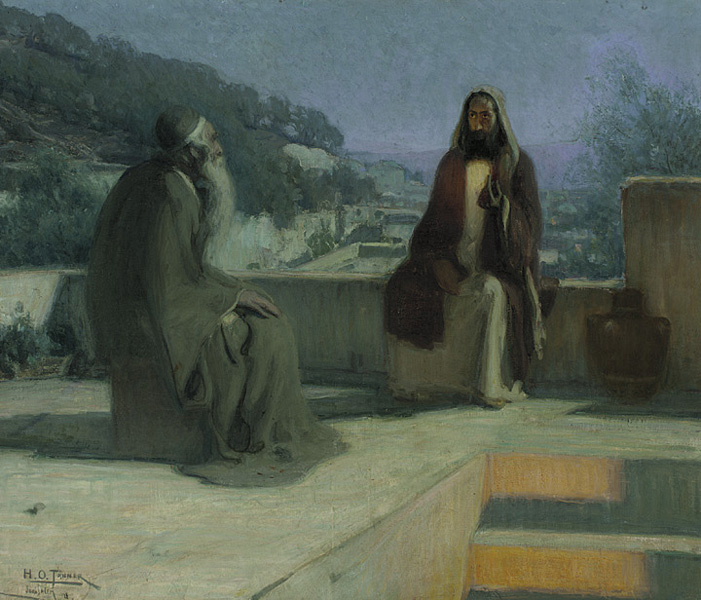
Henry Ossawa Tanner - Nicodemus and Jesus on a Rooftop

Henry Ossawa Tanner – Nicodemus and Jesus on a Rooftop

[I wrote this essay over seven years ago and would write it rather differently, were I to write it today. It is fairly mediocre and doesn’t make for especially gripping reading, but I thought that I would post it now because it touches upon some issues raised in John’s gospel, which we will soon be starting in the #Luke2Acts Twitter Bible study.]

Since John Wesley and others preached a ‘nontheological and experiential’[1] doctrine of new birth in the seventeenth and eighteenth centuries,[2] the term ‘born-again’ has enjoyed widespread popular usage. In recent years it has come to be employed as a common self-designation for evangelical Christians and also functions as an important sociological category.[3] Few terms so resonate in the popular consciousness of Protestantism, conjuring up images of sawdust trails and altar calls, of proselytizing zeal and evangelical fervency. Despite its popularity, the exegetical underpinnings of the term have often gone unexamined. Within this paper I will attempt to bring the language of new birth back into the orbit of the text of John’s gospel.


Birth from Above in John 3

Although the concept of being born of God appears earlier within the fourth gospel,[4] the locus classicus of the teaching is to be found in the conversation between Jesus and Nicodemus, the first of a number of major discourses within the Gospel.

Nicodemus initiates the conversation, expressing a degree of recognition of Jesus’ identity. Without being born ανωθεν, it is impossible to ‘see’ the kingdom of God. It is quite probable that the verb οραω involves a wordplay. To ‘see’ the kingdom of God is both to experience it[5] and to spiritually perceive it.[6] Jesus’ response summons Nicodemus to a deeper understanding. Outside of this passage, the expression ‘kingdom of God’ does not appear within the Fourth Gospel. In all likelihood the sense here is similar to that of the synoptical usages of the expression.

The word ανωθεν is ambiguous: it could mean either ‘from above’ or ‘again’. In light of the recurrence of the term in the closely related pericope of vv.31-36, the use of the term elsewhere within the gospel and the sense that the term commonly had in Greek, the primary sense of the term would seem to be ‘from above’.[7] Nevertheless, ‘again’ should be retained as an intentional secondary sense.[8] Nicodemus’ misunderstanding[9] is not that he takes ανωθεν in the wrong sense, but that he understands Jesus’ teaching in ‘crass physical terms’.[10]

The meaning of birth ανωθεν is further unpacked in Jesus’ second response of verse 5. Birth ανωθεν is birth εξ υδατος και πνευματος.[11] The meaning of this expression has been interpreted variously, the possibility of a baptismal allusion being a matter of considerable controversy.[12] I think it unlikely that υδερ here refers to semen or amniotic fluid;[13] nor do I think that Jesus is using the image of proselyte baptism as a metaphor for conversion.[14] I favour seeing in the water an allusion to the water of baptism (whether that of John, Jesus’ disciples or subsequent Christian baptism). Being born of water and the Spirit is not a reference to two separate realities — baptism followed by a later reception of Spirit — but refers to a unified event.[15] For those receiving baptism prior to the outpouring of the Spirit this birth would not be received immediately, but in ‘staggered’ stages; after this event it would be received instantaneously.[16]

At this point, anticipating some of the conclusions of this study, it is important to stress that any reference to baptism at this point must be read against the backdrop of the larger redemptive historical movement that is accomplished through Jesus’ ministry. As Ceslas Spicq counsels us, ‘[I]l faut lier étroitement la régénération individuelle du néophyte à la nouvelle ère du cosmos inaugurée par Jésus-Christ.’[17] A narrow preoccupation with the sacrament should not blind us to the fact that the waters of baptism are merely the distributaries of a far mightier river, flowing from the confluence of the water of John’s and Jesus’ baptisms with the torrents of the Spirit that were poured out at Pentecost.

In light of John’s later use of water as an image of the Spirit (7:37-39), Keener suggests reading εξ υδατος και πνευματος a hendiadys.[18] I am not convinced that it is necessary to take the language of water less than literally. The physicality of water need not stand in opposition to the Spiritual character of the birth from above.[19] It is worth commenting that, throughout the NT, manifestations of the Spirit often involve an almost embarrassingly close relationship between the Spirit and the physical forces and substances that provide imagery for its activity.[20] Consequently, we should not be surprised to find both literal and metaphorical uses of terms such as ‘water’ in relation to the Spirit.

In verse 6 Jesus presents a σαρξ/πνευμα dualism. Like begets like. The σαρξ/πνευμα contrast functions primarily as a contrast between the impotence of the merely creaturely (cf. Isaiah 40:6-8) and the life-giving power of the divine.[21] Whilst John’s dualism is not dissimilar to that of Paul, for John σαρξ does not carry the same connotations of sinfulness that it has within the thought-world of Paul.[22] Dodd suggests that Isaiah 31:3 provides background for John’s usage here.[23] A σαρξ/πνευμα dualism also appears in John 6:63, where Jesus teaches that only the πνευμα can give life.[24]

Jesus’ teaching in this passage operates in terms of a number of sharp dualisms: flesh/Spirit, earthly/heavenly, below/above, darkness/light. These dualisms do not reveal a ‘Gnostic distrust of the material as such’,[25] nor do they involve a depreciation of bodily existence. Whilst they are expressed primarily as vertical dualisms, contrasting life below with life empowered from above, John hasn’t abandoned the horizontal ‘two age’ dualism that one finds in the Synoptics.[26] The Fourth Gospel is suffused with imagery of new creation,[27] imagery that should warn us against overemphasizing the vertical (or moral) character of Johannine dualisms.[28] Furthermore, in interpreting John’s σαρξ/πνευμα contrast we should not forget that, for John, the Spirit is not given until Jesus is glorified (John 7:37-39).

In verse 7 Jesus addresses, not just Nicodemus, but the whole community that he represents.[29] Keener explains this in the light of conversion being understood to involve integration into a new community.[30] Jesus plays on the ambiguity of the term πνευμα, which can both ‘wind’ and ‘spirit’. The inscrutability of the wind is also a theme found in the OT.[31] The point being made here expands that of verse 6: like begets like. Just as the ways of the wind/Spirit cannot be grasped, so the ways of those who are born of the Spirit cannot be understood by those who are of flesh.[32]

John 8:13ff provides a potentially illuminating parallel here.[33] In verse 14 Jesus points out that the Pharisees who accuse him do not know where he came from, or where he is going, disqualifying them from judging either him or his movement. It appears that the Pharisees made it their business to inquire about potential Messianic movements (cf. 1:19-28). Jesus is making clear to Nicodemus that he is unqualified to judge either him or his movement.


Birth from Above elsewhere in the Fourth Gospel

John 1:12-13

In these verses John teaches that those who received Jesus were given the ‘right’ to become children (τεκνα) of God. This receiving of Jesus, which involves ‘welcoming him as God’s agent’,[34] is contrasted with the rejection that is mentioned in the preceding verses. Receiving Jesus is placed in apposition with believing on his name (possibly the divine name).[35]

The concept of being a child of God was not original to the Fourth Gospel and could be found in a number of earlier texts, both Greek and Jewish sources (and not just in the more Hellenized sources). Some works related being children of God to creation (cf. Acts 17:27-29), while others relate it to the possession of wisdom.[36] Keener claims, I believe rightly, that John’s usage is more closely related to that of Jewish works that are ‘less dominated by Hellenistic philosophy.’[37]

John’s usage of the concept here seems to suggest that he is operating within a more eschatological context. The OT can speak of divine sonship in the context of the restoration (Isaiah 43:6[38]) and reconstitution (Hosea 1:10) of the nation of Israel.[39] However, it seems that John’s meaning goes beyond this. Whilst undoubtedly related to the status enjoyed by OT Israel, John here speaks of a new status that is conferred upon those who believe in Jesus, the consummation of the status enjoyed by OT Israelites.

The term εξουσια here refers the ‘authorization to become what no human effort could accomplish.’[40] Significantly, it is Jesus himself who gives this authorization.[41] By virtue of his status as the ‘only begotten Son’ (1:14, 18; 3:16), into whose hands all things have been given (3:35), Jesus is uniquely qualified to confer the status of divine sonship onto others.

This sonship is conferred by being born of God, something contrasted with birth of the flesh. Those born of God are not born of bloods (presumably a reference to natural generation), of the ‘will of the flesh’ (as a result of parental passion), nor of a man’s will (the father’s authority in determining to have a child).[42]

There is a variant reading of verse 13, which either refers to the eternal begetting of Jesus, or to his virginal conception.[43] The manuscript evidence for this reading is slight, but its existence is interesting nonetheless, serving to illustrate that the close connection between Jesus’ being born of God and the divine begetting of Christians was recognized from early on.[44]


Other Passages

John 8

In 8:18-59 we find a dispute between Jesus and the Jews. Jesus’ argument in this passage turns once again on the concept that like begets like: the Jews are children of the devil as they do his works. Whilst Jesus is prepared to grant their genetic descent from Abraham (verse 37), he denies it in the sense that really matters.[45]

Jesus contrasts the status of the slave and the son within the household in verse 35. Some suggest that this verse is a later interpolation,[46] but if it is, it is nonetheless appropriate to the context. Keener observes the possibility of an allusion to the contrast between Isaac and Ishmael, in which case Jesus’ recognition that the Jews are children of Abraham may be primarily sarcastic.[47] If such an allusion were present the underlying logic of Jesus’ argument would not be altogether dissimilar to that of Paul in Galatians 4.[48]

Jesus, as the Son, has the power to set people free (verse 36),[49] presumably granting them a new status as freeborn children of God. There is a strong connection between being a child of God and being a child of Abraham, a connection that is made clear as the argument develops in verse 41. The true children of God will love Jesus (verse 42) and hear God’s words (verse 47).

Within this passage we see a distinction being made between those who are merely physical offspring of Abraham and those who are the true descendants of Abraham and children of God. This most likely relates to the distinction between those born of the flesh and those born of the Spirit in 3:6. Jesus does not deny the connection between divine sonship and Israel’s descent from Abraham, but redefines the latter concept in terms of a σαρξ/πνευμα type dualism.


John 16:20-21

In these verses Jesus employs the image of a woman giving birth. The strong eschatological associations of such imagery are not accidental to the meaning of this passage. The imagery of birth pangs is common in the OT prophets, where it is also occasionally used to refer to a period of intense suffering preceding a new age (similar usage is also to be found in Jewish literature).[50] In the prophets the image of labour pains followed by birth is associated with resurrection (Isaiah 26:16-21) and with the restoration of the people of God (Isaiah 66:8-14).[51] The prophets employed this imagery to refer to a national restoration and a general resurrection, an event within which faithful Israelites would find their salvation.[52]

John employs such imagery in the context of a broader inaugurated eschatology. For John the birth pangs begin in Jesus’ death; the birth itself is presumably the resurrection. A surface reading of the text might suggest that the birth pangs are undergone by the disciples; closer examination suggests that the reality is more complex. Murray Rae asks:

When Jesus says of the woman in travail … that ‘her hour has come’, might there not be an allusion here to Jesus’ own suffering?[53]

It is my view that the woman in John 16 represents Israel, undergoing the travail that will result in the birth of a new age. Her birth pangs are focused on the cross of Jesus, but are also experienced to some degree by the disciples. Raymond Brown suggests that the one who is born may be the Messiah, speaking approvingly of Feuillet’s thesis, which identifies the birth of the male child in Revelation 12 with the death and resurrection of Jesus.[54]

I find this position convincing in the light of the strong Johannine and NT connection between resurrection and new birth. In Revelation 1:5 Jesus is described as the ο πρωτοτοκος των νεκρων. This understanding of the resurrection is also to be observed in Lucan (Acts 13:33) and Pauline (Romans 1:3-4; Colossians 1:18) thought. Such a teaching is not treated as if it were in tension with the fact that Jesus is truly the Son of God before the resurrection. Jesus is the both the one who precedes the creation as the eternally begotten of the Father and the one who leads the way into the new age as the firstborn of the dead.[55]

Whilst the resurrected Christ is the most immediate referent of the newborn child, the image refers more broadly to the new birth of the people of God as a whole (cf. Isaiah 66:8; Revelation 12:17). It is through the birth pangs of the cross that the birth from above that Jesus has spoken of will become a possibility.[56]


John 19:25-35

Some have seen, within John’s depiction of the cross, the re-emergence of themes related to the birth from above.

Jesus gives his mother the beloved disciple as a new son. The fact that John withholds the name of Jesus’ mother might suggest that he wishes to highlight her typological significance.[57] In this passage it seems most likely that she represents Israel giving birth to her eschatological children. Both Heil and Brown relate this to the imagery of 16:20-21.[58] That the events of verses 25-27 are especially significant is suggested by the response of Jesus in verse 28.

In verse 30 Jesus is said to have ‘handed over the spirit’ (παρεδωκεν το πνευμα), presumably to his mother and the beloved disciple, in their typological roles. This language is symbolically charged and suggests a ‘very close connection between the gift of the Spirit and Jesus’ self-sacrifice.’[59]

In verse 34, blood and water flow from the side of Jesus. The ‘solemn witness’ that is borne to this event suggests that it has great significance.[60] Traditional readings have often related this to Eve being taken out of Adam’s side and to the sacraments of Baptism and the Eucharist.[61] Further background may be found in Jewish traditions concerning the rock at Meribah.[62] Others relate it to Jesus’ statement that water will flow from his belly in 7:38.[63] Burge sees it as a ‘proleptic symbol of the release of the Spirit’ and relates it to the eschatological waters that were to flow from the Temple.[64]


John 20:17, 22

In verse 17 Jesus declares to Mary Magdalene, ‘I am ascending to my Father and your Father, to my God and your God.’[65] N.T. Wright relates this passage to the themes of the prologue:

…the little company of those who ‘received him’ are told, for the first time, that the creator god is their father, their god (20.17; up to now Jesus has spoken of ‘the father’ or ‘my father’). They are now children of the father in their own right. Reading chapter 20 in the light of the prologue, we are thus to understand that Jesus’ death and resurrection have together effected for the disciples the new birth which was spoken of in 1.13 and 3.1-13.[66]

This is closely followed by the account of Jesus breathing the Holy Spirit into his disciples, in an account reminiscent of OT texts such as Genesis 2:7, just one of a number of allusions to new creation in the chapter. This gift of the Spirit is the begetting of a new humanity, who are born of the Spirit and are true children of God.


Background and Parallels

Hellenistic background

A number of scholars have argued for a Hellenistic context for John’s teaching concerning birth ανωθεν, relating it to Platonic teaching concerning rebirth and the teaching of the mystery religions and Gnosticism.[67] Others relate the concept of birth of God with Hellenistic teaching that mankind is begotten of God by virtue of creation.[68] Grese seeks a background in Jewish and pagan heavenly journey literature.[69]

Trumbower relates the teaching of John to the deterministic anthropology of Gnostics like the Valentinians. He distinguishes between two births: an original fixed birth from above and a subsequent birth, which will only be enjoyed by those who have the first birth.[70] There is no movement between the realms of flesh and Spirit.[71]

Keener observes that John’s language is not necessarily encountered in Gnosticism or the mystery religions and points out that many of the supposed parallels are too late and possibly reflect Christian influences.[72] Most importantly, though superficial similarities in language may occasionally occur, the thought world of John is quite different from that of many of the Hellenistic works that are suggested as background.


Jewish background

Some Jewish sources compare proselytes to newborn children.[73] Conversion was regarded primarily in a legal context, although there were more ontological and moral conceptions.[74] There are also Jewish texts that use sonship language of Israel in an eschatological sense.[75] Peder Borgen reads John’s language in the light of the Hellenistic Jewish tradition of Moses’ ascent into heaven at Sinai being a second birth.[76]

I do not believe that the above provide much significant background for John’s use of the concept of new birth. For instance, the new status of the proselyte is primarily legal, rather than spiritual,[77] and Jews did not believe that they needed the transformation of conversion.[78]


Old Testament background

I believe that the most promising background for John’s teaching concerning birth from above is to be found in the OT. In Ezekiel 36:25-26 the prophet speaks of God’s sprinkling water on the people and giving them a new spirit within them. This passage is related to forgiveness and deliverance from sin and national restoration. The combination of sprinkling with water and the imparting of a new spirit in Ezekiel 36 also suggests a close relationship with the reference to birth of water and the Spirit in John 3:5.

Immediately following the allusion to Ezekiel 37 in John 3, there is an allusion to Ezekiel 37, where the reference to the φωνη, of the Spirit is reminiscent of Ezekiel’s prophesying to the dead bones.[79] Allusions to this passage are also found in John 5:25 where the dead are raised by hearing the Son of God’s voice and in 20:22 where Jesus breathes πνευμα into his disciples.

In John 16:20-21, as I have already observed, OT prophetic texts concerning the birth pangs preceding the new age closely underlie the text. Isaianic texts such as Isaiah 26:16-21 and 66:7ff provide important background here. The birth being spoken of involves general resurrection and national restoration, following a period of suffering.

It is my position that, in his teaching and narrative of birth from above, John is purposefully evoking a number of OT texts that speak of national restoration, resurrection and the dawning of the new age. No single one of these passages bears the burden of his teaching, but taken in concert they provide a background against which John’s teaching can be properly understood. Bringing various OT passages into dialogue in an allusive text, John presents his reader with a stereoscopic vision of the birth from above that Jesus makes possible through his ministry.


Parallel Teachings in the New Testament

Potential parallels to Johannine teaching concerning the new birth are to be found elsewhere in the NT. A number of authors have observed the possibility that Jesus’ teaching in John 3 is related to the Synoptic sayings of Matthew 18:3 and Mark 10:15.[80] A contrast between birth of God within the kingdom of God and ordinary human birth may also be implicit in texts such as Matthew 11:11. In Matthew 19:28 the term παλιγγενεσια is used of the renewed world of the age to come.

Pauline theology is rich with potential parallels to the new birth teaching of John. Paul presents Jesus as the firstborn of the dead (Colossians 1:18) and as one declared to be the Son of God with power by the resurrection (Romans 1:4). Paul closely relates reception of the Spirit with being sons of God (Romans 8:14-16). Christ is the one who makes divine sonship a possibility (Galatians 3:26; 4:1-7), the ‘firstborn among many brethren’ and the prototype for all other sons of God (Romans 8:17, 29). Paul also employs the image of eschatological birth pangs in relation to this theme (Romans 8:18-23).

In articulating his theology of divine sonship, Paul tends to use the concept of adoption where John uses that of birth from above (Romans 8:15, 23; Galatians 4:5). Furthermore, the eschatology in terms of which Paul operates occasionally seems to be less realized than that of John (Romans 8:23). Within Paul we can also observe a far closer relationship between being a descendent of Abraham and being a son of God (Galatians 3:7; cf. 3:26). Paul employs a flesh/spirit dualism to contrast the status enjoyed by merely physical descendents of Abraham and the true family of Abraham characterized by faith (Galatians 4:22-31), exploring themes that are closely related to those raised in John 8.

The language of divine sonship and rebirth is also to be found in such places as Titus 3:5, which uses the term παλιγγενεσια in a context that bears certain similarities to John 3:5. 1 Peter 1:24 speaks of being ‘born again’ by the word of God. Divine sonship is also a theme to be found in Hebrews, where Jesus brings ‘many sons to glory’ (Hebrews 2:10-18), granting them a new status of sonship. James 1:18 refers to Christians having been begotten by the word of truth.

The Johannine epistles and Revelation are particularly rich seams for such imagery. Being sons of God and being born of God are recurrent themes throughout 1 John (2:29; 3:1-2, 9-10; 4:7; 5:1-2, 18). The children of God/children of the devil dualism appears in 3:10. In 5:18 we see that John can use the expression ‘born of God’ to refer both to Christ and to the believer, so close is the relationship between the two.[81] In the book of Revelation Jesus has the title ‘firstborn of the dead’ (1:5). The imagery of chapter 12 also seems to refer to Christ’s birth through the messianic woes of his death.

This brief list of texts serves to illustrate that John’s teaching concerning birth from above and divine sonship is not peculiar to John’s own thought-world, but is supported by a number of different voices, throughout the NT canon. The themes of new birth and divine sonship are deeply embedded in the NT texts, and find detailed theological expression both within and without the Johannine literature.


Conclusion

Throughout the Fourth Gospel it is clear that Jesus is the one who has the authority to give the new birth and that he is the one who leads the way into the new age, as the firstborn of the dead. He is the one who makes the new birth a possibility for all others. The messianic woes of his cross lead to the birth of the children of God.

This narrative has all too often been lost sight of. A category within a de-eschatologized ordo salutis takes the place of a climactic redemptive historical event. The dawning of the new creation in history is reduced to a mere personal spiritual epiphany. Without wanting to lose sight of the profound personal significance of the new birth I believe that it is necessary to recover the primacy of this larger picture, as the cosmic canvas upon which our personal experience of divine sonship must be situated.

Within the Fourth Gospel, John’s teaching concerning birth from above must be understood in the light of the overarching narrative. For those with ears to hear the excited whispers of OT texts within the Gospel, it is clear that John is narrating the story of Israel’s eschatological restoration, the story of new creation and the dawning of the coming age. Through the messianic woes of a Roman cross a new era is born. From the side of the pierced victim living water bursts forth, to form rivers that will bring healing to the nations. On the day of new creation, the new Adam breathes the Spirit of life into his brethren, making them sons of the Father, giving to all of us who will receive him the right to be called children of God.

Continue reading

Posted in #Luke2Acts, Bible, John, NT, NT Theology, Soteriology, Theological | 4 Comments

#Luke2Acts—Some Notes on Luke 17 to 24

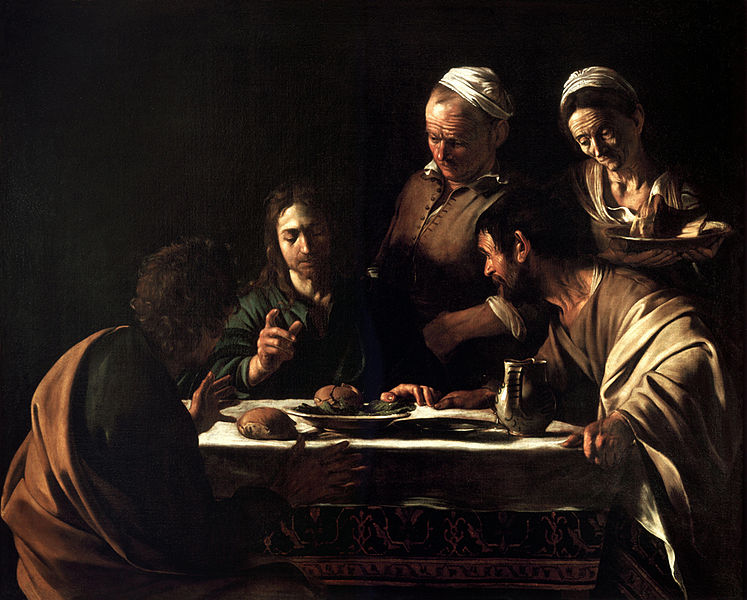
Supper at Emmaus - Caravaggio

Supper at Emmaus – Caravaggio

I have written a number of posts of notes on Luke as I have been working through it in the #Luke2Acts Twitter Bible study. In this, the final post, I have put together just over a week’s worth of tweets on the book to conclude my comments on the gospel. The following notes are rough and far from comprehensive notes upon the passages. However, they will hopefully give you an indication of my reading and of some of the interesting features of each chapter.


LUKE 17

Jesus is still talking with the Pharisees and scribes present (cf. 15:1-2), but this lesson is directed at his disciples (v.1). They must not follow the example of the scribes and Pharisees and put obstacles in the path of little ones entering the kingdom. Jesus refers to ‘stumbling blocks’ (or ‘offences’) in verse 1. Elsewhere Jesus is referred to as a stumbling block in the way of Israel (1 Peter 2:7-8). Jesus speaks of a millstone being hung around a person’s neck and of them being cast into the sea. The image of a millstone being cast into the sea is used in Revelation 18:21 for the overthrow of Jerusalem (Babylon the Great). The millstone is the city; the sea is the realm of the Gentiles. If the disciples place stumbling blocks in the path of the ‘little ones’, God will condemn them to Jerusalem’s fate.

We must rebuke, repent, and forgive. Cain may have been avenged sevenfold, but we forgive sevenfold (cf. Genesis 4:24).

‘If you have faith as a mustard seed, you can say to this mulberry tree…’—Trees are significant in Scripture. The mustard tree has already been compared to the kingdom (13:18-19). The fig-mulberry tree is an image of Israel. The fig-mulberry is to be ‘planted in the sea’ (like the millstone), once again a reference to Jerusalem being thrown into realm of the Gentiles. If Jesus’ disciples have the smallest seed of kingdom faith, they could bring about God’s judgment on Israel.

In verses 7-10, Jesus speaks of the duty of the servant and the impossibility of gaining merit with God by our actions. However, this saying must be read against background of Jesus’ statement in 12:37. There God actually does the unexpected action, but it is not something that we have merited by our faithfulness as his servants.

Lepers were prevented from entering into the community of worshippers. Jesus heals ten lepers. The one Samaritan leper who returns to Jesus seems to recognize Jesus as the one to return to, thank, and as the site of the presence and worship of God. His faith is commended. He alone seems to have a faith that appreciates what God is doing in Jesus.

The kingdom of God does not come with ‘observance’. Matt Colvin suggests ‘observance’ here refers to Torah-observance. The kingdom doesn’t come through our ever greater adherence to the commandments. I’m not 100% convinced, but it is an interesting proposal. I’m inclined to say that it means that the kingdom doesn’t come as something whose arrival we can closely monitor. The kingdom is already ‘in their midst’, hidden like leaven. The Pharisees can’t see what is taking place in Jesus’ ministry.

References to the Son of Man’s day should remind us of Daniel 7:13-14. Jesus’ coming in judgment will be sudden and catastrophic. The rejection by and suffering at the hands of the current generation must happen first, then destructive judgment (verse 25). Jesus compares the judgment to come upon Jerusalem to the judgment that befell the pre-Flood world and Sodom. In each case things were continuing as usual until unexpected, catastrophic, and final judgment hit.

The ‘day of the Son of Man’, the ‘days of Noah’, the ‘days of Lot’—Jesus, the Son of Man, is the one who leads a new group of people escaping final judgment, who are saved with him. The days of Noah and Lot refer to the days of peace and normality before judgment. The days of the Son of Man are the days of his personal presence and ministry with his disciples, the days they were currently enjoying. As the judgment loomed—the day of the Son of Man—I can imagine the disciples looking back upon the days by Galilee and wishing they could return. The Son of Man will be ‘revealed’ (verse 30). And all else will be laid bare.

Final judgment on Jerusalem is coming and all riches must be left behind, without looking back. Members of the early Jerusalem church later sold its property, pulling up its stakes, preparing to abandon the condemned city. One taken, another left: ‘taken’ here does not refer to the ‘rapture’ of the Left Behind series, but to being taken by the sword.

Where will they be taken? The ‘body’ (the carcass of Israel) is where the eagles (the unclean foreign force of the Romans) will be gathered together. Jerusalem and her people, overthrown Babylon, will become Rome’s carrion (cf. Revelation 19:17-18).


LUKE 18

The persistent widow represents the oppressed righteous in Israel, waiting for salvation. The parable argues from the weaker to the stronger: if even an unjust judge will respond, how much more the righteous God? The woman calls out to be avenged by the representative of the law against her adversary or oppressor. This is compared to the prayers of God’s people for judgment against their oppressors (v.7). Such prayers for vengeance are found at various points in the Psalms, but also in such places as Revelation 6:10. Handled appropriately, it is not wrong to pray in such a manner. As in Romans 12:19, we are not to avenge ourselves, but to give place to God’s vengeance. It can be helpful to read David’s imprecatory psalms written while fleeing from Saul alongside 1 Samuel’s description of his actions to see how not avenging ourselves and praying for God to avenge us needn’t conflict. The coming of the Son of Man is here associated with his coming to avenge his persecuted people.

I’ve commented on the Parable of the Pharisee and the Tax Collector before here. Prayer is central in both of these opening parables. We pray as those deserving nothing from God’s hands but who trust his mercy. The images of the people of the kingdom are striking: a widow, a tax collector, infants, the poor.

Jesus blesses and receives the children at their parents’ request. It is interesting to observe how many times in the gospel Jesus receives or blesses at the request of another. God works, blesses, and heals through bonds of friendship, love, and family. I find that a profoundly encouraging thought.

When listing the commandments to the Rich Young Ruler, Jesus only lists from those commandments about loving one’s neighbour. How is the Rich Young Ruler to obey the command to love God? By giving up the thing that he is most attached to—money—and following Jesus. Jesus implicitly asks for the loyalty that belongs to God here. The Parable of the Unjust Steward might be in the background here: the Rich Young Ruler should sell and make friends with the poor, then he will have great riches in heaven.

The disciples have shown their loyalty to and faith in Jesus by their actions, leaving everything to follow him. They will be richly blessed both in this present time and in the age to come. We gain much as we follow Jesus, even in this life.

Jesus’ statement here is the most direct prediction yet of his death and resurrection, but the disciples still don’t understand. They will be reminded of this statement after his resurrection.

The man by the side of the road needing assistance and everyone passing by might remind us of the parable of the Good Samaritan. The blind man calls out to Jesus as the ‘Son of David’, a significant act of faith, especially in the face of other’s objections. While others ask what they must do, the blind man begs for mercy and is asked what Jesus should do for him. All of our efforts trying to merit God’s salvation, when all we had to do was ask for mercy. Like pulling a door that says push.

The opening of the eyes of the blind man might relate to the disciples’ lack of perception in the previous verses. In time Jesus will open their eyes too, and they will glorify God.


LUKE 19

There is a progression of geographical references in chapter 19: Jericho … Bethany … descent of Mount of Olives … Jerusalem.

We are told the species of tree that Zacchaeus climbed: a fig-mulberry, like the tree symbolizing Israel in 17:6. Zacchaeus gets right with the poor and restores fourfold (cf. Exodus 22:1; 2 Samuel 12:6). Jesus describes him as a ‘son of Abraham’, continuing the theme of the redefinition of the family of Abraham and the recovery of his lost children.

As N.T. Wright and others have observed, verse 12 might allude to the history of Archelaus, son of Herod the Great. The nobleman going to a far country to receive a kingdom and return is Jesus ascending and returning in judgment in AD70. The citizens of the nobleman reject him, as people reject Jesus as Lord. The judgment in v.27 is the destruction of Jerusalem.

Current faithfulness in little leads to one being entrusted with much greater responsibility (cf. 16:10-12). The unfaithful servant mischaracterizes his master in v.21. The judgment upon him is according to his own assessment of his master. It is crucial to remember the failure of the unfaithful servant is inseparable from his false judgment of his master’s character. The mina of the unfaithful servant is given to the most productive servant. This parable is radical and scandalizing in its unequal outcome (vv.24-26). The unfaithful are dispossessed, while the responsibilities and blessings of the faithful are expanded. Proverbs’ teaching about the relative fate of the slothful and the diligent is perhaps helpful background here.

Jesus’ triumphal entry into Jerusalem echoes passages such as 1 Kings 1:33-44. It also fulfils the prophecy of Zechariah 9:9-10. Donkeys and mules were associated with judges and royalty. The kingdom began with a quest to find donkeys in 1 Samuel 9. The judges and Saul were associated with donkeys (cf. Judges 5:10; 10:4; 12:14; 1 Samuel 9:3). However, the sons of David rode mules.* The instructions given to the disciples are similar to the sorts of signs given to Saul at the dawn of the kingdom (1 Samuel 10). Matt Colvin helpfully connects this mission with 1 Samuel 10 and with preparing the Last Supper in 22:7-13.

No one has ever sat on the animal before. It is dedicated for a special purpose (cf. Numbers 19:2). The casting of garments is reminiscent of the welcome of Jehu to Jerusalem in 2 Kings 9:11-13, to destroy the worship of Baal. It might also remind us of David’s removal of his outer garments in the ‘triumphal entry’ of the Ark into Jerusalem. The Pharisees are like Michal, who sought to rebuke David in 2 Samuel 6, and was judged for it.

It is important to notice that Jesus moves from the Mount of Olives to Jerusalem and back again a few times in the chapters that follow (19:37; 21:37; 22:39; 23:33[?]; 24:50). This geographical to and fro is significant.

The reference to the stones crying out might recall John the Baptist’s claim of 3:8. It also should probably be related to the claim in immediately following verses that the stones of Jerusalem will be levelled.

Jehu’s ‘triumphal entry’ into Jerusalem was followed by the destruction of the temple of Baal and its priests. Unsurprisingly, Jesus goes to the temple and drives people out. Jesus’ statement about the temple being a ‘den of thieves’ should be read against the background of Jeremiah 7, to which it alludes (cf. Jeremiah 7:11). The Jews of Jeremiah’s day treated the temple as a sort of talisman protecting them from God’s judgment and enabling them to continue in oppression and lawlessness. Jesus is making the same point of his generation.

I don’t believe that the point of driving out those buying and selling in the temple was primarily to do with an objection to the money-changers and dove-sellers in particular, or with any principled opposition to the performance of such activities within the temple precincts. The chief point was to put a temporary halt to the sacrifices, which couldn’t proceed without these activities. Jesus then makes the temple the site of his teaching (v.47). It is also worth noticing that it is the language of exorcism that is used to describe the removal of those buying and selling in v.45.


LUKE 20

This is Jesus’ first interactions with the chief priests and Sadducees. He is playing with the big boys now.

Jesus answers the challenge to his authority in a shrewd manner, by asking his questioners a question about the baptism of John the Baptist. This was an indirect answer to their question, as John the Baptist was the key witness to Christ. However, it placed them in a difficult situation: they couldn’t deny the authority of John’s ministry without inciting the people, nor affirm it without acknowledging that Jesus did, in fact, have authority. This is also a window into just how volatile the situation was, when the crowds could so quickly become a lynch-mob.

The parable of the wicked vinedressers focuses upon those placed in charge of the vineyard of Israel, while the parable of Isaiah 5 focuses upon the house of Israel itself. The beaten and wounded servants represent the history of the prophets. Jesus’ coming is the culmination of this history. The wicked vinedressers wish to gain control over the ‘inheritance’ and legacy of the property by killing the heir. However, the vineyard owner will destroy them and give over vineyard to others. It is interesting to observe that the vineyard itself isn’t destroyed.

Jesus quotes Psalm 118:22 and alludes to Isaiah 8:14-15 and Daniel 2. God is erecting a new temple, with Christ as its once rejected chief cornerstone. Hereafter every person will be defined by how they stand relative to him. The chief priests and scribes know that they are the wicked vinedressers and builders Jesus is talking about (verse 19).

Throughout the run-up to the crucifixion, the large crowds surrounding Jesus protect him from harm.

The chief priests and scribes send spies to Jesus, hoping to catch him out. They ask a question about taxation, believing that, however Jesus answered, it would create problems for him in the political tinderbox of Jerusalem. Jesus recognizes that there is a Satanic attempt to test him taking place, but Jesus is wilier than the serpent.

Jesus’ response rejects the idea of a tax revolt. However, by focusing upon the image on the coin, he also makes a subversive point. If things bearing Caesar’s image like the denarius must be rendered to Caesar, things bearing God’s image—human beings—must be ‘rendered to God’. This shrewd answer might also skewer the testers in their love of money over their neighbours. There is another reference to a ‘superscription’ in 23:38: the ‘King of the Jews’ statement over Christ on the cross.

The final of the three tests comes from the Sadducees, with an extreme hypothetical case based upon the Levirate law (Deuteronomy 25:5-10). In the resurrection we are like the angels in the sense that we do not die and we function more as a ‘host’ than as an ongoing ‘race’, seeking to preserve life in face of death. How are we to understand the logic of Jesus’ response to the Sadducees? The Sadducees’ question focuses upon a form of marriage designed to keep the family line going in the face of death. Jesus’ response presumes that the primary purpose of marriage is procreation—filling the earth and continuing the race in the face of death. However, once death is abolished and the human race has become a multitude, the purpose of procreative union has been achieved and marriage ends.

The ‘sons of this age’ are contrasted with the ‘sons of the resurrection’ or the ‘sons of God’. Jesus might be implicitly contrasting two births: births within the birth-marriage-procreation-death cycle and the birth from dead in the resurrection. In the second birth, the cycle is no longer operative. This birth is associated with being God’s sons.

Jesus’ question to the Sadducees about David might play on this very ambiguity. Christ’s Messiahship is not grounded in birth within the first cycle as David’s descendent, but as the resurrected Lord, Son of God and firstborn son of the resurrection. Both Christ’s deity and his status as the firstborn from the dead disrupt the familiar cycles and order of this world.


LUKE 21

The story of the widow’s two mites needs to be read alongside the end of the previous chapter. The widow is investing all of her livelihood in the temple, which is about to be destroyed on account of the sin of the people and their rulers. This isn’t a parable about healthy sacrificial giving, but about the way that corrupt religious leadership preys upon the weakest of all and heaps up judgment for itself. It is also a very relevant word for many modern ‘Christian’ teachers. The prophecy of the destruction of the temple should be directly related to the oppression of such persons as the widow.

Jesus speaks of a final judgment upon the temple that is fairly imminent, but not immediate. Before that occurs, various other events will take place, events which they shouldn’t confuse with the end itself. The spread of the Christian message through trials before authorities should prepare us for the latter half of the book of Acts. The disciples are told some of them will die (v.16), but not a hair on their heads will be lost (v.18). This is an odd juxtaposition. The solution to the apparent tension is helpfully discussed by Matt Colvin in this post.

Jesus makes reference to the ‘days of vengeance’ (v.22), which weren’t mentioned in his Isaiah 61:1-2 reference in chapter 4.

Jesus gives his disciples a very specific sign and instruction about when things are to be fulfilled and what to do when they are (vv.20-22). There would seem to be an expectation that the siege will lift for long enough for the believers to flee.

The events that Jesus was predicting have to do with AD70, the end of the old covenant world, not the end of the whole cosmos. The language of verses 25-28 is prophetic language. The sign of the Son of Man coming on the clouds alludes to Daniel 7. The point is, when the disciples see the destruction of Jerusalem, they will have definitive proof Christ has entered into his kingdom.

The disciples must read the signs of the seasons. Looking at the fig tree (Israel) will be a sign for them that their ‘summer’ is near. All of the things will occur before the generation had passed away (v.32). In AD70, all of Jesus’ prophetic words were fulfilled. Knowing the imminence of the falling of the curtain on the old covenant and the dawning of the new age of the kingdom, the disciples had to be sober and vigilant in their behaviour and thinking. This way it wouldn’t overtake them unawares.

The movement between the Temple Mount and the Mount of Olives (v.37) is significant, perhaps a symbolic withdrawal in judgment.


LUKE 22

The Passover context is front and centre in Luke 22. Luke wants us to connect Jesus’ death with the events of the first Passover. The desire of the chief priests to kill Jesus is connected with the drawing near of Passover. Jesus is the Passover lamb.

Satan enters into Judas. I believe that this is the only time that we read of Satan himself entering into anyone. Satan’s reappearance after a long absence is significant. Luke 4:13 tells us that Satan departed ‘until an opportune time.’ Judas (‘Judah’) is the one of the Twelve who sells Jesus into the hands of his enemies. Judah was the one of the twelve sons of Jacob who sold Joseph to the Ishmaelites, also motivated by a desire for money (Genesis 37:26). Judas, as ‘Judah’, represents the Jews (the Judahites). The role of money in the transaction between Judas and the chief priests should remind us of all Jesus has taught on money.

The chief priests need to get Jesus away from the multitude. The multitudes have a sort of herd-like quality, acting as a unit.

Matt Colvin’s reflections on the instructions to follow the man with the pitcher are very insightful. Various suggestions have been made concerning a deeper symbolic import for the sign of the man carrying the pitcher. My suspicion is that Luke 22:7-13 needs to be read as a unit with 19:28-40 and that both read should be read against the background of 1 Samuel 9. In 1 Samuel 9 two men—Saul and his servant—go looking for donkeys, they then encounter women (presumably with pitchers) going out to draw water. The women direct them to the site of a meal with the prophet, in the ‘high place’. When Saul eats with the prophet Samuel in the high place, the kingdom is entrusted into his hands.

Very similar themes seem to be present in Luke. Why is it a man carrying a pitcher? The well was the place where most of the patriarchs of Israel had met their wives. It is interesting that Genesis 24 also records a divine sign involving a woman and a water pitcher. The relationship between king and people was often described as a sort of marriage. Perhaps meeting a man at the well plays on these themes: Jesus is the new royal ‘husband’ of Israel and the Last Supper has subtle wedding feast overtones. Perhaps.

The Feast ‘drew near’ (v.1). ‘Then came the Day…’ (v.7). ‘And when the hour had come…’ (v.14). Rising tension.

The Passover meal with disciples is connected with the ‘exodus’ (9:31) Jesus is about to accomplish and the covenant he will establish. It is interesting that the meal has two shared cups (vv.17-18, 20), sandwiching the bread.

This do as my memorial—the purpose of the memorial is not primarily to remind us, but to bring to God’s mind the sacrifice of Jesus, to declare his death. The meal is a covenant-sealing meal, giving a share in the kingdom to those who participate in it. The Twelve will sit on thrones, judging the twelve tribes of Israel (verse 30).

22:21-22 should be connected with Psalm 41:9. This also implies that Judas participated in the bread and wine.

The kingdom Jesus is giving to his disciples operates quite differently from those of Gentiles. However, the disciples don’t get it. Yet. There is authority in the Church, but it is exercised in the form of service. Jesus’ reference to being among his disciples as ‘one who serves’ as distinct to being one who ‘sits at the table’ might imply his washing of their feet in this scene. Incidentally, Jesus serving his disciples by washing their feet (not explicitly mentioned here, but implied) casts a startling light back upon the washing of his own feet in 7:36ff. The sinful woman does for Jesus what he does for his disciples.

Satan will tempt Peter three times to deny Jesus and Peter will fail three times. Yet Jesus prayed for him and he’ll be restored.

The nature of their mission will change from this point. They will need a money bag, sack, and sword. They will face a hostile reception, they can no longer rely upon hospitality being extended to them, and they won’t have assurance of their safety. It is unlikely that Jesus meant for them to buy actual swords. However, having swords helped to fulfil biblical prophecy (v.37).

Once again, there is a movement away from the city to the Mount of Olives.

I believe the story of David, especially 2 Samuel 15-16 is playing in the background here. David is betrayed by Ahithophel, a friend and advisor. He leaves Jerusalem and weeps as he ascends the Mount of Olives. He is ministered to by a messenger (Ziba) and then assaulted by Shimei with violence and cursing. His right hand man Abishai, like Peter, wishes to strike his king’s enemy down, but David prevents him. Luke is here presenting Jesus as the true Son of David.

Judas betrays Jesus with a kiss. How Joab of him (cf. 2 Samuel 20:9-10). Both Judas and Peter are behaving like the sons of Zeruiah, violent, vengeful, and treacherous.

Peter denies Jesus three times and then Jesus turns and looks at him. Hard to imagine how that look would have cut through him. Peter is tempted by the desire to fit in around the fire and avoid ostracization for the name of Jesus. We face many temptations to dissociate ourselves from Christ and his people in order to fit in around the fires of our society and not be left in the cold.

Jesus’ prophecy concerning Peter is fulfilled at the very time that Jesus is mocked and beaten as a false prophet. Jesus has also prophetically predicted that he will be mocked and insulted in such a manner in 18:32. The chief priests and scribes seek to get Jesus to claim to be the Christ, the Son of God, in order to have cause to hand him over to Pilate as a false Messiah. They won’t entertain the thought that he actually is the Messiah for a moment.


LUKE 23

The Sanhedrin sought to get Jesus to make Messianic claims. Brought before Pilate, they present Jesus as a political threat. They accuse Jesus of stirring up the crowds, when they are in the process of doing exactly the same thing.

Pilate sends Jesus to Herod, making friends with Herod in the process. Joining with others in scapegoating relieves antagonisms. Jesus is found innocent by both Pilate by Herod. When he sentenced him to death Pilate knew he committed a miscarriage of justice.

Jesus is put in a ‘gorgeous’ or ‘shining’ robe. A sort of ironic parody of the transfiguration.

The people want Barabbas released to them, rather than Jesus. The fact they chose Barabbas, a man guilty of insurrection, reveals the hollowness of their claims to be concerned for public order and opposed to the stirring up of the people. Pilate is supposed to be delivering justice, but he lacks the nerve to stand up to the crowd. He keeps exploring options to avoid having to make a decision, but the problem is constantly placed back into his hands.

In choosing Barabbas over Jesus, the people make their choice of the sort of destiny they want. Insurrection led to AD70. The choice between Jesus and Barabbas might have Day of Atonement themes. It also suggests Jesus as substitute. The crowd recognize Barabbas, who stirred up the masses in the city and was a murderer, as one of their own. He is their mirror.

Simon of Cyrene takes up the cross and follows Jesus. Notably, he was a Gentile. Simon of Bethsaida denies Jesus, but Simon of Cyrene follows him. At this point, when the twelve have largely abandoned Jesus, it is the unlikely disciples and converts—Simon of Cyrene (even if Simon of Cyrene was not an actual disciple, Luke has him symbolically acting out the role), the centurion, Joseph of Arimathea—and the women that come to the foreground.

What is happening to Jesus is just the harbinger of more terrible things to come in Jerusalem, when its leaders have favoured the way of insurrection over the way of Jesus. ‘Daughters of Jerusalem’—Jerusalem/Zion is often spoken of as a daughter in the prophets, the city being represented by its women.

Luke’s allusions to prophecy are subtler than Matthew’s (verse 34; cf. Matthew 27:35). You must know the Scriptures to see them.

Jesus asks the Father to forgive the people. They will have another chance. However, if they reject the message of the Church, only certain judgment will await them.

I’ve already suggested that there is a subtle repetition of the three temptations in this passage. Jesus is mocked as a king, served sour wine by ‘cupbearers’, placed with someone at his right and left hand (cf. Matthew 20:21), and given a superscription above his head (cf. Luke 20:24).

There is darkness from the sixth to the ninth hour, like the penultimate plague on Egypt. All that remains is the death of the firstborn. These are also akin to the signs of Christ’s coming in judgment and are signs of decreation. The veil of the temple is torn in two. I’ve made some comments about possible Samson parallels here.

Jesus alludes to the psalms in a number of his sayings on the cross recorded in the gospels. Verse 46 alludes to Psalm 31:5. Is Luke wanting us to see the Holy Spirit in verse 46?

The centurion responds by glorifying God, a truly remarkable response under the circumstances. Yet another Gentile. The crowd ‘beat their breasts and returned’. Already we see a sign of remorse, paving the way for Pentecost. The death of Jesus is immediately followed by signs of new life.

There is another scriptural fulfilment in the burial of Christ (Isaiah 53:9). Jesus is wrapped in linen and laid in the tomb. I’ve pointed out the parallels with his birth earlier. Jesus is laid in a tomb where no one had lain before (cf. 19:30). It was hewn in the rock. Perhaps this is a subtle allusion to Pisgah (‘cleft’), where Moses died (the translation of Pisgah in the LXX of Deuteronomy 4:49 might lend support to this). It might also remind us of the Rock of the Exodus narrative more generally, a rock opening up to give water (Exodus 17:6), associated with the tablets of stone written with God’s hand (31:18), and shielding Moses from God’s glory (33:22; cf. 1 Kings 19:11-13). The dead Christ is placed in the hewn rock. The rock is later opened, leading to living water flowing forth. The living Word of God comes out from the rock, and the one who enables us to know the glory of God without being destroyed by it. It also seems appropriate that the chief cornerstone should be brought forth from the hewn rock.

The resting of the women on the Sabbath parallels Jesus’ resting in the tomb on the Sabbath. 24:1 introduces the first day of a new creation.


LUKE 24

Should the women’s bringing spices and oils to the tomb and encountering angels be seen as a parallel to Zacharias’ performing of the rite of incense in the temple and encountering an angel at the beginning of the gospel?

The stone is rolled away and Jesus’ body is nowhere to be found. Two angels appear. ‘Why do you seek the living among the dead?’ The women return to tell the eleven what had occurred. They have faith, but the men doubt.

The linen cloths are lying by themselves. Like the High Priest on the Day of Atonement (Leviticus 16:23), Jesus leaves the linen garments behind and is clothed with the glorious garments of the resurrection.

Two people travelling from Jerusalem, returning from the feast, having lost Jesus three days ago, not realizing that Jesus had to be about his Father’s business: much like we see in 2:41-50.

Jesus feigns complete ignorance of the events that have just occurred. As this prompts them to share the events, he will reveal that they are the ones who are unaware of what has happened. The restraining of their eyes is associated with their slowness to believe, much as the restraining of Zacharias’ mouth.

Jesus declares himself in all of the Scriptures, from the Pentateuch to the Prophets. They still don’t recognize him. Jesus reveals himself in the act of taking, blessing, breaking, and distributing the bread—in the ritual of the Supper. The story of the road to Emmaus takes a liturgical shape. The Word is opened up and then Christ is recognized in the Sacrament. The pattern here is the pattern of Christian worship. Christ draws near to us on the first day of the word. He opens the Scriptures to us, makes himself known in the breaking of bread, and then sends us forth with joyful tidings.

The moment that their eyes are opened to him, he disappears from their sight. The eyes of the disciples open upon his absence, but it is now an absence filled with life, hope, and promise. Their hearts burned within them on the road. The fire in their hearts might be an anticipation of the fire of Pentecost. The opening of the eyes of the disciples is reminiscent of the opening of the eyes of Adam and Eve at the Fall, but it is blessed.

There is a threefold opening in this chapter: the opening of the tomb, the opening of the Scriptures and the opening of the eyes. These three openings are related. Before the risen Christ revealed himself, the Scriptures were a closed letter and the perception of the disciples was limited. As Christ opened the tomb, he also opened closed eyes to perceive his presence and purpose throughout the events that had occurred. He opened the Old Testament Scriptures, revealing his presence on every page. The resurrection transforms our reading of the Old Testament. Luke has been enacting this fact throughout his gospel. Texts whose meaning appeared closed are suddenly opened up to reveal a greater Person within them. As our eyes are opened to see the Risen Christ, we suddenly recognize the identity of the One who has been travelling and speaking to us all along in the words of the Old Testament, words concerning himself. The story of the Passover is seen to be about Christ. The story of the creation is seen to be about Christ. The story of David is about Christ. The Old Testament is Christian Scripture.

The story of Emmaus follows a pattern seen in two other Lukan stories: the road to Damascus and the Ethiopian Eunuch story. For more about the Emmaus story, see my comments on Louis Marie Chauvet’s treatment of it in this post (I highly recommend that you take the time to do this: Chauvet’s treatment of this passage and the related passages is tremendously illuminating).

Jesus’ body is glorified and not like normal bodies. It can apparate and can evade recognition. It masters both space and others’ perception. However, it is still very much a body: it can be handled and can eat.

Luke has been a book all about meals, eating practices, dinner companions, and who belongs at the table. It is thoroughly appropriate that the fact of the resurrection should be made known through a food ritual and through an act of eating. Following 1 Corinthians 11, our understanding of the Lord’s Supper is often focused primarily upon the context of the Last Supper. However, the Lord’s Supper is also based on the events in which the risen Christ revealed himself to his disciples. As we celebrate the Supper we are enjoying the reality of the joyful resurrection meals and breaking bread ritual, through which Jesus made known his presence to his disciples.

The eating of fish may be significant. Animals symbolize people. God only ‘ate’ five animals for most of the Old Testament. Fish symbolize Gentiles.

Jesus is the key to understanding the Old Testament. However, the Old Testament is also the key to understanding Jesus. Jesus is like the match and the Old Testament is like the striking surface. Bring the two together and light and fire results! Without the Old Testament we would not truly recognize Jesus. Without Jesus we cannot truly recognize the meaning of the Old Testament. The Church’s mission is also included in the revealed meaning of the Old Testament Scriptures (verse 47).

The disciples must wait in Jerusalem until they receive the gift of the Holy Spirit—the Promise of the Father and power from on high. This receiving of the Holy Spirit will be akin to Christ’s own receiving of the Spirit at his baptism, the event that began his ministry. As with that event, Pentecost is distinctly Trinitarian in its character.

There is much to-and-fro-ing in this chapter. Once again there is a movement away from Jerusalem to the Mount of Olives (v.50).

In the last act of his earthly ministry, Jesus blesses his disciples and is taken into heaven. They return to Jerusalem with joy. Jesus blesses his disciples. They then devote themselves to blessing God.

The gospel ends as it begun, with prayer in the temple. Amen.


* The mule was associated with royalty, as we see in 2 Samuel 13:29. However, this raises an interesting question: mules are the offspring of a donkey and a horse. Yet Leviticus 19:19 forbids the mating of two different types of animals. What gives? The solution to the conundrum is found as we appreciate that certain mixtures were forbidden to Israel, not because they were defiling, but because they had a holy status (cf. Exodus 30:32-33). The High Priest’s garments were mixed. The Tree of Life bears mixed fruit (Revelation 22:2). The living creatures bearing God’s throne chariot are hybrids (Ezekiel 1:5ff.). The mule is implicitly a beast with an elevated status.
Posted in #Luke2Acts, Bible, Luke, NT, NT Theology, Scripture, Theological | 3 Comments

Some Remarks on the Future of Protestantism Conversation

Last week, Biola University hosted a conversation between Peter Leithart, Fred Sanders, and Carl Trueman on The Future of Protestantism, an event organized by the Torrey Honors Institute, First Things, and the Davenant Trust, and moderated by the Calvinist International‘s Peter Escalante. Jake Meador has produced a helpful roundup of the various responses to the event. Here is the video of the event, for those who have yet to watch it.


I greatly enjoyed listening to the conversation and had several thoughts and questions arising from it, some of which I thought that I would share here.

Leithart’s Typology

Within his Brazos theological commentary on 1 and 2 Kings and elsewhere, Leithart has explored the account of the divided kingdom (which he relates to a divided Church), the prophetic movements of such as Elijah and Elisha (a sort of ecclesiolae in ecclesia), and the concept of the remnant. He employs these as figural frameworks within or paradigms from which we can discern our current situation within the Church. I believe that these analogies are often illuminating, affording richer accounts of the divisions within the Church than many of frameworks of understanding that are more common within our discussions. Leithart developed such a figural reading of the Church’s situation in various parts of his presentation. Unfortunately, he did not sufficiently articulate the weight that such analogies have within his thinking. Are they merely heuristic tools of understanding, or is Leithart positing a deeper relationship?

History and Eschatology

Leithart displayed the influence of the work of James Jordan in quite a pronounced fashion at various points (Jordan’s position is most fully articulated in Crisis, Opportunity, and the Christian Future). One of the things that interested me was the way that his description of the days of creation and the stages of Israel’s history segued fairly seamlessly into a discussion of Church history. This sparked a few questions for me. Leithart’s narrative has a pronounced surface linearity in its continuing patterns of death and resurrection. Does this lead to a sort of ‘sacralisation’ of the history of the Church, presenting it as a continuation of the history recorded in Scripture?

More significantly, if Christ is at the centre of history, is there not a disruption of linearity? Is not his death and resurrection climactic in a manner that cannot be surpassed by any subsequent age? While Leithart elsewhere speaks of history entering a climactic phase through the work of Christ, I wonder whether this unsettles his parallels between the relationship with the future in the old covenant and that which pertains in the new. How would Leithart respond to the claim that the future has already come in Christ and that our entrance into God’s future is at heart the entrance into and living out of a once-for-all achievement in the past? How does the history of the Church relate to Christ’s narrative?

To what degree is Leithart’s account of history dependent upon his particular brand of postmillennial eschatology? There is also an apparent note of Hegelianism within Leithart’s account of history. For many, the current problems in the Church will be resolved primarily by repentance, return, and restoration. By contrast, Leithart’s accent upon providentially orchestrated stages of death and resurrection in a larger process of development and maturation suggests that the primary source of the solution to current divisions is found elsewhere: in the ‘apocalyptic’ emergence of some synthesis that we cannot yet envision. Here the eschatological risks overwhelming the ethical and theological.

Situating our Differences and Discourses in History

On the other hand, I believe that the attention given to history, providence, and the temporal character of the processes of theological and moral discourse within Leithart’s account is salutary. Too often we view our theological divisions as absolute and insurmountable oppositions. In so doing, we fail to appreciate the degree to which they are contingent upon historical conditions and contexts, upon ways of framing our questions, and the preunderstandings that we bring to them, all of which are both amenable and likely to change. While the philosophy of history that informs Leithart’s hope may be suspect in some regards, there are indeed grounds to believe that the tension manifested in many current disputes may at least be partially relieved as new frameworks and perspectives emerge and as history changes us and our contexts and exposes us to the influence of others.

Such belief can give us both a measure of hope and a greater degree of patience. Even if no potential resolution to certain divisions presents itself on the horizon, this is not sufficient reason to believe that these divisions will be indefinitely enduring, or that they will always meet us in their current configuration. History is a realm of change and surprise and our theological and ecumenical conversations developing entities extended within it. Oliver O’Donovan, speaking of the importance of committing ourselves to the resolution of tensions through discourse in the context of communion, remarks:

The only thing I concede in committing myself to such a process is that if I could discuss the matter through with an opponent sincerely committed to the church’s authorities, Scripture chief among them, the Holy Spirit would open up perspectives that are not immediately apparent, and that patient and scrupulous pursuit of these could lead at least to giving the problem a different shape—a shape I presume will be compatible with, though not precisely identical to, the views I now hold, but which may also be compatible with some of the views my opponent now holds, even if I cannot yet see how. I do not have to think I may be mistaken about the cardinal points of which I am convinced. The only thing I have to think—and this, surely, is not difficult on such a subject!—is that there are things still to be learned by one who is determined to be taught by Scripture how to read the age in which we live.

Denominations

Many regard the division of the Church into various denominations and fractured traditions as a situation with very few redeeming features. However, these divisions do have some advantages. They can quarantine relatively corrupt, unorthodox, and dying parts of the Church from healthier parts of the Church, whose well-being might be jeopardized by close interaction. They can mark off the spiritual ‘hard-hat’ areas of the building of the Church. Trueman’s pastoral concerns are relevant here: the well-being of the Church is often endangered by the visible manifestations of its unified being.

Denominations and divisions within the Church may also have the benefit of holding open certain questions and issues for which we have yet to arrive at a satisfactory resolution. An immediate resolution would have the effect of prematurely collapsing the tension, rather than working through and being transformed by it. Dimensions of the truth might be abandoned in such a situation. Denominational boundaries can have the benefit of aerating our theological conversations, preserving a space within which biblical tensions can be maintained, when they would otherwise be collapsed or abandoned.

Doing Theology for the One Church?

From the following lengthy quotation from the preface to Robert Jenson’s Systematic Theology: Volume 1, it is hard to avoid the impression that Leithart has drunk deeply from his thought in this area:

Theology is the church’s enterprise of thought, and the only church conceivably in question is the unique and unitary church of the creeds. Therefore theology may be impossible in the situation of a divided church, its proper agent not being extant—unless, of course, one is willing to say that a particular confessional or jurisdictional body simply is the one church. To live as the church in the situation of a divided church—if this can happen at all—must at least mean that we confess we live in radical self-contradiction. Also theology must make this double contradiction at and by every step of its way.

We commonly speak of such things as “Roman Catholic” or “Baptist” or “Lutheran” theology. Such labels can be used in a harmless historically descriptive sense, as one can say that “Orthodox theology” tends to a Cyrillean Christology. They may be used in a somewhat more ominous descriptive sense, as someone might say that “Reformed theology” cannot accept certain ways of asserting papal primacy. But a theologian who described her or his own work as “Lutheran” of “Reformed” or whatever such, and meant by that label to identify the church the work was to serve, would either deny the name of church to all but his or her own allegiance, or desecrate the theological enterprise.

It is sharpened recognition of such stark alternatives that has driven a characteristic form of modern ecumenism, the search for healing of churchly divisions by theological “convergence.” The dialogues and the convergence-theology they practice have achieved marvels. But it is becoming clear that reestablishment of ecclesial fellowship between East and West and within the West across the divisions begun at the Reformation will not occur by any straightforward continuation of these efforts. It increasingly appears that no degree of theological convergence can by itself suffice to reestablish communion once broken. An act of God is needed.

Nor need this be a pessimistic prediction. The church must regard waiting as the most creative of activities, since she apprehends fullness of being only in the coming Kingdom. And God may act tomorrow. In the meantime, it is a great blessing specifically to theology that we need not wait for the church to be undivided to do theology for and even of the undivided church. For theology itself is a form of the waiting we must practice.

The present work is deliberately done in such anticipation of the one church…

As a long-term appreciative reader of Leithart’s work, one of my deeper concerns is with the way that he typically seems to operate from a deracinated theological posture (this is a fault that I occasionally recognize in myself too). Like Jenson, Leithart seems to be producing theology for the one Church of the future, or the unitary Church of the creeds. However, I fear that such a theological disposition is in danger of operating in terms of an implicitly over-realized eschatology and mischaracterizing the role that one’s own tradition should play in the theological enterprise.

In particular, viewed retrospectively from the perspective of the one Church of the future, the current oppositional particularity of theological traditions is apt to appear as a matter of distortion and limitation. In a direct quest for convergence, we can neglect the deep wells of our own tradition and our rootedness in a pre-eschatological situation. When these seem to be potential obstacles to the unity of the Church, we will fail to realize their significance within the distinct ‘prophetic’ ministry of a robust theological tradition to the Church as a whole. This is a ministry through which the Church as a whole can be edified and brought closer to a mature unity. Leithart has previously compared divisions between Roman Catholics and Protestants to the division between the kingdoms of Israel and Judah. Employing his own typology, it is important to remember that this division was put in place by God and God was the one who removed it. While there was a need for mutual recognition between the kingdoms, God didn’t seem to push for the people of both kingdoms to launch grand reunification projects. Rather, the people of God were called to act faithfully within the non-eschatological terms of a broken situation. Sometimes we are called to tarry in the wilderness and forbidden to enter the Promised Land.

The Future of Evangelicalism?

Near the end of Leithart’s presentation he declares:

I long to see churches that neglect the Eucharist blasted from the earth. I hope to see fragmented Protestantism, anti-liturgical, anti-sacramental Protestantism, thinly biblical Protestantism, anti-doctrinal, anti-intellectual Protestantism, anti-traditional Protestantism, rationalist and nationalist Protestantism slip into the grave. And I’ll be there to help to turn that grave into a dance floor.

Much of what Leithart is describing here is directly applicable to Protestant evangelicalism. The vehemence of Leithart’s statements is startling, especially in light of the more irenic and positive tone he struck in his presentation more generally. The mode of expression would seem to suggest that Leithart’s animus is not merely directed at certain traits that are present among Protestants (as he earlier challenges ‘Catholic tribalism’). Rather, a prima facie hearing suggests that he closely identifies the bearers of these traits with the traits and in some sense wishes to see both annihilated together. Does Leithart have a redeeming vision for evangelicalism itself, or must evangelicals just abandon the movement and join more liturgical, sacramental, traditional, and hierarchical churches? In the past Leithart has spoken of a split that occurred in the Church between high and low forms of culture: I wonder whether there isn’t some residual ecclesiological snobbishness lurking in his remarks at this point.

Evangelicalism as the Bearer Institution of Protestantism

Leithart’s implicit vision for evangelicalism sharply contrasted with Sanders’ vision for evangelical Protestantism as the bearer institution of the Protestant message. Evangelicals’ experience, Sanders maintains, arises directly out of the two central principles of Protestantism. The formal principle of the authority of Scripture is expressed in the significance evangelicals give to preaching and Bible study. The material principle of justification by faith alone is expressed in the centrality of conversion in evangelicals’ experience.

I am not so ready to grant Sanders’ claim here: I believe that, despite evangelicalism’s intense theological commitment to them, both principles are subtly compromised within much evangelicalism. If we were speaking about evangelicalism as a movement within a more sacramental, liturgical, and institutional church context I would. However, Sanders seems to have non-denominational, non-confessional, and baptistic churches in view here.

At one point in his presentation Sanders speaks of the need for ‘devices for symbolizing the living tradition.’ Without such devices, the tradition will have little force in the life of our churches. I want to argue that the maintenance of the formal and material principles of Protestantism require something akin to such symbolizing devices too and that. For the authority of Scripture we need external agencies that can effectively press its teaching over against us and our churches. Despite its commitment to the authority of Scripture in theory, evangelicalism has been poor on this front and, without such agencies, an affirmation of authority of Scripture has too easily lapsed into the authority of our particular church or our own authority as individual interpreters.

Likewise, to uphold justification by faith alone, we need the effective symbolization and presentation of Christ extra nos. Without such a presentation, faith can easily get lost in its reflexive self-regard (a self-regard perhaps most openly expressed in the ‘look at me, worshipping you’-style lyrics of some modern worship songs). There is, I believe, a distinction to be drawn between lively Christ-focused piety and a preoccupation with the ‘conversion experience’. With its typically weak account of the sacraments, I believe that evangelicalism faces real dangers here.

Such problems are not problems that can be addressed by better or more comprehensive or intensive teaching. What is required is a change in evangelicalism’s form to something closer to magisterial Protestantism and its greater realization of the sacraments, liturgy, tradition, confession, and subordinate authorities. As a movement within the context of such Protestant churches, evangelicalism could indeed be all that Sanders hopes for it and more. However, divorced from such contexts, I am far less optimistic about its prospects.

Word and Sacrament

The Word and Sacrament part of the discussion was perhaps more significant than many might presume, as are Sander’s subsequent remarks on the subject. While all parties would hold Word and Sacrament together and would regard the sacraments as word-based, both Trueman and particularly Sanders appear to regard the sacraments as more akin to intensifying restatements of the Word in a different mode. However, for Leithart, while the sacraments are Word-based rituals, as rituals they ‘effect’ something new: they are performative ‘words’, more akin to a wedding ceremony or the induction into a new office. Declaring ‘by the power vested in me … I now pronounce you man and wife’ is word-based, but it is a very different sort of ‘word’ from one only providing an intensifying illustration, declaration, teaching, or affirmation of the meaning of marriage, for instance.

Leithart’s emphasis upon the performative word of the Christian sacraments naturally shapes his understanding of Christian unity in various ways. Leithart also seems to have more of a sense of liturgy and the sacraments as practices designed to shape the imagination and to train the body. This should help to explain both why he places such an emphasis upon the weekly practice of the Supper in the context of the life and worship of the Church and why sacramental unity is a far more important dimension of his vision. Where the performative effect of the ‘word’ of the sacraments is downplayed along with their non-cognitivist inculcation of Christian truth, explicit teaching and doctrine will tend to be front and centre in our understanding of Church identity and unity. Leithart’s doctrine of the sacraments brings different dimensions into the picture.

Unity through Co-Belligerency

Trueman’s presentation helpfully brought into focus the issue of our current cultural predicament, where conservative Christians stand on the brink of suffering rapid and aggressive marginalization. As Protestants participate in the ‘culture wars’ they find themselves in co-belligerency with Roman Catholics and Christians from various other camps. As Brad Littlejohn observed in one of the questions, in the eyes of the Huffington Post, we are all on the same (wrong) side.

A danger that I perceive here is that of moving into a unity framed by the priorities of the surrounding culture, rather than in terms of faithfulness in the truth of the gospel. Opposition to abortion and same-sex marriage may be significant, but in framing our affiliations in terms of such negative positions we risk losing sight of the positive grounds of true Christian unity.

Creedal and Moral Unity

The role of the creeds as a source and site of unity was an issue that surfaced at various points during the discussion. I took up this question in a recent post. The ecumenical creeds principally focus upon identifying the God in whom we trust and whom we worship, the most fundamental concern of the Christian faith. They also represent the authority of the wider Church and tradition within our Christian thought and practice. However, many of the growing divisions in the Church no longer operate on the faultlines of creedal orthodoxy, but rather concern questions of morality.

It is as if creedal orthodoxy were that which defined the ‘playing field’ of the Church. While we will always have linesmen and the ball may sometimes go off the field, as we operate within the bounds of the creeds we will be engaged in a realm of activity that is recognizably Christian. However, most of our divisions today seem to be more akin to disputes over the identity or authority of umpires or referees and the form that the play upon the pitch should take.

Creedal unity is focused upon shared belief in the Triune God. Alongside this we would seem to need a basic degree of moral unity, a shared commitment to the moral authority of God exercised through Scripture and to the subordinate authority of the Church and tradition along with a commitment to a general form that the life of faithfulness should take, such that we can identify the shape of the restoration of human agency in Christ.

Sacramental Unity

Leithart seems to place an emphasis upon a further dimension of Christian unity, a dimension that received limited attention among his interlocutors: sacramental unity. This is the sort of unity that was at stake when Jews didn’t eat with Gentiles. For Leithart the ecumenical endeavour is not merely a project with potentially positive fruit: it is an imperative. We should not be satisfied with a situation in which different churches refuse to acknowledge the baptisms and authority of other churches, or where they will not share the Supper with them. While Trueman suggested that Roman Catholics had no apparent need of Protestants, Leithart’s line would push directly against this. Roman Catholics need Protestants because a failure to recognize Protestants is a failure to recognize the body of Christ and a subversion of their sacramental practice as Paul describes in Corinth. Likewise with Protestants: as long as our communion tables are sites of sectarianism, we are violating the meaning of the Supper.

What Does Christian Unity Look Like?

Perhaps the most prominent set of questions that emerged for me from watching the conversation concerned the actual shape that Christian unity would take. Different participants and questioners in the discussion spoke of unity from a number of different directions: top-down and bottom-up unity, unity in cultural co-belligerency, unity in the eyes of society, ‘branded’ institutional unity, non-‘branded’ unity in mutual recognition and the parachurch, creedal and confessional unity, sacramental unity, etc. I would have loved to have heard each of the participants share more of their thoughts on how different elements and loci of unity interact in their understanding and how much weight they place on each.

I believe that a discussion of this would prove rewarding. One of the things that it would serve to clarify, I believe, is the exact character of certain church divisions. For instance, the divisions between Eastern Orthodoxy and Roman Catholicism may operate in a rather different manner from the divisions between independent evangelicals and more ecclesial and liturgical orthodox Protestants. While Leithart spoke of Catholic and Protestant tribalism, I believe that the moderator, Peter Escalante, was pushing things in a helpful direction as he observed that there is significant equivocation here: Protestant tribalism is accidental, while Catholic tribalism is more constitutive.

In the case of the two sets of divisions I just mentioned there are different conceptions of the character of Church unity on either side (for instance, the role that the papacy plays in Church unity in Roman Catholic theology presents ecclesiological obstacles to unity with Orthodoxy). However, in the case of the divisions between independent evangelicals and ecclesial and liturgical Protestants this may be more of a pronounced factor. I would also suggest—as an evangelical Anglican—that what we may be seeing on both sides is the unnecessary opposition between two loci of unity that any healthy church requires, when both sides could gain a great deal by bringing and holding them both together.

In a recent post, I commented on evangelicalism’s focus upon a sort of ‘prophetic’ form of ministry and relative neglect of the ‘priestly’ dimensions of the Church’s life. What results is a rather attenuated liturgical, sacramental, traditional, confessional, and institutional existence to the Church. Conversely, higher church traditions have often emphasized the ‘priestly’ dimensions of the Church’s existence and neglected many of the areas of evangelicalism’s strength: robust biblical pedagogy, personal evangelism and discipleship, missions, an emphasis upon personal conversion and vibrant personal faith, deep spiritual community, individual devotional practices, etc. Bringing together alienated dimensions of the Church’s life is a rather different endeavour from attempting to unite ecclesial bodies practicing the same modes of unity according to sharply differing principles.

Evangelicalism can be a wonderful thing as a movement within strong ecclesial bodies, but it typically lacks a firm ecclesiology of its own. When it operates outside of the context of strong liturgical, sacramental, institutional, and traditional forms of the Church’s existence, this lack can prove debilitating. When push has come to shove, when I have had to choose between evangelicalism’s loci of unity and the loci of more ecclesial, liturgical, and sacramental unity, I have gone with the former. However, the fact that such choices face us is deeply regrettable.

Much more could be said, but I will leave it to others to leave their thoughts in the comments (as I have a lot on at the moment, I don’t intend to get involved there).

Posted in Controversies, On the web, Scripture, The Church, The Sacraments, Theological | 32 Comments

Casting Across the Pond

A few days ago I joined with two of my favourite fellow bloggers, Derek Rishmawy and Andrew Wilson to start a podcast conversation, with participants on both sides of the Atlantic. The first podcast, a thirty-five minute discussion of the uses of Old and New Testaments in the context of recent debates about the death penalty, has just been posted over on Mere Orthodoxy. Take a listen and share your thoughts!

Posted in Bible, Controversies, Ethics, Guest Post, John, NT Theology, Numbers, OT, OT Theology, Podcasts, Scripture, The Blogosphere, Theological | Leave a comment

The Politics of the Unknown God

I have just posted again over on the Political Theology blog:

As both right and left seek to tie the deity to their cultural identities or projects, we must join with Paul in proclaiming the transcendent God, who stands above and orders all human affairs. Sustaining and upholding us in existence, closer to us than closeness itself, this God eludes all attempts to reduce him to an object of our mastery. Like Paul, we must locate the interstices in the captive webs of our cultural idolatries, declaring the identity of our God from these points and calling all to account.

Paul’s message at the Areopagus received a lukewarm response. His declaration of a God who lays claim to us in Jesus Christ—his revealed and appointed agent of blessing and judgment—cut entirely against the grain of speculative and superstitious religion. The listless Athenian preoccupation with hearing something new was answered with a demand for absolute commitment. The darkness of superstition was scattered by the dazzling light of divine revelation. The council desiring to cast judgment on a new religion found itself called to account before the bar of heaven. It is this same message that we are called to declare to the powers of our own age.

Read the whole thing here.

Posted in Acts, Bible, Guest Post, NT, Politics, Theological | Leave a comment

#Luke2Acts – Some Notes on Luke 5 to 16

Rembrandt - Prodigal Son

Matt Armstrong has very kindly assembled all of my #Luke2Acts tweets from Luke 5-16 into a single document. I thought that I would order them into a less tweet-like form and post them here. You can see my other posts arising from this series here.


LUKE 5

The role that water, fishing, and water crossings play within the gospels should be attended to: it is highly significant. The Israelites in the Old Testament were led by shepherds. However, Jesus here calls his three closest disciples—Peter, James, and John—and they all happen to be fishermen. This should get our attention. He then connects their future work with the ‘fishing’ of men. Boats and fish hardly appear in the Old Testament at all, save in the book of Jonah. Why is this?

In the Old Testament, nations are compared to the sea, while Israel is the land. The nations are the realm of the fish and sea monsters, which can occasionally overwhelm the land. YHWH brought Israel ‘up out of the sea’, creating them as the ‘land’. In Jonah the sea, a boat, and a sea monster are given significance in connection to Jonah’s remarkable missionary journey to Gentiles.

The reason fish, seas, fishermen, and water crossings are everywhere in the New Testament has something to do with the changing nature of Israel’s mission. They are now to go out of the land and into the nations. Most of the gospels speak a lot of seas and sea crossing, where it might be more natural to speak of lakes, as if they mean to underline this theme. Luke, by contrast with the other gospels, does not speak of the ‘sea’, but of the ‘lake’. However, the emphasis shifts to seas and sea journeys in the book of Acts. Lakes are the ‘seas’ of the land, upon which the disciples train for the greater sea journeys that lie ahead of them. Peter will later go to the sea side town of Joppa, which is where he will be prepared for the mission to Gentiles (Acts 9-11).

From 4:38, we can see that Simon Peter and Jesus presumably knew each other already. Jesus wasn’t cold calling. What is going on in 5:1-11? Verses 9-10 suggest the events are, to some degree or other, to serve as a sign for the disciples. Jesus teaches from Simon’s boat put out from the land. A boat is a piece of land upon the waters, which is what the Church is. Jesus here symbolically represents the character of the Church’s future identity, mission, and success to his core three disciples.

The title of this section in my Bible is ‘Four Fishermen Called as Disciples’. However, the text only mentions three: Simon Peter, James, and John. People presume that Andrew was also present because of related accounts in Matthew and Mark. However, although his presence is implied within verses 4-6, he is an invisible presence, and the conversation between Jesus and Simon Peter proceeds as if they were the only significant people present. Jesus asks Simon to put out from land in verse 3 and instructs Simon to put down the nets in verse 5. Simon obeys in verse 5. It is as if only Jesus and Simon were in that boat, and James and John in the other. This may seem just an oddity, but there might be more to it.

As James Jordan has argued, a leader with three close supporters or friends is a pattern in Scripture. For instance, Abraham (Genesis 14:24); Moses (Exodus 24:1); David (2 Samuel 23:8-17); Job (Job 2:11—three supporters who failed him); Hezekiah (Isaiah 36); Daniel (Daniel 1:6-7); Jesus (Matthew 17:1); the Spirit and three ‘pillars’ (Galatians 2:9). The leader and his three are like cornerstones of society. This might be why Luke only focuses on Simon Peter, James, John, and Jesus. With Jesus, these three men will form the foundations of the new Israel.

Throughout this chapter, Jesus is forming a new Israel around himself. The leper (not the same as modern leprosy) would have been prevented from participating in worshipping community. The paralytic is in a similar position. He cannot get into the community, so has to be lowered through roof. Jesus forgives him, ‘raises him up’, and makes him one of community ‘glorifying God’.

As in the book of Galatians, table fellowship and food practices are crucial questions posed to Jesus (verses 27-39). In eating with tax collectors and sinners, Jesus is forming a new Israel, as Israel was defined by such things. By eating with sinners, Jesus is declaring them to be restored members of the true Israel and no longer outcasts. He is enacting Jubilee.

Jesus’ answer to Pharisees in verses 33-35 presents his meals with tax collectors and sinners as a sort of moveable wedding feast with himself as the bridegroom. The fasting John the Baptist was like the best man (cf. John 3:28-29).

In verse 35, Jesus is already alluding to his being taken away from his disciples.

Jesus brings new wine, something that cannot be contained in old structures. Jesus isn’t just patching up the old garment of Israel, but is making things new. The old way of being Israel cannot contain Jesus’ liberating kingdom. Verse 39 is perplexing, as it seems to run against the more general sense of the preceding verses. Perhaps Jesus is making a point about the instinctive conservative impulse of the Pharisees who have enjoyed the ‘old wine’. They presume that the old wine is better and that the best wine comes first (this interpretation could be filled out by comparison to John 2:10). However, the new wine that Jesus brings is the superior wine.


LUKE 6

Jesus’ actions upon the Sabbath were not technically against the Law. What they demonstrated, rather, was the priority of his mission over other considerations. Jesus’ argument is not that being nice is more important than following the Torah but is a claim about who he is relative to the Sabbath. Lest we forget, the Sabbath was a big identity marker for the Jews. People had died for this.

Jesus references 1 Samuel 21. The point that he is making isn’t ‘David broke the Law’, but rather that the status of David and his mission took precedence over ordinary priestly considerations. Note that in 1 Samuel David points to the holiness—not just the cleanness—of his men. For the period of their mission they were those with a status like that of priests (note that the Nazirite vow is associated with warfare at various points). In a related manner Jesus, as the bringer of true rest, takes precedence over the day of rest. He is its Lord.

Could the healing of the man with the withered hand be an allusion to 1 Kings 13:1-10?

Jesus goes to ‘the’ mountain to pray. The definite article is used several times in the gospels when referring to an unnamed mountain (just as it is within the Old Testament). What is the significance of ‘the mountain’?

Like other big transitions in the gospel, Jesus prays all night before choosing his disciples. Prayer is a significant theme in the gospel of Luke. Alone among the gospels, Luke speaks of Jesus praying immediately prior to his anointing by the Spirit at his baptism and at the moment of his transfiguration. The twelve disciples are the leaders of a new ‘twelve tribes’ of Israel.

The beatitudes should be read in the light of Old Testament prophecy. In Matthew’s gospel the beatitudes are alone in chapter 5, with corresponding woes in chapter 23 (they map onto each other: take a look). In Luke, by contrast, the beatitudes and the woes are side by side and the latter are the reverse of the former.

Jesus’ teaching breaks right through a culture of honour and shame, gift and debt. We are beyond shaming and can turn the other cheek. We can give to our enemies and those who can’t return because God is the guarantor of all gifts and debts.

As Peter Leithart observes, ‘sinners’ in Jesus’ teaching look a lot like Pharisees. Jesus is redefining the terms.

Jesus’ teaching about judgment, despite much modern misunderstanding, is not that we should never judge, but that we should always look to ourselves first, check our own ‘vision’, be alert to hypocrisy, and submit to the same judgment ourselves. Also, especially importantly, the giving of judgment is contextualized by the giving of bountiful gifts to others. We like to give our extravagant judgments to others, less so our lavish forgiveness.

We should not miss the shocking character of Jesus’ teaching about loving enemies and submitting to expropriation in the context of an occupied country.

Want to master your words and actions? Then guard your heart.

N.T. Wright suggests a temple reference in Jesus’ teaching about building the house. Israel was in the process of a massive temple-building project, but had built it without foundation. When the waters (of the Romans) arose against this house (cf. Isaiah 8:1-8; Luke 21:20-24), it would come crashing down, but temple of the Church built on Jesus’ words would stand.


LUKE 7

Jesus mentions Elisha and Naaman (2 Kings 5:1-14) and Elijah and the widow of Zarephath (1 Kings 17:8-24) in 4:25-27. The healing of the centurion’s servant (healing from a distance done for foreign military man) and the raising of the widow’s son are parallels of these events. Jesus is a new Elijah/Elisha.

The elders of the Jews present their case: ‘the centurion is worthy for you to do this, look what he has done for us’ (vv.4-5). The centurion’s assessment is strikingly different: ‘I am not even worthy for you to come beneath my roof, but you can do this.’ The centurion has far more faith than the Jewish elders. He knows Christ can heal from a distance, and knows he isn’t worthy. The Jewish elders still haven’t learned the lesson of 6:32-36.

John the Baptist is presumably expecting the judgment of fire that he announced that Jesus would bring. He didn’t expect that Jesus’ ministry would take the form that it does. Jesus enacts God’s gracious patience towards his people. In response to John the Baptist’s query, Jesus demonstrates his healing and reminds John of Isaiah’s prophecy (verse 22). John’s ministry obviously had deep significance for Jesus. He refers to John’s testimony on a number of occasions in the gospels.

‘Among those born of women’ is contrasted with ‘in the kingdom of God’—is Jesus implicitly contrasting two ‘births’ here?

The common people and tax collectors recognize the justice of God, but the Pharisees and lawyers reject God’s saving justice. They’re so out of sync with God’s justice they want to dance when they should be mourning, and to mourn when they should rejoice. They describe Jesus, the faithful Son, as a ‘glutton and drunkard’. Deuteronomy 21:20 is important background here: the wicked and rebellious son is put to death (the text immediately goes on to refer to hanging on a tree). Israel is actually the rebellious son, but Jesus is taking the judgment upon the nation. ‘Wisdom is justified by all her children’—the true children of God’s Spirit and Wisdom recognize and approach God’s justice.

Jesus is accused of eating with tax collectors and sinners. Next scene, he’s eating with a Pharisee. Touché.

Simon the Pharisee invites Jesus for a meal, but fails to provide some of the basics of expected hospitality. One is left with the impression Simon is trying to shame Jesus. The woman, realizing this, goes to Jesus and performs the most extravagant act of hospitality imaginable, performing far over and above anything that Simon has failed to perform. She goes to scandalous cultural extremes. We shouldn’t miss this. She looses her hair. She touches Jesus. She anoints and kisses his feet (actions which were more sexually weighted than they are today). She weeps openly. No ‘respectable’ woman would do any of these things (much like David’s actions in 2 Samuel 6). However, she loves Jesus too much to behave in a restrained fashion. She behaves towards Jesus in a way that one could only ever really imagine a wife behaving towards a husband. She recognizes that the Bridegroom has come to the feast. Simon, who completely fails to honour Jesus, does not.


LUKE 8

Jesus’ ministry was supported by faithful women, in much the same way as Elisha’s ministry was (cf. 2 Kings 4:8-11). These women also seem to have accompanied Jesus and his disciples as they travelled around. While the focus is usually upon the Twelve, Luke wants us to know that they were only some of a larger group.

The Old Testament prophets spoke in parables, which cryptically revealed God’s purposes. Jesus follows in their steps. Parables are not ‘illustrations’, but cryptic riddles, designed to hide prophetic mysteries from the unfaithful, yet reveal them to the remnant. Speaking in parables and riddles was a form of judgment upon a people without spiritual perception. The quotation of Isaiah 6:9 in verse 10 is very significant and potentially gesture towards a central theme. In Acts 28:26-28, this verse concludes and sums up Luke’s narrative.

The notion of ‘sowing’ is elsewhere associated with return from exile (e.g. Jeremiah 31:27). God will ‘sow’ his word and a new restored Israel will rise up (Isaiah 55:10-13). N.T. Wright suggests that the parable of the sower should be read as the climax and recapitulation of Israel’s story. Climax: it presents the history of Israel as a story of successive ‘sowings’ of differing success and duration, leading up to the great Kingdom Sowing, which Christ is undertaking in his day. Recapitulation: it presents all of these different responses to the word of God sowing a restored people as occurring within Jesus’ own ministry. Jesus’ ministry won’t meet with a universally positive response, but the word of the kingdom that resows a restored Israel will receive mixed responses.

Could the hundredfold increase be a subtle allusion to Isaac and his riches (Genesis 26:12)?

Is the lampstand a reference to the lampstand of the temple? The lampstand bears the light of the Spirit to light the world. It is like the burning bush. However, in the old covenant, the lampstand was hidden. At Pentecost the flame of the Spirit comes down and lights the Church as a living lampstand (note the connection between churches and lampstands in Revelation).

Jesus challenges the supposed claims of his natural family upon him. Just the Temple was his true Father’s house, so his true family are those who hear and obey his Father’s word.

We tend to read Jesus’ miracles as signs of his divinity, which is true. However, they are also signs of humanity enjoying the full dominion over the creation we were created to attain to. They are signs of God’s future for us thrown back into history.

There are echoes of Jonah and the Red Sea crossing in the story of the calming of winds and waves. Also notice the exorcism analogies.

René Girard has some perceptive comments on the story of the Gadarene man among the tombs here. The man among the tombs is the living dead. He is the scapegoat of his community, the one who bears all of their demons. When he is healed, it is crisis for the community, because they must face their own demons. The pigs are the unclean animals that represent the community. When the demons leave the man, the demons are revealed to belong to them. How often do we see situations where one member or group of persons in a family or community are made to bear all of the communities’ demons? If they are healed, it is a crisis, as people can no longer point the finger, but face their own demons.

Usually the crowd would cast the single victim over the cliff. Here the single victim is restored and the ‘crowd’ go over the cliff. Jesus reveals himself to be the master of the deep, not just stilling its winds and waves, but casting demons into the abyss.

The woman had a flow of blood; Jesus has a flow of power. Jesus raises the woman with the flow of blood from ceremonial death, enabling her to participate in Israel’s religious life again.

Jairus’ daughter is twelve years of age. The woman has suffered from the issue of blood for twelve years. These are two pictures of Israel. Jesus is raising the ‘daughter of Zion’ from exclusion and death to new life and fellowship (note that both Jairus’ daughter and the woman with the issue of blood are referred to as ‘daughter’).

‘Spent all her livelihood on physicians and could not be healed by any,’ wrote Luke, the physician.

The woman touched the tassel of Jesus’ garment. God commanded Israel to have blue tassels on the corner of their garments in Numbers 15:38-39. The threads are wool, more associated with garments of the priest. Every Israelite, as they are faithful to the covenant has, as it were, and as in garden of Eden, waters flowing out from them to give life to the world. Jesus’ healing of the woman who touched his tassel is a powerful fulfilment of this. Perhaps this is also connected with Ezekiel 16:6-9.


LUKE 9

We have seen a steady growth of the group around Jesus. It starts with core three in 5:1-11, then develops to the twelve in 6:12-16. In 10:1 there will be the seventy. Jesus is forming a new Israel around himself: three other cornerstones, twelve tribes, seventy elders. In commissioning the Twelve, Jesus emphasizes their dependence upon God’s provision. They don’t carry their own provisions.

I wrote a piece on Exodus themes in Luke 9:10-50 a while back. In feeding the five thousand Jesus is following the example of Elisha in 2 Kings 4:42-44. All of the gospels inform us that there were five loaves, two fish, and twelve baskets taken up. This suggests to me that the details are significant. I’ve already reflected upon the meaning of the twelve baskets in the post linked above: what about the five loaves and two fish?

At the outset, let’s pay attention to obvious: loaves are ‘landfood’ and fish are seafood. Fishing and fish are associated with the Gentiles. After his resurrection, Jesus eats fish and bread (Luke 24:42; John 21:13), which perhaps represents Israel and the nations.

Why five loaves? In 1 Samuel 21:1-6, David feeds his men in the wilderness with five loaves of the showbread. Notice that the seven loaves appear in the feeding of the four thousand in Matthew and Mark, making up twelve.

The reason why there are two fish is less clear to me (the feeding of the 4,000 is vague on the number of fish too). There were two fishing vessels in chapter 5. That might have something to do with it. But I am uncertain on that front.

The fact that Jesus’ prediction of his death and resurrection immediately follows Peter’s confession is not incidental, I think.

The reference to those standing there who won’t taste death before seeing the kingdom of God could be related to the Transfiguration but also points beyond, I believe, to the fuller realization of the mystery of God following the destruction of Jerusalem in AD70.

Jesus uses little children as paradigms of faith in his teaching on a number of occasions. This is worth reflecting upon.

The reference to the cross in verse 23 is the first in the gospel. Before anything is said about Jesus going to the cross, the disciples are told that they must take up their cross daily and follow. This image would have struck them with a particular force and Jesus’ going to the cross would probably have been understood at least in part in the light of it.

Peter wants to construct tabernacles or booths. However, the time for the Feast of Tabernacles has not yet arrived.

In verses 46-56, Jesus challenges a number of his disciples’ power issues. First, their desire to be greatest. Second, their desire to monopolize the market on Christ’s kingdom ministry. Third, their desire to wield destructive power against others.

Foxes have holes, birds of the air have nests. Is this a reference to Herod (13:32) and to the Gentile nations and rulers (Matthew 13:32)?

The final verses of chapter 9 seem to allude to the calling of Elisha by Elijah at the end of 1 Kings 19.


LUKE 10

Seventy—in some texts seventy-two—disciples are appointed and sent out. What to make of the number? Some observations: 1. There were seventy nations of world in Genesis 10, representing all of humanity; 2. Seventy persons came with Jacob into Egypt in Genesis 46:26-27. Jesus, the new Jacob, has twelve disciples as Jacob had twelve sons and seventy more in the wider body of his family; 3. There were seventy elders of Israel who received Moses’ Spirit in Numbers 11; 4. It could relate to the number in the Great Sanhedrin. The choosing and empowering of the seventy represents Christ’s formation of a new Israel and new polity.

Then what about the pesky two others, if the 72 text is correct? First, the 70 associations listed above would still generally pertain, albeit more loosely; Second, there were two extra in Numbers 11, Eldad and Medad. Third, 72=6×12. Luke has already used the numbers 77 (7×11) and 84 (7×12). The 12 would connect the number more closely with the tribes and with the Twelve.

The reference to the harvest might look back to the seed-sowing mentioned a few chapters earlier. Were the Twelve (9:1-6) sent as sowers, with the seventy as the reapers? There is a much greater emphasis upon judgment associated with the mission of the seventy, which might relate to this. They gather the wheat, but bring down judgment upon the chaff.

They are sent out as teams of two, which might recall the Flood. The sending of the Twelve and Seventy might also recall the spying out of Promised Land under Moses and Joshua (there are hints these went in pairs). These spies bring back a good report.

The connection between the reception of the seventy disciples and the final judgment reminds me of Matthew 25:31-46. Although readings of the parable of the sheep and the goats tends to focus upon our general attitude to people in need, this isn’t quite what the passage is about. The passage is about Jesus’ brethren, who aren’t the poor in general, but Jesus’ disciples (e.g. Matthew 12:47-49; 28:10). The way that the towns received Jesus’ seventy ‘brethren’ would weigh in their final fate.

Once again, in 10:17-20, the theme of heavenly conflict comes to the foreground. Jesus’ vision probably refers to something that hadn’t occurred (cf. Revelation 12), but which would result from events put in motion with the spying out of the land. The emphasis upon conflict with Satan and his demons makes clear that Israel is his occupied territory, not just Rome’s.

Verse 21 is a very Trinitarian verse.

The parable of the Good Samaritan reminds me of the story of 2 Chronicles 28:9-15, especially verse 15. I’ve commented at length on the connection here. The Levite and the priest were men associated with the serving of the temple. They probably avoided the half-dead man in part because they feared being rendered unclean by touching a corpse and having to suspend their temple duties for a time. The religiously compromised Samaritan, by contrast, has compassion upon the half-dead man. He pours on oil and wine, treating the half-dead man as he would a sacrifice. His act of mercy is a truer sacrifice than the compassionless ceremonial purity of the other two men.

The lawyer wants to present himself as being in the right relative to the Torah and thus wants to limit the scope of its definition of neighbour. Jesus answers him by pointing to an act of neighbour-making, an act that does not constrain its moral concern to a carefully defined scope, but which goes out of its way to form new bonds. This is only possible for people who are not trying to justify themselves: an expansion of moral concern for anyone trying to justify themselves will only produce guilt. Jesus turns the lawyer’s question around: not ‘who is my neighbour?’ but—implicitly—‘are you a neighbour?’

Mary of Bethany is associated with Jesus’ feet almost every time we meet her (Luke 10:39; John 11:2, 32; 12:3).

Mary takes the place of learning before the rabbi, a place usually restricted to men. Mary and Martha is too often read in terms of the typical double-bind placed on women: the expectation to serve accompanied by the judgment that they should be ‘more like Mary’. This, however, is not really the point. The story needs to be read with the parable that precedes it. Both are shaped by theme of inheritance: the lawyer wants to know what to do to inherit, while Mary has chosen the ‘good portion’ (cf. Psalm 16:5-6). Like priest and Levite, Martha is preoccupied with offering ‘bread’. The Samaritan appreciates that compassion is more important than sacrifice and Mary that the One who dwells in the temple is greater than the service of that temple. Martha, like many in the gospels, judges Jesus’ followers for failure of expected service, while missing the fact that God has visited his people and that he must take priority.


LUKE 11

Luke emphasizes prayer to a degree that the other gospels don’t. Notice, for instance, that Jesus prays before the heavens are opened in his baptism (3:21) and before he is transfigured (9:29). This isn’t recorded in the other gospels. Jesus also prays before all big developments in his ministry. Seeing the importance and power prayer had for Jesus, it is natural that the disciples would want to learn how to pray from him.

The Lord’s Prayer isn’t just a worked example of a good prayer, although it is that: we should pray with these particular words.

The Lord’s Prayer has the rough pattern of the Ten Commandments. It begins by identifying one God (commandment 1). It addresses him in heaven, implicitly ruling out all idols (commandment 2). It proclaims the hallowedness of his name (commandment 3). It seeks the coming of his Sabbath kingdom (commandment 4). It seeks for forgiveness for sins by referencing our addressing of our wrongs against our neighbour (commandments 5-9). It seeks for deliverance from temptation (commandment 10). In this chapter, Jesus will go on to address the mere outward observance of the Torah, versus the obedience of the Torah from the cleansed inside. It seems to me that the Lord’s Prayer and prayer in general is integral to Jesus’ teaching about this mode of obedience. The true Torah-observance that God seeks begins and ends in the act of prayer.

Notice that the example of prayer in verses 5-8 is of prayer in order to have something to give to others. Our heavenly Father will give the Spirit to those who ask him. Prayer preceded Jesus’ reception of the Spirit and also Pentecost.

The people accuse Jesus of acting by the power of Beelzebub. But they are the ones ‘testing’ him, just as Satan had done. ‘If I cast out demons with the finger of God…’—Note the parallel with Exodus 8:19. Jesus implicitly compares those testing him with Pharaoh’s magicians in the Exodus account. Jesus presents the situation in terms of the Exodus. He is delivering an enslaved people from Pharaoh/Beelzebub by the finger of God.

Verse 23 should be compared to 11:49-50. People who are ‘not against’ the disciples are for them. However, with Jesus himself, you are either expressly for or against him. There is not ‘not against’ middle ground.

Cleansing isn’t enough. It just makes us neutral and we can be overtaken by worse sins. We must be filled by the Holy Spirit.

‘Blessed is the womb that bore You’ … ‘More than that, blessed are those who hear the word of God and keep it.’ The blessing of Mary is not on account of the mere physical bearing of Jesus, but because she believed the word of God (1:45). Mary is the first and paradigmatic new covenant believer.

The sign of Jonah is the sign of Jesus’ death and resurrection but also of the fact that the Gentiles will be more responsive. Both dimensions of the Jonah story, but particularly the latter play into its typological importance in this context.

It is the eye that allows light to enter the body. If your ‘eyes’ are good and you can truly perceive the kingdom, your life will be filled with light. Notice that that which gives light to the body is not something that we create within ourselves: rather, it is a mode of perception of something outside of us that shapes us. As our eyes perceive Christ by faith our whole lives will be filled with his light.

The judgment upon that generation was the accumulated judgment due to the first to the last Old Testament martyrdoms (verse 51).

As hidden graves (verse 44), the scribes and Pharisees spread uncleanness to others without the others realizing. Throughout these verses, Jesus highlights the damage that unfaithful religious leaders spread to those around them and the immense judgment that they face.

Lawyers in v.45: ‘Be careful, some of your stray bullets are hitting us!’ Jesus in v.46: ‘Watch me take direct aim!’


LUKE 12

‘Beware the leaven of the Pharisees.’ Once again, Exodus themes are surfacing. In leaving Egypt the Israelites had to purge out its leaven in the Feast of Unleavened Bread. The leaven—the old life principle—associated with the Pharisees’ teaching, must be removed for all associated with the Exodus that Jesus was going to accomplish in Jerusalem.

Concealed things will be revealed and hidden things will be made known. The confession of Christ before men will be proclaimed in the heavens. The denial of Christ before men will lead to denial before the angels of God. Leaven is ‘hidden’ within loaves (cf. 13:21), but its effects become very visible over time. This is a powerful illustration of the hypocrisy of the Pharisees. It may not be easy to see at first and its workings are hard to uncover, but its effects are huge over time and affect the whole. The same is true of the leaven of the Holy Spirit. A similar pattern can be seen in families and churches. The background spiritual atmosphere of such contexts functions like the hidden working of leaven. Beware of hypocrisy.

Five sparrows are sold for two copper coins. Five loaves and two fish. Any reason why these numbers appear together?

What is the unforgivable sin of blasphemy against the Holy Spirit? Jesus is speaking of two stages in his ministry, a theme that Stephen later takes up in his sermon in Acts. Jesus’ first coming will end in rejection and death. However, Israel will be forgiven if they respond to ministry of the Holy Spirit through the Church. If they rejected that too, no forgiveness remained for them, just certainty of judgment.

Jesus does not take on the role of judge (v.14). Judgment will be delivered to him at the ascension. Notice the parallel between Jesus’ statement in verse 14 and the pointed question addressed to Moses in Exodus 2:14. The man wants to divide the inheritance, rather than sharing it with his brother in unity, and will go to law against him. This is why Jesus tells a parable about covetousness and greed. The man values the inheritance over his brother.

Verses 22-34 should be read and re-read. We fret and worry, but it is God’s good pleasure to give us the kingdom.

‘Where your treasure is, there your heart will be also.’ If you want your heart to be in Jesus’ service, invest in his work.

Verse 37 is an astounding picture. The master who finds his servants waiting for him will gird himself, set them down at his table and serve them with his food. The entire order is turned upside-down.

‘Life is more than food, and the body is more than clothing.’

Beating fellow servants is persecution of the people of God.

Jesus’ description of his death as a ‘baptism’ is striking and provides a background for idea of baptism into Christ’s death.

Verses 49-53 harken back to the themes of John the Baptist’s teaching.

The coming crisis will cut right through family relations. ‘Family values’ will never be comfortably underwritten by the kingdom.

Jesus calls his hearers to make every attempt to settle with their adversary before being brought to judgment. This refers both to giving up their doomed opposition to Rome, and, more importantly, to getting right with God before his judgment falls.


LUKE 13

‘You will all likewise perish’—as N.T. Wright argues, Jesus is probably referring to the literal judgment coming upon Jerusalem in AD70, with falling masonry and a sanguinary catastrophe that will fall upon the nation, its temple, and sacrificial system.

Jesus mentions 18 people killed in verse 4, then 18 years of infirmity for the woman in verses 11 and 16. I am unsure of the significance of this particular unusual number, but at the very least it serves to connect the two stories together. Again, the number three occurs a number of times in this passage (vv.7, 21, 32).

Elsewhere in the gospels the fig tree serves more explicitly as a symbol for the nation of Israel. Jesus is the patient keeper of the vineyard, seeking to delay judgment upon the nation and its temple.

Jesus seems to make a point of healing upon the Sabbath. He brings in the true Sabbath rest of the kingdom to Israel. The Sabbath healing of 13:10-17 should be read alongside the Sabbath healing of 14:1-6. They have much in common.

The mustard seed is later used as an image of faith (17:6). The mustard seed becomes a ‘great tree’. However, in real life it doesn’t: it just becomes a modest bush. This is part of the point of the parable, I suspect. Whatever size the kingdom appears to be, this is its actual significance.

The leaven may be an image of the people of God, hidden within the three loaves of humanity (Shem, Ham, and Japheth). We may not be seen, but God will accomplish a hidden work through us that nonetheless has very visible effects.

Jesus’ teaching regarding the fewness of people to be saved probably shouldn’t be taken as a general statement about all of history, but as a particular word addressed to his own generation. He speaks of people coming from all over the world.

In verses 32-33, Jesus describes his work in a symbolic three day pattern, corresponding to pattern of death and resurrection.

Jerusalem is the site where the prophets’ blood must be gathered. Is the blood of the prophets scattered in the holy city to be related to the blood of the sacrifices poured out in the temple? The house—the temple and, by extension, the whole nation—is to be left desolate.

Jesus wants to gather Israel under his ‘wings’, a biblical image of God’s protection and provision of refuge for his people. Jesus compares himself to a hen immediately after speaking of Herod as a fox. This is probably not a coincidence.


LUKE 14

Luke 14 is set at the meal table. The kingdom is like a great supper and the way of the kingdom is seen in its ‘table manners’.

Jesus heals on the Sabbath again. Notice the parallels with 13:10-17. He is bringing in the Sabbath rest and feast. The man is suffering from dropsy, a condition involving fluid retention and a dangerous thirst. Jesus heals him and thereby addresses his thirst, a symbol of longing for deliverance in exile.

The meal table is where dynamics of honour and shame are most potently expressed. Seating arrangements and dinner invitations are means for social climbers to accrue honour and status among men in an honour/shame society. Jesus challenges this by calling his disciples to reject the way of honour-seekers and, like their Master, to despise the shame. As we humble ourselves before men, God will raise us up.

An implied teaching in these verses is God is the guarantor of all gifts and debts. No gift that we give will go unrewarded and if we give by faith to the poor, we will receive a bountiful reward at the resurrection. Conversely, we need not be placed in others’ debt when we receive their gifts, because God has promised to repay them on our behalf. The significance of such teaching in a society of gift and debt is absolutely immense and seldom truly appreciated.

Jesus tells us to invite the poor, maimed, lame, and blind to our suppers, rather than people who can repay us. God is the one who will reward us with a place at his table in the resurrection of the just. How seriously do we take Jesus’ teaching here? I think that Jesus meant us to take this quite literally.

Jesus’ meals were a symbolic means by which he was reforming Israel around himself. Those who rejected Jesus would find themselves outside of the eschatological feast, while the poor and the outcasts celebrated within.

We must count the cost if we want to be Jesus’ disciple. We tend to present being a disciple in the most positive of terms, suggesting that it will make people’s lives wonderful. By contrast, Jesus presents discipleship as deeply demanding and alerts us to how hard it is. We try to ‘sell’ discipleship like a product, while Jesus challenges prospective disciples to demonstrate their level of commitment to him. If anyone, Jesus is in the position of the buyer in the transaction. It seems to me that we haven’t reflected half enough on the significance of these verses when it comes to Christian evangelism.

‘Salt is good.’ The reference to salt probably has to do with the sacrifices (Leviticus 2:13). The people of God are to be the seasoning on the sacrifice of the world, giving it its savour to God.


LUKE 15

As we read these parables, it is important to keep in mind that they are addressed to the Pharisees and the scribes (vv.2-3).

These three parables need to be read together. They each develop a single theme in a different way and the contrasts and progression between them matter.

The first parable is about a shepherd. Jesus is the Good Shepherd, but is addressing false shepherds of Israel (cf. Jeremiah 23; Ezekiel 34). It seems to me that the shepherd here is not God, but the ideal leader and teacher of Israel. The parable reveals the sin of the scribes and Pharisees, as they destroyed, scattered, and fleeced the flock of Israel and did not seek the lost. The finding of the lost sheep leads to a feast of celebration, whose joy reflects the joy of heaven itself (v.7). Jesus’ meals with tax collectors and sinners enact this celebration of the discovery of the lost. Not only are the Pharisees and scribes failing to seek the lost sheep of Israel, they also lock themselves out of the joyful feast of celebration. The recovery of the lost sheep might remind us of the idea of the Lord’s ‘restoring the soul’ of the psalmist in Psalm 23:3.

The parable of the lost coin is the second parable in the cycle. The woman had ten coins, in what was most likely a bridal garland or dowry, from which she had lost one. This was a serious thing to lose. The coin was a mark of the woman’s marital status. Who is the woman? It seems to me that the woman is most likely Israel. The implication is that recovered lost sinners of the house of Israel are akin to the marks of Israel’s status as God’s bride.

The house imagery might also be worth reflecting upon. We have already read of a swept house (11:25) in relation to casting out Satan. We have also seen a number of references to lamps (11:33-36; 12:35). There might be some allusion to the temple here. Jesus is a true son of the Bride, sweeping out Satan from the house, relighting the lamp of Israel, and recovering the marks of Israel’s marital status by recovering lost sinners. He makes the unswept and dark house of Israel the site of a joyous feast. By contrast, the scribes and Pharisees are leaving the house dark, unswept of Satan, and are losing the marks of marriage.

The final parable in the cycle is of the lost son. Notice the movement: 1 of 100 sheep lost. 1 of 10 coins lost. 1 of 2 sons lost. The wave of anticipation should be rising. In the older brother figure, it makes explicit what is implicit in the others.

If I am correct, there is a movement in the parables from the ideal leader or teacher of Israel (the shepherd), to Israel herself (the woman with the coins), to Abraham or God (the father). The Pharisees and scribes are shown to be acting contrary to each of these, demonstrating that they are not truly of Israel at all.

The identity of the father in the parable could be God, as God’s fatherhood has been a theme in the book of Luke. However, a good case can be made that the father is actually Abraham. Abraham’s fatherhood, the identity of his children, and his centrality in the eschatological feast of restoration is a running theme in the book of Luke (1:55, 73; 3:8; 13:16, 28; 16:23-30; 19:9). Also, as the two sons recall characters in the book of Genesis, the father could fairly naturally be associated with their patriarchal father.

The younger son is in exile, in a ‘far country’ among the unclean swine. A number of people identify the younger son as Jacob, but I don’t believe that this is correct (even though the story plays off the Jacob story). Jacob is a righteous son who flees on account of the threat of his older brother, while here the younger son is Israel the nation who are a poor parody of their forefather, wilfully choosing the way of exile.

‘My son was dead and is alive again’—Resurrection!

The son expects a begrudging greeting, but finds his father running towards him and arranging a huge celebration in his honour.

There may be a development here too: ‘joy in heaven’ (v.7), ‘joy in the presence of the angels of God (v.10), God’s own joy (vv.20-24).

While it was famine or threat that typically led Israel away from the land, here it leads them back.

Everything is topsy-turvy in this parable relative to the story of Jacob and Esau. Israel hasn’t followed the script. Notice the greeting of the father (v.20) is precisely the same as the greeting given by Esau to the returning Jacob (Genesis 33:4). However, the older brother in this story will shut himself out of the feast, rather than welcome his returning brother. The older brother is clearly the Pharisees and scribes, who can’t even live up to the example of Esau. The younger brother seeks to return as a slave and is welcomed as a son. The older brother appeared to be a son, but all the time was thinking of himself as a slave and was seething with resentment and bitterness (v.29). The end of the parable leaves things hanging and unresolved (the end of Jonah is another example of this). The resolution must take place within the actions of the hearers of the parable.

Just as there is an inversion of the role of Jacob and Esau, there might be another inversion here too. I’ve wondered before whether Jesus was playing on themes of Exodus 32 here: like Moses, the older brother returns to hear the sound of music and dancing, wondering what is taking place. There is also a calf involved. The Pharisees and scribes feel anger like Moses. However, their anger is at the scandal of God’s grace in restoring such an idolatrous nation. Jesus alludes to Israel’s past unfaithfulness in his description of the mode of God’s welcome extended to them upon their return.

In sum, these three parables speak of the value of those who have been lost, the need to go to lengths to find them, the incredible joy at their return, and the tragedy and loss in locking oneself out of this joy on account of one’s resentment.


LUKE 16

The parables in Luke 16 are some of the trickiest of all. There is much here to reward closer attention, though.

Jesus is still speaking in the context set by 15:1-2 and will be doing so until 17:10. While he addresses his disciples (v.1), the Pharisees are also listening in (v.14).

In the parable of the unjust steward it is important to keep in mind that Jesus is praising his shrewdness, not his morality. The steward would have managed his master’s estate in his absence, sorting out rents and the like. Reference to ‘squandering’ might suggest some connection with the parable of the lost son that preceded it. The steward hasn’t been faithful to his master and faces imminent removal from his position. It is crisis time. What is he to do?

The steward comes up with an ingenious scheme. While he is about to lose his position, apart from his mater no one else yet knows this. He goes around all of his master’s debtors and reduces their debts. This would make him a hero in the neighbourhood and his master would appear to be generous and good. The master now couldn’t easily remove him from his position or recover full debts without appearing grasping and courting public disfavour. Even if removed from his position, the steward would be welcomed by people in the neighbourhood. The steward was accused of wasting his master’s goods. There is also a distinct possibility that he was raising the rents. The reduced debts were probably largely taken from his unjust cut. He had been placing heavy burdens on people.

So, what is the point of the parable? The Pharisees and scribes are unjust stewards. They have been squandering God’s riches and laying heavy burdens upon his people. The time for their accounting to their master has come. They are now faced with a choice: will they double down on their injustice, or will they use the brief remaining period of their stewardship to take emergency action to prepare for the future?

The action that Jesus implies they should take is that of getting on the right side of their master’s servants and debtors before it is too late. The servants and debtors are the common people they had been mistreating. If they reduced their burdens and made friends with the poor, the poor might welcome them into the eternal habitations of the kingdom (the theme of making peace with the poor for the sake of a future part in the kingdom might also be alluded to in the rich man’s address to Lazarus).

Of course, unlike the shrewd steward, the Pharisees, scribes, and lawyers were oblivious to their predicament and remained unjust. The scribes and Pharisees have not been faithful with the old covenant ‘least’: God will not entrust them with new covenant riches. Jesus is clearly accusing the Mammon-serving Pharisees of abusing their power for the sake of dishonest gain from the poor. There is a change in the world order afoot and people are pressing into the kingdom. The Pharisees must hurry or be left out.

Why the reference to divorce? It seems to me that the implication is that the religious leaders were abusing their role as the guardians of the law to exploit poor and gain wealth, but also to loosen standards of marital unfaithfulness and sexual sin in their favour. Important background here is book of Malachi, which speaks about such unjust religious leaders and highlights divorce (2:14-16).

I think that N.T. Wright is correct in his claim that the parable of the Rich Man and Lazarus is not about the post-mortem state (just as the parable of the Sower is not primarily about sowing but about the proclamation of the kingdom). Rather, its description of the post-mortem state is a parable of something else.

The rich man clothed in purple and fine linen is an image of priesthood (cf. Exodus 39:1ff.), Lazarus is like the leprous outcast. The ‘deaths’ of the rich man and Lazarus most likely refer to the end of the old order and the bringing in of the kingdom. Lazarus is now welcomed and the rich man finds himself excluded and seeking the mercy of the poor man. The rich man, finally appreciating what is taking place, begs for Lazarus to be resurrected to warn his ‘brothers’.

Jesus makes clear that the ‘brothers’—scribes and Pharisees—don’t know what is taking place before their eyes. Even someone rising from dead won’t change this (as his own resurrection will prove). They haven’t heeded Moses and the prophets; they won’t respond to kingdom resurrection. There is a stark image here. The rich man (symbolizing the priesthood), will be cast out in torment, while Abraham welcomes the poor Lazarus as his child. The lines of the family of Abraham are being redrawn in surprising ways.

See other #Luke2Acts posts here.

Posted in #Luke2Acts, Bible, Luke, N.T. Wright, NT, NT Theology, Theological | 2 Comments

Eleven Theses on Being a Creedal Christian

Nicaea_icon

1. Confession of the creed is not just about faith, but is an exercise of faith. The creed, while being an expression of true doctrine, involves us adopting a committed posture of trust in the God whose identity we declare. It brings together faith as a subjective disposition and commitment relative to an identified God with faith as the objective deposit and integral act of the Church throughout its history.

2. The creed symbolizes the intensely personal posture of faith as one shared with other Christians and the Church throughout many ages. In confessing the creed we recognize faith as a constitutive act of the Church that we all participate in together. The confession of the creed challenges the privatization of faith and any sharp individual/corporate dichotomies. By teaching us to articulate our faith in borrowed language, the creed alerts us to the fact that our personal faith is rooted in and receives its strength from the faith of the body of Christ over history.

3. The creed serves to focus our faith on its personal object. The creed is a positive statement of the identity of the Triune God whom we trust and worship. It expresses God’s identity in terms of those acts through which he has made himself known to us, through creation, salvation and revelation in Christ, the Spiritual life of the new creation, and eschatological judgment.

4. The creed is confessed as a norm of faith, not just a summary of faith that happens to be true. While as Protestants we hold that Scripture is the means by which God exercises final authority in the life of the Church, the creed has a deep yet subordinate authority. When we confess the creed we do not merely affirm that its statements are true, but we acknowledge them as authoritative for our articulation of the faith. The confession of the creed is a symbolic expression of our submission to the authority and pedagogy of the Church.

5. The creed is a yardstick of orthodoxy. The creed provides a means by which we can test teachings to see whether they are consistent with the faith confessed by the Church throughout its history. The creed is given to us as a tool by which to discern error and as a form within which to recognize shared truths. Much is implied within the creed that is not explicitly stated. Various theological stances adopted by people who express the creed may be discovered to be unorthodox as their positions are revealed to be contrary to the creed on account of their hidden implications.

6. The creed is not a lowest common denominator of faith. Our confession of the creed does not mean that our position is completely orthodox and beyond challenge or censure. Rather, our confession of the creed is a principle upon which we enter into and proceed in challenging conversation with each other. Through this conversation we must demonstrate that we keep faith with the Church’s position expressed in the creed. It is a standard to which we submit ourselves and by which we will be tested.

7. The creed isn’t comprehensive. The creed doesn’t mention several doctrines of great importance. The creed focuses upon identifying the one in whom we trust. While it may be somehow implied within it, the creed doesn’t explicitly teach such things as the creation of humanity in God’s image, for instance. One could argue that it doesn’t explicitly teach salvation by grace either. However, providing a comprehensive declaration of Christian faith was never its purpose.

8. The creed presents us with its truth in embryonic form. The statements of the creed need to be unpacked. What it means for the Church to be ‘one holy catholic and apostolic’ is not necessarily obvious on the surface of things. It must be expounded. Further, like the summary of the Torah—the two great commandments—and the Ten Commandments, it is the compression of a much larger body of material into a statement that contains the whole in nuce. The summary and the full exposition are mutually illuminating. The summary highlights the purpose and telos of the various parts, while the more extensive body of law within the Torah fleshes out what the two great commandments and the Ten Commandments might mean in concrete practice. We dare not dispense with one for the sake of the other. Without the summary, the integrity and focus of the larger corpus of material can be lost sight of: without the larger corpus of material, the summary can become the victim of considerable interpretative license.

9. The creed is not the only thing that defines the faithful. The creedal definition of orthodoxy—its identification of the God whom we worship and its adoption of a posture of faith relative to him—must be complemented by standards of orthopraxy, standards which identify those practices, rites, and behaviours within which his character and blessing is expressed and known. Although the Apostles’ Creed may speak about the ‘communion of saints’, this is not an explicit declaration of the doctrine of the Eucharist. However, it would be strange indeed if we could express Christian faith without any reference to the Eucharist. There is nothing about our commitment to the poor, nor is there anything about Christian sexual or economic ethics. All of these issues are given great importance in Scripture. The creed must be accompanied by the liturgical and moral norms of the Christian Church. Some have recently argued, for instance, that treating same-sex marriage as an issue upon which Christian orthodoxy is at stake is a challenge to some supposed ‘sufficiency’ of the historic Christian creeds. Yet the creeds were never intended to be ‘sufficient’ to define the faithful.

10. The relative importance of issues cannot necessarily be deduced from their absence from the creed. The creed doesn’t directly address the issue of the construction of idols nor does it condemn the taking of God’s name in vain. It doesn’t really tackle the prohibition of wilful murder. Nevertheless, I think that all of us would rightly recognize such matters as non-negotiable matters of first importance. The importance of issues is not always immediately obvious. Issues that may seem trifling can assume considerable weight when they directly impinge upon matters of primary importance. For instance, while the historicity of most governorships within the Roman Empire might be of limited importance, somewhat more is at stake when we are discussing the historicity of Pontius Pilate’s governorship of Judaea. This truth is of some consequence, as it impinges upon several matters of primary importance. As our faith is overwhelmingly (and appropriately) articulated in positive statements, we do not usually explicitly oppose positions that might nonetheless impinge directly upon matters of core importance. Nevertheless, when claims that compromise truths of first importance arise, we must forcefully attack them, even though some might receive the impression that we have badly lost sight of the relative proportion of issues in the process.

11. The creed affirms the authority of the Scriptures and cannot be used to dispense with, marginalize, or denigrate them. The ‘normed norm’ recognizes the authority of the ‘norming norm.’ We confess that Christ died and rose again ‘according to the Scriptures’ and that the Holy Spirit ‘spake by the prophets’. As Chris Seitz argues, implicit in these expressions is a declaration of the faithful and authoritative testimony of the Scriptures and their witness to Christ.

Posted in The Church, Theological | 6 Comments

Open Mic Thread 3

Mic

The open mic thread is where you have the floor and can raise or discuss issues of your choice. There is no such thing as off-topic here. The comments of this thread are free for you to:

  • Discuss things that you have been reading/listening to/watching recently
  • Share interesting links
  • Ask questions
  • Put forward a position for more general discussion
  • Tell us about yourself and your interests
  • Publicize your blog, book, conference, etc.
  • Draw our intention to worthy thinkers, charities, ministries, books, and events
  • Post reviews
  • Suggest topics for future posts
  • Use as a bulletin board
  • Etc.

Over to you!

Earlier open mic threads: 1, 2

Posted in Open Mic, Public Service Announcement | 51 Comments

The Prophet Oded and the Good Samaritan

The Good Samaritan by Aimé Morot (1880)

The Good Samaritan by Aimé Morot (1880)

In the #Luke2Acts Bible study on Twitter, we recently studied Luke 10, with the parable of the Good Samaritan and Jesus’ visit to Mary and Martha. Rereading these accounts a number of things struck me. I thought that I would post a few remarks here for others’ reflections.

One of the things that has long intrigued me about the parable of the Good Samaritan was the specific geographical references—Jerusalem, Jericho, and Samaria. These details became even more interesting to me when, a few years ago, they jumped out at me from a reading of 2 Chronicles 28. Today, with some help from Bronwyn Lea, I think that I got a better handle on the connection.

2 Chronicles 28 describes the sinfulness of king Ahaz of Judah. On account of Ahaz’s sin and the sin of Judah, they were delivered into the hands of the king of Syria and the king of Israel. The king of Israel gains a massive victory over the king of Judah and takes an immense number of Judahites captive: ‘And the children of Israel carried away captive of their brethren two hundred thousand women, sons, and daughters; and they also took away much spoil from them, and brought the spoil to Samaria.’ I have highlighted some of the significant details in 2 Chronicles 28:9-15:

But a prophet of the Lord was there [Samaria], whose name was Oded; and he went out before the army that came to Samaria, and said to them: “Look, because the Lord God of your fathers was angry with Judah, He has delivered them into your hand; but you have killed them in a rage that reaches up to heaven. “And now you propose to force the children of Judah and Jerusalem to be your male and female slaves; but are you not also guilty before the Lord your God? “Now hear me, therefore, and return the captives, whom you have taken captive from your brethren, for the fierce wrath of the Lord is upon you.” Then some of the heads of the children of Ephraim, Azariah the son of Johanan, Berechiah the son of Meshillemoth, Jehizkiah the son of Shallum, and Amasa the son of Hadlai, stood up against those who came from the war, and said to them, “You shall not bring the captives here, for we already have offended the Lord. You intend to add to our sins and to our guilt; for our guilt is great, and there is fierce wrath against Israel.” So the armed men left the captives and the spoil before the leaders and all the assembly. Then the men who were designated by name rose up and took the captives, and from the spoil they clothed all who were naked among them, dressed them and gave them sandals, gave them food and drink, and anointed them; and they let all the feeble ones ride on donkeys. So they brought them to their brethren at Jericho, the city of palm trees. Then they returned to Samaria.

How might this possible background illuminate the Parable of the Good Samaritan? The captives of Judah and Jerusalem are like men who have ‘fallen among thieves’. Judah has suffered a great loss of life and many of those remaining will be weak and badly wounded. The half-dead man from Jerusalem in Jesus’ parable corresponds to the men of Judah crushed and plundered on account of their sin.

Oded the prophet came before the army returning to Samaria and informed them of the jeopardy in which they were placing themselves on account of their sin. The Judahites were their brethren, members of the same covenant people. This serves to expose the true significance of the question of the ‘neighbour’ in Jesus’ parable. The question ‘who is my neighbour?’ is inextricably connected with the question of the membership of the people of God.

In his treatment of this parable, N.T. Wright reminds us of the question that is hovering in the background: who are the people who will inherit the kingdom (cf. Luke 10:25)? The question of the neighbour is the same question from a different perspective: who are my fellow heirs? The common reading of the parable argues that everyone is to be treated as a neighbour without distinction. However, while the scope of ‘neighbourly’ concern should embrace all within it, I would suggest that the ‘neighbour’ never quite becomes a generic reference to another human being: the fellow covenant member is always the neighbour in a more pronounced sense.

In Leviticus 19:18, the original call to love one’s neighbour as oneself, the ‘neighbour’ is paralleled with ‘the sons of your people,’ suggesting a particular reference to the fellow Israelite (the same treatment is to be extended to the foreigner in verse 34, but the foreigner is not thereby identified as a neighbour). The fellow covenant member is a neighbour in a manner that the outsider, stranger, or enemy is not. In Ephesians 4:25, for instance, we speak truth to our neighbour because we are members of one another. The neighbour bond that exists in Christ is stronger than that which exists with those outside of Christ. While we seek to do good to all men and some measure of neighbour-bond extends to every other human being and living creature, those within the body of Christ are given special recognition in this regard (Galatians 6:10).

In identifying the Judahite captives as the brethren of the men of Israel, Oded was making clear that they were the nearest of ‘neighbours’ within the bond of the covenant. The way that the men of Samaria treated their covenant ‘neighbours’, the Judahites—the people to whom they had the most immediate and most pronounced of duties—was a matter that could provoke the anger of YHWH and that could lead to covenant judgment upon them. Those who refuse to recognize their brethren will find themselves removed from the family.

In the actions that followed the prophetic rebuke of Oded, the men of Samaria expressed their kinship with the Judahites. The Samaritan in Jesus’ parable does the same. He places the man upon his own animal and pays for him out of his own pocket. In the despised Samaritan and the half-dead Judahite, we see the two halves of the divided kingdom in 2 Chronicles 28. As in 2 Chronicles 28, through the ‘neighbourly’ act of the Samaritan(s), these two parties are being restored in the familial bond of the covenant.

The priest and the Levite are both men who serve in the worship of God. They avoid the half-dead man, presumably because they don’t want to be rendered unclean by potentially having contact with a corpse, as this might exclude them from their religious duties for a period of time. In this action, those pursuing covenant membership and identity through adherence to the fine points of Torah and Temple worship fail to recognize their covenant brother and come under the judgment of the covenant as a result.The religiously compromised Samaritan, by contrast, has compassion upon the half-dead man. He pours on oil and wine, treating the half-dead man as he would a sacrifice. His act of mercy is a truer sacrifice than the compassionless ceremonial purity of the other two men. The half-dead Jew is one of Christ’s own ‘brethren’: those who recognize Christ’s brethren are members of the family too (cf. Matthew 25:34-46).

Through this allusion to the Old Testament, Jesus is presenting the restoration of the broken covenant family. The Samaritan outsider becomes a family member and ministers to his half-dead Jewish brother. They are the true neighbours in the covenant. Meanwhile, the presumed sons of the kingdom—the priest and the Levite—exclude themselves and come under judgment.

The lawyer questioning Jesus probably expects an answer to the question of the identity of his neighbour that clearly delineates one group from others. However, Jesus’ answer does not present us with a static set of neighbours and not-neighbours. Rather, he offers a picture of a dynamic process of the restoration and new formation of neighbour bonds, of the inclusion of the ‘outsider’ and the restoration of the half-dead ‘insider’. The neighbour bonds are established and maintained through the expression of mercy. We are members of the covenant people of God as we participate in Christ’s merciful work of restoring the deep breaches between us and others, as we bring in the alienated and restore the wounded.

The story of Mary and Martha which immediately follows this parable explores many of the same themes. This story is too often read in terms of the typical double-bind placed on women: the expectation to serve accompanied by the judgment that they should be ‘more like Mary’. This, however, is not really the point. The story needs to be read alongside the parable that precedes it. Both are shaped by theme of inheritance: the lawyer wants to know what to do to inherit, while we are informed that Mary has chosen the ‘good portion’ (cf. Psalm 16:5-6).

Like the priest and the Levite, Martha is preoccupied with offering the ‘bread’ of God and, as such, represents those who seek the covenant inheritance through sacrificial observance. The Samaritan appreciates that compassion is more important than sacrifice and Mary that the One who dwells in the temple is greater than the service of that temple. Martha, like many in the gospels, judges Jesus’ followers for failure of expected service, while missing the fact that God has visited his people and that he must take priority.

The inheritance belongs to those who recognize their wounded or alienated brethren. The inheritance itself is the presence of Christ—God among us.

Posted in #Luke2Acts, 2 Chronicles, Bible, Ethics, Luke, N.T. Wright, NT, NT Theology, Scripture, The Church, Theological | 8 Comments