
Please, Everybody, Let’s Not Dance Now

A few days ago, this video of a flash mob wedding dance went ‘viral’. The wedding dance video is already an established genre for the Youtube generation, most famously represented by the ‘JK Wedding Entrance Dance’: this is just the latest addition to its growing canon. However, the prominent participation of the vicar within this particular dance and its occurrence in the middle of the wedding service, rather than before the beginning or after the conclusion marks it out from most others like it.

Some of the responses that the video have occasioned are especially noteworthy. Writing in the Guardian, Andrew Brown claims that the video provides evidence that ‘there is still some hope for the Church of England.’ Vicky Beeching, in her Independent article, maintains that the wedding dance video provides a salutary vision of the possibility of a more participatory style of worship, expressing her hope that, in Kate Bottley, we are witnessing a woman bishop in the making. To a number of commentators this video represents more than an exuberant and joyous wedding dance alone: it is an indication of the promise a more relatable, engaging, and involving Church of England.

I demur at such encomia. While the joy of the dance is undoubtedly infectious and is not generally inappropriate to the celebration of a wedding, the context is not an appropriate one.

Marital Expressivism

To my mind, this wedding dance represents a further example of the phenomenon of the bespoke wedding ceremony, the wedding ceremony where the expression of the personality of the couple is a primary concern, a phenomenon most typically seen in such practices as the use of self-composed marriage vows. Without wishing to censure the genuine and often laudable intentions of many of those who adopt such practices, they should not be encouraged. The primary responsibility for their prevalence lies not with loving young couples, who are merely uncritically adopting a cultural trend, but with churches that lack the wisdom to resist these.

In a culture where, contrary to Christian sexual ethics, most couples have been openly cohabiting for some time prior to their wedding, the wedding itself becomes less about the solemn creation of a union before God and man and more about the public expression and celebration of the couple’s love. While both of these elements should always be present, their relative priority seems to be shifting quite markedly.

The occurrence of this shift has been particularly noticeable in the context of debates surrounding same sex marriage. Within these, many of us have been especially struck by the degree to which marriage is now widely conceived of in a manner that actively resists any institutional limitations on couples’ rights to self-fashioning. For instance, we are told that it should be ‘open to each couple’ to determine whether sexual exclusivity is something that they deem important in their relationship.

One of the most startling things to observe has been the manner that many of the most vocal advocates for same sex marriage are vehemently opposed to the notion that same sex couples should be exposed to the norms of a marriage culture, norms such as lifelong union, sexual exclusivity, and the general expectation that sexually active persons should move in the direction of marriage. Marriage is discussed in terms of social status and privileges, the right of individuals to express their love publicly and have it affirmed and validated, and the importance of having the choice to get married, with remarkably little positive said about the demands that marriage places upon those entering into it or the possibility that those who want the choice to get married may also rightfully be subjected to the expectation to, and to the other norms that come with the institution.

This resistance to those dimensions of marriage that place limitations or expectations upon us, or that evidence marriage’s identity as an institution that transcends us, grows out of the notion that marriage finds its basis and overriding justification in the love of the couple and that the unique chosen expression of a couple’s love should take priority over all social norms, restrictions, rituals, or customs. As this understanding gains traction, the standard ritual of the wedding will become downplayed, with a growing importance being placed upon the right of couples to treat the wedding service as a customizable template for their self-expression.

When the institution of marriage has been weakened through changing divorce laws, the widespread practice and toleration of cohabitation, the deprioritization of the concerns of children, and other shifting cultural norms, what it means to get married will change too. The institution of marriage will have much less to offer many people. Less of a clear step into something very new, getting married becomes more akin to a sort of formalization of a de facto situation. While this formalization obviously entails certain legal and social benefits, this shift in understanding gives the wedding and the events surrounding it a degree of significance that they did not possess before. While a marriage certificate is often regarded as ‘only a piece of paper’, the wedding and the public recognition and celebration of one’s love are very concrete things.

With the gradual departure of an understanding of marriage as a universal cultural value and a shared project, with norms and ends that transcend particular couples, and expectations to which we must submit, even the traditional form of the wedding ceremony can become reappropriated as a chosen means of self-expression, rather than being submitted to as unchosen expression of something greater than ourselves. With marriage as self-expression, wedding vows function less as solemn commitments and more as subjective romantic aspirations and idealizations, some couples already having checked their exits with carefully crafted prenuptial agreements prior to entering into any formal union.

When self-expression and a couple’s desire and expectation that their community celebrate and recognize their love becomes the point of marriage, weddings will tend to become more lavish affairs, designed to express a romantic ideal of fairy tale love, displaying the family’s wealth and status, and showcasing the creative ingenuity and individuality of the couple. In such a cultural context, it should not surprise us that a sort of competitiveness starts to enter into our wedding practice. When the wedding becomes less about a cultural form that is shared by people from all classes and backgrounds and more about self-expression, each couple will want a performance that matches up to or exceeds those of others. Hence a drive towards greater expense, more extreme creativity, larger stunts, and the like.

All that one needs to do is spend a few hours on Pinterest to appreciate the strength of this competitive impulse that pervades our wedding culture. In the digital age, the wedding is performed, not merely for those attending, but for a wider audience on Pinterest, Facebook, and Youtube.

Weddings have often been lavish and expensive affairs throughout human history. This isn’t new. The important development is the steady retreat of public institutional meaning and the rushing in of self-expression to take its place. When marriage starts to lose clear cultural meaning as an institution, and comes to mean whatever we want it to mean, the wedding is elevated as the couple’s definitive public performance of this meaning. Unsurprisingly, this encourages a sort of gentrification of the institution of marriage as the excessive weddings demanded by its new meaning put it beyond the financial reach of many from less affluent classes.

And this is why this wedding dance video is such a troubling leaf in the wind: it is just another indication of the way that the ritual, the institutional, the greater than ourselves, is surrendering ground to the rising tide of expressivism in our practice and understanding of marriage.

Solemnization?

This particular stunt, occurring within the context of a service traditionally called the ‘solemnization of matrimony’, a service beginning with the warning that the institution be entered into ‘reverently, discreetly, advisedly, soberly, and in the fear of God,’ seems to strike a very jarring note. Disco dancing is not the first thing that comes to one’s mind when one hears words such as ‘reverent’, ‘discreet’, or ‘sober’. We shouldn’t need to provide assurances that we are not condemning crazy dancing to stress that there is an appropriate time and a place and that during a service for the solemnization of matrimony is not that time and place.

The word ‘solemn’ carries unfortunate connotations in our culture, suggesting dourness, graveness, and cheerlessness, a mood more befitting to a funeral than a wedding. As C.S. Lewis observes in his A Preface to Paradise Lost, part of our problem is our loss of the sense of the Middle English word solempne (the 1559 Book of Common Prayer refers to the ‘Solempnizacion of Matrimonye’):

This means something different, but not quite different, from modern English solemn. Like solemn it implies the opposite of what is familiar, free and easy, or ordinary. But unlike solemn it does not suggest gloom, oppression, or austerity. The ball at the first act of Romeo and Juliet was a “solemnity.” The feast at the beginning of Gawain and the Green Knight is very much a solemnity. A great mass by Mozart or Beethoven is as much a solemnity in its hilarious gloria as in its poignant crucifixus est. Feast are, in this sense, more solemn than fasts. Easter is solempne, Good Friday is not.

The Solempne is the festal which is also the stately and the ceremonial, the proper occasion for pomp—and the very fact that pompous is now used only in a bad sense measures the degree to which we have lost the old idea of “solemnity.” To recover it you must think of a court ball, or a coronation, or a victory march, as these things appear to people who enjoy them; in an age when every one puts on his oldest clothes to be happy in, you must re-awake the simpler state of mind in which people put on gold and scarlet to be happy in. Above all, you must be rid of the hideous idea, fruit of a widespread inferiority complex, that pomp, on the proper occasions, has any connexion with vanity or self-conceit. A celebrant approaching the altar, a princess led out by a king to dance a minuet, a general officer on a ceremonial parade, a major-domo preceding the boar’s head at a Christmas feast—all these wear unusual clothes and move with calculated dignity. This does not mean that they are vain, but that they are obedient; they are obeying the hoc age which presides over every solemnity. The modern habit of doing ceremonial things unceremoniously is no proof of humility; rather, it proves the offender’s inability to forget himself in the rite, and his readiness to spoil for every one else the proper pleasure of ritual.

Solempne is a joyful weightiness, resulting from a realization that we are participating in a reality greater than ourselves, humbling us as it raises us up. As a culture loses its sense of the true ground of the solemnity of marriage, of matrimony as the disclosure of a deep reality beyond human choice and self-fashioning, of the reality of the mystery of Christ and the church, and of the realization of the telos of the created realities of sexual dimorphism and heterosexual procreation, in place of these profound transcendent realities that can arouse true solempne even in the most understated of wedding ceremonies we will have such ersatz artifices as fairy tale love, aesthetic spectacle, or dramatic event.

Some might appeal to David’s dancing before the ark in 2 Samuel 6 as an argument in favour of the appropriateness of dancing in the context of festal proceedings. Yet my argument is not against that. Despite my rather excessive British reserve, I will readily admit that there is biblical precedent and justification for dancing on festal occasions. However, David’s dancing before the ark represents a stark contrast to the flash-mob dancing of the video. David’s dancing was a self-forgetful dancing before YHWH. This was dancing characteristic of true solempne, a self-effacing practice designed, not as a performance before men, but as a humble and praising joy before YHWH as the leading worshipper of the nation (and not as a private form of ‘pimping’ an established ritual). By contrast, the wedding flash-mob interrupts proceedings occurring before God to perform a disco-dancing flash-mob for Youtube.

The Solemnity of the Church and its Ministers

In his Guardian piece, Andrew Brown praises Kate Bottley for realizing that it is ‘much better to be silly than self-important.’ Many others have articulated their approval for Bottley’s dance as an expression of a relatable Church of England, a Church of England that isn’t disconnected and judgmental, but which is welcoming and which doesn’t take itself too seriously.

Not taking oneself too seriously is something of a virtue nowadays, especially for the Church in the eyes of the wider society. If the church doesn’t take herself too seriously, the non-practicing population needn’t take her that seriously either. A vicar dancing in her vestments during wedding proceedings is a positive and reassuring image of a church that has shed its forbidding seriousness, abandoning its hubristic and proselytizing affirmation of the primacy of its truth over others for a culture-affirming tolerance, relevance, light irreverence, and accommodation. Such a church can be applauded and then safely ignored.

It has been interesting to observe how much of the conversation following the release of the wedding dance video has treated the dance as evidence of Bottley’s particular suitability for ordained Christian ministry (a few commentators mentioning the b word) in the contemporary context. That such a connection should be drawn is evidence if any were needed that we urgently need to have a conversation about the biblical character of priestly ministry or church leadership. For all of the interminable discussions about women priests and bishops – and, I would suggest, in large part the reason why we are having these discussions in the first place – remarkably little attention seems to be given to close scriptural analysis of what the office and task of a priest actually is.

The popular vision of the ideal contemporary priest seems to be someone affirming, non-threatening, folksy, accommodating, relatable, occasionally gently irreverent, someone who doesn’t take their office too seriously, and who doesn’t have notions about their authority or importance. Instead of authoritative words given from the front, we want a priest who will moderate the discussion of our various opinions in a manner that ensures inclusivity. Instead of a more paternal priesthood, characterized by virtues such as authority, judgment, fortitude, and uncompromising nerve in divine service, we want a more therapeutic and nurturing maternal priesthood, one that will make people feel affirmed and welcomed.

Yet, as we look through Scripture, it shouldn’t be hard to see that the form of priesthood and church leadership encouraged and exemplified is one that is framed by deeply agonistic realities. The priest is a man who deals with life and death and for whom a primary qualification is his power and determination to stand against the most vehement spiritual and personal opposition, first evidenced in his self-discipline in personal holiness. He is a guardian of the most important things of all: the holiness of God’s Name and of the community in which he has placed it. As a shepherd, it is his charge to face off with wild beasts and murderous thieves who would destroy the flock entrusted to his protection and care. He has the responsibility of teaching and guarding the word of God, representing divine authority to the church and ministering that authority in his leadership of a congregation. He stands over against the congregation in important respects, and his sex is not accidental to this. He has to be the sort of man who can resist the pull of a false pity and who has the nerve to make tough and unpopular decisions. Obviously, as a father figure, he must also be characterized by gentleness and concern for those entrusted to his care, but this fact does not negate the other dimensions of his ministry.

This is a very serious and solemn calling, one that is measured, not by popularity and relatability within society, but the degree to which the priest has maintained the integrity of the congregation and the word of the Lord that he proclaims, and established the congregation in the truth in a manner that encourages their growth in freedom and life.

Given the weightiness of this vocation, it is utterly inappropriate for a priest to behave in their official capacity as a representative of the Lord in a manner that would downplay the dignity of that office. The priest is under authority. He is not ministering an authority of his own, but God’s authority in and for the sake of his Church. In faithfully guarding and upholding the authority committed to his charge the priest maintains the claims of his master and the rights of those he serves. His strength in resisting sin and error in his own life and in the wider community is essential to the spiritual immune system of the congregation.

A priesthood that is concerned not to take itself too seriously is a priesthood that risks robbing the church of a ministry that has been given to it for its protection and edification. While I do not want to place the full responsibility of these judgments onto the shoulders of Kate Bottley, who I have every reason to believe is just a well-meaning daughter of our generation of the Church of England, I believe that it should be clear that interrupting wedding proceedings occurring before God to engage in a disco dancing flash-mob is a gross debasement of the dignity of the Christian ministry. Those who represent Her Majesty the Queen in an official capacity would not assume the licence to behave in such a manner: why should the ordained representatives of the King of Kings assume that they can? Perhaps one of the most basic ways in which priests uphold the authority of God within the churches to which they minister is by the seriousness with which they treat their vocation and office.

Participation

Finally, a few words about Vicky Beeching’s remarks about participatory worship.

First, one of the reasons why we have a standard form of wedding service – one which does not include provisions for disco dancing flash-mobs – is in order that the wedding service might be more fully participatory. As I have argued in the past, the liturgy and such rituals as the wedding service have a set form in order that they might be more truly public and shared. The unified form of the ritual expresses the equal stake that every couple has in the institution of marriage. It expresses the truth that marriage is a cultural project that we inherit from previous generations and a project that we must in turn pass on to our children.

However, as we permit people to insert more of their own elements into this ritual, the ritual becomes less a manifestation of our common heritage, vocation, and blessing and more of a template for a (frequently competitive) self-expression within which the truth of a common calling that transcends each particular couple is easily forgotten.

Second, representing the wedding dance flash-mob as a model of participation strikes me as rather odd. For one, it is still very ‘front-led’. While it was definitely entertaining and engaging for those in attendance, its purpose wasn’t really to include every person attending within its performance, as only some were in on the stunt. A significant number of those in attendance weren’t participating at all and I suspect that among them were a few who felt alienated from the proceedings on account of physical immobility, their lack of rhythm, their confusion over the dance moves, or cultural alienation from the music. At least in a regular service, one feels far less awkward in one’s non-participation.

Third, we need to discuss the place of performance within the life of the church. What occurs in the video very much falls into such a category, being primarily performed for the sake of those attending the wedding, some of whom joined in, and then also for a wider audience. The performance was clearly dynamic, joyful, humorous, and engaging, but the suggestion that it provides a model for the more general practice of the Church is very questionable. The appeal of the performance owes much to the fact that it was designed to entertain (which I believe puts a finger on what was really taking place better than the word participation does), to its orientation towards a human audience, and to its suspension of the linguistic and cultural forms of the Church for those of the disco.

Unfortunately for those who would want to adopt this as a model for the Church’s worship, worship isn’t designed to be entertaining and often isn’t even supposed to be ‘uplifting’. Worship isn’t about us and, rather than honouring our desire to express ourselves and our unique generational or subcultural preferences, tends to foist upon us catholic forms that subject us to a form of worship that we must share in common with people from many other different ages and contexts.

If the church went to lengths to encourage deeply participatory psalm-singing, for instance, setting aside time to teach congregants various parts, much as those engaged in the wedding dance flash-mob spent several weeks in preparation, would this be something that make the church a more appealing place to be? Or would the so-called ‘participatory’ factor diminish with the level of entertainment? If we were participating in something that clearly wasn’t about us, wasn’t entertaining to us, but was undertaken in service of God, would we be so interested in becoming involved?

In the context of worship, ‘participatory’ is one of those buzzwords that are far more commonly deployed than they are analysed and unpacked. Let me make one thing very clear, though: participatory worship is something of which I am firmly in favour. I believe in the importance of a form of worship that acknowledges the participation of all ages in worship. I believe in the importance of a form of worship that acknowledges the common stake that each of us, young or old, hip or square, possesses in the realities that we declare. I believe in the importance of a form of worship that acknowledges that we participate in the same worship that the church has been engaged in throughout its history, treating it as something that we inherit from past generations and pass on to future ones. I believe in the importance of a form of worship that discourages self-expression that draws attention to ourselves and our preferences, in favour of common expression that draws attention away from us and our tastes to God.

Such common, participatory worship has the effect of blunting the sectarianism of private taste, the cause of more division in the church in the past generation than perhaps any other single issue. It would resist the stratification of the church on the ground of generational musical tastes, in favour of a common culture that called all of us beyond the elevation of our personal preferences. It would also encourage the sense of true solempne, which exceeding the feeling of being caught up in the electric euphoria of an entertained crowd, situates us within an event far greater than us, as with the saints of all ages, and the angels around God’s throne, we joyfully declare the worth and goodness of his Name in words and melodies that we share with Christians from many different ages. However, one suspects that such a vision of participatory worship conflicts rather sharply with much that Vicky and others would envisage.

Conclusion

As a priest in the Church of England has a unique responsibility to provide ministry to every person in their parish, questions of how to establish some sort of cultural contact will be especially keen. Bottley’s position isn’t one that many of those outside of the established church tradition will experience in quite the same way. Apart from this wedding ceremony, the couple and many of their guests might have little contact with the church and its life. Trying to make them feel welcome and providing them with some assurance of the truth that the Church of England exists for their benefit, among other things, is an important and worthy, though difficult, task.

The joy exhibited in the dance is also completely appropriate to the general celebration of a wedding. God has given us marriage as something to delight in and to celebrate and he smiles upon us as we do so. However, there are appropriate and inappropriate contexts for the expression of such things. Had this dance occurred later at the reception, my feelings about it would be markedly different.

What has been more troubling than the video itself has been the response to it in many quarters, and it is to this response that this post has been primarily directed. Far from demonstrating a healthy model for the church to follow, I believe that the video and its popularity are indicative of troubling trends in people’s understanding of marriage and Christian worship. While I appreciate that many will very strongly disagree with the position articulated above, hopefully I have provided some measure of a rationale and a provocative starting point for an important conversation.

Posted in Controversies, Culture, Ethics, In the News, On the web, Sex and Sexuality, Society, The Church, Theological, Video | 5 Comments

Oliver O’Donovan on Male and Female in Marriage

Oliver O'Donovan

Marriage fulfils, and so makes sense of, a feature of our common human biological nature. Human beings come into existence with a dimorphically differentiated sexuality, clearly ordered at the biological level towards heterosexual union as the human mode of procreation.

It is not possible to negotiate this fact about our common humanity; it can only be either welcomed or resented. Marriage, precisely by being organized around this fact, enables us to welcome it and to acknowledge it as a part of God’s creational gift. It therefore enables us to be Christians, who believe in the goodness of creation, rather than Manichaeans who do not. We learn through marriage to rejoice in the fact that humankind is sexually dimorphic and heterosexually procreative, because within marriage this non-negotiable biological datum enables us to form relationships of love, between husband and wife, parent and child. What marriage can do, which other relationships cannot do, is to disclose the goodness of biological nature by elevating it to its teleological fulfilment in personal relationship. Other relationships, however important in themselves and however rich in intimacy and fidelity, do not disclose the meaning of biological nature in this way. They float, as it were, like oil upon water, suspended upon bodily existence rather than growing out of it.

It is clear why Christian understanding of marriage cannot be expressed solely in terms of relationship between persons. It is not that we can do without speaking of relationships and persons, but that this is only one of the two poles around which a Christian theology of marriage must move. To abstract this pole from the other is to deprive Christian thought of a movement which is essential to it, the demonstration that that which is distinctively human, the ‘personal,’ belongs most securely within the context of creation as a whole…. But a conception of marriage that abstracts the personal from the biological leaves the meaning of the biological order ambiguous, even questionable. Whereupon the temptation soon overtakes us to regard it as an arbitrary and pointless limitation on personal freedom which is better resisted.

Oliver O’Donovan, Transsexualism: Issues and Arguments (Cambridge: Grove Books, 2007), 6-7


Posted in Controversies, Creation, Culture, Ethics, Sex and Sexuality, Society, Theological | 2 Comments

An Ethic of Nerve and Compassion

The Ethic of Empathy

A couple of days ago, I posted on the subject of the new purity ethic. As I have followed the development of this conversation over the last couple of years, among the things that I have found the most striking is the degree to which progressive evangelical discussions on purity and sexual ethics are governed by what one could term an ‘ethic of empathy’.

At the heart of this ethic is a concern for the feelings and sensitivities of persons and an acute attention to the internal character of people’s experience. The currency for this ethic is the personal narrative and the sharing of feelings. Truth emerges from the empathetic encounter, as people bravely and authentically articulate their stories, in a manner ‘true to themselves’. These stories and the feelings that they express should be honoured as sacred and we should be careful not to invalidate or judge either.

Such an ethic is concerned about anything that might negatively impact upon people’s feelings. This negative impact can take a number of forms. None of us should be made to feel judged, condemned, or defiled on account of our actions, nor should we be allowed to feel that we are suffering the just consequences of past sinful actions. As much as humanly possible, we should all be affirmed and validated in our choices and stories. It is unreasonable to hold people to standards that are painful and unpleasant and especially wrong to maintain that someone has a very demanding moral duty when we have no personal experience of their position. Instead of harsh and judgmental language such as ‘sin’ and ‘fornication’, we need to be prepared to adopt softer and more therapeutic terms, palliating the unpleasant feeling of shame, and, rather than speaking of God’s claim upon us, which can seem demanding and subject us to external judgment and potentially coercion, speak of virtue in terms of the language of self-realization, authenticity, and being all that we can be.

For such an ethic, the sin of non-marital sex takes a backseat to the sin of ‘slut-shaming’. Far, far worse than having sex outside of marriage is the possibility that one should be made to feel really bad, impure, judged, or subject to long term adverse consequences on account of that fact. It is also necessary for us to recognize just how painful and demanding it is for people in certain positions to live according to Christian norms, how difficult for the long term unmarried person to live with the possibility of never enjoying any sexual contact, for the unhappily married person to live out a hopeless existence in a marriage where all of the spark has gone and only bitterness remains, for the gay man to spend the entirety of his life resisting some of his most powerful desires, or certain young divorced persons to be denied the chance ever to remarry by God.

As I observed in my previous post, within such an ethic, we gradually become the measure of our own selves. As this occurs, we cease to be expected to act in accordance with higher norms, principles, and realities, which provide criteria by which our lives can be judged and by which we can be held accountable. As truth is increasingly situated within the incommensurable particularity of people’s subjective narratives, our moral principles become partial truths – true for me, but perhaps not for you – bespoke rules that will sit awkwardly on other’s shoulders.

With this ethic comes a new form of discourse, a greater dependence upon a conversational and self-revelatory style, and typically leads to an overflowing of mutual affirmation. Any truth that claims to be public or objective is treated with great suspicion. When truth is largely situated in the subjective narrative and the immediacy of the feelings that ground it, ‘objective’ truth could only be the tyrannical and power-hungry masquerade of an imperious subjectivity (typically perceived to be that of the privileged white male). In such a context, any impression that the subjective narrative might be invalidated, challenged, or subordinated to a greater narrative will typically be reacted to with outrage, especially if white privileged males are seen to be doing this.

The Critique of the Purity Culture

The purity culture falls foul of this ‘ethic of empathy’ in a number of respects. It is seen to place an onerous burden upon young unmarried people, a burden that very few can live up to, leaving many with a deep sense of futility, frustration, guilt, or personal worthlessness. It shows little regard for the particularity of people’s stories, for the way that some might experience non-marital sex as a minor issue or even as a blessing, or for the particular harshness of its demands upon some. It judges people by a standard beyond their truthfulness to themselves, threatening their autonomy and right to tell and determine the meaning of their own stories. Even adherence to the demands of this culture, despite the claims that one sometimes hears within it, will often leave people trapped within profoundly unhappy marriages. This ethic is seen to be particularly demanding and demeaning in its treatment of women. For many others, a limited pool of marriageable Christians will mean a lifetime of celibacy and childlessness. For an ethic that tends to fetishize feelings and subjective narratives, all of this is unconscionable.

It might be recognized that these charges against the purity culture are certainly not all unjustified. The purity culture can often be legalistic and graceless, feeding a poisonous shame. It can be blind and indifferent to the sorts of demands that it places upon people, many of which could be partially relieved with a little more mindfulness. It often manifests a pronounced and troubling double standard in its treatment of men and women, judging women in an especially harsh manner, making them feel hopeless and worthless on account of past sexual sin or their lack of a spouse. It also can make false promises, teaching a sort of sexual prosperity gospel, suggesting that ‘abstinence’ will lead to marriage to highly eligible partners, to fulfilling ‘sex lives’, and to higher self-esteem.

These faults of the purity culture are well-publicized and, having pointed many of them out in the past, I don’t plan to rehearse them again here. While I firmly hold that we must reject such an abusive purity culture, the ethics of empathy are not the solution.

Chastity as Commitment without Guarantee

Some have read my earlier writing of the subject of chastity to be teaching that sexual abstinence prior to marriage will guarantee a fulfilling and happy marriage, with a rich and enjoyable sex life. This reading has surprised me, as I do not hold such a position at all and believed that this should have been clear to anyone reading my writing on the subject. Apparently not. Let me clear this misunderstanding up now.

The relationship between premarital virginity and marriage is not one between a series of sacrifices and the expected pay-off, but between a state where key virtues are learnt and practiced and values are upheld and another differing state where strong forms of those virtues and values will typically be required. The faithful practice of chastity prior to marriage won’t necessarily make one’s marriage easier or happier, but it can be important preparation for being faithful, committed, self-controlled, and willing to sacrifice for others within the context of matrimony.

As I have observed, marriage is deeply coloured by the tragic and it is a seeming inability to reckon with the tragic that seems to characterize many of the parties in the current discourses concerning purity culture. On one hand we see people who have the peculiar notion that abstaining from sex as an unmarried person will guarantee a happy and sexually fulfilling marriage and who fail to speak openly and truthfully about the extensive evidence that it doesn’t. On the other hand we see people who have the no less peculiar notion that, because marriages can be contexts of great tragedy, suffering, lack of fulfilment, loneliness, and frustration, we can’t really be expected to keep or allowed to impose norms of premarital sexual abstinence and sexual exclusivity and lifelong commitment within marriage. We shouldn’t deny the painful and difficult stories of individuals – these stories need both to be told and to be heard – but these stories, although they should excite our compassion, do not negate the principles of behaviour that we are called to abide by.

My conviction that the faithful practice of chastity is a better preparation for marriage than the accumulation of sexual experience is not founded on the belief that it guarantees anything. There are no guarantees whatsoever. Rather, the practice of chastity is the better preparation for marriage because it trains us in the art of dying to ourselves, living for, and being open to Christ and our neighbour.

The accumulation of sexual experience is about approaching marriage in a manner calculated to maximize the chance of sexual self-fulfilment, so that marriage will be more of a known and negotiable quantity. Chastity is about learning to approach marriage with the sort of self-denying determination and commitment necessary to face whatever it might throw at us, in the recognition that marriage will always have the character of an unknown and unnegotiable quantity.

I do not expect marriage to be a cakewalk. I have no doubt that marriage can often be a far more difficult state than singleness, a place of even more profound loneliness, pain, frustration, sexual dissatisfaction, or hopelessness and that even the very best marriages will have these experiences in them on occasions. However, I don’t believe that marriage is so detached a state from singleness as to render the virtues that I am learning and practicing now irrelevant to it.

What chastity gives is not a guarantee of a pleasant and fulfilling marriage, but the formation of character that helps us to be faithful and loving even in a difficult and unfulfilling marriage. As these traits will tend to improve the quality of married life, we should not be surprised that the marriages of those who are chaste prior to marriage will in general prove to be happier and more durable. However, we do not pursue chastity because it is a guarantee of pleasant results, but because it is the form that the life of Christian faithfulness must take. The chief earthly promise attached to this life is not personal fulfilment but suffering.

On Making Judgments Beyond Our Experience

For many of those who place great weight upon personal experience as the locus of truth, the application of frameworks of judgment to contexts beyond our experience can be a cardinal sin. Moral judgments are illegitimate unless we have walked a mile in the other person’s shoes, seen what they have seen, and experienced what they have experienced. For instance, we have never been in the position of the terminally ill person in acute pain, so we have no right to speak about the ethics of euthanasia. We may never have been pregnant in poverty without a partner to support us, so we have no right to speak about the ethics of abortion. We may never have experienced what it is like be trapped in a loveless marriage, so we have no right to speak about the ethics of divorce. We may never have experienced the sexual frustration of living with a spouse who cannot fulfil our sexual needs, so we have no right to speak about the ethics of monogamy. We may never have experienced the hopelessness of the aging unmarried person, so we have no right to speak about the ethics of chastity.

The application of moral judgments to such situations is taken as evidence of a dearth of empathy. We are only equipped to speak of such situations when we have experienced them fully for ourselves and, even then, we must recognize that our experience of such situations is probably incommensurable with that of others. The consequent reticence in all judgment, ethical direction, and articulation of moral norms can be surprisingly pronounced in the context of certain moral debates, perhaps few more so than in the discourse surrounding homosexual practice.

For a younger unmarried person to put forward judgments concerning the morality of chastity and its relationship to the practice and morality of marriage is a sign of considerable hubris on such an account. If anyone has the right to make judgments concerning the morality of sex and marriage, it can only be one who has experienced those realities in all of their potential unpleasantness for themselves.

Yet God does not seem to justify the reticence of many here. The primary teaching on the subject of sex and marriage within the New Testament comes from unmarried men, Jesus and Paul, at least one of whom was also a younger virgin. Jesus and Paul can give difficult teaching on such subjects as divorce, without having to experience the bitterness of an unhappy marriage to qualify them to do so.

The biblical teaching on sex, sexuality, and marriage doesn’t hinge on what it feels like to be married or in a sexual relationship, but on the ends of sexuality, ends which can be ascertained even by the unmarried. In fact, sometimes the ends of sexuality and marriage can best be discerned by the unmarried, as they have an existential distance that can lead to a clarity of judgment and the freedom from the sort of self-serving ulterior motive that can blunt our moral sense. They are also less likely to confuse immediate private ends with greater ends to which those personal ends should be subject. Just as the person in acute pain is probably not in the best position to discuss the ethics of euthanasia, the depressed person to discuss those of suicide, or the businessman lusting after his secretary to discuss the morality of adultery, we are often among the least qualified to judge the moral coordinates of our situations.

Holding Our Selves to Account

The principle of judgment beyond experience is at the very heart of the institution of marriage. Every couple when they get married make profound and binding public vows, promising things whose personal cost they have absolutely no way of ascertaining. For all that one knows, one’s spouse may have a terrible accident within the first year of marriage, leaving you to nurse a mentally disabled spouse and go without sexual relations, deep companionship, and career fulfilment for the rest of one’s life.

One of the reasons why we have marriage vows is because, without being bound by words that articulate overarching principles, the existential potency of one’s ‘personal story’ can become overwhelming, leading one to abandon one’s duty and moral sense. I have no personal awareness of just how difficult it would be to be in the position of the husband nursing a paralyzed spouse, but I commit myself to doing the right thing, precisely so that it will be harder for me to lose my nerve and back pedal if the situation arises. If we are not to make strong normative judgments concerning situations that we have no experience of, we shouldn’t get married in the first place.

One of the very reasons why it can be good to articulate governing principles of behaviour at those times when it is easier to do so is because those public words of moral commitment can come to our aid at points where we have little resolve or our will tends in a very different direction. Personal experience can be one of the most consistently opacifying factors when it comes to moral judgment. I know that, under certain very extreme circumstances, I might consider all sorts of things: euthanasia, adultery, abortion, suicide, or even murder. This is exactly why I am distrustful of the idea that personal experience really provides assurance of moral insight in many areas. Some of the very best people to provide moral insight are those who are detached from the feelings that we are experiencing, because they will be guided by a clearer judgment, rather than swayed by mere sentiment.

Personal stories are some of the most elevated forms of the rationalization of sin and strong feelings are perhaps the greatest motivation to the construction of such narratives. There are rather too many men who have suddenly started to reconsider the biblical teaching on adultery and divorce when they have ceased to be attracted to their wives, their sex lives have fizzled, or they have met someone else that they lusted after. There are principles and values that transcend all of our stories and serve as means of judging and evaluating all of them.

Moral Nerve

Among the threats to Christian ethics in the contemporary world, empathy stands out as one of the greatest. Empathy is characterized by a very low pain tolerance for suffering and discomfort, both of ourselves and of others (I have commented on some of this here). The resulting concern to avoid and alleviate suffering or discomfort can be very dangerous. Furthermore, as empathy involves a profound openness and vulnerability to the feelings and impressions of ourselves and others, it also involves a higher vulnerability and openness to the rationalizing and self-justifying narratives that are often spawned under the influence of such feelings. This vulnerability is especially pronounced when we are close to persons as family or friends. It is also widely exploited by the media to disorient our moral sense by getting us to identify emotionally with criminals, adulterers, fornicators, and other such characters.

One of the marks of a strong moral sense is the capacity to resist the pull of empathy, to hold one’s nerve and moral bearings in the face of extreme discomfort and under immense pressure. As we look through Scripture and Church history we can see that many of the greatest moral leaders of the people of God were characterized by this ability to resist empathy, to be morally unbending – even ruthless – in situations where common human feeling would pull all others towards compromise. Perhaps one of the greatest charges laid at the door of many of the most famous leaders in Scripture is their capitulation to peer pressure, pity, or indulgence. Empathy – a natural identification with and vicarious experience of the feelings of others – lies at the root of many of these failures. This trait, far from being the great prerequisite for moral leadership and insight that many deem it to be, is one of its greatest liabilities.

It isn’t much reflected upon, precisely because it is so scandalous to contemporary sensibilities, but among the chief common traits of the great leaders of the people of God in Scripture is their peculiar willingness to employ lethal force for the sake of what was right: Moses, Joshua, the judges, Samuel, David, Elijah and Elisha, Jesus’s closest disciples: James, John, and Peter, Paul, etc. The Levites and people like Phinehas were even especially set apart for divine service through radical acts of violent ‘zeal’. Far from being the most empathetic persons that were looked to for moral guidance and leadership, it was the least naturally empathetic who were established by God at the head of his people. Kevin Dutton has commented on the way that the traits that are most associated with ‘psychopaths’ are perhaps especially pronounced among many leading saints: ruthlessness, charm, focus, mental toughness, fearlessness, mindfulness, and action.

It is the nerve to resist the powerful pull of feelings upon our moral judgment and will that best equips us to be self-disciplined and to lead others.

Empathy vs. Compassion

While the ability to regulate one’s emotions and resist the pitfalls of empathy is a benefit, the danger is that persons that find this easy are prone to be callous and cruel, something that is definitely not to be celebrated. The true alternative to empathy – the close emotive identification with the feeling of others – is not callousness but compassion.

Empathy and compassion are commonly equated with each other. However, I believe that a very important distinction can be drawn between the two. Empathy is an emotive bond with the feelings of others, which takes those feelings as its object, seeking to relieve discomfort, pain, and suffering. While this can often be a good thing, it manifests a number of dangers, not least the inability to gain a broader moral sense of a situation or effectively to cast judgment upon sympathetic wrongdoers.

Rather than being an immediate and emotive connection to other people’s suffering, compassion is a moral relation to other people’s suffering, one mediated by a moral framework. Given the immediacy of empathy’s relation to the other party’s feelings, it tends to be reactive in its attempts to address pain, fastening on the most immediate or visible cause, which is often merely a symptom, rather than the root problem. In contrast, compassion is responsive rather than reactive to the pain of others and involves an impulse to carefully considered action to address others’ pain.

Compassion takes for its object the good of persons, not their feelings. Pursuing the good of ourselves and others will often involve more acute discomfort, or continuing suffering, when that suffering could easily be avoided by taking another route. The empathetic individual, bound up with the feelings of the other person, can be deeply reluctant to cause them further or exacerbated pain, even though that pain may be in their good. By contrast, compassion has sufficient nerve to wound the other person for the sake of their good, like the surgeon prepared to cut into the patient in order to save their life.

When we are suffering, we all too typically want empathy, a non-judgmental validation and sharing of our feelings, stories, and situation. We are less keen about compassion, because compassion, while still involving concern for us, can often invalidate our preferred subjective impression and interpretation of our situation, place it within a broader moral framework, and orient it towards ends that may not be comfortable for us.

An Ethic of Nerve and Compassion

In place of the ethics of empathy, I am arguing for an ethics of nerve and compassion. On the one hand, a robust ethical sense requires an immune system, which can regulate our attachment to the feelings and impressions of others. Such an immune system enables us to resist empathy and pity in certain instances, while leaving us able to identify with others’ feelings in appropriate situations and to an appropriate degree. Empathy binds us to other people’s emotional states. True compassion is only possible for those who are capable of cutting themselves loose, regulating their feelings, and then relating to the other by means of a moral commitment, rather than a purely reactive and affective bond.

The ethic of empathy, bound up with other people’s feelings, struggles with the notion of chastity and the condemnation of fornication. It blanches at the discomfort, shame, and guilt that this causes people and seeks to palliate these, while downplaying the notions that create them. By contrast, the ethic of compassion recognizes that the solution is not to dull the pain of these negative feelings, but that it is appropriate that we should feel shame when we do something shameful. The solution is not to remove our feeling of the nail, or just to sympathize with the sufferer’s experience of their plight, but to remove the nail itself. Christ can address all of our sexual shame at its very root, rather than just numbing our awareness of it. Our shame is a healthy thing, inasmuch as it alerts us to the fact that something is wrong.

This ethic of nerve and compassion does not take its key bearings from feelings, but holds all of our feelings and stories subject to higher principles. It devotes itself to the service of those principles and publicly binds itself by them. It places commitment prior to experience and judgment over feeling. It desires to be held accountable by others and is suspicious of raw feeling and empathy, always testing them against its principles.

As an ethic of compassion, it is radically and uncompromisingly committed to people’s good, even when that good is a painful one. It has a deep concern for others’ pain and suffering, but knows better than to try to remove this altogether. Where it is impossible or inappropriate to remove people’s suffering completely, it will seek to minimize their pain, be present to them in it, and bear it with them.

In the arena of Christian sexual ethics, an ethic of nerve and compassion will be aware that God will often call us to a painful path and that we cannot truly attain to our good without being prepared to deny ourselves, take up our crosses, and follow Christ. By holding our nerve and judgment, we help others to hold theirs, maintaining our commitment, but being present to them in a shared struggle. In such a manner we will become better masters of ourselves and leaders of others, venturing into the future on the basis of a committed response to God’s truth and call, rather than a fickle and reactive relation to experience, feeling, and circumstance.

Posted in Christian Experience, Controversies, Culture, Ethics, Sex and Sexuality, Theological | 47 Comments

The New Purity Ethic

It has been almost two months since I last posted here. I don’t expect to post much over the next couple of months. I wasn’t even intending to post anything today but, after writing the following in the form of a comment yesterday, I first decided not to post it at all, and then thought that it might be worth rewriting it as a blog post, just to reassure you all that I am still alive.

Having a personal interest in the subject, and having ruminated on a Christian ‘purity’ ethic myself in the past, I have read many of the various treatments on the subject that have been written over the last year or two. While I strongly share many of the concerns that have been voiced about the ‘purity culture’, much that has been written against it is profoundly unsatisfying. I have also been troubled by the dearth of close biblical and theological analysis, the fairly uncritical and unreflective appropriation of standard feminist or liberal lines of argument in many quarters, and the absence or weakness of the alternatives to the purity culture that have been advanced.

Over on A Deeper Story, Elizabeth Esther has written a piece on the subject of a purity ethic, which avoids the greatest problems of purity culture. As hers has been one of the prominent voices in this discourse and as she is here attempting to move beyond the work of criticism to the constructive task of framing a Christian ‘purity ethic’, I believe that it is worth engaging with. Her article is only around 800 words long. I recommend that you read it before you read the rest of this post.

Reading this, I don’t disagree with much that is said – I have made similar points in the past. Purity is not just or primarily about avoiding certain things – although it does involve that – but is at heart the pursuit of something. Also, as pointed out, purity isn’t just about adhering to a set of arbitrary and detached rules, but finds its meaning within something akin to what Catholics have termed, in a slightly different, though not unrelated, context, a ‘seamless garment’ – a consistent and integrated moral ethic/ethos.

However, when I finish reading the piece, I am far from certain that much has been said. In fact, I wonder whether its instinctive appeal might reside in its vagueness, which gives the impression that much more has been said than actually has been. So, for instance, it is suggested that ‘purity is similar to integrity in that it means acting in accordance with a set of core values.’ However, what these ‘core values’ actually are is far from clear.

Rather than clearly defining these values, vague concepts relating to ‘wholeness of humanness,’ and ‘living wholly’ are deployed. The problem is that everyone can see what they want in such expressions. Words such as ‘wholeness’, ‘holism’, and ‘integration’, are modern Christian buzzwords, much like ‘story’ or ‘relationship’, but they often sound a lot more profound than they actually are. The positive connotations of such terms also lead to fewer searching questions. What exactly is wholeness and where does it reside? What serves as the principle or locus of integration? Where such questions are not truly addressed, we are left with something that appears deep but is actually quite ambiguous.

What is said about the principle and locus of integration is far from satisfying.

Purity is living wholly–in all areas of my life. It starts with me.

Am I expressing my sexuality in a way that honors the wholeness of who I am?

Purity is knowing myself and honoring the whole of my personhood – because once I know myself, I am living honestly.

All of this may sound great to modern Western ears, but is any of this recognizably Christian? For one, Christian ethics starts with placing our subject position under radical question and presenting a startling decentring of our selfhood as the new principle of redeemed existence: ‘I have been crucified with Christ; it is no longer I who live, but Christ lives in me; and the life which I now live in the flesh I live by faith in the Son of God, who loved me and gave Himself for me.’ ‘Integration’ within such an account is about integration into Christ’s body – about living and growing ‘in Christ’. This means living wholly for something greater than ourselves: ‘and He died for all, that those who live should live no longer for themselves, but for Him who died for them and rose again.’ It doesn’t start with me: it starts with Christ.

Christian sexual ethics takes for its principle something much greater than us, and is framed and ordered by realities that transcend us: God, creation, human nature, the body of Christ, the eschatological kingdom. Flesh, in its current state, is presented as compromised throughout by the powers of Sin and Death, misled by evil and deceptive desires, which cannot discern the good of our natures. As this ethic places ourselves in question and presents realities that transcend and overarch us as the ordering principles of true human existence, the true ethic of purity is established extra nos, has an objective force, and comes to us as an external imperative.

This sort of Christian sexual ethic is not privatized and individualized. It doesn’t begin and end with me and my authenticity. As Stanley Hauerwas puts it: ‘In the church we tell you what you can and cannot do with your genitals. They are not your own. They are not private. That means that you cannot commit adultery. If you do, you are no longer a member of “us.”’ Or as Paul says, ‘Or do you not know that your body is the temple of the Holy Spirit who is in you, whom you have from God, and you are not your own? For you were bought at a price; therefore glorify God in your body and in your spirit, which are God’s.’ In Scripture, our purity is not about some private ‘authenticity’, but about the worship that we owe to God, and the honour that we owe to each other. Christian sexual ethics are about community, about the way that we are stewards of our bodies for the sake of God and each other, rather than predicated upon the notion of bodily autonomy as contemporary liberal and feminist sexual ethics typically are. I am responsible to people beyond myself in my use of my body and consent and authenticity alone aren’t a sufficient foundation for a Christian sexual ethic.

The upshot of the relocation of the principle and locus of integration is the revelation that: a) our being needs to be integrated into something beyond and greater than it; b) we are in a state of radical dis-integration, both on account of sin and on account of immaturity; c) we will never be fully ‘integrated’ prior to the eschaton. As the principle and locus of integration lies outside of us, we do not provide the form of wholeness. Rather, that form is Christ, to whom we must become ‘conformed’. As this form lies outside of us, there is an external measure against which our behaviour can be measured.

Further, as we have not attained to the full level of maturity in Christ, the form of Christian ethic has not yet been internalized, which means that it can still come to us as an external command. While the ethical instruction and direction that we provide to children and teenagers have deeper integrating rationales, they are often not yet able to grasp this. This doesn’t make the ethic any less integrated. It just means that the integration of the ethic hasn’t yet been subjectively apprehended. Of course, we labour towards that end, but in the meantime, the moral imperative of ethical commands as yet not fully subjectively integrated is still present.

This is important when it comes to the question of a purity ethic, which will often have to be addressed to people who do not yet truly grasp its integrating principles. We want teenagers to understand why it is wrong for them to engage in sexual intercourse outside of marriage, and why it is important to comport and clothe themselves in a non-sexualized manner, but the fact that many do not yet appreciate why does not negate the ethical coordinates of the situation. In our laudable desire to communicate the integrating rationale of Christian sexual ethics, we should not neglect the objective force of those ethics. This may take the form of telling teenagers that certain actions are wrong and forbidding them to engage in them, even when they do not yet understand why.

On this front, Scripture is quite specific that certain sexual actions or behaviours are objectively wrong: adultery, sex outside of marriage, homosexual practice, lasciviousness, the public celebration of lust, the immodest publication of sexuality, debauchery, coarse jesting, licentiousness, obscenity, etc. That some people struggle to grasp a unifying and integrating principle for these norms and thus reject them is akin to the child who disobeys their parents having not received an answer to the ‘why?’ question which satisfies them.

Scripture is not vague on this front. In contrast to the pagan writers of the period, the New Testament places a particular accent upon the condemnation of sexual vices. Scripture doesn’t treat sexual sin as simply parallel to other sins: it is placed in a category of its own. Paul writes: ‘Flee sexual immorality. Every sin that a man does is outside the body, but he who commits sexual immorality sins against his own body.’ When Paul speaks of paradigmatic sin in Romans 1:18-32, he highlights homosexual practice as a dishonouring of the body. Stealing, by contrast, is serious, but it cannot dishonour the body in the same way. This is also one reason why sexual sins and murder are among the only sins against human beings in Scripture that receive the death penalty in the Old Testament – they alone represent a direct assault upon the image of God.

Elizabeth writes:

Purity is living wholly–in all areas of my life. It starts with me. I must ask myself: am I taking care of myself? Am I taking drugs? Am I drinking too much? Am I getting enough sleep? Am I over-eating? Am I getting enough exercise? Am I expressing my sexuality in a way that honors the wholeness of who I am?

One can’t help but wonder whether this is a slip towards a modern liberal ethics of the body beautiful and self-expression, which focuses on the health and realization of the ethical consumer’s body, on fitness, eating healthily, buying organic food, avoiding smoking, being environmentally friendly, and having plenty of enjoyable and adventurous consensual sex, rather than upon the integrity of the ‘soul’. A sort of vague bourgeois responsibility to live healthily, to enjoy our bodies to their full potential, and feel good about ourselves as a result, is substituted for Christian purity ethics.

Scriptural ethics raise a very different set of questions, a set of questions within which the healthy treatment of our physical bodies is of relatively marginal concern and the integrity of our ‘souls’ is far more important (let’s not forget the punishment that both Christ and the apostles subjected their bodies to, how prepared they were to forgo sexual relations, and how indifferent the Scriptures are to our cultural fixation upon dieting and exercising). The Scriptures really do not devote much concern to the ‘expressing’ of our sexuality in our bodies, but say a great deal about expressing and glorifying Christ through our suffering and dying in the flesh, on the daily renewing of our ‘inward man’ as our ‘outward man’ decays.

While it is important to criticize the unchristian abuses of the purity culture, we must do so precisely because they are un-Christian, not because they don’t square with the convictions and ideologies of modern liberalism and the feminist movement. We must recognize that sexual ethics in Scripture are not primarily about feeling good about and self-realized in our bodies, but that sexual behaviour has profoundly personal implications, relating to us as selves and divine image-bearers, not merely as those with a duty to nourish and care for our own flesh. The reframing of purity ethics in terms of some self-oriented liberal ethic of the depersonalized and autonomous body, where sexual behaviour ceases to impact upon our very selves, is a development we should firmly resist.

Posted in Controversies, Culture, Ethics, Sex and Sexuality, The Blogosphere, Theological | 29 Comments

Blogging Silence

Some of you might be wondering why this blog, typically so active, has been quiet over the last few weeks. Since Easter there have been more demands upon my free time and energy and, when I have had free time, I haven’t felt as inspired to blog, but have been reading more instead. This situation looks likely to continue for a few more weeks. However, I look forward to returning to blogging here before long, refreshed and energized, ready to complete my 40 Days of Exoduses posts.

Posted in What I'm Doing | 1 Comment

This Joyful Eastertide

This joyful Eastertide,
Away with sin and sorrow!
My Love, the Crucified,
Hath sprung to life this morrow.

Had Christ, that once was slain,
Ne’er burst his three-day prison,
Our faith had been in vain:
But now hath Christ arisen,
arisen, arisen, arisen.

My flesh in hope shall rest,
And for a season slumber:
Till trump from east to west
Shall wake the dead in number.

Had Christ, that once…

Death’s flood hath lost his chill,
Since Jesus cross’d the river
Lover of souls, from ill
My passing soul deliver.

Had Christ, that once …

May God bless you all richly this Resurrection Sunday!

Posted in Uncategorized | Leave a comment

Pages!

As there are some posts that, judging from my site stats, are of perennial interest, even though they are buried deep in my archives, I decided today to go to the effort of setting up a number of pages. These pages will be easily accessible from the navigation bar, just beneath the photo at the top of the blog. Hover over ‘Larger Projects’ to look at a particular series. Here are a few highlights of the recent changes:

  • A page linking to all of the guest posts that I have written.
  • A comprehensive list of the 40 Days of Exoduses posts written so far.
  • much expanded version of my ‘The Same-Sex Marriage Debate – Questions and Answers’ post, always easily accessible beneath ‘Larger Projects’.
  • A page linking to my photos and travelogues from the navigation bar.
  • A page linking to all hosted guest posts on this blog.

If there is anything that I seem to have missed out, or which you would like me to add, please leave a comment below. Thanks!

Posted in Public Service Announcement | Leave a comment

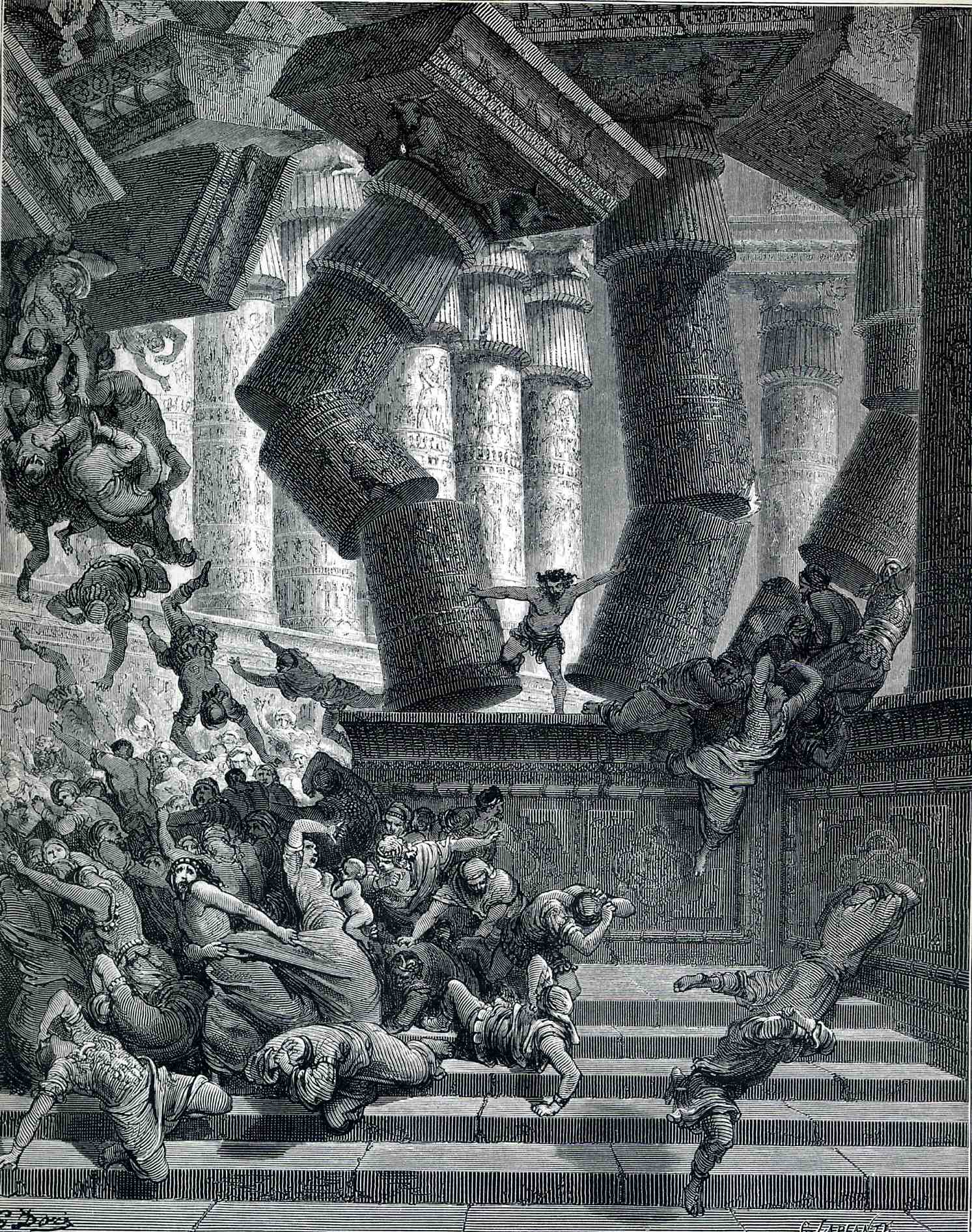
Samson on the Cross: A Good Friday Reflection

Death of Samson

In my recent post on the subject of exodus in 1 Samuel 1-7, I observed the way that the narrative explores themes of strength and weakness. At the battle of Aphek, the Ark of the Covenant, which was supposed to bring supernatural power to the aid of the Israelites, turns out to be a damp squib: it is captured by the Philistines and taken into captivity, placed at the very heart of their civilization, next to their god Dagon in his temple.

At that point, however, what once seemed weak and powerless begins to display immense and terrifying power and the world of the Philistines starts to collapse around it. It begins with the statue of Dagon falling on its face before the Ark. He is placed back on his pedestal, but the next day he has fallen again, but now is dismembered and decapitated. His hands lie on the threshold, as if he were seeking to flee from the terrifying presence of YHWH in his own temple. Over the coming months, the territory of the Philistines is ravaged with plagues.

This isn’t the first time in the Scripture that we encounter Dagon and his temple. In Judges 16, Samson is betrayed by one of those closest to him, one who kisses him but then gives him into the hands of his enemies in exchange for pieces of silver. He is bound, blinded, and imprisoned. He is made a grinder in the prison, a gruelling back-breaking task. The leaders of the Philistines hold a celebration of their victory over him, sacrificing to Dagon in his temple. Samson is brought before them so that they can make mockery of him. The one who was once thought so powerful is a weak plaything for them now, a target for their sport and jest. Samson is placed between the pillars of the temple, one on his right and another on his left. He asks the lad holding his hand to guide his hands to the pillars, so that he can lean upon them.

At that point he prays that, just that one final time, God would strengthen him. He braces himself on the two pillars of the temple, then pushes with all of his might. The temple of Dagon collapses, falling on all of those within it. Willingly giving up the Spirit that had returned to him in that final act, Samson dies with the Philistines, accomplishing a greater victory in his death than at any point in his life.

The temple of Dagon appears on three different occasions in Scripture and, on each occasion, it is the site of a different form of decapitation or head-crushing. In 1 Chronicles 10:10, the severed head of Saul is brought to the temple of Dagon to be displayed. In 1 Samuel 5, it is Dagon himself who is decapitated by YHWH. In Judges 16, we see Samson, who as a Nazirite has separated his head to YHWH (Numbers 6:18), give up that head, with the result of the crushing of the heads of the Philistines.

Turning to the gospels, we encounter a story that might be familiar to us. A Man perceived as a great threat by the authorities is betrayed into their hands by someone extremely close to him in an act of seeming intimacy (Luke 22:47), handed over in exchange for pieces of silver. The Man is blinded and mocked (Luke 22:64). The Man once feared and considered so powerful is ridiculed, his impotence apparent for all to see.

A crown is placed on the Man’s head, dedicating it (the crown is a sign of consecration: in fact, the Hebrew word for it is the same one as used for the Nazirite’s ‘separated’ or ‘consecrated’ head). The Man is giving the back-breaking task of carrying his cross and is led to Golgotha – ‘the Place of the Skull’ – the site where heads are removed and skulls are crushed. He is placed between two wooden pillars, bearing those crucified with him, one on his right hand and another on his left. The body of disciples depart and their Head is left alone.

The Man is taunted: ‘You who destroy the temple and build it in three days, save Yourself! If you are the Son of God, come down from the cross.’ The Man is seemingly abandoned by God and cries out for his presence. Psalm 69 is alluded to in the context on a number of occasions, a plea for God’s help in a time of great need and persecution, a plea for God’s judgment upon wicked oppressors: ‘…let their habitation be desolate; let no one dwell in their tents…’ The Man, with one last gasp of strength, cries out with a loud voice and gives up the Spirit. Immediately, the veil of the temple is torn from top to bottom. The earth quakes, the rocks are split, the graves are opened (Matthew 27:50-53). The whole old world order comes crashing to the ground.

In the very act of his death, the Man who was considered powerless accomplishes the greatest victory of all. It is through his crucifixion in weakness that the true power of God is displayed.

‘But we speak the wisdom of God in a mystery, the hidden wisdom which God ordained before the ages for our glory, which none of the rulers of this age knew; for had they known, they would not have crucified the Lord of glory.’ The Man whom they mocked brought the house down. And nothing will ever be the same again.

Posted in 1 Samuel, Bible, John, Judges, Lent, Luke, Mark, Matthew, NT, The Atonement, The Atonement, Theological, Theology | 12 Comments

The Same-Sex Marriage Debate – Questions and Answers

UPDATE: A considerably expanded version of this post can be read here, in a page that should always be easily accessible from my front page (under ‘Larger Projects’).

Just under a year ago, I wrote a post on the subject of same-sex marriage – The Institution of Marriage, Same-Sex Unions, and Procreation. With the topic such a live one in the American context at the moment, my post has come to people’s attention again and has been receiving a large number of hits over the last couple of days. I thought that I would take this opportunity to begin to address a few common questions, questions that I have been asked many times in the past, and will probably be asked many more times again in the future.

This isn’t going to be a comprehensive treatment of the subject of same-sex marriage, nor even of the questions that its opponents often face. However, since I am often asked certain questions, I thought that it would be good to have a single location where those questions are addressed, to which I can direct people in the future. For this reason, I will probably update this post at various points over the coming months. This is a work in progress. I am posting a few initial questions and quickly written answers now (27th March 2013), but would welcome feedback from all parties on questions to add and ways to hone existing answers. I don’t plan to answer comments below the line, but the concerns that they raise will hopefully be addressed in later drafts.

Ground Rules

While regular readers of this blog are well aware of how things operate around here, for the sake of visitors, and on this subject in particular, I want to clarify a few things before I proceed. First, I positively welcome strong and challenging disagreement in my comments and elsewhere. I believe that good arguments need to prove themselves by sparring with strong arguments from their opponents. I have little respect for positions that resist exposing themselves to such challenge, from whatever side they may come. You do not need to apologize for disagreeing with me, nor do you need to preface your remarks with obligatory affirmative comments to soften the blow of your criticisms.

Second, I recognize that such issues are sensitive ones for many persons and understand that many might not want to expose themselves to the context of such disputation. This does not absolve their positions from this responsibility, however. The fact that some of these debates are a little close to home for many of us does not mean that debates should be closed down and that the most sensitive party’s positions should win by default.

Third, while tough and challenging arguments are welcomed and encouraged here, personal attacks and name-calling are not. Someone firmly and strongly disagreeing with you and presenting arguments to support their case is not a personal attack. This said, given the sensitivity of these issues, I would request that everyone consider others when making their arguments and seek to disagree respectfully, treating other participants in the discussion with dignity. Continue reading

Posted in Controversies, Culture, Ethics, Politics, Sex and Sexuality, Society, Theological | 48 Comments

The Crusade of the Lost Ark – 40 Days of Exoduses (22)

A Barren Woman

Our last study concluded with Israel having crossed the Jordan and destroyed the city of Jericho. At this point we jump forward in biblical history, leaving the rest of the book of Joshua and skipping the books of Judges and Ruth. Although the intervening texts have a few exodus sequences, given the limitations of our forty part series, I will have to pass over them without comment. The Israelites have now been settled in the land for a few hundred years. If we follow the chronology of the text, the book of 1 Samuel begins around 280 years after the conquest of Canaan. This figure presumes that the ministry of the judges overlapped, as they operated in different regions of the country. Samuel would have been a contemporary of such figures as Samson and Jephthah.

The book of 1 Samuel begins in a manner very similar to that of the book of Exodus. Israel is languishing under wicked and spiritually dull rulers. The priests, Hophni and Phinehas, the two sons of Eli, were wicked and corrupt. They despised the offering of YHWH (2:12-17) and violate the women at the door of the tabernacle, the virgins who were to represent Israel’s holiness as the bride betrothed to YHWH (2:24). In committing this act of sexual violation, Phinehas is the opposite of his namesake in Numbers 25 and reminds us of the apostasy at Baal of Peor.

The high priest, Eli, was spiritually dull. He couldn’t even recognize prayer when it was taking place at the tabernacle (1:12-16), which suggests both his and the people’s spiritual laxity. In 3:1-3 we have a threefold parallelism: the lack of the word of YHWH and prophetic vision (v.1); the dimness of the eyes of the high priest and judge, representing poverty of spiritual sight (v.2); the lamp of God that will soon go out, as the world of the tabernacle is rendered dark and formless again (v.3). At this time the people are also oppressed by the Philistines and are about to be defeated by them at the battle of Aphek.

In this context we are introduced to a barren wife, Hannah, who is one of two wives of an Ephraimite named Elkanah. Hannah is constantly provoked by Peninnah, her rival, who has a number of children (1:2, 4). However, Elkanah loves Hannah and gives her the firstborn portion (v.5), even though YHWH had closed her womb.

As a barren wife, Hannah should remind us of the wives of the patriarchs: Sarah, Rebekah, and Rachel, who were all barren also. The opening of the barren womb is a crucial exodus theme. As the barren and oppressed wife, who calls out to YHWH, Hannah represents the entire nation, waiting for the promised seed of the woman to deliver them from their condition. The fact that the narrative of 1 Samuel begins at this point, rather than many years later, when Samuel reached maturity, gives us insight into YHWH’s priorities and the way that he both works and views the world. As in the original story of the Exodus and in such stories as that of Ruth, when covenant history seems to have broken down irreparably, it is through the prayers and the courage of faithful women that a new future becomes possible. In the midst of the gathering gloom of history, God plants the seeds of his future in unexpected places.

In praying for a son, Hannah promises that, if YHWH hears her request, she will dedicate him to YHWH and that he will be a Nazirite all of his life (v.11). Like Samson and John the Baptist, both also children of barren women, Hannah’s son would be a dedicated servant, bound by a vow of special service for all of his life. The Nazirite was a person who exercised a priest-like task within the wider world, with many of the same limitations that the priests were under in their service. Hannah’s son would be set apart for a lifelong special mission, a form of holy war, preparing the way for the establishment of the kingdom to come.

A Miraculous Child

The woman who cried out to YHWH was remembered by him (v.19), something that should recall the Exodus for us, where YHWH heard the groaning of his people, remembered them, and opened the womb of Egypt for the birth of the firstborn son that was dedicated to him. Hannah gives birth to a son and names him Samuel. When Samuel was weaned, Hannah brought him up to Shiloh, to give him to YHWH. Samuel was adopted as a son of Eli, although, as we shall see, Samuel as one dedicated to YHWH and sleeping in his tent (3:3), is primarily the son of YHWH, with Eli as his guardian.

The theme of adoption is important in 1 Samuel. Peter Leithart writes:

Eli’s paternal relation to Samuel forms the background for the contrast between Samuel and Eli’s natural sons that is developed in chapter 2. Father-son relations are, moreover, prominent throughout 1-2 Samuel. Samuel’s troublesome sons provided a pretext for the people to ask for a king, and Saul was “adopted” as Samuel’s son. Later, David became a son-in-law to Saul, and much of the account of David’s reign in 2 Samuel is taken up with recording David’s difficulties with his sons.

In each of these cases, biological sons were replaced by an adopted son. Just as Eli and his sons lost the priesthood and were supplanted by Samuel, so Samuel’s sons were supplanted by Saul and Saul’s son by David. In contrast to Genesis, the true son in 1-2 Samuel is not a younger biological son but an adopted son who comes from outside the genealogy… 1-2 Samuel thus makes the typology of Genesis more precise by showing that the “seed” would not come through the normal channels of fleshly descent but would be pre-eminently the one “born according to the Spirit” (cf. Lk. 1:35; Gal. 4:21-31).

Hannah responds to the birth of Samuel with a prayer of rejoicing (2:1-10), a prayer which is the pattern for Mary’s Magnificat in Luke (Luke 1:46-55). Much as the parents of Noah, Moses, John the Baptist, and Jesus, Hannah realizes that the birth of Samuel heralded more than her own vindication against Peninnah. It was a sign that YHWH was about to turn Israel upside-down, throwing down the rich and mighty and raising up the weak and poor. Hannah’s prayer praised YHWH that he was about to tear down the corrupt house of Israel and re-establish it again upon righteous foundations.

As in the story of the Exodus, there is a lot of focus upon doors at the beginning of 1 Samuel. The door or threshold is the place of birth and death. In 1:9, Eli is sitting by the door as Hannah prays for a son. Hophni and Phinehas violate the women at the door of the tabernacle (2:22). Later, Eli will die at the gate (4:18). Significantly, Samuel is the one who opens the doors of the house of YHWH (3:15). The connection between passing through the doors and the firstborn’s opening of the womb in Exodus occurs again here. The birth of Samuel opens the doors of the womb of Israel, so that faithful children can be born.

Unlike Eli, who was a poor guardian of the gate, and Hophni and Phinehas who violated the women there, Samuel will guard the gate, protecting the holiness of the people of YHWH. In opening the doors, he will also bring the life and word of YHWH out to the nation.

Tearing Down the House of Israel

Eli is an indulgent father, who fails to deal seriously with the wickedness of his sons, much as the blind Isaac planned to bless the wicked Esau rather than Jacob. YHWH declares to him through two witnesses – first through a man of God (2:27-36) and then through Samuel (3:1-18) – that his house will be brought low and his two sons killed in a single day. While Eli indulges his wicked sons, Samuel grows and is blessed by YHWH, the faithful adopted son who will take their place leading the nation.

In chapter 4 the entire house of Israel is brought crashing to the ground. The Israelites go out to fight against the Philistines, but are defeated by them and four thousand men are killed. In response to this tragedy, the elders of Israel suggested that they bring the Ark of the Covenant of YHWH to the battle, hoping that it would lead to their victory. Hophni and Phinehas are among those who bring the Ark (4:4). The camp of Israel responds with a mighty shout.

The Philistines were fearful at the report, recognizing that YHWH was the one who struck the Egyptians with plagues (vv.6-8). Once again, it is important to remind ourselves that the Philistines have been connected with the Egyptians from the first time that we read of them in the Scriptures (Genesis 10:13-14), and a couple of the exoduses that we have encountered have been from Philistine territory.

However, things do not work out as expected. The Philistines inflict a great slaughter upon the Israelites. Thirty thousand foot soldiers of Israel perish, ten times the body count following their sin at Sinai. The Ark of YHWH was captured and the two sons of Eli, Hophni and Phinehas, were killed.

A man from Benjamin ran to tell Eli, who inquires about the meaning of the uproar that he is hearing. When he hears what has occurred, he falls backwards off his seat by the gate, breaks his neck, and dies. Perhaps there is some parallel to be seen between this event and Joshua’s inquiry about the meaning of the noise in the camp of Israel in Exodus 32, immediately followed by the breaking of the covenant (Exodus 32:17-19), as Moses casts down the tablets of stone, as they realize what is occurring, the breaking of heavy high priest relating to the broken of the stone tablets. At the battle of Aphek, Israel commits a new act of national apostasy, compounding all that has occurred before. They treat the Ark of the Covenant as if it were an idolatrous technology by which a wicked nation could control YHWH. As a result, as at the Golden Calf incident, the covenant is broken and the worship of YHWH exiles himself from the people.

After the capture of the Ark, the tabernacle worship was never truly restored again. The tabernacle and the Ark would always be separate – a broken house of YHWH – until the Ark was finally brought into the temple. At this point, Phinehas’ wife gives birth to a son, dying shortly after childbirth (v.20), another sign of the desolation of Israel. She names the son Ichabod, ‘Inglorious’, because ‘the glory has been exiled from Israel’. The Ark of the Covenant, the throne chariot of YHWH, upon which the Glory of YHWH rode, had been taken away from the nation.

At the end of chapter 4 we see the complete destruction of the house of Israel. The high priest has died as have his two sons, devastating the priestly house. The house of YHWH, the tabernacle, has been torn in two, with the Ark taken into captivity. The house of Israel has been ravaged by their enemies and has lost 30,000 men, in an event of national apostasy, akin to that with the Golden Calf at Sinai.

The Ark in Captivity

As in Exodus 33:7-11, where the presence of YHWH leaves the camp after Israel’s apostasy, after the battle of Aphek the Ark leaves Israel to go into exile. The grace of YHWH is seen in that, rather than sending Israel into exile, he went into exile for them.

The Ark is brought to Ashdod and placed in the house of Dagon, the Philistines’ god, beside the statue of Dagon. YHWH was presented as a vassal of Dagon, the supposedly greater god. The next morning, the Philistines come to the temple of Dagon to find Dagon prostrate before the Ark, as it were bowing to YHWH. They restore Dagon to his upright position, but the next day they find that Dagon is prostrate before the Ark once again. This time, however, the head of Dagon and the palms of his hands have been removed. The decapitated Dagon is like a defeated serpent, whose head is crushed. The removal of his hands signifies the removal of his strength.

In 1 Chronicles 10:8-10, we see that the Philistines brought the head of Saul to the temple of Dagon and fastened it there. If it was customary for the Philistines to display the decapitated heads of defeated enemies there, it adds an extra level of irony to YHWH’s decapitation of Dagon in his own temple. The falling of Dagon and his being broken at the neck also recalls the death of Eli in the previous chapter. Just as the judge of Israel is broken, so shall the god of the Philistines be.

We have already noted that a significant feature of many exodus motifs is a battle of YHWH with false gods, or the humiliation of idols. As YHWH humiliates Dagon, strips him of power, and triumphs over him in his own temple, decapitating him in the very place where the heads of his defeated enemies would have been presented, we see this theme re-emerge. YHWH is above all of the gods of the nations and can prove his supremacy in the very places of their presumed power.

The hands of Dagon may have been cut off, but the hand of YHWH was heavy on Ashdod and the surrounding region. They are struck with a great plague. The people of Ashdod determine that the Ark must be removed from their city, for their own safety and for the well-being of their beleaguered deity, Dagon. The men of Ashdod want the Ark to depart from them, much as the Egyptian people desired the Israelites to leave them as they were plagued by YHWH. The Ark was then brought to Ekron, where the same thing happened. The Ekronites insisted that the Ark be sent back to Israel, because they feared complete destruction at YHWH’s hand.

Leithart observes the presence of exodus allusions in the language of the text (further allusions can be found in David Daube’s work):

1 Samuel 5:6 says that the hand of the Lord was heavy on the Ashdodites and smites them with tumors; similarly, in Exodus 9:3 we read that the hand of the Lord brought severe pestilence on Egypt. When the plagues hit, “the cry of the city went up to heaven,” (1 Sam. 5:12); similarly, on the night of Passover, there was a “great cry” throughout the land of Egypt (Exod. 12:30). In 1 Samuel 5:11, the people pleaded with their leaders to get the ark out of Philistia; similarly, in Exodus 10:7, Pharaoh’s servants advised Pharaoh to let Israel go before Egypt was completely destroyed. Philistia’s priests and diviners advised the rulers how to get the ark out of the land (6:2), just as the Egyptian magicians warned Pharaoh to remove Israel. In 6:6 we learn that the priests and diviners even know part of the Exodus story about Pharaoh hardening his heart, and they warned the Philistines not to do the same. The effect of the whole series of events was that the Philistines came to “know” Yahweh (6:9), and this was also the issue throughout the confrontation between Moses and Pharaoh. There are also many verbal similarities. The word “smite” is used in both Exodus 3:20 and 1 Samuel 5:6, 9; the phrase “strike with plague” occurs in both Exodus 9:14 and 1 Samuel 6:4; and the phrase “destruction of the land” is repeated in Exodus 8:20 and 1 Samuel 6:5.

All of the five cities of Philistia appear to suffer the plague. We encounter five cities in a number of key connections in Scripture (as usual, James Jordan has some interesting observations on this front). In Genesis 14:2 we see that there were five cities of the plain: Sodom, Gomorrah, Admah, Zeboiim, and Zoar. All of these, save for Zoar (cf. Genesis 19:22), were destroyed by YHWH (Deuteronomy 29:23). The Philistines are also associated with five cities: Ashdod, Gaza, Ashkelon, Gath, and Ekron (1 Samuel 6:17). Jordan observes that there is an association drawn between both of these sets of five cities and Egypt, which is also associated with five cities in Isaiah 19:18-19. The five cities of the Philistines should remind us of the five cities of the plain in Genesis, both ‘Egypt-like’ civilizations that Abraham and his children had to relate to while in the land and both cities that were judged by YHWH.

Crucified in Weakness

When the Ark was brought out to the battle at Aphek, the Israelites were expecting a miraculous and mighty deliverance and the defeat of their enemies. However, they suffered a catastrophic rout and the Ark passed into the hands of their enemies, seemingly powerless. The great strength that they had associated with the Ark, which had been involved in the crossing of the Jordan and the defeat of Jericho, was not displayed. Instead it seemed to be characterized by a tremendous impotence.

The Philistines then placed the Ark in the temple of their god, at the very power centre of their civilization. It is there, like a timed explosion, that the might of YHWH finally breaks forth. The Philistines had unwittingly served in YHWH’s plan, bringing the Ark to the very place where YHWH’s victory over them and their god might be most dramatically displayed.

A very similar disaster befell the Philistines, probably not many years after this (remember that the chronologies of Judges and 1 Samuel overlap). In Judges 16, a chapter with a couple of exodus patterns, Samson is betrayed by one close to him (Delilah, much as Joseph was betrayed by his brothers), is taken captive by the Philistines, his eyes are removed, and he becomes a slave grinding in the prison. The lords of the Philistines gather together at the temple of Dagon to sacrifice and celebrate the defeat of their enemy. They bring Samson out to perform in front of them, to make a mockery of him and to gloat over him. Samson’s strength returned to him, he took hold of the pillars of Dagon’s temple, and pushed against them, bringing down the entire building, crushing the heads of all of the lords of the Philistines and the others within the building, giving up the Spirit and dying with them.

There is the theme of deception here once again. If the lords of the Philistines had known what Samson and the Ark would do, they never would have taken them to the temple of Dagon. At the very climax of their apparent victory, the foe them thought vanquished rose up and dealt them a deadly blow from which they could not easily recover. This God, one who seems to be utterly stripped of power, who is taken to the very heart of the dragon lair, and then rises up to crush the head of the beast, is, of course, the God that we know in Jesus Christ.

The Release of the Ark

The lords of the Philistines, the priests, and the diviners consult about the best course of action. They determine that the Ark must be returned, but must be accompanied by a trespass offering, offering restitution for their sacrilege. As Daube observes, in the discussion of the Philistines, the Ark is personified, spoken of as a slave to be released.

The statement ‘If you send away the ark of the God of Israel’ in 6:3 is a significant one. As I have already observed, the freed slave was not to be released empty-handed, but was to be sent away with many gifts (Deuteronomy 15:12-14). The Ark is treated as a slave that must be allowed to go free and treated according to the law for released slaves. Once again, Exodus parallels are underlined here.

The Philistine lords decide to send five golden tumours and five golden rats with the Ark. The golden tumours represented the five cities of the Philistines and the golden rats their surrounding villages (6:17-18). They also related to the form of the plague with which they had been afflicted (v.5). Once again, the Philistines seem prepared to learn from the lessons of the Egyptians, not wanting to harden their hearts as Pharaoh did and court the level of destruction that he faced (v.6). The sending of the Ark with gifts also relates to the plundering of the Egyptians in Exodus.

Wanting to rule out the slight possibility that the plagues that had befallen them and Dagon were purely chance occurrences, unrelated to their taking of the Ark, the Philistines determined to return hitch two milk cows that had never previously been yoked, separate them from their calves and see whether they would bring the Ark back to the land of Israel. They did, bringing the cart bearing the Ark up towards Beth Shemesh.

The Ark in the Wilderness

As Leithart points out, the people of Beth Shemesh sin in a number of respects. They offer a false sacrifice, offering the milk cows instead of the bulls required by the Law (Leviticus 1:3). They placed the Ark on a stone, and looked within it (or at it). It should have been kept covered and never touched. The people of Beth Shemesh were struck with a dreadful plague as a result (6:19), suffering the same sort of judgment as the Philistines had.

The men of Beth Shemesh, fearful of YHWH’s judgment, wish to be free of the Ark, much as the Philistines did. The men of Kirjath Jearim bring the Ark there and leave it at the house of Abinadab, who consecrates his son to keep it (6:20—7:2). The city of Kirjath Jearim was one of the cities of the Gibeonites (Joshua 9:17), which means that its population was primarily Gentile, while under the rule of Israel. The Ark’s resting in a Gibeonite city and not being restored to the tabernacle is a sort of wilderness period, after release but prior to settlement and restoration. It would be almost a century before the Ark was brought up to Jerusalem (2 Samuel 6), and even longer before the pieces of the torn house of YHWH were brought back together in the temple.

Resurrection!

Twenty years after the return of the Ark to Israel, Samuel and the Israelites re-establish and affirm the covenant at Mizpah, acknowledging their sin, forsaking their false gods, and asking Samuel to pray for them. As they are doing this, the Philistines gather together and go up against Israel.

The contrast with the battle of Aphek is striking. Here the Israelites are the fearful ones, not the Philistines, as in chapter 4. However, even though they did not have the Ark of the Covenant to bring to the battle, the storm chariot of YHWH fought for them. YHWH thundered against the Philistines and confused them so that they were overcome (7:10) and fled before the Israelites.

Once the heart problem of the people had been addressed, the conquest of the land could occur in earnest. At the very place where the Philistines had camped twenty years earlier, prior to the battle of Aphek (4:1), Samuel establishes a memorial stone, Ebenezer, marking the help of YHWH that they had received to that point (7:12). All of the territory that they had lost to the Philistines was recovered, the Philistines were driven back, and YHWH judged the Philistines for all of the days of Samuel (vv.13-14).

In chapter 7 we see Hannah’s prayer coming to fruition. The corrupt house of Israel had been torn down at Aphek and the rich and the oppressors had been crushed – first with the battle of Aphek and its aftermath, the plaguing of the Philistines, and then in Samson’s crushing of the heads of the Philistines in the temple of their god. Now the poor and weak are being raised up from the dust, as they turn to YHWH in humility and repentance.

Posted in 1 Samuel, Bible, Exodus, Lent, OT, OT Theology, Theological, Theology | 4 Comments