Pentecost!

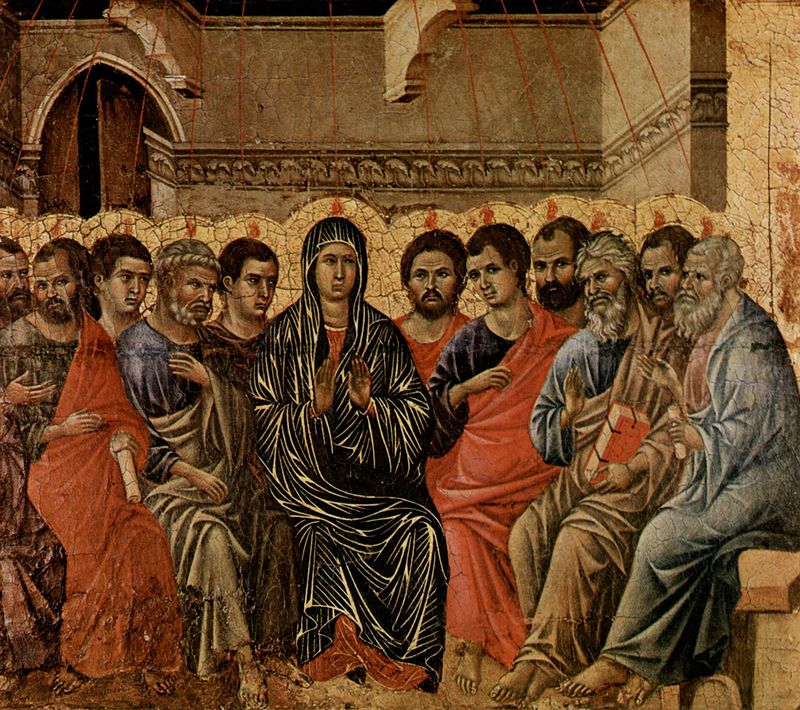
Duccio di Buoninsegna

As it is Pentecost tomorrow, I took the time to correct a broken picture and some formatting problems in an old post on the subject: The Background of Pentecost. Within the post, I discuss several of the Old Testament narratives that provide background for the New Testament event of Pentecost. So, for instance:

As part of God’s construction of a new temple, God prepares new lamps. In the original created order, the sun, moon and stars were the lamps prepared by God on the fourth day. In the tabernacle the lamp provided light. In the nation of Israel, the political and religious leaders were seen as the anointed lightbearers. The prophets, empowered by the Spirit, were the anointing ones (Samuel and Elijah are both prominent examples of anointing prophets — 1 Samuel 10:1; 16:13; 1 Kings 19:15-16). It is important to notice one of the more obvious parallels between the lamp and ruler: both were the recipients of sacramental oil, a symbol of the Holy Spirit. The association of the imagery of lamps and rulers is seen in such places as Zechariah 4. It is also seen in such places as 1 Kings 11:36 and 15:4, where God promises that David will always have a ‘lamp before Me’, i.e. an heir on the throne.

In the gospels the lamp imagery is seen on a number of occasions. In Mark 4:21 Jesus points out that the lamp — it has the definite article in the Greek — does not come in order to be put under a basket or bed. Rather, the lamp comes in order to be publicly displayed. We should never forget that it is a parable (or riddle) of the kingdom that is being given here, not merely a timeless piece of moral advice for the individual believer. The lamp and light that is coming should be read in terms of the broader framework of redemptive history (e.g. Isaiah 60:1-3, 19-21). Christ and the new Israel that He is forming around Himself are to be the light of the world. The Church is to be a city set on a hill (a new Jerusalem — Isaiah 2:1-4). The lampstand giving light to the house (the language of the Sermon on the Mount) is quite probably temple imagery. We also see the lampstand imagery taken up in Revelation 1, where the lampstands represent the churches, with Christ, the great High Priest, tending them. The lampstand is also a symbolic burning bush. The burning bush of the Church is where man now meets with God. Wherever the Lampstand Church is, there is holy ground.

[Perhaps we should also read the lighting of the lampstand imagery against the background of the liturgical patterns of Exodus 29-30. The ascension offerings of 29:38ff would presumably have been followed by the lighting of the lamps and burning of the incense, which took place at the same time of the day (Exodus 30:7-8). The connection of ascension and lamp-lighting might help us to some degree in our understanding of the relationship between Ascension and Pentecost.]

When we hear of tongues of flame resting on the heads of the disciples at Pentecost we should instantly connect it with such biblical imagery. The disciples are being set up as new lightbearers. Being baptized by the Holy Spirit they are being placed in the heavenly places with Christ (cf. Ephesians 2:6) to shine as stars.

This is just a taster: there is lots, lots more in the post.

In another five part series, I discuss the manner in which the events of the day of Pentecost establishes the Church as a prophet:

Just as Jesus’ baptism by John marked the beginning of his prophetic ministry and his succession from John’s own ministry, so the ascension and Pentecost mark the time when the church is anointed for its prophetic ministry and the transition from Jesus’ public earthly ministry to that of the church.

The two most important prophetic succession narratives of the OT involve the transition from the leadership of Moses to the leadership of Joshua (Numbers 27:12-23) and the transition from the prophetic ministry of Elijah to that of Elisha (2 Kings 2:1-15). In both of these cases the mission started by the first prophet is completed by his successor. Moses’ mission to lead the children of Israel out of Egypt and into the Promised Land is only fulfilled in the ministry of his successor Joshua. Similarly, the mission that Elijah is charged with in 1 Kings 19:15-17 is only completed in the ministry of Elisha (2 Kings 8:13; 9:1-3).

Elisha is a new Elijah (2 Kings 2:15), just as Joshua is a new Moses (Numbers 27:20; Joshua 1:5). The parallel between the ministries of Joshua and Elisha and the ministry of Jesus’ disciples is worth highlighting. Both Joshua and Elisha serve as apprentices to prophets, whose ministries they inherit following the time of their masters’ departures. The same pattern holds in the case of Jesus’ disciples: having left their work to follow Jesus as disciples, they receive their master’s Spirit following his departure and continue his mission.

The relationship between the prophet and his apprentice is akin to the relationship between a father and his son. In Numbers 13:16 we see that Joshua’s name was given to him by Moses. Moses also lays his hands on Joshua (Deuteronomy 34:9) in a manner reminiscent of the patriarchs’ blessings on their sons (Genesis 48:13-20). A similar relationship exists between Elijah and Elisha. Elisha receives a ‘double portion’ of Elijah’s spirit, the inheritance appropriate to the firstborn (Deuteronomy 21:17), and, as Elijah is taken into heaven, Elisha addresses him as his ‘father’. Jesus’ farewell discourse and blessing of his disciples (Luke 24:51) belongs within this pattern of prophetic succession.

Zwiep notes the parallel between the stress on the visibility of the master’s departure in both the account of Elijah’s rapture and that of Jesus’ ascension. Seeing Elijah taken up was an indispensable condition for Elisha’s right to succeed him. Moberly explains the logic of the test: ‘…it is the responsibility of the prophet to be able to see God, and if Elisha cannot see God in this critical instance, then he is not able to take on the role of one who sees God in other instances; Elisha cannot be a prophet like Elijah unless he has the requisite spiritual capacity.’ The Lukan stress on the disciples’ witnessing of Jesus’ ascension might serve to underline their suitability for prophetic office.

Elijah and Moses typology is multilayered within the Lukan literature. However, in the critical movement in the narrative with which we are concerned, the disciples are typologically related to Joshua and Elisha. As their master departs, they will inherit his Spirit and continue his mission. The Spirit that the disciples will receive is the Spirit of Christ, the Spirit that supervised and empowered his own mission.

Read the whole thing: Part 1Part 2Part 3Part 4Part 5.

Finally, I posted on the subject of Pentecost earlier this week, over on the Political Theology blog:

Pentecost is a unification of the separated families of humanity. This unification isn’t accomplished through the will and power of empires and their rulers, but through the sending of the Spirit of Christ, poured out like life-giving rain on the drought-ridden earth. In place of only one holy—Hebrew—tongue, the wonderful works of God are spoken in the languages and dialects of many peoples. The multitude of languages is preserved—a sign of the goodness of human diversity—and human unity is achieved, not in the dominance of a single human empire, or in the collapsing of cultural difference, but in the joyful worship of God.

Posted in #Luke2Acts, Acts, Bible, NT, NT Theology, The Church, Theological, Theology | 14 Comments

#Luke2Acts—Some Notes on John 14 to 21

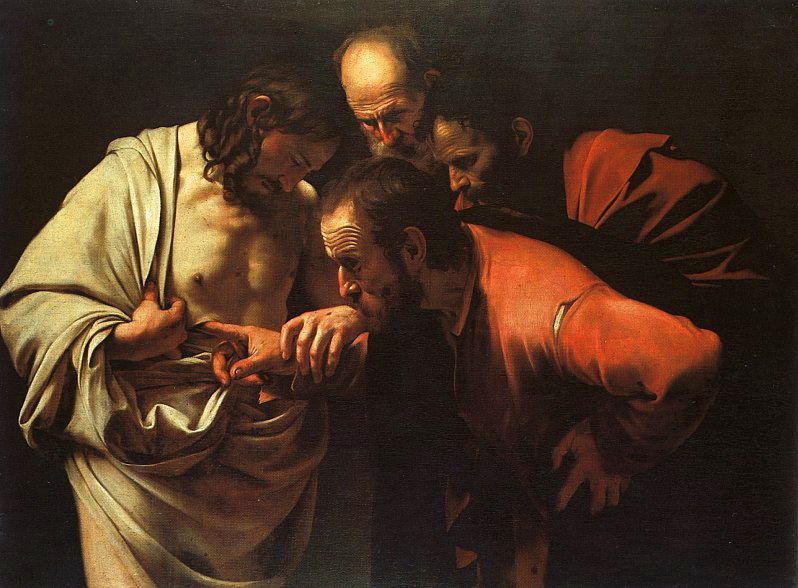
Caravaggio - The Incredulity of Saint Thomas

Caravaggio – The Incredulity of Saint Thomas

The Twitter #Luke2Acts Bible study has just reached the final chapter of John. I have written notes from the beginning of Luke. The full list of Luke posts is found here. The full list of John posts is found here.

JOHN 14

Jesus’ charge, ‘Let not your heart be troubled,’ contrasts with his own state (13:21). It also recalls the charge given in Joshua 1:1-9. This passage and those that follow it are akin to Moses’ final address to Joshua and Israel, the testimony of the departing leader. ‘You believe in God, believe also in Me’—the relation that Jesus establishes between belief in the Father and belief in himself is significant. This also might relate to the statement concerning the people’s belief in God and Moses following the Red Sea crossing in Exodus 14:31.

‘In my Father’s house are many rooms’—what and where is the Father’s house? I believe that it is the temple (2:16) of Jesus’ body (2:21). Many read this as a reference to heaven and the eternal state. While this is part of the picture—the New Jerusalem descends from heaven in Revelation 21:2—I think that there is a more immediate fulfilment than that. I don’t believe that the place that Jesus is preparing is heaven per se. Rather the ‘place’ is his body, the Church. As we see in Revelation, the Church is prepared in heaven, but it is prepared on earth too. In order to prepare the place, Jesus must die, rise again, ascend to give the Spirit, and form the Church, bringing us into his presence by the Spirit. This interpretation is strengthened by the other references to God’s dwelling in the chapter, especially verse 23. Jesus and the Father will make their home with the believer, making them a room in the new temple that Christ is preparing.

Christ is the only way to the Father. He is the Truth (throughout the gospel he has been described as the ‘true’ version of various things—1:9; 6:32; 15:1). He is also source of eternal life, having life in himself (5:26). He is unique in all these respects. As he is the image of the Father, the only begotten Son, if you have seen Jesus, you have seen the Father. The Father is known in Christ. Christ does the Father’s works, acts with the Father’s authority, speaks his words, and the Father is in him.

Whatever the disciples ask in Jesus’ name, he will do for them, for the Father’s glory. To ask in Jesus’ name probably means to ask as representatives of his work and person in the world.

‘If you love me, keep my commandments.’ These commandments aren’t burdensome, but liberating (1 John 5:3).

Jesus will intercede for his disciples, so that they may have another ‘Paraclete’. What is a Paraclete? The word Paraclete is also found in 1 John 2:1, where we are told that Jesus is our ‘advocate’ with the Father. It seems to me that the Paraclete is a more legal concept, rather than just ‘Helper’ or ‘Comforter’, as it is often translated. The implied setting is a sort of law court or council, where both Christ and the Spirit act as our divine representatives against all accusers, particularly Satan.

As we see the Spirit described, we should see that the Spirit is like Jesus in many respects, as it is his Spirit. These verses also speak of the Spirit in a manner that supports the Spirit’s own personhood. The Spirit is currently present with them in Jesus, but will later be in them. The coming of the Spirit is related to the coming of Christ himself to his disciples (v.18). The sort of succession being suggested here is reminiscent of Elijah and Elisha, for instance. Elisha received the firstborn ‘double’ portion of Elijah’s Spirit after Elijah’s ascension (2 Kings 2:9-15). The disciples will later receive Jesus’ Spirit in like manner. Also, Elijah and Elisha’s ministry was a unity, with Elisha completing what Elijah started. There are similar themes here: the disciples will perform greater work than Jesus as they continue his mission in his Spirit (v.12).

Our love for Christ is revealed by our having and keeping his commandments (v.21). 1 John develops this point. Jesus and the Father will make their home with those who keep his word (v.23). We are the many rooms of the Father’s house. The Spirit will teach and remind the disciples of everything that Jesus had spoken, as Jesus’ representative. Jesus demonstrates that he loves the Father by obeying his Father’s commandment (v.31), just as he calls us to do (v.15, 21).


JOHN 15

The image of the vine was associated with Israel in such places as Isaiah 5. The vine and the olive tree (Romans 11) are also both ‘sacramental’ trees, one giving wine and the other giving oil. I do not believe that this is accidental. Jesus is the ‘true’ vine. The relationship between the Father (vinedresser) and the Son (vine) is interesting and ties in with other descriptions in the gospel. Persons are committed to the Son’s care by the Father and here also seem to be removed from it. The word that is translated ‘prunes’ in many Bible is the same word as that used for ‘cleansed’. The use of the word ‘clean’ in verse 3 follows from the reference to being cleansed in the preceding verse. The disciples are cleansed by Jesus’ word (v.3), which stands for his broader revelation and message (cf. John 14:23-24). The Father ‘cleanses’ the branches of the sacramental vine in preparation for the great eschatological wedding feast of wine.

The idea of removing branches from the tree of the people of God is similar to that found in Jeremiah 5:10-11. How are the branches cut off? Perhaps by means of persecution, which prunes existing branches for greater faithfulness and removes the branches that lack genuine life. The image of mutual ‘abiding’ (an important word in John) is very powerfully illustrated by the ‘organic union’ between vine and branches. The vine gives the branches all of their life and bears fruit through them. Apart from the vine, branches die.

The vine imagery can be helpful for understanding works in the Christian life. First of all, works are cast as fruit, in terms of blessing, harvest, and gift, rather than mere exercise of duty. Second, we have no power to produce fruit apart from Jesus. Fruit is produced as his life works itself out in our lives by his Spirit as we abide in him. Third, the Father is at work on the vine to help it to grow fruit: every person of the Trinity is active here. Fourth, bearing fruit is a (the?) central point, not just some sort of ‘salvation’ abstracted from that (I do not believe that we would truly be saved were we not rendered fruitful).

Jesus’ words must abide in us (v.7). The words of Jesus, the Word who created all things made flesh, are not like regular words, but are Spirit and life (6:63), and the words of the Father (3:34) with the power to judge (12:48), and raise the dead.

The idea that the Father wants to produce fruit through us is a remarkable one. Our bearing fruit is not some mere duty laid on us, but something which God delights and wills to accomplish through us, just as Jesus died to produce much fruit (12:24).

‘If you keep my commandments, you will abide in my love’—this reverses the earlier order of 14:15. There is a circular character to be observed, a ‘gracious cycle’—as we love Jesus, we will obey his commandments: as we obey his commandments, we will grow and abide in his love. Our relationship to Jesus’ commandments should be modelled after his relationship to his Father’s life-giving command (12:49-50).

The commandments that Jesus gives us are liberating, empowering, and life-giving and designed to give us fullness of joy (v.11). We shouldn’t regard Jesus’ commandments as a treadmill of rules and limitations, but as the shape of an authorizing vocation. This vocation takes the shape of loving and laying down our lives for each other as Christ did for us. As we follow this vocation, Christ will be powerfully at work within us to produce lasting fruit for his Father.

‘You are my friends’—reminiscent of Abraham (James 2:23) and Moses (Exodus 33:11). How remarkable to be Christ’s friends! The friend is also someone who enters into another’s counsel. We aren’t just servants doing Jesus’ bidding from a distance, but are those who take an active role in shaping things, like the prophets in the heavenly council. Friendship also seems to be a particular emphasis in John’s gospel, where there are a lot of one-to-one interactions and where the cross itself is precipitated by Jesus’ healing of his friend, Lazarus.

There is something eschatological about the rich and multifaceted character of friendship, something more lasting than the divides between the generations, the sexes, the nations. Even in this age, sexual and intergenerational relationships tend to take their most mature form in the shape of deep friendship. In all of our society’s focus upon sex and its separation of generations in its idealization of youth, I love to reflect on the fact that at the last we’ll all sit together as friends. I blogged on the subject of friendship some time ago.

The hatred of the world is to be expected: it hated our Master before us. If the world loves us, it is probably a sign that something is seriously wrong. The world loves its own, but we should not be of the world.

As his people, we didn’t choose Christ. He chose us, and appointed us to bear much lasting fruit. It is a great encouragement to know that the Church’s purpose in the world rests upon something more robust than our human will and purpose.

No excuse remains to those who have seen the light and still preferred the darkness over it. Christ testifies of the Father. The Spirit testifies of Christ and through him the disciples will also testify of Christ.


JOHN 16

The disciples will be excommunicated from the synagogues (v.2). This suggests a sort of legal context. There is an ironic reversal here: although the disciples will be put on trial, through the work of the Spirit, it will be the world that will be on trial through their witness. The work of the ‘Paraclete’ in John is primarily ‘legal’ in character.

It is beneficial for Jesus to depart, because this leads to the sending of the Spirit, introducing a new stage of ministry (v.7). The Spirit convicts the world of sin on account of their rejection of Christ; of righteousness, because God and his people are demonstrated righteous through the heavenly advocacy of the vindicated and ascended Christ; of judgment, as Satan is condemned.

Just as Christ did not act on his own authority, but on his Father’s, so the Spirit does not act on his own authority (v.13). The Spirit will guide the Church—and the apostles more particularly—into all truth, not least through inspiring the witness of the New Testament.

‘A little while’—the time before the crucifixion—‘and you will not see me; and again a little while, and you will see me’—resurrection! I’ve commented at more length on 16:20-22 here (see my post on new birth in the gospel of John too). After the resurrection and ascension, the disciples will have greater access to the Father in Christ’s name (vv.23-24).

Praying in Jesus’ name does not mean praying for Jesus to pray for us (v.26), but, on account of Jesus, having privileged access to the Father, as we are known and loved by Him (v.28). This more direct access to the Father should be related to the advocacy of the Spirit that is at work through us.

The disciples will soon be scattered, like sheep without a sheep (v.32; cf. Matthew 26:31). ‘In the world you will have tribulation; but be of good cheer, I have overcome the world.’


JOHN 17

Many have characterized Jesus’ prayer as a ‘high priestly prayer’. It could be compared to the prayers and blessing of such figures as Jacob (Genesis 49) and Moses (Deuteronomy 32-33) before their deaths. It could also be seen as making us privy to Christ’s intercession for us in the heavenly council.

There is an exchange of glory between the Father and the Son (v.1). The Father is glorified in the Son and the glorification of the Son is so that the Father can be glorified. We can never play one off against the other.

Christ has been given authority over all humanity and this authority is exercised in order to give eternal life to the persons who have been given to him by the Father (v.2). Christ rules over all for our sake.

At root, eternal life is about being brought into life-giving fellowship with the one true God and his Son, Jesus Christ. Jesus has displayed his Father’s glory on the earth (v.4; cf.1:14) and finished the work he was given to do. Jesus prays that his Father would glorify him along with himself, with a glory he possessed before anything was created (v.5). In such places, I believe that we need to recognize a reference to the Holy Spirit.

Jesus’ disciples are presented as a gift from the Father to the Son. They aren’t just seen as individuals who chose to follow of their own accord, or even just as persons chosen by Jesus. They are situated in the loving bond between Father and Son. The Father is glorified in Jesus (v.1): Jesus is glorified in his disciples (v.10). Of those given to Christ, only the ‘son of perdition’—Judas—has been lost, to fulfil the Scripture. The rest are kept through God’s name. God’s name is his sign of ownership and authority over us, protecting us from rival claims.

That it is implied that Judas was given to Jesus by the Father is interesting. Judas is purposefully chosen (6:70), in full awareness that he will fall away. In fact, Judas’ falling away is itself included in God’s purpose. Judas is a vessel fitted for destruction, like Pharaoh in Romans 9, a wicked person who plays a crucial but cursed role in the precipitation of God’s future. Perhaps we should also relate him to Korah. It is interesting to observe the parallels between Judas and the apostate antichrist figure. The other occurrence of the expression ‘son of perdition’ is found in 2 Thessalonians 2:3. Should we see a relationship between the two?

The fact that the disciples are not of the world is revealed by the fact that the world has hated them (v.14). The disciples are set apart by the Father’s word, the life-giving Word/words of his Son. They are not of the world, just as Jesus is not of the world, but are sent ‘into’ the world like Jesus himself (v.18; cf. 20:21).

The unity of those who will believe on Jesus through the disciples’ word is found within the unity between Father and Son (v.21). This unity through fellowship will demonstrate Jesus’ mission to the world. 1 John 1:1-7 is important here:

That which was from the beginning, which we have heard, which we have seen with our eyes, which we have looked upon, and our hands have handled, concerning the Word of life—the life was manifested, and we have seen, and bear witness, and declare to you that eternal life which was with the Father and was manifested to us—that which we have seen and heard we declare to you, that you also may have fellowship with us; and truly our fellowship is with the Father and with His Son Jesus Christ. And these things we write to you that your joy may be full. This is the message which we have heard from Him and declare to you, that God is light and in Him is no darkness at all. If we say that we have fellowship with Him, and walk in darkness, we lie and do not practice the truth. But if we walk in the light as He is in the light, we have fellowship with one another, and the blood of Jesus Christ His Son cleanses us from all sin.

The fellowship between the Father and the Son and the authenticity of Jesus’ mission is manifested and authenticated in the fellowship of the Church.

Jesus gives the glory given to him by the Father to believers. They are made the site of his presence and dwelling by the Spirit. Jesus wants believers to be with him where he is—in the presence of the Father. This looks forward to the future, but is also partly realized in the present, as we have fellowship with the Father in Jesus.

The Father loved Jesus before the foundation of the world. He prays that the love with which the Father loved him might be in us (v.26). Notice the 1 John themes again. Both ‘love’ and ‘glory’ seem to be treated almost as if they were concrete things in this passage. I believe that this is because the ‘love’ and the ‘glory’ being spoken of are realized in the person of the Spirit. The ‘love’ with which the Father loved the Son is the Spirit and the ‘glory’ with which he glorified him is the Spirit.

Jesus declared to the disciples the Father’s name. It is worth remembering that the temple was the place where God put his name (2 Chronicles 6:20; 20:9) and that his name was ‘in’ the Angel of the Covenant (Exodus 23:20-21). Jesus is both.


JOHN 18

Jesus’ crossing of the Brook Kidron should be related to David’s crossing of the brook in 2 Samuel 15:23, during Absalom’s coup. I’ve discussed the 2 Samuel background in my treatment of Luke. Judas is like Ahithophel. Ralph Smith also has some helpful reflections on John 18:1-11 here, developing some of these themes further. Jesus enters into a garden (v.1), which obviously carries all sorts of biblical resonances.

Jesus answers those coming to arrest him with the highly significant words, ‘I am’ (cf. 8:58), at which they draw back and fall to the ground, as if in worship.

Jesus’ words in verses 7-9 show his commitment to suffer on behalf of the disciples and protect them, even as they abandon him. The disciple who attacks the high priest’s servant isn’t mentioned in the other gospels, but here we are informed it is Peter. David Daube suggests that an attack upon the right ear might be intended as a disqualification for priestly service. I am not so sure. Notice that Malchus is Peter’s ‘opposite number’—both are servants of a high priest. Peter is the lead priestly assistant to Jesus, a fact that is particularly significant from this chapter onwards in John. This is the sort of laying down of his life that Peter had in mind in 13:37. He was less prepared to lay down his life in the manner that Jesus actually required of him.

Simon Peter serves as a sort of ‘high priest’ among the disciples, under Christ. While Jesus is being tried before Annas and Caiaphas, Peter is denying Jesus in the high priest’s courtyard. There is an important parallel being established. Peter stands around the fire of coals. Notice that Jesus has a fire of coals when he restores Peter in 21:9. The other disciple, presumably the disciple Jesus loved, was known to the high priest (18:15-16). He seems to have good connections and access. This might be evidence in favour of the theory that the beloved disciple is Lazarus: it would seem odd for a young Galilean fisherman to have such a connection, but Lazarus lived in Judea and was known to the Jews (Judeans).

I’ve commented upon the rest of the chapter in this post. The choice between Jesus and Barabbas and the release of Barabbas might suggest themes of the goats on the Day of Atonement. Pilate’s movement in and out to the people might also suggest that he is playing an ironic priestly role.


JOHN 19

I’ve commented on verses 1-16 of the chapter here and won’t repeat myself in this post.

Throughout this passage, Jesus is presented as being in control, rather than just a victim. He bears his own cross. The title above the cross is written in Hebrew, Greek, and Latin, suggesting the worldwide significance of Christ’s work and rule. Notice that two other words are translated in the passage (vv.13, 17). The title was presumably the charge that led to Jesus’ crucifixion. However, as in many places in John, there is a rich irony here, for Christ is indeed the King of the Jews. Though the chief priests object to title over Jesus, Pilate’s word is treated as final, like the Scripture it ironically fulfils.

Various scriptures are fulfilled in the crucifixion and aftermath (Psalm 22:15, 18; Exodus 12:46; Zechariah 12:10; Isaiah 53:9).

The appearance of Jesus’ mother (once again, not named) at this point is somewhat surprising, yet significant. John arguably never speaks of the virgin birth, yet birth is a constant theme of his gospel. 16:21 speaks of the cross as if it were a birth. In Revelation 12, the ‘birth’ seems to occur not at the beginning of Jesus’ life, but at the end. In Revelation 12, the woman who gives birth to the male Child has other children (verse 13; cf. Isaiah 66:7-9). The death of Jesus is like Israel giving birth. However, it is also accompanied by the giving of a new son (the archetypal disciple) to his mother. The womb of Israel is being opened and the Firstborn delivers his brethren into the arms of his mother. Christ gives the beloved disciple and his mother to each other, much as we are given to each other by Christ in his Church.

When speaking about the motherhood of Mary, our focus is generally upon her physical role in the Incarnation and Jesus’ conception and his birth in Bethlehem. The physical dimension of this is obviously significant. However, the biblical text would seem to focus upon the spiritual and symbolic role that Mary plays. The merely physical act of bearing and nursing Jesus is not the great thing: rather, the spiritual act of hearing God’s word and keeping it is (Luke 11:27-28). Mary’s bearing of Christ is presented as a fuller realization of this greater act of faith: Mary is ‘she who believed’ (Luke 1:45) and her physical bearing of Christ is fundamentally a Spiritual act, one in which the Spirit comes upon and empowers her (Luke 1:35). The physical dimension of Mary’s bearing of Christ is not highlighted in John’s gospel, but in passages such as this one, the Spiritual and symbolic aspect of it is. Mary’s motherhood here is not according to the flesh, but is a stronger, ‘fictive’ kinship of the Spirit formed by the gift of Christ.

Jesus hands over his Spirit (verse 30). Even his very moment of death seems to occur on his terms. John 7:39 speaks of the Spirit being given over when Jesus was glorified. The lifting up of Jesus on the cross was the first stage of his glorification for John so, appropriately, there is a handing over of the Spirit at this point. Blood and water come out from Jesus’ pierced side. Some have related the piercing of the side to the formation of Eve from the side of Adam. Perhaps we should also see birth imagery here. Jesus’ is the ‘belly/womb’ (7:38) from which living waters flow. Blood and water might also relate to the blood of the covenant and the water of baptism. Finally, Jesus has spoken of his body as the temple (2:19-21): as in Ezekiel 47, water that will heal and give life to the nations flows out from the temple (the torn body of Jesus might be related to the torn temple veil of other gospel accounts—cf. Hebrews 10:19-20).

As in 1:29, Jesus is once again related to the Passover Lamb (v.36; Exodus 12:46). [This reference brings up the questions of harmonization and dating regarding Passover between the Synoptics and John’s account. I am inclined to follow something like this interpretation.] Zechariah 12, from which the verse quoted in verse 37 comes, tells of repentance given to Israel through the gift of the Spirit. This also serves as the fulfilment of Jesus’ being ‘lifted up’ for all of the nations to look at as a sign bringing healing (cf. 3:14; 12:32).

It is the women and the secret disciples that come to the foreground in this chapter, when all others have fled. Joseph of Arimathea’s request for Jesus’ body is brave, involving willing association with a man crucified as a royal pretender. The quantity of myrrh and aloes brought by Nicodemus is truly remarkable and, without exaggeration, fit for a king. The kingship of Jesus has been a constant theme of the last few chapters, with John presenting the irony of the actions and words of Pilate and the Jews in this regard. Nicodemus is the first in these chapters to treat Jesus’ kingship with utmost seriousness. A new tomb, where no one had previously been laid, in the garden: all significant details.


JOHN 20

There have been temple themes throughout the gospel. Here the empty tomb is presented as if it were the Holy of Holies. The removed stone is, once again, like the torn veil. Angels at the head and foot of the place where Jesus’ body was laid (v.12) is reminiscent of the mercy seat (Exodus 25:19). The linen garments left in the tomb might suggest a reference to the Day of Atonement.

We should probably relate some of this to John 13:1-12. Jesus’ ‘priestly’ garments were removed before the crucifixion. He was wrapped in linen, like the high priest on the Day of Atonement. Then he puts the garments of a servant aside, taking up the glorious garments of resurrection.

The beloved disciple beats Peter to the tomb, looks but does not go in. Then Peter arrives, goes in, and then the beloved disciple follows him. This is interesting. Is Peter being cast as a sort of high priest, who must lead the way?

Jesus’ tomb was scented with myrrh and aloes, associated with love and marriage. The man and woman in the garden scene that follows with Jesus and Mary might recall Eden and Adam and Eve. I’ve commented on the rest of the passage here—where I focus upon the significance of the character of Mary Magdalene—and here—where I compare and contrast the commission in John with that in the Synoptics.


JOHN 21

At first glance, John 20:30-31 would seem to be the natural ending of the book, with chapter 21 being an awkward later addition. Richard Bauckham has presented a strong case that there is an intentional two stage ending of the book. He writes:

The structure of the concluding parts of the Gospel is quite coherent: there is a narrative epilogue (21:1-23) framed by a conclusion divided into two carefully designed stages (20:30-31 and 21:24-25). One reason the conclusion comes in two stages is that they serve to fence off the narrative in ch. 21 from the main narrative of the Gospel, thus indicating its status as an epilogue. An epilogue, it should be noticed, is not the same as a subsequently added appendix. While being deliberately set apart from the main narrative, an epilogue may be fully part of the design of a work. In the case of this Gospel, the Epilogue balances the Prologue at the beginning of the Gospel (1:1-18). The Prologue sketches the prehistory to the Gospel’s story, while the Epilogue foresees its posthistory. Just as the Prologue goes back in time to creation, so the Epilogue previews the future mission of the disciples, symbolized by the miraculous catch of fish, and focuses especially on the different roles that Peter and the Beloved Disciple are to play in it. The time projected by the Epilogue runs to the parousia (future coming) of Jesus. Its last words, in v. 23, are Jesus’ words “until I come,” corresponding at the other end of time to the first words of the prologue: “In the beginning” (1:1).

Bauckham observes that, while the Prologue has 496 syllables, the Epilogue has 496 words. In comparing and contrasting the two summary statements of 20:30-31 and 21:24-25, Bauckham argues that we should recognize the distinction between the ‘signs’—symbolic acts performed to reveal Jesus’ glory—spoken of in the first and the ‘things’—more general deeds—spoken of in the second.

The epilogue is a story about the failure of the disciples in their fishing, followed by a miraculous catch of fish, in a story that is similar to the story associated with the first calling of Peter, James, John, and Andrew in Luke 5:1-11. Peter takes the lead in the plan to go fishing (v.3). Jesus’ question to his disciples about whether they have any food in verse 5, might recall a similar question in the feeding of the five thousand (6:5). Once again, Jesus instructs them, and they receive numerous fish.

The beloved disciple is the first to recognize Jesus (v.7). However, Peter is the one who plunges into the sea, seeking to beat the boat to the land. The fact that he puts on his outer garment before doing so suggests some impressive feat of physical strength, especially as he then drags the net, filled with 153 fish, to the land (v.11). The beloved disciple physically outmatched Peter by some distance in the previous chapter (vv.4-6), but Peter is without equal here. Putting on the garment again might also suggest that he is returning to his office, an image of restoration.

The catching of fish is probably symbolic of the role of the Church in the mission to the Gentiles, as I observed in this Luke study. The nations are presented as the sea in the Old Testament. Peter’s plunging into the sea could be related to his leading of the way in the Gentile mission (Acts 10-11). The fact that the net was not broken suggests the capacity of the Church to fulfil its mission in the world.

That there were 153 fish caught (v.11) is an unusual detail, in which many have seen symbolism. As James Jordan argues (the link is only to the first part of the article in question), 153 is the triangular of 17. There were 70—7×10—nations mentioned in the table of nations in Genesis 10 and there were 17—7+10—nations mentioned on the Day of Pentecost in Acts 2:5-11.

I have already mentioned the prophecy of Ezekiel 47, of the healing water flowing out from the temple, in connection with John 7:39 and 19:34. Jordan suggests that it might also be relevant here, especially verses 9-10, which tells of the ‘very many fish’ that will live in the Dead Sea on account of the healing waters:

And it shall be that every living thing that moves, wherever the rivers go, will live. There will be a very great multitude of fish, because these waters go there; for they will be healed, and everything will live wherever the river goes. It shall be that fishermen will stand by it from En Gedi to En Eglaim; they will be places for spreading their nets. Their fish will be of the same kinds as the fish of the Great Sea, exceedingly many.

Jordan writes:

The Dead Sea is the boundary of the new land after the exile, and a place of contact with gentiles. The fishes are clearly gentile nations. The fact that the sea is formerly dead and now is brought to life surely indicates the influence of Restoration Israel over the nations before Christ, and points to the greater influence of the Kingdom after Pentecost.

Now, it is well known that Hebrew letters are also numbers; the first nine letters being 1-9, the next nine being 10-90, and the last five being 100-400. “Coding” words with numbers is called gematria.If we subtract the “En” from En-Gedi and En-Eglaim, since “en” means “spring,” then the following emerges:

Gedi = 17 (ג= 3; ד = 4; י = 10)
Eglaim = 153 (ע = 70; ג = 3; ל = 30; י = 10; ם = 40)

Again, this seems too close to the mark to be a coincidence. Once again, we have the number 17 (Gedi, mentioned first) and its relative 153 (Eglaim, mentioned second) connecting to the evangelization of the gentiles, symbolized by fishing.

Conclusion: The number 153 represents the totality of the nations of the world, which will be drawn in the New Creation.

Jesus has prepared a fire of coals, with fish and bread. The fish and the bread might recall the feeding of the five thousand (v.13; cf. 6:11). The fire of coals recalls the fire of coals of 18:18, by which Peter denied Jesus. The fact that Jesus asks Peter three times whether he loves him would also seem to recall Peter’s three denials.

Is the reference to Peter as ‘son of Jonah’ (v.15), a reference to his calling to the Gentiles being akin to Jonah’s call to Nineveh? Remember that Peter has just plunged into the sea.

‘Do you love me more than these’—Jesus is most probably referring to the fish and to fishing more generally. Although Peter will be a fisher of men, his primary calling is now that of chief shepherd, the one who will be the principal leader in the earliest years of the Church. Jesus here restores and commissions him.

Jesus then goes on to predict Peter’s death. The physical strength Peter has just displayed will depart and he will be girded, as Jesus was, for the utmost act of service. The suggestion is of martyrdom, specifically upon a cross (vv.18-19—‘will stretch out your hands’). There is a parallel between the death of Peter and the death of his Lord (v.19; cf. 12:33). In 2 Peter 1:14, Peter suggests that Jesus had informed him about the nature and timing of the death that awaited him.

Peter proceeds to ask about the manner of the beloved disciple’s death. This isn’t for Peter to know: rather, he must focus upon following his own calling. It is at this point that the identity of the author of the gospel is revealed to be the beloved disciple. This concluding passage presents the characters of Peter and the beloved disciple alongside each other, revealing them to have two unique and crucial callings. Bauckham writes:

The Epilogue compares and contrasts the roles of Peter and the Beloved Disciple, first in the event of the miraculous catch of fish, then in Jesus’ conversation with Peter. The Beloved Disciple, with his “It is the Lord!” (21:7), appears in the role of witness, identifying Jesus, while Peter, hauling in the net (21:11), takes the more active role in mission. In his conversation with Jesus, we then learn that Peter will have the active role of the shepherd who tends the flock and will die for it (21:15-19). The contrasting destiny of the Beloved Disciple, on the other hand, is conveyed more cryptically in Jesus’ saying, “If I will that he remain until I come…” (21:22, 23). This saying is not quoted and discussed solely for the rather banal purpose of correcting the way it had been over-literally misunderstood (21:23). The Beloved Disciple’s own Gospel does not end with the anticlimactic revelation that, contrary the way it had been over-literally misunderstood (21:23). The Beloved Disciple’s own Gospel does not end with the anticlimactic revelation that, contrary to expectations, he is going to die. Rather this saying of Jesus is given a characteristically Johannine level of hidden meaning, and this becomes clear in the second stage of the conclusion, which immediately follows (21:24-25). While the Beloved Disciple may not personally survive to the parousia, he will continue to fulfill the purpose Jesus has given him until the parousia because, as the conclusion says, that role is to witness and, moreover, he has written his witness and so his witness remains. Thus the Gospel withholds the revelation that the Beloved Disciple wrote the Gospel until this can be shown to be the hidden meaning of a cryptic saying of Jesus. This particular disciple’s writing of a Gospel is finally authorized by the explanation that he did so in fulfillment of the role that Jesus himself assigned him.

I have remarked upon the importance of the theme of witness throughout the gospel. The beloved disciple is the ideal witness and his witness is what we have received. As chief witness, paralleled to John the Witness, at the beginning of the gospel, he complements the calling of Peter as chief shepherd. In light of the extensive legal framework of the book, with its implicit and explicit trials, witnesses, advocates, judgment, and condemnation, it should be clear that the beloved disciple’s role is not merely that of recording things that have taken place in a detached fashion. Rather, the beloved disciple and his witness are active means of the Spirit’s advocacy, of the vindication of the righteous, the judgment of the world, and the testifying of Christ within the underlying legal drama of human history. As the readers of this testimony, we are left with the question of where we stand in relation to it.

Posted in #Luke2Acts, Bible, Holy Week, John, NT, NT Theology, Scripture, The Atonement, Theological | 2 Comments

Mere Fidelity on iTunes

Ladies and gentlemen, Mere Fidelity is now available on iTunes. Thanks to Matt Lee Anderson and Christopher Hutton for their work on the podcast and sound editing.

UPDATE: For those who want to follow using a different podcatcher, I think that this RSS feed should work.

Posted in Audio, Podcasts, Public Service Announcement | Leave a comment

Open Mic Thread 5

Mic

The open mic thread is where you have the floor and can raise or discuss issues of your choice. There is no such thing as off-topic here. The comments of this thread are free for you to:

  • Discuss things that you have been reading/listening to/watching recently
  • Share interesting links
  • Ask questions
  • Put forward a position for more general discussion
  • Tell us about yourself and your interests
  • Publicize your blog, book, conference, etc.
  • Draw our intention to worthy thinkers, charities, ministries, books, and events
  • Post reviews
  • Suggest topics for future posts
  • Use as a bulletin board
  • Etc.

Over to you!

Earlier open mic threads: 123, 4

Things are extremely busy here at the moment, so I probably won’t have time to participate in any discussions in the comments right now.

Posted in Open Mic, Public Service Announcement | 94 Comments

Podcast: On the Doctrine of Sanctification

Mere FidelityThe latest Mere Fidelity podcast has just been posted. Within this instalment, Derek Rishmawy, Andrew Wilson, Matt Lee Anderson, and I are discussing the live question of the doctrine of sanctification.

In a couple of weeks’ time we are planning to start working through Begotten or Made? in the first of a series of podcasts on the subject. Despite the fact that it was written 30 years ago, Oliver O’Donovan speaks with startling relevance and insight into contemporary debates about technology, medicine, artificial procreation, and transgender issues. The book is extremely expensive for its length (~90 pages) and we will be trying to discuss it in a manner that doesn’t require any of our listeners to have a copy. However, as I am sure that some of you would like to read along with us and it is definitely a worthwhile book to own, I am giving this advance warning.

Posted in Audio, Controversies, Podcasts, Soteriology, Theological | 2 Comments

The Politics of Pentecost

I’ve posted over on the Political Theology blog again, this time on the politics of Pentecost:

The Church created at Pentecost is a dramatic contrast to the project of Babel and all attempts to repeat it. Rather than gathering all together within an imposed imperial uniformity and polity, the Church of Pentecost is scattered abroad, where it freely traverses all human differences with its message and identity. Dispersed throughout the world and its peoples, the unity of the Church represents God’s achievement and prerogative against the hubris of empires. Present within all nations, yet belonging to none, God’s worldwide kingdom cannot be contained, controlled, circumscribed, replicated, or assimilated by any other power.

Read the whole thing here.

Posted in Acts, Bible, Guest Post, NT, NT Theology, Politics, The Blogosphere, The Church, Theological, Theology | 2 Comments

#Luke2Acts—Some Notes on John 3 to 13

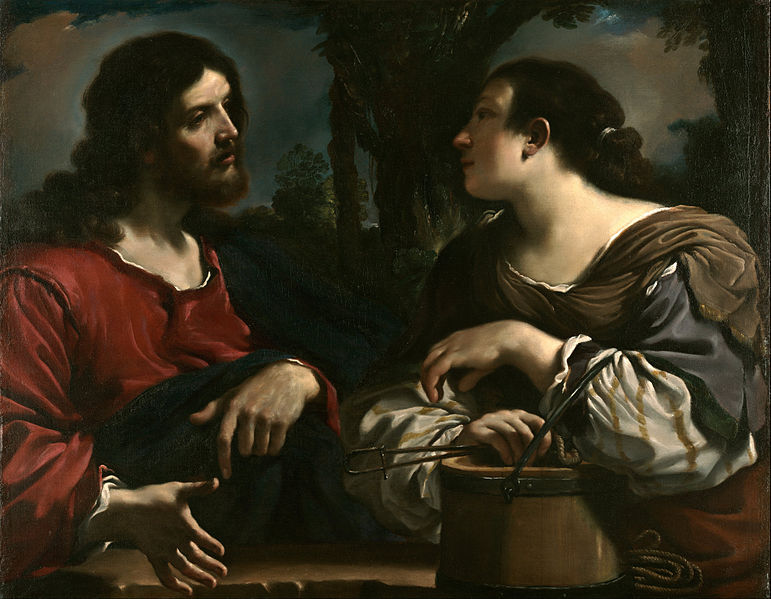
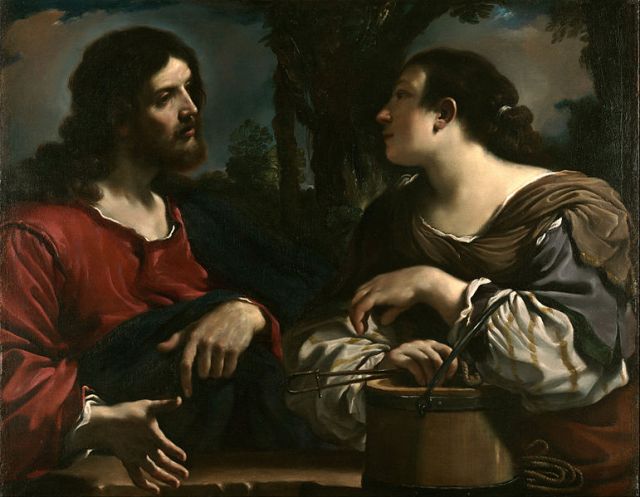
Guercino - Christ and the Woman of Samaria

Guercino – Christ and the Woman of Samaria

Last night I posted some of my comments on chapters 1 and 2 of John in the continuing #Luke2Acts Twitter Bible study. The following are more condensed notes on John 3 to 13.


JOHN 3

I’ve addressed the theme of new birth in the gospel of John at length in a recent post (of a piece I wrote several years ago). As I tackle John 3 in some detail there, I won’t repeat myself again here.

I wonder whether Nicodemus’ question in verse 4 was serious rather than facetious, depending on the relationship between the mother’s womb and the earth, which we see in the parallel between the judgments upon the man and the woman in Genesis 3, in Job 1:21, Psalm 139:13-15, and Isaiah 26:19. It might also be worth reflecting upon the fact that themes of new birth are prominent in the Exodus narrative. The new Exodus that Jesus will accomplish is also a new birth, as we see in John 16:21.

Within covenant history there are a number of cycles of wombs and birth. After arriving at this conviction myself, I was unsurprised to discover that James Jordan beat me to it and that he had developed certain parts of the picture that I hadn’t. Jordan suggests that there is a four-stage pattern to be observed:

Now, children are also nursing, not eating and drinking, when they are first born. Yet, they are not weaned until they stop nursing, which comes later then when they first start to eat and drink. If we look at covenant history, we can also see that this phase also occurs. For the sake of convenience, we shall call the time before a child begins to eat and drink the time of swaddling, and the time after he starts to eat and drink but before he stops nursing the time of weaning. Thus, there are four phases:

1. Womb, while the child is being prepared for birth.

2. Swaddling, while the child is still getting everything from his mother and needs to be held and coddled.

3. Weaning, while the child still needs to nurse, but is also eating and drinking from sources outside his mother.

4. Full separation from the womb, when the child is fully weaned and receives all his food and drink from outside his mother.

Consider that even after God moves His people fully into a new world after a swaddling time, He continues to nurse them with special “old” provisions. The exodus from Egypt provides the most obvious analogy. After exiting the womb of Egypt we were swaddled and nursed by God’s miraculous care in the wilderness and then sent into the land. But even after we entered the land, God continued to provide some miracles during the Conquest until we were fully ready to stop nursing from Him. Then the miracles ceased.

There are periods in covenant history when the people of God have to enter into the womb in order to be reborn. The family of Jacob had to go down into the womb of Egypt in order to be reborn as a nation in the Exodus. The people that came out of the womb of Egypt were very different from those who had entered. Periods of swaddling are also very significant. The Garden of Eden was a swaddling period for humanity, for instance, a sort of swaddling period for the human race. Jesus’ ministry is a preparation for the birth of a new humanity.

‘You must be born again’—‘You’ here is plural. Nicodemus is the teacher of Israel and it is Israel as a nation that must be resurrected. While individual persons must participate in this resurrection, it is important to appreciate that the new birth that Jesus is referring to is an event in covenant history, rather than just a private experience in the human soul.

Notice the parallel between John 3:8 and 8:14. As the Spirit is, so is Jesus, the Man born of the Spirit. Jesus is the first to be born again, the first to return to the womb of mother earth and be raised again, firstborn of the dead.

In verse 14, Jesus relates his death to the events of Numbers 21:4-9. The connection between the two events is worth reflecting upon. The Numbers passage occurs within the context of the Exodus, when Moses raised up the bronze serpent in order that the Israelites, who were being bitten by fiery serpents on account of their rebellion, could look at the bronze serpent and be healed. What exactly the bronze serpent was is unclear, although I think that there is reason to believe that it may have been an image of a winged seraph (in Revelation the serpent is related to the dragon). The serpent on the pole was probably also related to the earlier signs of Moses’ and Aaron’s rods in the Exodus narrative (Exodus 4:2-5; 7:8-13).

In the LXX of the Numbers account, the serpent is stood upon a ‘sign’ (σημειον—or standard). For John, Jesus’ cross plays a similar role. Jesus is raised up as a ‘sign’ (σημειον) and, as people look to him (in faith), they will be healed (cf. John 19:37; Zechariah 12:10). It might also play off the Isaianic background of texts such as Isaiah 49:22 and 52:13. Throughout John’s gospel, the cross is presented as a ‘lifting up’ of Jesus, a sort of ascension event (cf. 8:28; 12:32-34). In fact, Jesus’ ministry and death is a progressive movement upward: up to Jerusalem, up to the cross, up from the grave, up to heaven.

Jesus doesn’t just compare himself to the elevated serpent, but to the serpent which Moses lifted up in the wilderness. Beyond the comparison between Jesus and the bronze serpent, there is also an implicit reiteration of the relationship between Moses and Jesus here. Moses, who bore witness to Christ’s glory, also typologically raised him as a symbol to the people. The mention of the wilderness might also be significant. The wilderness was the staging ground for the new exodus, as we have already seen in John the Witness’ description of himself as a voice crying in the wilderness (1:23). It will be within this wilderness that Christ will be raised up for the people. The Isaianic references to God’s raising a standard as part of the new exodus may be a dimension of the background here (Isaiah 49:22; 59:19; 62:10).

More generally, the vertical polarity between above and below, heaven and earth is quite pronounced within this chapter and meshes with the Spirit-flesh polarity in various ways. Note the themes of water, purification, and a wedding, which were also present in the previous chapter (v.29). Also light and witness from the first chapter. Night and day, darkness and light are key themes in John’s gospel. The old covenant was a period of faithfulness in darkness, but the light arrives in Christ, revealing all. Are we drawn to the light or do we want to hide in the shadows (vv.19-21)?

Baptisms were performed in Jesus’ name by his disciples (v.23), but presumably not by Jesus himself (4:2). His baptizing work would not occur until the Day of Pentecost.


JOHN 4

This Jerome Neyrey article on meeting the woman at the well is superb for grappling with cultural background. I’ve also touched on the chapter in the following posts: ‘The Politics of Exposure’, ‘The Whore and the Bible’, ‘The Cup of the Adulteress’.

Meeting with women at wells is a familiar OT theme. Isaac, Jacob, and Moses’ wives were all first encountered at wells (Genesis 24, 29, Exodus 2). Marital themes are an important part of this passage. Once again, notice that the giving of water is a theme, as is everlasting life.

‘The hour is coming’—the coming hour is a familiar refrain within the gospel of John.

The ‘true worshippers’: throughout John’s gospel reference is made to the ‘true X’ (1:9; 4:23; 6:32; 15:1) and to the ‘truth’. In Christ, the genuine article has arrived, the epitome, the culmination, of all of the things anticipated in the OT. The true worshippers will worship the Father in the Spirit and in the Truth (Christ). Jesus speaks of a new form of worship that will come, whose location isn’t that mountain or Jerusalem, but in the True Temple of the Spirit, the body of Christ. Worship in Spirit and in Truth is more than ‘really meaningful and heartfelt’ worship: it is a reference to a new manner of worshipping God, no longer geographically bound to the Temple at Jerusalem, but occurring in the environment of the Spirit. This new form of worship arrives through Christ’s death and resurrection and exists because he is the true tabernacle and temple of God.

Jesus’ statement about his food in verse 34 is reminiscent of his response to the first temptation in Luke. Verse 44 also seems to allude to Jesus’ sermon in Nazareth after his temptations in Luke 4.

In verse 6, we read that it is the ‘sixth hour’. In verse 21, we are told that ‘the hour is coming’. Finally, in verse 52, the fever leaves the nobleman’s son in the ‘seventh hour’. Come the hour, come the man. Note that the woman has had five husbands and another man who isn’t her husband (cf. Revelation 17:10). Jesus, the man who is coming (v.25) and now has come (v.26), is the seventh man in the sequence, the promised Messiah.

The healing of the nobleman’s son is the second of Jesus’ signs. It involves healing from a long distance in the seventh hour for a (quite possibly disliked) royal official. It reveals the power of Jesus’ word and is performed in the same location as his first sign (v.46; cf. 2:1). Jesus’ statement in verse 48 ties in with the gospel’s distinction between faith based upon signs and seeing and faith based upon hearing, something which culminates in Thomas. Jesus’ rebuff is addressed more broadly (‘you’ is plural), expressing frustration with the crowd’s dependence upon signs-faith and calling them to something deeper.


JOHN 5

The particular ‘feast’ in question isn’t specified (5:1). The main point is that Jesus is in Jerusalem again. Note that the theme of water and cleansing continues. Chapter 1: John’s Baptism; chapter 2: water to wine; chapter 3: new birth of water and Spirit; chapter 4: meeting at the well and offer of living water; chapter 5: healing at the Bethesda pool.

The people are gathered near the Sheep Gate (Jesus will later refer to himself as the door of the sheep—10:7), waiting for the water of the pool to be stirred by an angel (making it living water). The stirring of the water might be akin to be wind of the Spirit in Gen 1:2, at the flood (Gen 8:1), or the Red Sea (Ex 14:21; see Psalm 77:16 [LXX 76:17] too). The setting is evocative: infirm ‘sheep’ at a pool, struggling to get to the water. Moses was the great shepherd of Israel (e.g. Psalm 77:20; Isaiah 63:11-12), yet Jesus is greater still.

The man had an infirmity for 38 years. This is a highly significant number: Israel wandered for 38 years after their failure to enter into the land (Deuteronomy 2:14). The lameness of the man may well have entailed some degree of exclusion from the precincts of the Temple (cf. 2 Samuel 5:8; Acts 3:1-10). The healing of the man is a sign of giving the languishing flock of God entrance into the Promised Land. Jesus—Joshua—gives rest to the man, who takes up his bed, his ‘instrument’ of rest, as a sign, and later enters into the Temple. For this, Jesus is accused of breaking the Sabbath, when he actually was fulfilling its meaning.

Jesus’ works are like his Father’s and he completes the works of his Father. Jesus continues and completes the act of creation. His claims in this chapter are startling. He enjoys judgment, the power to raise the dead, life in himself, and divine works. Resurrection is already underway in the present (5:25), fulfilling the Sabbath and anticipating new creation.

Jesus is witnessed to by John, the divine works given to him by the Father, the Father himself, and the Scriptures.


JOHN 6

John connects Jesus’ actions to the timing of Jewish feasts at various points. Here it is Passover (v.4). Jesus crosses the Sea, followed by a multitude and goes to the mountain, which he ascends and sits down on with his disciples (cf. Exodus 24:9). There is a food crisis, as there isn’t enough food to feed the multitude (v.5; cf. Exodus 16:3), a crisis answered by miraculous provision (vv.10-13; cf. Exodus 16:4ff.). The fact that Jesus proceeds to talk about the manna in the wilderness in the discourse that follows strengthens the Mosaic connection, as does the Passover context, and the suggestion that Jesus is the prophesied Prophet like Moses (v.14; cf. Deuteronomy 18:15-19).

The gospels frequently speak in terms of ‘the mountain’ (cf. vv.3, 15) but don’t make clear its identity, as does the OT. In its non-specified particularity, ‘the mountain’ has a sort of symbolic force, gathering all of the great mountain themes of Scripture upon itself.

The feeding of the five thousand is one of the only events recorded in all of the four gospels. I’ve commented on Luke’s version of the story here and here. The differences between the accounts are worth attending to. For instance, Luke doesn’t mention a mountain, but speaks of a deserted place (Luke 9:10). The mountain in Luke’s account is the mountain comes later: the Mount of Transfiguration (9:28-36). John’s account is also alone in mentioning the grass in the place (John 6:10), a detail that might accentuate certain themes of the passage and book, as we will see later.

Jesus’ action in taking, blessing, and distributing the loaves is similar to that of the Supper (v.11). There is no institution of the Supper in John’s gospel and this account and the discourse that follows takes its place in many respects. Note that each of the gospels give significance to the numbers: five loaves, two fish, twelve baskets of fragments. Notice that the feeding of the five thousand is the fourth sign in John’s gospel.

God is the one who walks upon the waters (Psalm 77:16-19), in an action associated with the Exodus, further strengthening the Exodus themes of the chapter (note the presence of a strong wind in Exodus 14:21). Jesus’ walking upon the sea—probably his fourth sign—connects him to God’s own power over the elements in his great acts of deliverance. The statement that the boat ‘immediately’ arrived at the land where they were going might also suggest a miraculous occurrence, similar to the acts of Spirit teleportation that we see in the OT, not least in the book of Ezekiel (Ezekiel 3:14; 8:3; 11:1; etc.). The great wind that was blowing might be the same wind associated with theophanic appearances of God in the OT, the wind of God’s throne chariot (e.g. Psalm 18:10; 104:3), just as the throne chariot is associated with the teleportation. Jesus functions like the throne chariot of God.

Christ is the ‘true’ bread from heaven. He fulfils the manna, the sacrifices (the ‘bread of God’—Leviticus 21:6), the tree of life (eating and living forever), and the Passover.

The Father entrusts people to the safe-keeping of the Son, a relationship that is explored at various points in John’s gospel.

We have life as we eat the flesh and drink the blood of the Son of Man. Familiar claim, yet still startling. Jesus makes two incredible claims here: 1. He came down from heaven; 2. We must eat his flesh and drink his blood to have life. The first claim will be demonstrated when he ascends to the place where he was before (v.62). The second claim needs to be understood in terms of the work of the Spirit, not mere physical power (flesh). Christ’s person and words bring Spirit and life.

This teaching may mark a watershed in the gospel. Jesus has passed ‘peak popularity’ and now disciples start to leave.


JOHN 7

Like his mother earlier, but from different and unbelieving motives, Jesus’ brothers request signs from him (verses 3-4). They seem to desire a prematurely open sign and demonstration of Jesus’ power, rather than recognizing God’s timing. John 7 has themes of hiddenness and openness. Against his brothers’ request Jesus goes secretly to the feast, then reveals himself.

If circumcision—removing a small part of a bodily member—superseded Sabbath, why not making entire body whole (v.23)? The healing of the man in John 5 still seems to be in view here.

The origins of the Messiah are supposed to hidden, but Christ’s are known. However, even though Jesus has made his origins known to them (in the previous chapter, for instance), they remain hidden. Jesus’ origins are ‘known’ yet hidden (vv.26-29).

The declaration of verses 37-39 is generally connected with the water-drawing ceremony of the Feast of Tabernacles. The invitation for the thirsty to come and drink recalls the conversation with the woman of Samaria and Isaiah 55:1. Notice the development from 4:14—a fountain of water springing up—to 7:38—rivers of living water flowing out. The rivers of living waters flowing out from the heart presents the heart of the Christian believer as akin to the Garden of Eden (Genesis 2:10), the new temple of Ezekiel 47, and the throne of God in Revelation 22:1. Our body is the temple of the Spirit, in which God dwells and from which life flows. Of course, as the new temple (2:19-21), Christ is the first one from whom living water flows (cf. 19:34). Then we are made like him.

For the second time in two chapters (6:14; 7:40), Jesus is connected with the promised Prophet like Moses (Deuteronomy 18:15,18). The dispute among the people about the origins of Jesus at the end of the chapter sheds light back on verses 25-29.


JOHN 8

7:53—8:11 is not present in many of the earliest manuscripts. What are we to do with it? While there are arguably some Johannine themes, on the surface of things, I think that it would be a neater fit with the themes and style of Luke’s gospel (although I don’t believe that it is Lukan). Although not present in all of the oldest versions, this passage has been received by the Church from fairly early on and I believe that it is an authentic tradition. I am inclined to treat the text as if it were an orphan that has, through God’s providence, been taken into the house of John’s text, without coming from it. I treat it as Scripture. However, I would be wary of making a decisive theological argument on its basis and highlight the doubts over its ‘paternity’ whenever I speak about it. That said, if I were preaching through John, I wouldn’t skip the passage and would be prepared to devote a whole sermon to it. I believe that it should be left where it is, albeit in brackets, or with some other indication of its questioned origins.

I’ve commented on the story of the woman caught in adultery here and here. The scribes and Pharisees seek to trap Jesus in his words, much as when Jesus taught in the temple in the final chapters of Luke. The scribes are only mentioned here in John and the movement between the temple and the Mount of Olives is only mentioned here in John. The attempts of the scribes and Pharisees to trap Jesus in his words and Jesus’ shrewd question in response is also similar to passages from Jesus’ teaching in Jerusalem in the Synoptics. My suspicion is that this records an authentic tradition concerning Jesus, but wasn’t written by the author of the gospel.

Jesus’ point in challenging the scribes and Pharisees is not that the death penalty is wrong per se, but that the death penalty could only be unjustly exercised under the current circumstances. Every one of the ‘witnesses’ is somehow compromised, whether in a conspiracy of entrapment (where’s the man?), or through their own guilt of the same sin. There may well be an implicit challenge to the scribes and Pharisees’ sexual licence here, as in Luke 16:14-18.

The first stone is important in a number of respects. 1. As Girard observes, it is the first stone that sets the pattern for all others. Each successive stone is easier to throw. 2. The first stones were to be cast by witnesses (Deuteronomy 17:7). These witnesses were subject to the same penalty themselves if they sinned in their judgment. If no one could cast the first stone, then no execution could occur. Where there were no witnesses in a case of adultery, the jealousy test applied.

The verses that follow return to John’s themes of judgment and witness. Jesus refers to his crucifixion as being ‘lifted up’ again (8:28): as I’ve already observed, crucifixion is presented as a mini-ascension.

As in Luke and the Pauline epistles, the question of the identity of the true sons of Abraham is important in John (vv.30-59). Jesus addresses the Pharisees as those who were only slaves in the house of Abraham, who would one day be removed (v.35). They are children of the devil, seed of the serpent, a brood of vipers (cf. Genesis 3:15). Who is our true father? The one we take after. The logic of verse 42 is very similar to logic employed in the epistle of 1 John, for instance 5:1. Jesus’ argument about slaves and sons in the house of Abraham is like Paul’s allegory of Hagar and Sarah in Galatians 4.

The Pharisees may be insinuating that Jesus is a bastard child of a Samaritan (vv.41, 48), as the Samaritans challenged the Jews’ claim to be the exclusive descendants of Abraham. Also notice that the Samaritans received Jesus earlier.

4:12—‘Are you greater than our father Jacob?’ 8:53—‘Are you greater than our father Abraham?’ Yes and yes.

‘Your father Abraham rejoiced to see My day, and he saw it and was glad.’ When? Possibly in the vision of Genesis 15. However, Jesus may also be referring to Abraham’s encounters with the divine Angel of YHWH in Genesis 18-19 and 22. This is a very important theme in John’s gospel. The great appearances of God to his people in the OT are all Christ. Christ is the vision of God Moses had on Mount Sinai (1:14-18). Christ is Jacob’s ladder at Bethel (1:51). Christ is the appearances to Abraham (8:56). Christ was the glorious vision of YHWH that Isaiah saw in the temple in Isaiah 6 (12:41). Christ is the great I AM (Exodus 3:13-14). Not only is Christ the One through whom all things were created, he is also the One who has been active throughout all of Israel’s history, now made flesh and dwelling among us.

As Jesus claimed to be God himself, it was not surprising that they tried to execute him. John 8 both begins and ends with failed attempts at stoning.


JOHN 9

Much of my treatment of this passage will be from my memory Leithart’s stellar treatment of the passage in Deep Exegesis.

Jesus once again declares himself to be the light of the world (1:5, 9; 3:19; 8:12; 12:35, 46). The mode of the healing is bizarre: Jesus spits on the ground, makes clay, ‘anoints’ the eyes of the blind man with the clay, then sends him to wash in the pool of Siloam. The parallel with the story of Elisha’s healing of Naaman the Syrian (2 Kings 5) should come to mind. Sent to wash and healed, without seeing the one healing him.

The forming of clay from the ground is reminiscent of the creation of man in Genesis 2:7. Leithart raises the possibility that spitting is connected with water and the Spirit/wind/breath. The reference to anointing and the opening of eyes through washing in the pool is suggestive of baptism. In Acts 9, Saul of Tarsus also receives his sight back in connection with baptism.

The ‘translation’ of the name of the pool of Siloam isn’t so much a translation as an interpretation of the meaning of the word.

The story of the healing of the blind man echoes that of the healing of the lame man in chapter 5. Both have had their condition for a long time, both stories involve a healing pool, both take place on the Sabbath, both lead to conflict with the Jews.

In John 3, Jesus talks about the need to be born again of water and the Spirit to see the kingdom of God. This healing shows that truth in action. The man’s birth is repeatedly referred to (vv.1, 19-20, 32, 34). After his healing, people fail to recognize him. He has become as a new person, been reborn through his anointing and baptism. The blind man is a model disciple and a pattern for the later Church. He is baptized and illumined, but cannot see Jesus. He bears faithful and bold witness to the Pharisees, who cast him out of the synagogue. Then Jesus comes again and he worships him.

Light and eyes go together, as we saw in Luke: the eyes are the lamp of the body. The person with a good eye is illumined in the entirety of their person. The blind man, who can ‘see’ Jesus (though still not physically seeing him) is one such person. The blind man is the perfect example of the blessed person who has not seen yet has believed (20:29).

The story of John 9 is about giving sight to the blind and about striking blind those who refuse to see (verse 39). The formerly blind man is tested by the Jews, who want to silence his witness. He responds with bewildered sarcasm (v.30). The blindness of the Pharisees is astonishing to him. He still hasn’t even seen Jesus, but just trusted and obeyed his voice.

As this is probably still the Feast of Tabernacles, Jesus’ identification of himself as the light of the world was appropriate. The Feast would have involved dramatic lights in the Temple in a culture without much nocturnal lighting.


JOHN 10

John 10 shouldn’t be detached from that which precedes it: it’s still a response to Pharisees after the healing of the blind man.

The imagery of sheep and shepherding comes to the surface here. However, it is found throughout the gospel, from chapter 1 where Jesus is the Lamb to chapter 21, where Jesus tells Peter to feed his sheep. Here he is the shepherd and door.

The biblical background of shepherd imagery is immensely important here. Israel descended from shepherds. The great leaders of the nation—Moses and David—were shepherds, both literally and symbolically. See also passages such as Ezekiel 34 and Jeremiah 23:1-4. Of course, God was also described as the Shepherd of his people (Psalm 23).

Jesus is alluding to verses such as Micah 2:12-13, where God’s flock is gathered together then led out through the gate. ‘He calls his own sheep by name and leads them out’—Perhaps an image of Exodus. Remember that the Exodus was the leading of a flock out of Egypt with the rod of the shepherd Moses (cf. Isaiah 63:11-12; Psalm 77:20) and the striking of the false shepherd, Pharaoh (Exodus 2:16—3:1 is an anticipation of Moses’ later work).

The shepherd imagery here should help us better understand chapters 5 and 6. In chapter 5, Jesus meets the lame man near the Sheep Gate, bringing him back into the Temple fold of Israel. Jesus here describes himself as the true door for the sheep. In chapter 6, Jesus leads a large multitude out like a flock, across the sea, and provides them with food. Notice the strange detail in 6:10: ‘there was much grass in the place.’ Why point it out? 10:9 suggests an answer: ‘he will be saved and will go in and out and find pasture.’

Who is the doorkeeper/watchman in v.3? This probably refers to the faithful leader of the people, in contrast to the Pharisees.

The biblical imagery of the shepherd is fairly rough and violent, not like our understanding of shepherds. The shepherd is described as figure who struggles with wolves, wild beasts, thieves and bandits, and with the perils of the wilderness. He is associated with death, conflict, and difficulty. I’ve written on this here. We need to measure our concepts of ‘pastoral’ ministry against biblical models. Is your pastor good in conflict and struggle, able to drive off wolves, protect the flock, and give safe and good pasture? Is your pastor prepared to suffer hardship and die for the sake of the flock? The flock is in dangerous territory and we need tough and dedicated people as shepherds.

Notice the allusion to Numbers 27:16-17 and the appointing of Joshua as Moses’ replacement in the reference to coming in and going out.

One of the primary points of this section is to highlight the intimate relationship between sheep and shepherd. The sheep have been given into Christ’s hand by his Father. He calls them all by name. They know and respond to his voice. Mary Magdalene is a great example of this in 20:16. It is when Jesus calls her by name that she recognizes his voice. Notice also the connection with 5:25. The dead ‘will hear the voice of the Son of God; and those who hear will live.’ Lazarus is a further example in 11:43-44: even the grave cannot prevent the sheep from hearing their Shepherd’s voice.

Laying down life for sheep pushes the image of risking life for the flock to its limits. However, Jesus also takes up life again. Jesus brings Gentile sheep too, forming one new flock of both Jews and Gentiles. The Church is in view in this imagery.

It is profoundly encouraging to reflect upon the fact that the Father commits us as his sheep into the hands of his Son, the Shepherd. No predator can snatch us from his protection, nor from that of the Father. Nothing can separate us from the love of God in Christ.

Jesus argues from the lesser to the greater in 10:33-38. If God can speak of human beings as ‘gods’ (Psalm 82), how much more the Son that he sanctified and sent into the world and to whom he granted testifying works! The reference to actual ‘gods’ apart from God in Scripture refer to great judges and rulers of the nations, human and angelic.


JOHN 11

The raising of Lazarus is probably the seventh sign of the gospel. 1. Water to wine. 2. Raised nobleman’s son. 3. Healing of the paralytic. 4. Feeding of 5,000. 5. Walking on the sea. 6. Healing of the man blind from birth. 7. Raising of Lazarus. Is there a possible allusion to the creation week? Signs 5-7 fit very well. The others, not so well.

Verses 1-2 are interesting. Do they presume that the readers have some knowledge of Mary and Martha already? From where? They also anticipate the story of 12:1-8. The connection of the two stories seems significant.

‘He whom you love is sick’—Ben Witherington, in an appealing theory, argues that Lazarus was the ‘disciple Jesus loved’ and the primary author of the gospel. Read his theory here. Worth thinking about as a possibility. It would certainly help to explain a number of interesting details.

The sickness is ‘for the glory of God, that the Son of God may be glorified through it’ (v.4). Not just by the demonstration of his power as a miracle worker, but because the raising of Lazarus precipitates events leading to Jesus’ own death.

Lazarus is inactive. The focus is upon his sisters and their faith. Jesus delays, probably so that the miracle will be more noteworthy when it occurs. The disciples know that returning to Judea was a very risky thing to do and would likely lead to death (verse 16). Knowing the geography, Lazarus had probably already died by the time that news of his sickness had reached Jesus.

Jesus doesn’t enter the town, but Martha goes out to meet him and then later secretly tells Mary (vv.20, 28, 30). They probably knew that Jesus’ life was sought by the Judeans and wanted to keep his presence discreet. Martha makes a dramatic statement of faith in verses 21-22. Verse 25-26 is another one of the great ‘I am’ sayings of the gospel. Martha’s response of faith in verse 27 to Jesus’ statement is striking under the circumstances.

The first sign (water to wine) and the last sign (raising of Lazarus) have some interesting parallels. Both involve a reference to the glory of God (2:11; 11:4, 40). Both are key moments leading to Jesus’ death: the first sign is the first step; the seventh is the climactic step. Both involve a response to the request of a woman who loves him, first seemingly rebuffed then answered in response to a persistent faith.

Jesus weeps, entering into the grief of the occasion, despite knowing that he will raise Lazarus. In Jesus’ response in verses 33 and 38 there is a sense of anger and the troubling of his spirit that he experiences approaching his own death (12:27; 13:21). He enters into their grief, but seems to be angry at their unbelief.

There are some comparisons between the portrayal of Lazarus’ tomb and burial and that of Jesus (women grieving, a stone, wrappings). There are also contrasts. The stone is moved for Lazarus and he comes out wearing the graveclothes.

Jesus prays openly to the Father, so that when the miracle occurs, it will serve as a direct confirmation of his authority. Calling out to Lazarus with a loud voice should remind us of the sheep hearing the Shepherd’s voice calling them out (10:3) and of the dead being raised by the voice of the Son of God in 5:24-30. This sign demonstrates Jesus’ power over death.

In the light of AD70, the Jews’ fear that Jesus will lead to their loss of their ‘place and nation’ to the Romans is ironic. They seek to prevent Jesus working signs but, by conspiring towards his death, prepare for the greatest sign of all.

Jesus’ raising of Lazarus leads towards his own death. He lays down his life for his friend. And not just his friend but, as Caiaphas unwittingly prophesies, all the children of God, from every nation.


JOHN 12

John 11:2 mentions the events of 12:1-8 before they occur, connecting the story of the raising of Lazarus with this. The stench of Lazarus’ dead body is mentioned in 11:39. In 12:1-8, Lazarus’ sister pours out fragrant oil upon a living person.

Mary’s act takes the form of the most profound devotion. Notice that it occurs in the chapter immediately before Jesus washes his disciples’ feet. Mary’s radical act of service anticipates and prepares for Jesus’ own radical act of service.

The house was filled with the fragrance. I would suggest that that is a reference back to Isaiah 6:4. The ‘smoke’ mentioned there is probably the fragrant smoke of incense, filling the temple (such an understanding is evidenced in the Syrian tradition, for instance).

Martha serves, but Mary is known by her love and her devoted presence at Jesus’ feet, as in Luke 10:38-42. Both here and in the following chapter, a disciple seeks to prevent the radical act of service. Judas here, Peter next chapter. This account frames two acts in sharp juxtaposition: Mary’s loving service and faith and Judas’ betrayal and wickedness. Judas’ love of money is introduced at this point. A significant detail, partly explaining his later motivations. The cost of the oil would have been more than many women would have inherited. This was a most remarkable act.

Jesus was ‘anointed for his burial’. It was a preparation for death and also had overtones of a coronation. In the resurrection these two themes can be reconciled.

Jesus enters Jerusalem on a donkey, in fulfilment of Zechariah’s prophecy (Zechariah 9:9). The disciples don’t yet understand. The gathered multitude is accounted for in large part on account of the spreading word of the raising of Lazarus.

Verse 19 really is a rather comical bad guys moment!

The passing of messages from one disciple to another in verses 20-22 is reminiscent of the end of chapter 1. However, here the movement is towards Jesus, rather than going out to tell others about him. Greeks are being drawn to Jesus. Finally, the hour has come that the Son of Man should be glorified. Jesus’ death is here presented in almost natural terms, as a grain dying and rising to produce much fruit. The arrival of the Greeks seems to serve as a sign that the hour has come. When the nations start to come, he must be lifted up. ‘And I, if I am lifted up from the earth, will draw all peoples to myself’—notice that this is the fulfilment of prophecies typically related to the temple or the mountain of God (Isaiah 2:1-4). The Greeks are the anticipation of what is to come.

There is no mention of the voice from heaven at Jesus’ baptism or on the Mount of Transfiguration in John, but there is one here.

The continued presence of the light is not something that can be taken for granted. It will disappear without warning.

Verse 41 is startling: Isaiah saw Jesus’ glory. This continues the references to OT people who witnessed Christ. Also notice that a possible allusion to Isaiah 6 in verse 3 is strengthened by the connecting context and themes of glory, etc.

Christ’s word isn’t given to judge, but to save. However, if we reject it, it will stand in witness against us at the last day. How sad, to value not being excluded by the Pharisees over confessing the name of Christ (verses 42-43)!


JOHN 13

Matt Colvin has some comments on this passage here.

Notice the many similarities between John 12:1-8 and 13:1-11: a meal before Passover, washing feet, reference to coming death. In the Synoptic gospels, Jesus performs an action symbolizing his death, taking bread and wine in the context of the Passover meal and instituting the Supper. Here Jesus performs a different symbolic action with a similar purpose.

Why does John omit reference to the institution of the Supper? Why does his chronology seem to place the Last Supper before the celebration of the Passover? Perhaps because John wishes to present Jesus as the Passover Lamb (1:29, 36; 19:36). While Luke was all about meals and eating, John has focused upon water and washing. It is not entirely surprising, then, that the symbol of Jesus’ death is a washing action, rather than a meal.

Verses 1-3 presents us with a situation within which all of the key details have become aligned. The scene is fully set. When Jesus knows that the end has come, when he knows that his work had reached its climax, then he gets up and takes the towel. The deliberate manner in which the action is entered into underlines its significance.

The more Jesus is exalted, the more he stoops to serve us. The first thing that Jesus did when he knew that the Father had given all things into his hands (v.3) was to take those hands and use them to wash his disciples’ feet. The costliness of the liquid is stressed in 12:3. Jesus’ washing is achieved with his blood, infinitely more costly.

It was a sign of Jesus’ love for his disciples (‘He loved them to the end’) and of his provision for them. Jesus removes his garments, as they will be removed at his crucifixion and wraps himself in a linen towel, as he will be wrapped in linen cloths at his burial. 10:17-18—Jesus lays down his life to take it up again. 13:4, 12—Jesus lays aside his garments and takes them up again.

The disciples were reclining to eat. Their feet would have been outside of the sphere of conversation and fellowship. Once again, the disciples will only fully understand the meaning of Jesus’ action at a later point.

The washing is absolutely essential. Without Jesus’ act of service for us, we have no part in him. Peter’s objection (like Judas’ in the previous chapter), is an objection to the symbolic action displaying the necessary work of Christ. Judas is headed for betrayal, Peter for denial.

What to make of verse 10? It seems to me that the prior ‘bathing’ that Jesus refers to is baptism, and all that stands for. The feet are the part of the body that come into direct contact with the judgment-bearing dust. The footwashing is more akin to the forgiveness of sins over the course of the Christian life as we continually return to our first washing.

The footwashing isn’t just a symbol of Jesus’ death, but a model to follow. This is the form that our life together should take.

Jesus quotes Psalm 41:9 in speaking of Judas. The psalm itself has interesting resonances. The opening statement—‘blessed is he who considers the poor’—reminds us of Judas’ false concern for the poor (12:6). The psalm then speaks of enemies saying of David that he is lying down never to rise up (Psalm 41:8). Then David prays that God would ‘raise him up’ (verse 10).

John 13:20 is like Luke 9:48 and 10:16.

The beloved disciple in Jesus’ bosom (verse 23), should remind us of the Word in the bosom of the Father (1:18). In both cases we see that a witness is qualified for witness-bearing by virtue of their extremely close relationship with the one to whom they bear witness.

Matt Colvin has an interesting thought on the morsel given to Judas. Satan first puts the plan in the heart of Judas (verse 2), then enters into Judas personally (verse 27).

Much of John’s first epistle is devoted to exploring the meaning of verses 34-35.

Posted in #Luke2Acts, Bible, John, NT, NT Theology, Scripture, Theological | 4 Comments

#Luke2Acts—Some Notes on John 1 and 2

The Marriage Feast At Cana

The Marriage Feast At Cana

The #Luke2Acts study has continued on Twitter over the last couple of weeks (you can see my notes on Luke here). I thought that I would post some notes from chapters 1 and 2 of John. I wasn’t able to say much on these chapters on Twitter, so I thought that I would extensively elaborate on my sparse Twitter notes. Expect notes on the rest of John at some point in the future.


JOHN 1

Both the gospel of Matthew and the gospel of John openly echo the book of Genesis in their introductions. Matthew’s opening—‘the book of the genealogy of Jesus Christ’—is lifted from Genesis 2:4 and 5:1. Peter Leithart writes:

Matthew begins his gospel with an overt quotation from the LXX of Genesis: He is writing the βιβλοσ γενεσεωσ of Jesus, just as Genesis records the βιβλοσ γενεσεωσ of heaven and earth (Gen 2:4) and of Adam (5:1). Matthew follows with a genealogy, like the numerous genealogies of Genesis (4:16-26; 5:1-32; 10:1-32; 11:10-32; 36:1-43), recounts a miraculous birth (cf. Isaac, Jacob) to a dreamer named Joseph.

John 1:1 takes us back further, back to the very beginning, to Genesis 1:1 and the creation of the world. If Matthew wants us to present Jesus against the backdrop of the story of humanity from its origins, John wants us to look back further still, to see the Word as the Creator of all things, the One who was with God and the One who was God.

Just as the first act of creation was the declaration ‘let there be light!’ so the Word is the utterance of God who gives light to all the world. This light, the true Light, enters into the world and the stage is set for a glorious new creation. Creation themes continue throughout the chapter and the book. Leithart and others have suggested that the days mentioned in the first chapter follow the days of the creation (there are various ways of slicing them up).

That the name and vocation of the John the Witness—for John is more witness than baptist in the fourth gospel and the title ‘Baptist’ is never given to him within it—features so prominently in the majestic chords with which the symphony of this gospel begins is evidence of his significance. John the Witness plays a similar part to the other John the Witness, mentioned at the beginning of the book of Revelation (Revelation 1:1-2). The first John the Witness witnesses to and prepares people for the first coming of Christ; the second John the Witness witnesses to and prepares people for the second coming of Christ.

John’s witness within this chapter has a more overtly visionary character than it does in the other gospels. The fourth gospel, alone among the gospels, presents the descent of the Spirit upon Jesus—we are to presume at his baptism—as something that occurs primarily for John’s sake, as a revelatory vision. The parallels with Revelation are interesting here as well:

John 1:32—And John bore witness, saying, “I saw the Spirit descending from heaven like a dove, and He remained upon Him.”

Revelation 21:2—Then I, John, saw the holy city, New Jerusalem, coming down out of heaven from God, prepared as a bride adorned for her husband.

John 1:14-18 displays the importance of the Exodus background for the gospel writers. In a richly evocative statement, within which John encapsulates the fundamental import of his gospel, a number of Exodus themes are alluded to. It is Exodus 33-34 in particular that stands behind John’s text. The specific verb employed in verse 14a is noteworthy as it involves a tabernacle allusion: the presence of the incarnate Word is implicitly compared to the presence of God in the midst of his people in the tabernacle at Sinai (the consonants of the Greek verb also correspond to the Hebrew consonants for the Shekinah glory of God). The reference to the Spirit descending and remaining upon him might also recall Exodus 33:9 and 34:5, where it refers to the descent of YHWH upon the tabernacle or Sinai in the cloud. The fundamental imagery in terms of which John frames the incarnation is drawn from the Exodus.

The beholding of the glory of God (v.14b), coupled with the reference to the fact that no one has seen God at any time (v.18a, cf. Exodus 33:20), also suggest an allusion back to the events of Exodus 33 and 34, where God passed before Moses and showed him his glory. The Logos made flesh is described as being ‘full of grace and truth,’ a rough approximation to Exodus 34:6, where God describes himself as ‘abounding in goodness and truth.’ Such an implied parallel relates Christ to God’s revelation of his glory to Moses at Sinai and perhaps by extension to the Angel of the Presence and Glory-Spirit theophanies. This detail would fill out John’s understanding of Christ’s glorious pre-existence and prior activity in the history of Israel (cf. John 8:58; 12:41; 17:5). Christ has been active in Israel’s history all along.

Christ is greater than Moses. Moses witnessed the glory of God and acted as an intermediary for the people of Israel. He gave testimony to the glory of God to the people, as did the Law that was given through him. However, Christ is the glory of God, the One whom Moses witnessed. Through Christ we become like Moses: those who encounter God apart from an intermediary.

The only begotten Son, who is in the bosom of the Father, has declared him. This is an image of surprising intimacy, and one worth reflecting upon. It is most akin to the image of an infant being held by its parent, or even suckled by its mother. The imagery recurs later in the gospel, in 13:23, as the disciple Jesus loved and the author of the gospel reclined in the bosom of Jesus (see also 13:25, 21:20). The association is significant: the extreme intimacy between the Father and the Son qualifies him as the perfect witness-bearer. Likewise, the great intimacy between Jesus and the disciple that he loved qualifies that disciple to bear witness to him in the gospel that we are reading. The imagery is highly unusual for a man and Revelation 1:13 has even more startling imagery, referring to Jesus’ ‘breasts’. It shouldn’t be so surprising to those who know their Bibles, though.

The statements of faith concerning Christ in John 1 are really striking (vv34, 36, 41, 45, 49).

I’ve previously commented on verses 35-51 of this chapter here. Nathanael is called from beneath the fig tree symbolizing Israel. Jesus is here presented as Jacob’s ladder (Genesis 28:12), the connection between heaven and earth (John 1:51). This is the third time that Jesus is either explicitly or implicitly presented in theophanic terms within this chapter. In verses 14-18, Jesus is presented as the glorious revelation of God that Moses witnessed upon Mount Sinai. In verses 32-34, John the Witness sees the Spirit descending and remaining upon Jesus in another theophany. In verse 51, Jesus speaks of yet one more theophany, in which Nathanael will see the angels ascending and descending upon Jesus. Perhaps there is also a progression to be observed here: the first theophany is of the descending Word; the second theophany is of the descending Spirit upon the descended Word; the third theophany is of the angels ascending and descending upon the descended Word upon whom the Spirit rests. In Christ, heaven is coming down to earth.


JOHN 2

Mary is never referred to by name in John’s gospel. She is always ‘Jesus’ mother’ or addressed as ‘woman’. It would be surprising indeed if Mary’s name were unknown to the readers of the gospel, not least because the Beloved Disciple took Mary into his own home (19:25-27). The omission of her name is more likely to be on account of the important symbolic role that she plays.

John 2:1 begins ‘on the third day’. Should we see this as a subtle hint of resurrection themes, especially as the precise numbering of the days seems to be both unnecessary and unclear on the surface level of the narrative? In 2:19 there is another reference to three days.

Jesus’ answer to his mother is distancing: ‘Woman, what is there between us? My hour has not yet come.’ This might imply a few things: 1. Mary must relate to Jesus more as disciple than as his mother; 2. More significantly, Mary does not realize the weight of her request: by prompting Jesus’ first sign her request sets him on the path that leads him towards the cross. Very significantly, he accepts this.

The theme of water and purification is huge in John and recurs several times in the opening chapters. Here the water of the old covenant is replaced by the wine of the new. The new wine is better (cf. Luke 5:39). Over 150 litres of water (now wine) are in the waterpots. It will be a good feast! The master of the banquet would have been different from the host, the bridegroom, and the best man. He would have been chosen by lot, by the hosts, or maybe even by the guests themselves.

The turning of water into wine—thanks to Richard Campeau for alerting me to this!—would also seem to be a pretty strong echo of the first plague upon Egypt, in which the waters were turned to blood. Jesus has already been identified as the Passover Lamb and the scene has been set for a new Exodus. However, rather than performing great acts of de-creation, Jesus’ signs herald a glorious new creation.

The setting—a wedding feast—the bringing of new wine and the statement of the master of the feast may all suggest that this miracle is a sign of the character of Jesus’ work more generally. He is the bridegroom (cf. 3:29). He replaces the water of old covenant with wine of the new. In the wedding feast of God’s kingdom the best comes later.

While the synoptic gospels record temple cleansing in last week of Jesus’ ministry, John records a cleansing at the beginning. I don’t believe that there are two temple cleansings: why has it been moved? First, placing the temple cleansing at this point situates the entire narrative following the first sign under the shadow of the Passion Week. While the other gospels climax in Jerusalem, John is centred upon Jerusalem throughout.

Second, it may serve to introduce a symbolic movement through the temple. John 1 presents Christ as the Ark upon which God’s presence rests, as the lamp of the world, and as the altar from which things ascend and descend between heaven and earth. John 2, in presenting Christ as the temple, introduces us to the structure itself. The next chapters focus upon the laver, with their washing and baptismal themes. In the feeding of the five thousand and manna discourse we reach the table of showbread. Chapter 8-9 bring us to the lamp within the temple. In the high priestly prayer of chapter 17 we see the rite of incense. In Christ’s death he passes through the curtain. In chapter 20 we encounter the open Ark in the Holy of Holies of Christ’s tomb (notice the angels on either side). Presenting the temple action later would disrupt this theological sequence.

Third, in the other gospels, it is in large part the temple cleansing that precipitates the plot to take Jesus’ life (Mark 11:18; Luke 19:47). Note that Jesus’ words in 2:19 are also found in Matthew 26:61 in the trial leading to his death. By moving forward the cleansing of the temple, the threat to Jesus’ life hangs over the entirety of his public ministry. Also this threat reaches its theological climax, less in the temple action than in Jesus’ action in raising his friend, Lazarus (11:45-57). This allows John to frame Jesus’ death less as the consequence of a prophetic action against the institution of the temple than as the consequence of his self-giving love for his disciple and the world more generally.

‘Zeal for your house will eat me up’ (Psalm 69:9). Jesus’ identity and destiny is bound up with the temple. Jesus’ very body is the temple, God tabernacling among us.

The cleansing of the temple is reminiscent of Nehemiah 13:4ff.

Posted in #Luke2Acts, Bible, Exodus, Genesis, John, NT, NT Theology, Theological | 2 Comments

Podcast: Is there a ‘Moral Orthodoxy’?

Mere FidelityThis week’s podcast has just been posted and we have a new name: Mere Fidelity (thanks to Jordan Ballor). This time around Derek Rishmawy, Andrew Wilson, and our guest Matt Lee Anderson are discussing whether there is such a thing as moral orthodoxy. We address the question of the status such issues as same-sex marriage should have in our thinking and the manner in which we should use the term ‘heresy’. Take a listen and leave your thoughts in the comments!

Posted in Audio, Controversies, Ethics, Podcasts, The Blogosphere, Theological | 5 Comments

Podcast: Do Calvinists Worship Another God?

After our first podcast received a positive response, Derek Rishmawy, Andrew Wilson, and I recorded another podcast, this time on the question: Do Calvinists Worship Another God?

We interacted with Fred Sanders’ superb piece, How Not to Fight Calvinists and Zach Hunt’s Dear John (An Open Letter to John Calvin).

Do take a listen and share your thoughts in the comments!

Posted in Audio, Controversies, Podcasts, Theological | 2 Comments