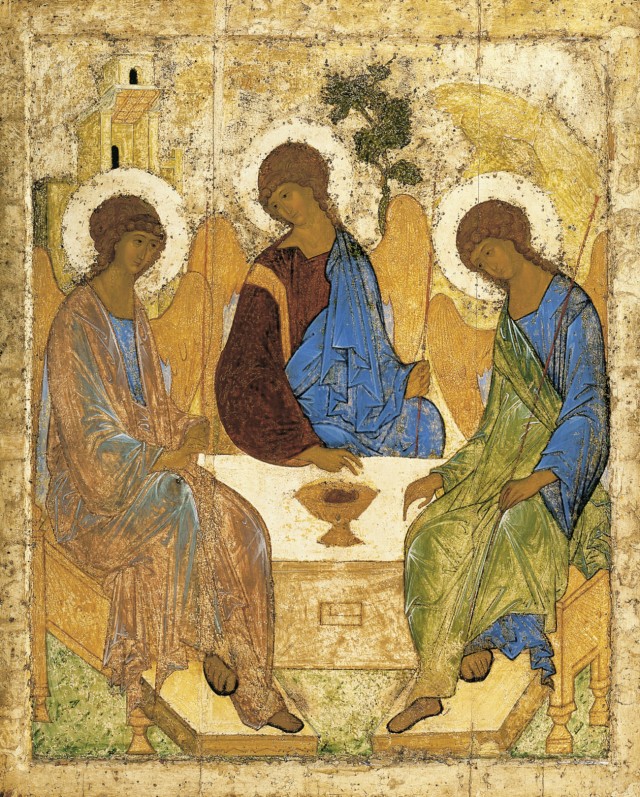
Social Trinity?
Steve Holmes has a post worth reading, reflecting upon the recent book, One God in Three Persons: Unity of Essence, Distinction of Persons, Implications for Life. The book in question seeks to defend the ‘eternal submission of the Son to the Father,’ a controversial theological position that nonetheless plays an important role in many contemporary defences of complementarianism. The book presents an assortment of theological, exegetical, and historical arguments for the position, from a number of writers who advocate various—and occasionally opposing—forms of the doctrine.
Holmes is fairly scathing in his treatment of the book, not merely on account of his principled opposition to complementarianism, but also on account of his theological concerns as a leading Trinitarian scholar (I recommend that anyone interested in Holmes’ perspective on the current state of Trinitarian theology read his book The Quest for the Trinity: The Doctrine of God in Scripture, History and Modernity). He concludes that the arguments—even the chastened ones—advanced in support of the eternal submission of the Son fail beyond recovery. He wonders why the eternal submission of the Son argument has passed through so many iterations, when it has been disproved every time; one would presume that after a few versions the doctrine itself would have been condemned as beyond salvage. I won’t summarize his arguments here: I suggest that you read his post yourself before proceeding with my discussion here.
There are several issues at play in this particular discussion, a number of which many laypersons might unfortunately perceive to belong to the arcane area of Trinitarian theology, a daunting quagmire of abstruse philosophical distinctions better avoided than engaged. Unfavourable as this ground may appear, it is an important site of the theological discussion surrounding gender. I hope that the following points will give readers a better purchase upon this particular discussion and perhaps also upon Trinitarian theology and the debates surrounding it more generally.
Social Trinitarianism
According to an oft-told narrative, Trinitarian theology underwent a revival in the latter half of the twentieth century, after having languished in general neglect for many centuries. A common feature of such narratives of retrieval is the claim that the Western doctrine of the Trinity suffered from taking the oneness of God as its starting point, while the Trinitarian theology of the fourth century Cappadocian Fathers (Basil the Great, Gregory of Nyssa, and Gregory of Nazianzus) more appropriately began with the three persons. For the first—supposedly ‘Western’—approach, the problem was how to account for the three persons. For the second—‘Eastern’—approach, the question was reframed as that of how God could be one.
One of the issues in these debates concerns the meaning of the term ‘person’ as it functions in orthodox Trinitarian formula—one God in three Persons. While it is granted by almost all parties to current debates that the historic theological term does not bear the same meaning that it has in contemporary discourse, ‘social Trinitarians’ use the term in a manner that more closely resembles popular usage. When applied to the Trinity, such language suggests that each of the persons of the Trinity possesses a distinct centre of consciousness, self, will, etc. Social Trinitarianism is a position represented by such figures as John Zizioulas, Jürgen Moltmann, Miroslav Volf, Colin Gunton, and the majority of leading theologians who have addressed the doctrine of the Trinity over the past fifty years.
Social Trinitarians typically articulate the unity of God in terms of community, freely chosen, loving relationship, empathy, mutual belonging, perichoresis/interpenetration, etc. The Trinity is conceived of as the manner in which three distinct yet equally divine selves are bound together in eternal unity. The eternal submission of the Son to the Father, as it is commonly understood, is another instance of such a social conception of the Trinity.
Holmes is a leading figure among those who have firmly criticized this social Trinitarianism, arguing that it departs from and misrepresents the tradition that it claims to retrieve. He writes in the conclusion to The Quest for the Trinity:
…we set out on our own to offer a different, and we believed better, doctrine. We returned to the Scriptures, but we chose (with Tertullian’s Praxeas, Noetus of Smyrna, and Samuel Clarke) to focus exclusively on the New Testament texts, instead of listening to the whole of Scripture with Tertullian, Hippolytus, and Daniel Waterland. We thought about God’s relationship with the creation in the economy, but we chose (with the Valentinians, Arius, and Hegel) to believe that the Son must be the mode of mediation of the Father’s presence to creation, instead of following Irenaeus and Athanasius in proposing God’s ability to mediate his own presence. We tried to understand the divine unity, but we chose (with Eunomius and Socinus) to believe that we could reason adequately about the divine essence, instead of following Basil, Gregory of Nyssa, Augustine, Thomas Aquinas, and John Calvin in asserting divine unknowability. We addressed divine simplicity, and chose (with Socinus and John Biddle) to discard it, rather than following Basil and the rest in affirming it as the heart of Trinitarian doctrine. We thought about Father, Son, and Holy Spirit, but chose (with Sabellius, Arius, and Eunomius) to affirm true personality of each, rather than following Augustine and John of Damascus in believing in one divine personality. We called what we were doing a ‘Trinitarian revival’; future historians might want to ask us why.
A recurring feature of social Trinitarianism is its use of the inner life of the Trinity as a basis for its social vision. Karen Kilby (doc file) observes the way in which social Trinitarianism has been used to justify and support a vast range of ecclesiological, sociological, anthropological, and political projects. Moltmann, for instance, writes: ‘it is not the monarchy of a ruler that corresponds to the triune God; it is the community of men and women, without privileges and without subjugation,’ challenging the hierarchical privileging of a single person that are implicit in many other conceptions of God. The feminist theologian Patricia Wilson-Kastner writes:
Because feminism identifies interrelatedness and mutuality—equal, respectful and nurturing relationships—as the basis of the world as it really is and as it ought to be, we can find no better understanding and image of the divine than that of the perfect and open relationships of love.
The liberation theologian, Leonardo Boff, uses the doctrine of perichoresis to justify a more egalitarian polity. The Orthodox theologian, John Zizioulas, emphasizes the monarchy of the Father to uphold the importance of the episcopal office. Miroslav Volf uses the Trinity to justify a congregationalist ecclesiology. It is within such company that Holmes is placing the complementarian argument about the eternal submission of the Son to the Father.
This is an important point to register for those who might think that Holmes’ objection is simply to the implied hierarchy in the notion that the Son is eternally subordinate to the Father. Although that is a claim to which he strongly objects, his argument rests more heavily upon the theological claim that, if we hold to a single divine will and ‘inseparable divine operations’, we cannot meaningfully speak of ‘submission’ and ‘authority’ as such terms imply relations between distinct subjects or selves with distinct wills. This claim, it should be noted, also strikes at the root of many favoured social Trinitarian arguments for egalitarianism and feminism.
Inseparable Operations, Immanent and Economic Trinity
One of the points that Holmes emphasizes in his critique is the doctrine of inseparable operations. This doctrine is related to the doctrine of divine simplicity, which teaches that God is not made up of parts. For instance, God doesn’t have qualities such as love as a set of characteristics: rather, God is love. The doctrine of divine simplicity also maintains that God’s actions are inseparable, an inseparability that Holmes argues arises from the ‘single simple event’ of the eternal divine relations. Although there is a proper ordering (taxis) to the eternal divine relations—the Son is begotten by the Father, the Son does not beget the Father, etc.—these relations don’t arise from a sort of sequence of successive events, nor can the persons be thought of as if they, logically or otherwise, preceded their relations (another corollary of divine simplicity).
A further important theological distinction to introduce here is that between the ‘immanent’ and the ‘economic’ Trinity, between God as he is in himself and God as he is revealed in his work in creation and redemption. The claim of God’s simplicity has implications not only for our account of the immanent Trinity, but also for our account of the economic Trinity. Because God is one God with one will, everything that God does is inseparably done by Father, Son, and Spirit, and not just as a team of human persons might willingly work in concert with each other. Every action of God is indivisibly an act of Father, Son, and Spirit, acting according to the order of the eternal divine relations. The incarnation is the act of Father, Spirit, and Son, even though it is only the Son who puts on flesh: it is the undivided action of the one God.
The economic Trinity is the earthly image of the immanent Trinity. It is through God’s action in the world, and especially in the incarnation, that he reveals who he is in himself. Within the gospels we see Christ being obedient to his Father’s command. The form that Christ’s eternal Sonship takes under the conditions of our human flesh is this obedience to his Father’s command. However, although the eternal order or taxis of the divine relations makes it appropriate for the Son, rather than the Father, to become incarnate, the inseparability of divine action—God is one God with one will—makes it inappropriate for us to understand the relation of the second person to the first person of the Trinity as one of submission to authority.
The Problem with Projections, Archetypal and Ectypal Theology
The critics of social Trinitarianism typically remark upon the degree of projection that occurs within it. The danger of projection—of unwittingly or wittingly importing our ideological prejudices into what we are studying and misrecognizing them as arising from the matters that we are studying themselves—is one that is frequently highlighted in various contexts of theology. Ludwig Feuerbach argued that God was a projection of humanity’s nature that humanity mistook for other. Albert Schweitzer supposedly characterized the Jesus questers that preceded him as people who looked down a deep well and saw their own reflection. Karl Barth challenged his contemporaries, insisting that ‘one cannot speak of God simply by speaking of man in a loud voice’. Social Trinitarians seem to have a related problem: the God that they speak of always seems to have the sort of inner life that underwrites their sociological or ecclesiological prejudices.
Karen Kilby helpfully highlights what is especially ‘distinctive and problematic’ about the part that projection typically plays in social Trinitarianism. She argues that social Trinitarianism as it generally operates has to be projectionist. Social Trinitarianism’s question of what binds the three persons of the Trinity together as one doesn’t find any clear answer in the Scripture. The ‘something’ that binds the persons of the Trinity together is called the divine perichoresis. This divine perichoresis is then given content by comparing it to the things that bind humans together: ‘interrelatedness, love, empathy, mutual accord, mutual giving and so on.’
She goes on to observe:
Anselm, in formulating his doctrine of atonement, famously drew on feudal concepts of honour and justice. So one can say, to some degree at least he projected contemporary concepts and ideals onto God. And, one might want to argue, in so doing his theology may have served to legitimate and reinforce those very ideas and the corresponding social structures. But suppose Anselm had gone on to say that the main relevance of the doctrine of the atonement, the new and important thing that it teaches us, is that at the very heart of God is the notion of honour: it teaches us that God is all about honour and what is due to one’s honour, and that we too must in various ways make these concepts central to our lives. If Anselm had, in other words, trumpeted as the most important thing about the doctrine those very concepts which he himself had imported to solve the intellectual difficulty posed by it, if he had said, these concepts are the heart of the doctrine, they are what we must learn about God and ourselves from the doctrine of the atonement, then, I think, he would have been doing a very different, and a much more worrying, kind of theology.
Projection, then, is particularly problematic in at least some social theories of the Trinity because what is projected onto God is immediately reflected back onto the world, and this reverse projection is said to be what is in fact important about the doctrine.
Social Trinitarianism, Kilby argues, tends to employ a ‘three stage process’:
First, a concept, perichoresis, is used to name what is not understood, to name whatever it is that makes the three Persons one. Secondly, the concept is filled out rather suggestively with notions borrowed from our own experience of relationships and relatedness. And then, finally, it is presented as an exciting resource Christian theology has to offer the wider world in its reflections upon relationships and relatedness.
The distinction between archetypal and ectypal theology is also important in this area. Archetypal theology refers to God’s own exhaustive self-knowledge. Ectypal theology rests upon archetypal theology: God, acting with exhaustive self-knowledge, reveals himself. Ectypal theology is the analogical and derivative knowledge of God that has been established by God for humanity, communicating his truth in a way accommodated to our understanding.
Forgetting this distinction is dangerous. Projection reverses the direction of revelation. Rather than receiving God’s accommodated revelation and resisting speculation beyond its bounds, it attempts to conceptualize God using our own autonomous processes of symbol-making and idolatrous elevation of virtues and characteristics to the level of the divine. As Kilby’s critique of social Trinitarians should illustrate, it is easy for us to do this unwittingly, which is why we must be on our guard.
The Shape of the Debate
Here it is important to make a few points about the character of this debate.
First, as we have already seen, social Trinitarianism is not a complementarian distinctive, but is widely found among egalitarian and feminist theologians too.
Second, more specifically, belief in some sort of eternal subordination of the Son is not a complementarian distinctive. Here’s Colin Gunton, Holmes’ former doctoral supervisor, on the subject:
Indeed, Paul’s account of the progress of the risen and conquering Christ in 1 Corinthians 15 ends with the confession that when he hands the Kingdom over to the Father, God will be all in all (v. 28). Here, however, the priority of the Father is not ontological but economic. Such talk of the divine economy has indeed implications for what we may say about the being of God eternally, and would seem to suggest a subordination of taxis—of ordering within the divine life—but not one of deity or regard. It is as truly divine to be the obedient self-giving Son as it is to be the Father who sends and the Spirit who renews and perfects. Only by virtue of the particularity and relatedness of all three is God God.
A ‘subordination of taxis’ is pretty much what most complementarians are arguing for. However, Gunton is not defending a complementarian position here but is just engaging in Trinitarian theology, a form of Trinitarian theology that many complementarians have appealed to for support.
Third, the doctrine of the eternal subordination of the Son is questioned by many complementarians (yours truly among them). Fred Sanders writes on the subject here.
To sum up, although complementarian advocates of the eternal subordination of the Son are most clearly under challenge here, this debate cuts across typical complementarian-egalitarian boundaries in a number of respects.
Possible Objections
Even while I largely find myself nodding along with the objections presented by such as Holmes and Kilby to social Trinitarianism, there remain some nagging concerns. At the heart of these concerns may be the fact that I have a far more positive account of the analogical knowledge and divine revelation provided within ectypal theology. Though I can readily agree with the dissimilarities that Holmes may emphasize, I believe that we need to think more seriously about the similarities. Yes, the Son’s eternal relation to the Father is inappropriately characterized as obedience to a command or submission to authority. However, Christ’s obedience to the Father is revelatory of God and we should say more about that. Yes, inseparable operations is an important theological point. However, this can easily be expressed in a manner that obscures the distinct ways that the persons act in the economy of salvation. Yes, we should be aware of projecting human models of sociality onto God. However, the divine self-revelation as Father, Son, and Spirit already seems to imply that there is a divine relation to which the interpersonal relation between a man and his male child is somehow faintly analogous. Yes, a straightforward relation between human sociality and the divine life is problematic. However, Jesus declares:
I do not pray for these alone, but also for those who will believe in Me through their word; that they all may be one, as You, Father, are in Me, and I in You; that they also may be one in Us, that the world may believe that You sent Me. And the glory which You gave Me I have given them, that they may be one just as We are one: I in them, and You in Me; that they may be made perfect in one, and that the world may know that You have sent Me, and have loved them as You have loved Me.—John 17:20-23
While those who project an image of sociality onto the Trinity are dangerously mistaken, the complete exclusion—or the practical neglect—of a social analogy may be mistaken.
Despite having reservations about his general case within it, I think Peter Leithart makes a crucial point in his recent book, Traces of the Trinity: Signs of God in Creation and Human Experience. Leithart observes the stark contrast between the Scripture’s bold and confident employment of analogy—its ‘naïve’ supposition ‘that human language can accurately reveal God’—and the anxious reticence of many theologians to treat scriptural analogies as if they had genuine heft. One of the key points here is that we ought to begin and end with the language of the Scriptures, approaching ectypal theology with great confidence in God’s accommodated and analogical revelation, despite our awareness of its dissimilarity from archetypal theology. Within the bounds of the revelation that God has given us, we can speak with assurance, an assurance founded upon our trust in the self-knowing (archetypal theology) God who has revealed himself to us in a manner suited to our understanding (ectypal theology). And such revelation may tell us more than we might first think (note, for instance, that a crucial move in Kilby’s argument is the claim that Scripture doesn’t give us a clear answer about what binds the Trinity together).
One of the dangers of theology is that of censoring the boldly analogical language that Scripture uses of God out of theological discomfort. Yes, God doesn’t have a body, but the innumerable ways in which Scripture describes God’s dispositions and actions in terms of bodily action shouldn’t just be disregarded on this account. Yes, God isn’t a physical object, but he is the Rock and Refuge of his people. Yes, God doesn’t have a sex or sire offspring, but he is our Father. Yes, God’s rule is quite different from that of earthly rulers, but he appears to Isaiah on a throne in a palace wearing a robe. Yes, the Trinity is radically different from any human society, but Christ relates the unity of believers to his unity with his Father. Taking analogical revelation seriously means holding onto relation despite pronounced discontinuities and dissimilarities (it also means being far more aware of the problems with employing other language as if it could be used univocally of God and humanity: why do we feel theologically awkward about speaking about the ‘face of the Lord’ but much less so about the ‘mind of God’?).
While we do not have grounds for a natural Trinitarian theology—deriving a doctrine of the Trinity from reflection upon creation and human relations—I believe we have grounds for believing that God created the world in a manner communicative of himself and apt for greater communication. Mountains and seas, birds and beasts, fathers and sons, husbands and wives, mothers and infants, cities and societies, temples and thrones, fire, wind, and water: like stained glass they can bear reflections of their Triune Maker, the light of whose transcendent self-revelation shines through them, diffusing his creation.
Although I understand the relation differently from most complementarians, I believe that God did create male and female in a manner that reflects his Triune life, more particularly as that life is revealed within the economic Trinity. I think that there are good biblical reasons for believing this. I do not think that we need to project human relations onto divine relations, or impose the pattern of the latter upon the former to recognize this. The pattern is established within creation itself. It is an analogy within which the dissimilarities between the two aren’t reduced or minimized and where similarity doesn’t collapse them into a single univocal pattern—we don’t and shouldn’t derive our gender ethics from our doctrine of the Trinity, or our doctrine of the Trinity from our account of gender—yet where a resonance is nonetheless genuinely perceptible.
Conclusion
Many questions remain, not least regarding the proper way to read the crucial text of 1 Corinthians 11:3, which is a hugely vexed issue itself and upon which I would part ways with many complementarians. However, the principal questions that I see here concern the way that we should relate our accounts of gender and society with our doctrines of the Trinity. These are questions that cut across our typical boundaries.
I would be interested to hear people’s thoughts.

 Our latest Mere Fidelity podcast is on the subject of liturgical formation and the use of liturgies from the past. It takes up the themes that I address in my Theopolis Institute post from last week and in the post that will follow it tomorrow. Within the podcast, I mention this post in which I discuss Louis-Marie Chauvet’s discussion of the ways in which the traditional practice of baptism functions in different forms of popular understanding. This conversation on the subject of Lent with Jake Meador from last year might also be of interest to some.