Podcast: What’s Wrong (and Right) with “Relatability”

This week’s Mere Fidelity podcastMere Fidelity is now online. This time around, we are discussing the theme of ‘relatability’, following Rebecca Mead’s New Yorker piece on the subject (see also Alan Jacob’s comments). Mead writes:

To appreciate “King Lear”—or even “The Catcher in the Rye” or “The Fault in Our Stars”—only to the extent that the work functions as one’s mirror would make for a hopelessly reductive experience. But to reject any work because we feel that it does not reflect us in a shape that we can easily recognize—because it does not exempt us from the active exercise of imagination or the effortful summoning of empathy—is our own failure. It’s a failure that has been dispiritingly sanctioned by the rise of “relatable.” In creating a new word and embracing its self-involved implications, we have circumscribed our own critical capacities. That’s what sucks, not Shakespeare.

We take this as a starting point for a wide-ranging conversation about relatability in contemporary fiction and in our reading of Scripture. Listen to the whole this here.

You can also follow the podcast on iTunes, or using this RSS feed.

Posted in Uncategorized | Leave a comment

Infant Baptism and Faith

Phillip Melanchthon baptizing an infant, altarpiece in Wittenberg by Lucas Cranach the Elder and the Younger (1547)

Phillip Melanchthon baptizing an infant, altarpiece in Wittenberg by Lucas Cranach the Elder and the Younger (1547)

Last month I had a lengthy and very stimulating discussion in the comments of one of my friend Andrew Wilson’s posts on the subject of credobaptism and baptismal efficacy. Andrew subsequently posted a summary of David Gibson’s paedobaptist position from that discussion.

He has now posted a summary of my position, and there is already a helpful conversation in the comments. Here are a few tasters of my comments:

Baptism functions much like adoption. It can occur before or after our conscious awareness and choice, but either way it changes our status and identity, makes us participants of a new context and life, and comes with new responsibilities and privileges. Even though adoption often precedes any choice of the child, we rightly presume that, as they grow up, they will willingly identify with the life and family into which they have been brought. While an adoption always achieves something, even when it ‘fails’, its presumed and desired effect is that of the adopted child maturing happily in a new loving context, responding with gratitude to the grace of their adoptive parents. The long term outcome of the adoption is fairly important. The child needs to be subjected to the long term practices of formation and inclusion that constitute ‘family life’ or adoption is emptied of much of its significance, becoming a hollow formality. Baptism is much the same.

And:

When Paul addresses the Church, he speaks of the realities that they have been given and made part of in terms of their proper reception, much as we do. When speaking generally about adoption, we don’t typically hedge our language to accommodate the cases where the child grows to reject their adoptive parents. In speaking of adoption, we appropriately assume that it will have its proper and desired effect and speak of it in such a manner. In the same way, Paul addresses the whole Church as the family chosen in Christ before the foundation of the world, even though some will fall away, all receiving the Supper as partaking in the ‘cup of blessing’, even though some will drink judgment to themselves, and all the baptized as receiving the benefits of incorporation into the life of Christ, even though some will turn their back on this.

Take a look at the rest here and see my much more detailed comments beneath the post that started this conversation off. Thanks to Andrew for hosting and advancing this worthwhile discussion!

Posted in Uncategorized | 6 Comments

Podcast: What Adoption Is and Isn’t

Mere FidelityAfter a week off, the latest Mere Fidelity podcast has just gone online. This week we are discussing what adoption is and isn’t, both within Scripture and in society today. We take our starting point in the following quotation from page 40 of Oliver O’Donovan’s Begotten or Made?

Adoption is not procreation, and does not fulfil the procreative good of marriage. It is a charitable vocation indicated to childless couples by the personal tragedy of their deprivation in this area. And although it may richly compensate for the sorrow and satisfy the desire to nurture and educate children, it is still a substitute for procreation rather than a form of procreation. This is not to belittle or demean the adoptive relationship. Indeed, it might be said to praise it on altogether a higher level, inasmuch as it points beyond the natural goods of marriage to the supernatural good of charity. But adoption cannot be taken as a precedent for interpreting procreation as a simple enterprise of the will.

You can also follow the podcast on iTunes, or using this RSS feed.

Posted in NT Theology, Podcasts, Society, Soteriology, Theological | 8 Comments

Open Mic Thread 9

Mic

The open mic thread is where you have the floor and can raise or discuss issues of your choice. There is no such thing as off-topic here. The comments of this thread are free for you to:

  • Discuss things that you have been reading/listening to/watching recently
  • Share interesting links
  • Ask questions
  • Put forward a position for more general discussion
  • Tell us about yourself and your interests
  • Publicize your blog, book, conference, etc.
  • Draw our intention to worthy thinkers, charities, ministries, books, and events
  • Post reviews
  • Suggest topics for future posts
  • Use as a bulletin board
  • Etc.

Over to you!

Earlier open mic threads: 123456, 7, 8.

I will have a very full schedule over the next few weeks and, beyond podcasts, I will be keeping a low profile online. The main upshot of this is that I am unlikely to be an active presence in comments for the next month or so. I don’t expect to be participating in the comments beneath this post, although I will definitely read them. I have a few posts that might make an appearance tomorrow: giving up commenting will give me a chance to finish those before going quiet.

Even though, after tomorrow, I won’t be commenting or blogging much, here are a number of posts beneath which I have enjoyed lengthy and stimulating comment discussions over the past week:

On understanding our evangelical backgrounds
On feminism and its Christian critics
On same sex relations and their tensions with the ‘icon’ of marriage

If you have been involved in any thought-provoking and worthwhile discussions in comments yourself, please share the link with us all in the comments here.

Posted in Open Mic, Public Service Announcement | 78 Comments

The Politics of God’s Plenty

I’ve posted over on the Political Theology blog again, this time on Isaiah 55:1-5 and the politics of God’s plenty.

This passage confounds the logic of our capitalist economies. As if the owner of a great market, God summons his people to buy, yet ‘without money and without price.’ Wealthy or penniless, all are called to the waters in the same manner, invited to share in the Promised Land’s riches, its wine and its milk. Those who have been weighing out silver for things that do not sustain them and expending their wages on items that do not satisfy are called to delight in God’s abundance and to feast on the good things that he offers.

Read the whole thing here.

Posted in Bible, Culture, Economics, Guest Post, Isaiah, OT, OT Theology, Theological | Leave a comment

The Loss of Pastoral Credibility in the Age of the Internet

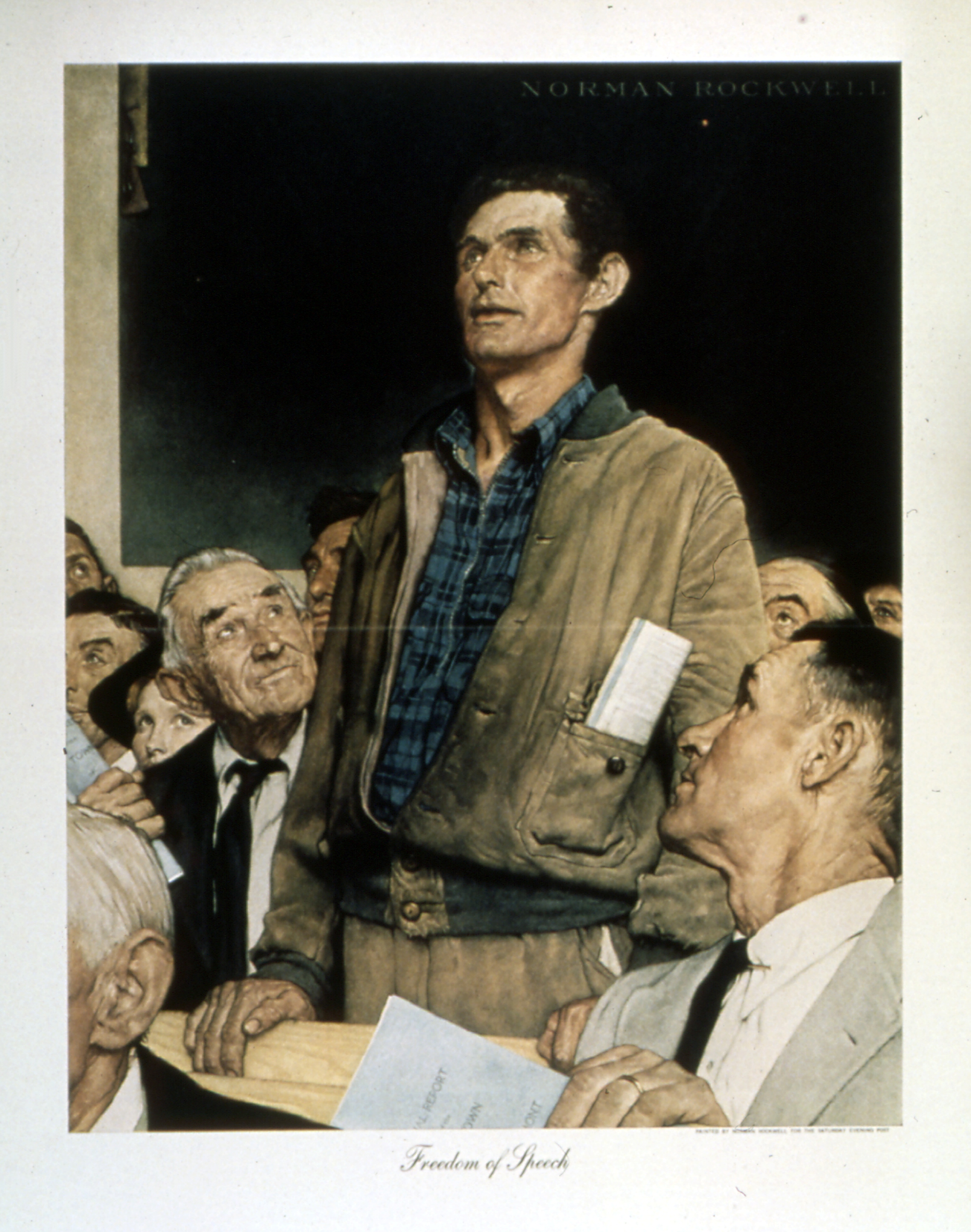
Rockwell - Freedom of Speech

The Internet has introduced a new level of visibility to areas of our social life, exposing certain uncomfortable realities. Rod Dreher recently wrote a perceptive and troubling piece on the way that the Internet reveals corruption and abuse within the Church and other institutions, provoking a reaction of distrust and a loss of these institutions’ effective authority. While the dramatic collapses of trust in the institutional authority of the Church following the exposure and scrutiny of cases of abuse may receive the most attention, there are other ways—albeit slower and more gradual—in which this trust is being eroded. Perhaps the most significant of these in my experience has been our greater exposure to Church leaders and their thinking.

On Twitter earlier today, I remarked that the Internet exposes the fact that most people were never trained to function effectively in the context of an argument. As forms of discourse such as debate, disputation, and oral cross-examination are largely absent within people’s education, relatively few have the ability to keep a level head in an argument, to have a close rein on their passions, to spar with opposing viewpoints, to open their strongly held beliefs up to questioning and challenge, or to operate well in contexts that allow for the expression of many different perspectives and arguments.

Many contemporary forms of education privilege non-agonistic modes of discourse, seeking to avoid confrontation, combat, and threatening challenge, and to foster an inclusive, egalitarian, affirming, and safe community. People trained within such contexts are affirmed and protected from exposure to direct, forceful challenge and opposing voices. The modes of discourse privileged and taught within such contexts are heavily weighted towards the non-oppositional and involve little direct disputation or interaction between opposing voices. As Walter Ong has observed, the individual voice of the essay displaces the conflicting voices of the disputation. While other voices may be represented within the essay, they are much less directly engaged.

All of this leaves people singularly unprepared for the world of the Internet, where they are exposed to opposing viewpoints and have to engage with them more directly. People who can appear to be brilliant in non-oppositional forms of discourse can crumple when subjected to critical cross-examination or manifest themselves to be emotionally incapable of interacting in a non-reactive manner with contrary perspectives. No doubt we can all think of many instances of this online. However, my concern in this post is to draw attention to how commonly I witness this failure in pastors and church leaders.

On the Internet, one soon discovers that many respected church leaders are quite unable to deal directly with opposing viewpoints. In fact, many of them can’t even manage meaningful engagement with other voices. Their tweets may be entirely one-way conversations. They talk at their audiences. They can talk about other voices, but fail to talk to them, let alone with them. Their representations of opposing viewpoints reveal little direct exposure to the viewpoints in question. They may talk about ‘postmodernism’, but one has good reason to believe that they have never read any postmodern philosopher. They make bold generalizations about ‘feminism’, but you can be pretty certain that they don’t know their Butler from their Greer or their Irigaray. When they are actually exposed to an intelligent and informed critic, they reveal themselves to be reactive and ignorant. Their views are quite incapable of withstanding the stress-testing of disputation.

Around this point, it can start to dawn on one that many church leaders have only been trained in forms of discourse such as the sermon and, to a much lesser extent, the essay. Both forms privilege a single voice—their voice—and don’t provide a natural space for response, questioning, and challenge. Their opinions have been assumed to be superior to opposing viewpoints, but have never been demonstrated to be so. While they may have spoken or written about opposing voices, they are quite unaccustomed to speaking or writing to them (not to mention listening to or being cross-examined by them). There are benefits to the fact that the sermon is a form of discourse that doesn’t invite interruption or talking back, but not when this is the only form of discourse its practitioners are adept in.

Many church leaders have been raised and trained in ideologically homogenous cultures or contexts that discouraged oppositional discourse. Many have been protected from hostile perspectives that might unsettle their faith. Throughout, their theological opinions and voices have been given a privileged status, immune from challenge. Nominal challenges could be brushed off by a reassertion of the monologue. They were safe to speak about and habitually misrepresent other voices to their hearers and readers, without needing to worry about those voices ever enjoying the power to answer them back. Many of the more widely read members of their congregations may have had an inkling of the weakness of their positions in the past: the Internet just makes it more apparent.

A system is only as effective as its weakest component in a particular operation. The same is true of the human mind and the communities formed around thinkers. Where the capacity of agonistic reasoning is lacking, all else can be compromised. If one’s opinion has never been subjected to and tried by rigorous cross-examination, it probably isn’t worth much. If one lacks the capacity to keep a level head when one’s views are challenged, one’s voice will be of limited use in most real world situations, where dialogue and dispute is the norm and where we have to think in conversation with people who disagree with us.

The teachers of the Church provide the members of the Church with a model for their own thinking. The teacher of the Church does not just teach others what to believe, but also how to believe, and the process by which one arrives at a theological position. This is one reason why it is crucial that teachers ‘show their working’ on a regular basis. When teaching from a biblical text, for instance, the teacher isn’t just teaching the meaning of that particular text, but how Scripture should be approached and interpreted more generally. An essential part of the teaching that the members of any church need is that of dealing with opposing viewpoints. One way or another, every church provides such teaching. However, the lesson conveyed in all too many churches is that opposing voices are to be dismissed, ignored, or ‘answered’ with a reactive reassertion of the dogmatic line, rather than a reasoned response.

I believe that there are various problems in the Church that are exacerbated by this. Where they are led by voices that can’t cope with difference or challenge, churches will tend to become fissiparous echo chambers, where people are discouraged from thinking critically about what leaders are saying and doing. The integrity of the Church’s theological conversation will not be tested through criticism and challenge. Churches that are led by such leaders will habitually develop polarized oppositions with their critics.

Growing attention is being given to the problem of engaging men in churches. I suggest that developing contexts of dispute, debate, questioning, and challenging dialogue in churches is one of the solutions to this. It has often been recognized that men have a particular affinity and appreciation for oppositional and agonistic discourse. An over-reliance upon the pedagogical form of the sermon leaves persons who learn and think best through sparring in dialogue without a good context within which to learn, or to develop skills of thought and argument that could be of immense benefit to the Church.

Finally, as many young people leave our churches, claiming that their questions were never taken seriously, it seems clear to me that the incompetence of church leaders when it comes to interacting with opposing viewpoints is a crucial dimension of the problem. Young people are less shielded from opposing viewpoints than their parents, especially given the role played by the Internet in their lives. They are more likely to realize just how incompetent church leaders are in their attempts to deal with critical and dissenting voices (to whom the Internet has granted a voice) and how heavily their credibility has formerly rested upon the absence of the right to talk back to them.

The crisis of moral authority that Dreher identifies is thus accompanied by a crisis of theological authority. In both cases the only answer will be found in the formation of new patterns and structures of leadership and the raising up and training of leaders who can survive this new level of scrutiny. While difficult in the short run, in the long run this could be of great benefit to the Church.

Posted in Controversies, Culture, On the web, Society, The Church, Theological | 197 Comments

Podcast: On Divine Accommodation

Mere FidelityIn this week’s Mere Fidelity podcast Derek Rishmawy, Andrew Wilson, Matt Lee Anderson, and I discuss the doctrine of divine accommodation and its immense importance within several contemporary debates, from discussions of the Bible and science, to the morality of God’s actions in the Old and New Testaments, to the applicability of various scriptural teachings, to the dangers of certain forms of apophatic theology, to the concept of cultural relevance and contextualization. Early in the podcast, Derek reads a quotation from Herman Bavinck’s Reformed Dogmatics Vol. 2: God and Creation, which encapsulates this doctrine forcefully and succinctly:

1. All our knowledge of God is from and through God, grounded in his revelation, that is, in objective reason.

2. In order to convey the knowledge of him to his creatures, God has to come down to the level of his creatures and accommodate himself to their powers of comprehension.

3. The possibility of this condescension cannot be denied since it is given with creation, this is, with the existence of finite being.

4. Our knowledge of God is always only analogical in character, that is, shaped by analogy to what can be discerned of God in his creatures, having as its object not God in himself in his knowable [sic.] essence, but God in his revelation, his relation to us, in the things that pertain to his natural, in his habitual disposition to his creatures. Accordingly, this knowledge is only a finite image, a faint likeness and creaturely impression of the perfect knowledge that God has of himself.

5. Finally, our knowledge of God is nevertheless true, pure, and trustworthy because it has for its foundation God’s self-consciousness, its archetype, and his self-revelation in the cosmos.

Hope that you enjoy the podcast and, as usual, leave your comments beneath this post or, even better, beneath the post on Mere Orthodoxy. We’ll do our best to answer any questions or engage with any thoughts that you might have.

Posted in Doctrine of God, Podcasts, Revelation, Scripture, Theological | 8 Comments

A New Icon of Marriage

Old Couple - Flickr-Candida-Performa

Candida Performa via Flickr

I just had a conversation in which I was reminded of this beautiful passage in Alexander Schmemann’s For the Life of the World:

In movies and magazines the ‘icon’ of marriage is always a youthful couple. But once, in the light and warmth of an autumn afternoon, this writer saw on the bench of a public square, in a poor Parisian suburb, an old and poor couple. They were sitting hand in hand, in silence, enjoying the pale light, the last warmth of the season. In silence: all words had been said, all passion exhausted, all storms at peace. The whole life was behind—yet all of it was now present, in this silence, in this light, in this warmth, in this silent unity of hands. Present—and ready for eternity, ripe for joy. This to me remains the vision of marriage, of its heavenly beauty.

Marriage is typically discussed from a protological perspective, from the vantage point of the creational institution and its blessed vocation of filling and subduing the earth. The couple who marry are like Adam and Eve, standing at the beginning of a history. One of the things that I love about this passage is that it draws our attention to the neglected seam between this age and the next and presents us with an ‘icon’ of marriage from an eschatological perspective.

In Luke 20:27-40, Jesus answers the Sadducees’ question about marriage in the resurrection, arguing that there will be neither marriage nor giving of marriage in the resurrection. As N.T. Wright and others have recognized, Jesus’ argument here rests upon the assumption that procreation is essential to the purpose of marriage: once humanity has multiplied and filled the earth and death is no more, the purpose of marriage will be completed. This does, however, raise the question of what becomes of people’s marriages in the age to come.

Schmemann’s ‘icon’ can be helpful here. This is a marriage that has fulfilled its vocation and is ready to enter into its rest. At this point in a marriage, the couple is no longer presented with the unitive and procreative purposes of marriage principally as a prospective task, but increasingly as realized ends to be delighted in. Marriage has united the couple together, richly interweaving their lives over many decades, in their common history, legacy, and life. They will bear no more children of their own, but can now enjoy the fruit of their procreation, as they witness their grown children raising their grandchildren.

A frequent image of the eschaton is that of a great harvest. The present age is one of sowing, while the age to come is one of enjoying the harvested fruit of our current labours in Christ. The elderly married couple experience small foretastes of the reward of this harvest. As marriage enters into this stage, the distinctive character of the vocation of marriage starts to be less pronounced, its purpose largely complete. More prominent now is the dimension of friendship as the married couple—‘heirs together of the grace of life,’ both that given through procreation and the life of the eschaton—begin to enjoy their heritage together. As I’ve argued in the past, friendship has a peculiar eschatological significance. The vocations of marriage and family are passing, belonging to this period of development and maturation: it is friendship that endures.

It is in friendship that that we come into a realization of what it means to be peers, of what fellow-ship is. In friendship, different generations become contemporaries. In friendship, the force of sex—which holds men and women as poles apart, even as it draws them together—fades as companionship comes to the foreground. In friendship, the tribes, tongues, and nations can transcend the differences of their origins and stand alongside each other. The forces and histories of our origins and development are never effaced, but they are taken up into something greater. In the eschatological communion of the Spirit, all will become ‘fellows’ and contemporaries. Marriage will be no more, not because it is destroyed, but because it is fulfilled, its natural bonds elevated into the new bonds of glorious eternal fellowship in the Spirit. The practice of friendship in the Church can thus serve as a prophetic witness.

Held alongside common protologically oriented ‘icons’ of marriage, not only does Schmemann’s icon present us with a richer vision of what marriage is, it also offers us a means by which to recognize the mode of passage between the ages.

Posted in Sex and Sexuality, Society, Theological | 7 Comments

Open Mic Thread 8

Mic

The open mic thread is where you have the floor and can raise or discuss issues of your choice. There is no such thing as off-topic here. The comments of this thread are free for you to:

  • Discuss things that you have been reading/listening to/watching recently
  • Share interesting links
  • Ask questions
  • Put forward a position for more general discussion
  • Tell us about yourself and your interests
  • Publicize your blog, book, conference, etc.
  • Draw our intention to worthy thinkers, charities, ministries, books, and events
  • Post reviews
  • Suggest topics for future posts
  • Use as a bulletin board
  • Etc.

Over to you!

Earlier open mic threads: 123456, 7.

Once again, I can’t promise to respond to comments myself here. I am hoping to post something this evening and want to prioritize that.

Posted in Open Mic, Public Service Announcement | 77 Comments

Podcast: On Marriage and Donated Gametes

Mere FidelityThe latest Mere Fidelity podcast was posted earlier today. This week’s episode is on the subject of gamete donation or, more particularly, artificial insemination by donor (I expect that a later episode will focus upon IVF). This is a particularly important issue, raising a number of questions that are seldom studied closely. Unfortunately, given the limited time we had, we could only scratch the surface of the issues raised by this. I dealt with some of the matters in more depth in this comment, which some of you may be interested in.

As I observe in the podcast, one of the most important matters for me is the relationship between the manner in which we bring children into the world and the way in which we perceive them. For instance, I have argued in the past that we need to recognize the practices and institutions that sustain our phenomenology of unborn children. The phenomenology of children involves reflection upon the manner of children’s arrival into our world, the meaning that can be perceived within this, and the ethical character of our proper engagement with it (James Mumford’s recent book, Ethics at the Beginning of Life, provides a helpful treatment of some dimensions of this). With the introduction of new modes of conception we are doing more than merely making a relatively insignificant change to a process, while securing the same results: we are establishing the basis for a new phenomenology.

The conception a child through the loving mutual gift of the bodies a husband and wife pledged to each other before many witnesses at their marriage is a profoundly personalizing fact—the wife is bearing her husband’s child. From the very dawn of its life, the child is situated in a tight web of loving relationships, being itself a concentrated expression of these bonds, not least a concrete expression of the loving one flesh union of its parents. The child is also a physical manifestation of a union to which its parents have pledged their lifelong commitment. The child thus enters the world as one afforded a natural welcome and accorded a natural claim upon both of its parents.

When a child is conceived with the donated gametes of a third party, anonymous or not, the child is not begotten from a profoundly personal loving gift of pledged bodies. Rather, its origins are now situated in a less personal realm of economic transactions, legal decisions, and medical procedures, in the realm of human construction. The donated gametes are not the expression of a loving marital gift of self, but depersonalized genetic ‘material’ from which the baby is to be formed. It shouldn’t require much reflection to appreciate the problematic impact that this can have upon the way that the child’s arrival in our midst, its identity, the manner of its being, and the being of children more generally will be perceived. Conversely, to the extent that we are morally formed by close attention to the natural phenomenon of conception through the loving procreative union of man and woman, will we readily countenance the use of such procedures as artificial insemination by donor?

Anyway, over to you. Leave any comments that you may have beneath this post, or over on Mere Orthodoxy.

Posted in Ethics, Podcasts, Society, Theological | 4 Comments