Why Mark Driscoll is Damnably Wrong

This morning I glanced at the number of visitors that each of my blog posts has received over the last few months. In something that continues to be a cause of both frustration and curiosity to me, I once again observe that the posts into which I have put the most thought and work generally receive the least attention, while hastily written or rough comments or rants can prove immensely popular. While, in the case of my blog, this effect can in part be explained by the forbidding character of long and dense posts (yes, I know…), I am not convinced that this is a sufficient explanation for the effect.

My theory – to which research lends some support – is that the degree to which people will respond to, share, and amplify a post is primarily dependent, not upon the depth of insight or even the novelty of a thought, but the nature and intensity of the emotions provoked by it. Posts that evoke complex, subtle, or little emotion, or which produce more sluggish emotions such as sadness, guilt, regret, or contentment, receive little attention or amplification, while posts that are likely to spark outrage, shock, anger, or feelings of moral or intellectual superiority over some other party receive much.

If the evoking of emotion is the primary criteria of sharing, we should not be surprised that the most amplified material online tends to be dominated by simple and intense emotions, often polarizing in character. There is a lot of good material being written online. However, the criteria for our engagement and sharing are skewed in such a manner that material that arouses simple and intense emotions will receive the most attention. This is why a significant proportion of your Twitter feed will always be filled with people being outraged at something some other party has just said or done, the actions or words of this party being presented in a highly caricatured manner that enables the most emotional and unreflective of outraged responses.

When it comes to the emotions that provoke response and amplification of online material, I suspect that it is outrage that is the most important. We like our reading material to make us feel right. However, the feeling of being right is never so delicious as when someone else is profoundly and completely wrong. The other person needs to be shockingly wrong, so shockingly wrong that we are shocked by how right we are in contrast to them. This is why the title of this post will produce so many more hits than a post entitled ‘Thoughts on the Flawed Criteria for Engagement with and Amplification of Ideas Online’.

Lest we forget, given the current social network dominated form of the Internet, online sharing and engagement is driven primarily by social considerations. The sharing of ideas is less about the ideas themselves as it is about the manner in which those ideas serve to connect you with people and communities, or enable you to define yourself over against other persons and communities. Even when people may find themselves persuaded by ideas that don’t fit tidily into particular online communities and identities, these won’t be the ideas that they are most likely to share with their friends. Communities are more generally bound together by the simplest tribal emotions, rather than by engagement with complex ideas. It is very hard to rally people around ideas that decrease their sense of certitude or moral superiority.

The other foolish party is not a dispensable element of this picture, but is a necessary foil to our rightness and moral superiority: the more wrong they are, the more right we feel. In the process we can be incredibly gullible about other people’s levels of gullibility. While ostensibly engaging with another person’s ideas, we are constantly tempted to engage rather with the caricature of that person that serves to sustain our own community’s self-identity. The invincible stupidity of our opponents is often the stupid and blindly swallowed belief that underwrites our own sense of self and belonging. The outrage at the supposedly guilty opponent is perhaps the most potent emotion of all: there is nothing more uniting than collectively stoning the ideological scapegoat.

An emotional response is easy. It can give us the immediate and intoxicating frisson of moral and intellectual certitude and a clear sense of belonging and identity. A considered and articulated response is far more difficult, requiring the self-denial of forgoing the emotional satisfaction offered by a sense of moral and ideological superiority and certitude.

The emotional responses of offense or outrage are characteristic of the emotionally reactive society that I discussed in my Edwin Friedman posts. Friedman observes that reactive societies are characterized by blame displacement and statements that focus on parties other than the speaker. The form of emotion-driven and social-driven sharing and ideological amplification that we encounter online caters perfectly for such reactivity. In the realm of theology this will involve a constant reactive posture to other communities and persons, as we become fixated on our ideological opponents. The difficult alternative to this is to speak with theological self-definition, the sort of theological self-definition that functions as an immune system, enabling you to engage and disagree with people who differ with you without feeling threatened by them or needing to caricature or react to them. It is our own emotional immaturity that leads us to fixate on the outrageous statements of other communities and persons, rather than forging our own clear and defined theological identity.

Writing and reacting to rants is easy. Responding in a self-transforming and self-defining manner to another person’s insights, or writing self-defining thoughts of your own, is far more demanding. It usually involves some loss of certitude, moral and ideological. It will also tend to alienate us from ideological communities, who will almost always feel threatened by self-defined parties in their midst, parties who engage, interact with, and appreciate them, while maintaining distinctive views of their own. Even if you have clear differences with the scapegoats, for instance, pointing out that they are innocent of many charges and are being unjustly scapegoated as an expression of a community’s own emotional immaturity is likely to get you stoned yourself.

For this reason, I believe that we should all be much more cautious and conscious when engaging with or spreading ideas online. Are we reacting to persons, communities, parties, or ideologies in an emotionally immature fashion, or are we being self-defined, and responding to others in a manner that exhibits self-control over our feelings and reactions, and desire to understand and represent them fairly?

Posted in Society, The Blogosphere | 17 Comments

More Durham in the Snow

Posted in Photos | 2 Comments

Durham after a Light Snowfall

I took a break from my studies today to see what it was like after the first light snowfall of the season. Here are a few pictures.

Posted in Photos, What I'm Doing | 1 Comment

The Religious Magnetism of Bodies

Image

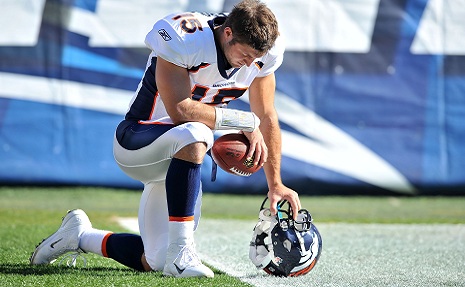
In a post on the ever-stimulating Sociological Images blog, Donovan O Schaefer comments on the charismatic character of Tebow’s body and the manner in which it has become ‘a sort of theological battleground for broader religious and cultural forces’. He writes:

My argument, however, is this: this profile of the divergent responses to the nexus of religious and cultural forces that converge on the image of Tebow’s body would be irrelevant and unread if Tim Tebow were a schlub–a homely, uninteresting, modest body, the kind of body that bus drivers drive past at the bus stop.  It is also an open question to me how we would be responding to Tebow if he were not a white body.  Those who want to challenge Tebow, to fight Tebow, to talk about Tebow are drawn in by the seductions of this image–the power of Tebow’s body — no less than those who are so ardently admiring of Tebow that criticism of him becomes a political rallying cry.  Tebow’s body is a magnetic body, a charismatic body.  It bends other bodies towards it–in both positive and critical ways.

This, then, is one of the main ways that religion happens — how identities, beliefs, and affects form and fuse: not through the advance of doctrine, but through the magnetism of religious bodies.

The ‘magnetism of religious bodies’ is a subject that should be of great interest to Christians. At the heart of our faith is not a mere set of ideas, a system of ethics, or even a teaching concerning salvation, but a particular body, a body upon which the destiny of the entire human race falls, a body crucified and a body risen, a body as sub-human refuse and a body glorified. Consequently, the manner in which our particular bodies can articulate this destiny is a matter of great significance.

I happen to think that the author of this piece is wrong: the magnetism of the religious body need not depend upon its imposing and physically impressive appearance. The magnetism of the body of Christ does not depend on its physical appearance – of which we know little beyond the fact that it wasn’t beautiful or desirable – but on the narrative of divine action that it manifests. Likewise, the body of Paul, torn by scars of beatings, stoning, physical deprivation, possibly suffering from blindness, and lacking imposing physical presence, becomes a focus of theological attention at various points, precisely for those reasons. Paul’s body becomes a ‘magnetic’ body as it is drawn into the field of Christ’s own body, through Baptism, Communion, and suffering.

This is not to deny the particular significance that a body such as Tebow’s can have in a culture such as ours, which worships the muscular and well-toned athletic body. When such a body submits itself to the magnetic field of Christ’s body, and starts to become cruciform, people will pay attention.

The idea that a particular narrative of the body is at the heart of religious life, and that it is from the magnetism of religious bodies that faith draws much of its power, is an important one, especially in the context of Western society, where our relationship with our bodies (eating, exercising, body modification, ageing, social ideals of physical appearance, clothing, etc.) and between bodies (of different sexes, appearances, races and ethnicities, ages, sexualities, etc.) is such a fraught one. In certain respects, the body of Christ can be viewed as a body shorn of distinctions, disgorged from the social order and brutalized beyond recognition in the crucifixion and transformed to be capable of appearing incognito and perhaps beyond a single determinate description in the resurrection. It is a body that voids itself and a body that invites all to write themselves into it. The Christian faith is committed to a narrative of the body, a counter-narrative to many of the contemporary narratives that dominate popular consciousness. It is worth reflecting on how this narrative shapes our relationships with our own bodies. How does the magnetism of Christ’s body draw our own bodies into its field?

Posted in Uncategorized | Leave a comment

Introversion and Why Evangelicalism is Doing It Wrong

Introversion

In a recent interview for Scientific American, Susan Cain claims that American society is biased in favour of extroversion. Cataloguing some of the ways in which introverts can be marginalized and their skills underappreciated, she argues that this results in a loss for the whole of society.

Introverts are routinely misunderstood. As Jonathan Rauch observes, in a superb article on the subject of introversion:

In our extrovertist society, being outgoing is considered normal and therefore desirable, a mark of happiness, confidence, leadership. Extroverts are seen as bighearted, vibrant, warm, empathic. “People person” is a compliment. Introverts are described with words like “guarded,” “loner,” “reserved,” “taciturn,” “self-contained,” “private”—narrow, ungenerous words, words that suggest emotional parsimony and smallness of personality.

While I have a few social skills that I can dig out when I really require them, I am a fairly extreme introvert. I consistently test as an INTJ, with a very high level of introversion (100% in the last such test that I took). My own personal history, which I won’t bore you with here, has compounded my natural introverted tendencies in several respects. I am extremely self-contained, and can happily go for days without human interaction, provided that I have the stimulation of books and ideas.

As Cain observes, introverts are not anti-social, although we are often labelled as such. Rather we are differently social. Engaging in small talk or in socially or emotionally ‘charged’ group situations quickly depletes the introvert’s energy. However, in a situation with a small group of close friends, or with a single friend, where conversation flows naturally and doesn’t need to be ‘made’ we don’t have the same trouble. While the ideal form of sociability for the extrovert may be the buzz of the larger group of friends, for those of us who are introverts it is more likely to be that enjoyed with a close friend with whom you can share the silences and be alone together. Being introverted doesn’t mean that you will be less invested in your relationships. In fact often it is quite the opposite that is the case: the introvert has fewer relationships, but is more invested in the ones that they have.

Introversion and Evangelical ‘Fellowship’

All of this raises questions for me about how introverts are to fit in within the context of evangelicalism. Being an introvert can prove especially interesting within the context of the evangelical church, with its loud piety, demonstrative and expressive forms of worship, preference for spontaneity over form, liturgical chattiness and lack of silence, and elevation of sociability to the level of a central Christian virtue. I would suggest that evangelicalism’s extroversion rises to the level of a theological and liturgical pathology.

In contrast to perhaps even the majority of other Christian traditions, the evangelical church places a particular form of extroverted sociability at the very heart of its life, practice, and theology. The evangelical Christian is expected to find in the church a readymade social life, a social life raised to the level of a Christian duty, under the name of ‘fellowship’. To abstain or distance oneself from this is viewed with suspicion, as indicative of spiritual vulnerability, disobedience, or failure.

The noteworthy thing about evangelical ‘fellowship’ is that it frequently tends to be identified primarily with the informal and unstructured socializing that occurs after church meetings, and in social get-togethers during the week. Actual liturgical practice can often be conceived of in very individualistic terms. Baptism (as the rite of adoption) is merely the expression of one’s personal faith. Perhaps most ironically of all, the celebration of ‘Communion’ itself is generally treated as a time for private reflection and meditation.

This is not to say that there is no sense of ‘fellowship’ sought in evangelical church services. The evangelical worship service can often present a very charged atmosphere, creating the sort of ‘buzz’ that extroverts seek. This can be seen in the evangelical sacrament of the emotionally demonstrative worship song, in the loud and spirited singing of which a sense of mutual belonging can occur. Evangelical worship is a place of routine public expression of feelings and tends to be very ‘chatty’ in character, with lots of noise and words and little time for quiet and reflection. Evangelical sermons are also typically loud and histrionic compared to those of other traditions.

Although this can be draining for introverts, it seems to me that there are deeper issues here. Evangelical worship, with its heavy focus upon social energy as the site of communion, presents us with a constant need to ‘make conversation’, with God and with each other. The Bible, by contrast, presents fellowship as a fact rather than as something that we have to create with our spiritual gregariousness and energy. The fact that fellowship is a fact frees us to shut up and belong to God and to each other in shared silences, to encounter God in the quiet ritual and habits of the liturgy, without a need to be spontaneous and intense.

Introverts in the Church

None of this is designed to underwrite introversion as the normative form that Christian spirituality must take. My point is rather that the place of introverts in evangelical churches can be difficult in large measure on account of a profound theological misunderstanding of the concept of fellowship. Attention to the biblical concept of fellowship would produce a form of church without such a bias towards extroversion, in which fellowship could be practiced in many forms, catering for the needs of both introverts and extroverts and valuing all personality types for what they have to contribute to the life of the church.

For instance, such a broadening of our concept of fellowship could include a recovery of the practices of spiritual direction, visitation, and of more reflective and meditative spiritual disciplines. Solitude could be given a place in evangelical piety, along with the practices of pilgrimage and monasticism. An evangelicalism that provided more in these areas would also be a far more supportive place for the lonely, the sick, long-term singles, the socially awkward, and the isolated, people who, for one reason or other, often cannot easily enter into the regular social life of the congregation.

Evangelicals frequently think of church in terms of the ‘core’ and the ‘periphery’. The ‘core’ membership of an evangelical church all too often refers to those who are more socially active and visible. This concept of the ‘core’ thus carries a bias in favour of the extroverted. The ways in which introverted persons can be no less engaged in the life of the church, without being so visibly sociable can be forgotten. Introverted Christians may be gifted in one-to-one ministries such as spiritual direction and mentorship, in private visitation, in prayer for the life of the church, in theological reflection, small group teaching, etc. These are ministries that can easily pass beneath the radar, but are no less essential to the life and health of the church. This entails a loss for the church, as introverts can become detached from the life of the church, falling through the cracks (this is perhaps one of the greatest dangers that I have found in my Christian life). The church loses out on the many gifts that they could bring to the table.

Challenging this core-periphery dichotomy (about which much more could be written from other angles) would result in a Church with far less clearly defined edges, and with a redefined centre. Such a church could be less threatening to the newcomer. The evangelical understanding of fellowship can lead to people being expected to engage in ever increasing numbers of social activities. It can produce people who lose their individuality in the group, and with the dulling of the Church’s critical faculties, for instance (prophets tend to be introverts). Within a church that has been reformed in this area, although congregations would be much less aggressively social, they could be significantly more engaging.

I would love to hear any thoughts or personal experiences that anyone might have that relate to this issue in the comments.

Posted in Christian Experience, Culture, The Church, The Sacraments, Theological, Worship | 43 Comments

How the Liberal Market Revolutionized our Understanding of Humanity

In The Making and Unmaking of Technological Society, Murray Jardine raises questions about the underlying anthropological assumptions of the market as it functions within liberal societies (I raise a slightly different set of questions about its anthropology of individual self-interest in this post). He observes how unusual the modern market is as a phenomenon within history. For instance, most human societies ‘are structured in such a way that people typically have much more substantial long-term obligations to each other, and agreements between two individuals are usually subject to the approval of other members of the community.’ Within contemporary liberal societies, however, the market model of pure individual choice, without enduring obligations to other persons and society becomes the norm for all social interactions. Jardine suggests that the market is increasingly serving as the model for institutions such as marriage, leading to a reinvention of the institution including, but by no means limited to, the permitting of same-sex marriage and easier divorce.

The market relationship is essential to the logic of liberalism on the subject of human society. For instance, if we look at John Locke’s political theory, it is the market relationship of the contract that lies at its base. Jardine suggests that early liberalism tends to embody a middle-class perspective on the world. ‘According to Locke, if one is rational, one will obey the Law of Nature, which means one will work productively; according to Smith, if one works productively, one will be successful in the market.’ This conviction can be illustrated by the manner in which blue-collar workers routinely have to clock in and out, are subject to far more surveillance than white-collar workers, and receive pay-checks at more regular intervals, as they are perceived to be less rational and responsible.

In premodern societies, people seldom worked anything like the hours that we do today, just enough to satisfy their basic needs, after which they devoted the rest of their time to other activities. In its reliance upon the market, liberalism embodies a secularized version of the Protestant work ethic. Work becomes the central human activity: we start to live to work, rather than working to live. While we might be able to satisfy our basic needs and wants for only half of a week’s work, within the society governed by the market if you work less you are eliminated by competitors who work harder. This sort of market-driven society devastates less productive workers, by intensifying the pressures that they face and driving them out of employment.

For Adam Smith, human beings have a ‘natural propensity’ to buy and sell, a propensity that is facilitated by the market. Jardine remarks:

Note that it is extremely important for Smith’s argument that people do have this natural propensity. If a liberal system is supposed to maximize individual freedom, and the market will be the central institution of liberal society, then if people don’t have a natural propensity to buy and sell, they must be forced to participate in the market, and the liberal system will actually be very unfree. The assumption that a liberal market system maximizes individual freedom is based on the more fundamental assumption that market activity is something people do freely, that is, naturally. But do people actually have this natural propensity?

Posted in Culture, Economics, My Reading, What I'm Reading | 2 Comments

‘Symbol and Sacrament’ Chapter 7: Sacrament and Ethics

Symbol and Sacrament Posts: IntroductionChapter 1Chapter 2:IChapter 2:IIChapter 3Chapter 4:IChapter 4:IIChapter 5, Chapter 6

Chauvet frames his seventh chapter with the question: ‘How can we avoid the temptation to oppose ethical practice and ritual practice without yielding to the reverse temptation to reduce the tension that must remain between them?’ (228).

The Jewish Cult

In many traditional cultures, the awareness of the passage of time can be shaped by the succession of the generations and the patterns of the cosmos and the cycles of nature. Such awareness need not be strictly ‘cyclical’, as it can take the form of an ‘open circle’ or spiral, like an ascending circular staircase, where the same point is passed over again, but on a different level.

The Bible makes a dramatic break with the pattern of this “spiral” notion of time structured by great cosmic cycles. From the beginning it prizes events perceived as moments of the advent of unexpected newness. (229)

The prophetic character of events is clearly revealed in Judaism. The story of the world’s origins is the bearer of a story of a new world to come: ‘it is from the Omega that we read the Alpha’ (230). The first place of God’s revelation is in history, and Israel’s faith is founded upon this history. While we should beware of losing sight of the creation and its consistency, we should always relate the creation of the world firmly to the history of redemption. Creation is that which sets time in motion: ‘The divine word is before all else the creator of history, and each new word of God makes a new event-advent arise’ (231).

Biblical time is most appropriately thought of, not as the time of metaphysical Being, but as that of the historical Perhaps and thus as that of the symbolic Other in connection with human liberty snatched thereby from Ananke or blind Fatum; it is a risky time but capable by this very fact of giving birth to the unheard-of, instead of simply reproducing the always-expected of the eternal recurrence of the Same.

The Memorial

It is perhaps in the concept of the memorial, paradigmatically displayed in the Passover, that the essence of the Jewish cult is most clearly seen. The concept of the memorial involves the ‘insertion of those who are remembering into the very event the celebration commemorates’ (232). It can involve both a remembering of God’s self-revealing action in the founding event, and a reminding of God on the basis of that action. ‘The memory of the past thus makes the present move; it puts back on their feet, in view of a new beginning, those who are prostrate in the silence and oppression of exile’ (233). This is the communal memory whereby the people of God are regenerated. ‘In its Passover memorial, Israel receives its past as present, and this gift guarantees a promise of a future’ (234).

Chauvet discusses the firstfruits rite of Deuteronomy 26:1-11 in this context. The form of this rite teaches Israel that the land ‘is to be always conquered – or rather always received.’ Israel continues to ‘enter authentically into possession of the land’ through a ‘symbolic act of dispossession’ (236). Chauvet suggests that the role of the Levites within Israel was in large part to ‘remind Israel, from deep within itself, of its identity: even after having entered into possession of the land, Israel can live as Israel only by continuing, generation after generation, to receive it from Yahweh’s gracious hand’ (237).

The lesson of the desert, ‘under the dispensation of the manna, … of the pure non-thing sign, of non-possession, of pure expectation’ taught Israel to rely upon God’s grace alone. Entering into the land brought with it the temptation ‘to appropriate the land as a pure non-sign thing, as mere possession without dispossession, as mere attainment without need for expectation.’ The firstfruits ritual involved re-calling Israel to its responsibility within history. A crucial aspect of the firstfruits ritual is that its expression of Israel’s reliance upon and thankfulness to God ‘can be true only if they are veri-fied in recognition of the poor: it is in the ethical practice of sharing that the liturgy of Israel is thus accomplished’ (238).

The stress upon the ‘liturgy of the neighbour’ – the verification of Israel’s liturgy in the treatment of the poor – brings about a ‘crisis in ritual’. Unlike the pagan nations, Israel cannot be ‘in tranquil possession of its own cult’, but is constantly challenged in its existential and ethical responsibility. This theme is especially noticeable in the prophets and their opposition to cultic formalism.

The Eschatological Status of the Christian Cult

Eschatology is at the heart of the difference between Christianity and Judaism. Eschatology should not be thought of merely as the ‘not yet’ of the parousia. Rather, the ‘eschaton is the final manifestation of the resurrecting force of Christ’, it ‘speaks the future of his resurrection in the world’ (240). Eschatology means that ‘one cannot confess Jesus as risen without simultaneously confessing him as resurrecting the world.

Chauvet speaks of the manner in which, under the weight of prophetic and Hellenistic criticism, the order of sacrifice moved towards the elevation of the peace offering or ‘eucharistic sacrifice’ over sacrifices and that the weight of this sacrifice began to shift ‘from the animal victim toward the prayers’ (243). By this means the ‘eucharistic sacrifice’ (in the sense of the Jewish peace offering) came to be viewed as a ‘sacrifice of the lips’.

Such is the zebah todah, the aineseos (eucharistias) thusia that Hebrews 13:15 recommends as an offering to God through Jesus, the unique high priest: “Through him, then, let us continually offer a sacrifice of praise to God [Ps 50:14-23], that is, the fruit of lips [Hos 14:2] that confess his name.” Thus, “to make eucharist” is in the first place to confess God as savior; and this confession of thanksgiving has an immediately sacrificial connotation. In this perspective one understands that the ritual proclamation of “the Lord’s death until he comes” (1 Cor 11:26) “corresponds exactly to the todah” and that it could have marked for the first Christian communities “Christ’s substitution of the Christian meal for the ancient todah.” (243-244)

In his relationship to the cultic worship of the temple, Jesus seems to take the prophetic critique of the temple worship a step further. Without given clear directions, Jesus’ actions and teachings seem to suggest ‘a new status for worship as such’ (247).

A New Cult

It is after the ‘tear’ of Easter that this ‘newness’ begins to appear. Chauvet explores the metaphor of the tear as it is employed as a metaphor for newness in the New Testament – the tearing of the heavens at Jesus’ baptism, the tearing of old wineskins, the high priest’s tearing of his clothes as Jesus’ trial, and the tearing of the Temple curtain from top to bottom. ‘In Jesus, Christ and Lord, the religious fabric of Judaism has been torn’, and something radically new arises within it (249).

As this is proclaimed to occur in accordance with the Scriptures, the question that arises is ‘what becomes of the two great salvific institutions of the Mosaic covenant: the Law and the Temple?’ Paul’s epistles focus primarily upon the first; the book of Hebrews deals more directly with the second. ‘Christians have no other Temple than the glorified body of Jesus, no other altar than his cross, no other priest and sacrifice than his very person: Christ is their only possible liturgy’ (250).

The Christian cult is ‘of another order than the Jewish cult whose heir it is.’ This isn’t primarily a moral difference, but a difference of the theological order.

More precisely, it is founded entirely upon the rereading of the whole religious system, a rereading imposed by the confession that Jesus is the Christ. Thus, all rests on Easter and Pentecost. In a word, the difference is eschatological.

Although Jews recognized the Law as a gift and their observance of the cult as a response, their justification occurred through their performance of the cultic works of the Law (in a ‘eucharistic’ manner, not an accumulation of merit). Christ creates the key difference.

For Christians’ thanksgiving is Christ himself, and no longer their own faithful execution of the Law or the uprightness of their grateful hearts. The very principle of justification is different from what it is in Judaism: it is identified with Christ, the unique subject who has fully accomplished the Law, inscribed as it was by the Spirit in his innermost being. Consequently, to be a Christian is to live under “the law of the Spirit” … to share in “the Spirit of Christ” (Rom 8:9). The new modality of justification is to be understood starting from and in connection with this new Christo-pneumatic principle: no longer the practice of the works of the Law … but faith in Jesus as Christ and Lord. (252)

A New Cultic Status

The Jewish cult involved ‘ascending’ to God, albeit as a response to God’s previous descent in the Covenant and the giving of the Law.

From now on it is a question of welcoming salvation from God’s self, fundamentally bestowed as a grace “descended” upon us in Jesus… Thus, we no longer have to lift ourselves toward God through the performance of good works, ritual or moral, or through the intermediary of a priestly caste, but we have to welcome salvation in our historical existence as a gift of grace…

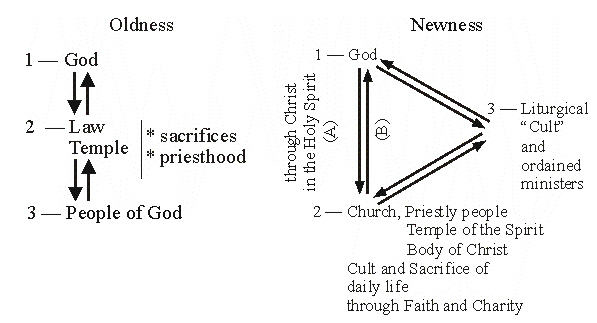
Chauvet’s diagram of the difference between the two systems is shown above. In the second diagram, in contrast to the first, the Law and the Temple no longer stand in an intermediary position.

According to the direction of rotation (A) indicated on the outside, the cult acts as a symbolic revealer of what enables human life to be authentically Christian, that is to say, the priestly act of an entire people making their very lives the prime place of their “spiritual” worship; according to the direction of rotation (B) drawn on the inside, it acts as a symbolic operator making possible this priestly and sacrificial act that is “pleasing to God” through Jesus Christ and in the Holy Spirit. (253)

This diagram helps to illustrate how sacrament both comes from (direction A) and sends us back to (direction B) ethics.

‘The life of the Christian community is … presented as a long priestly liturgy’ (255). The issue of ‘universal priesthood’ ‘has little to do with the question of ministries within the Church’, but rather speaks of ‘the ministry of the Church in the world’ (257). The ministers of the Church should not be understood as ‘priests’ nor the Eucharist as a ‘sacrifice’ in the Old Testament senses, even though certain parallels between functions can be drawn.

From now on, the new priesthood is the priesthood of the people of God. The temple of the new covenant is formed by the body of Christians, living stones fitted together by the Holy Spirit over the cornerstone that is Christ himself. And the sacred work, the cult, the sacrifice that is pleasing to God, is the confession of faith lived in the agape of sharing in service to the poorest, of reconciliation, and of mercy. (260)

In light of this, ‘the ritual memory of Jesus’ death and resurrection is not Christian unless it is veri-fied in an existential memory whose place is none other than the believers’ bodies’ (261). ‘The ritual story at each Eucharist, retelling why Jesus handed over his life, sends all Christians back to their own responsibility to take charge of history in his name; and so they become his living memory in the world because he himself is “sacramentally” engaged in the body of humanity they work at building for him.’

The Letter, the Rite, and the Body

Within the New Testament the Old Testament concept of the ‘sacralisation’ (the setting apart) of the profane is replaced by the ‘sanctification’ of the profane: ‘the prime location of liturgy or sacrifice for Christians is the ethics of everyday life sanctified by theological faith and charity’ (262). The Jewish concept of the ‘intermediary’ is also substituted by the Christian concept of ‘mediation’: ‘a milieu in which the new communication of God with humankind made possible by Christ and the Spirit takes place.’ This milieu is ‘corporality itself’. The Christian faith does not challenge sacredness as such, but rather establishes a different relationship to it.

Within the previous chapter, Chauvet argued that sacrament ‘acts as a symbol for the passage from the letter toward the body’ (263). In the relationship between sacrament and ethics we see how the community begins to ‘write itself’ into the text that it is reading. The teaching of the new covenant is that ‘the Book, through the action of the very Spirit of God, will become one with the body of the people.’ Christ is the one subject who has fully incorporated, and we live out of his Spirit.

‘[T]he resurrection of Jesus and the gift of the Spirit specify corporality as the eschatological place of God’ (264). ‘The body is henceforth, through the Spirit, the living letter where the risen Christ eschatologically takes on flesh and manifests himself to all people.’ As we have already seen, the proclamation of the Scriptures in the ecclesia manifests their very essence. The Scripture always seeks to be inscribed in the social body: there is an essential connection between the two. This essential connection is crucial to understanding the place of sacrament:

The element “Sacrament” is thus the symbolic place of the on-going transition between Scripture and Ethics, from the letter to the body. The liturgy is the powerful pedagogy where we learn to consent to the presence of the absence of God, who obliges us to give him a body in the world, thereby giving the sacraments their plenitude in the “liturgy of the neighbor” and giving the ritual memory of Jesus Christ its plenitude in our existential memory. (265)

If Judaism was characterized by a ‘second naiveté’, as the cult was leavened by the prophetic critique, Christianity must be characterized by a ‘third naiveté’. The liturgy still embraces our whole being and not merely our brains. However, the prophetic criticism is fulfilled as the transition from letter to body becomes an eschatological possibility.

Posted in Ethics, My Reading, Reviews, The Sacraments, Theological, Worship | 10 Comments

Daniell on Tyndale’s Style and Effect on the English Language

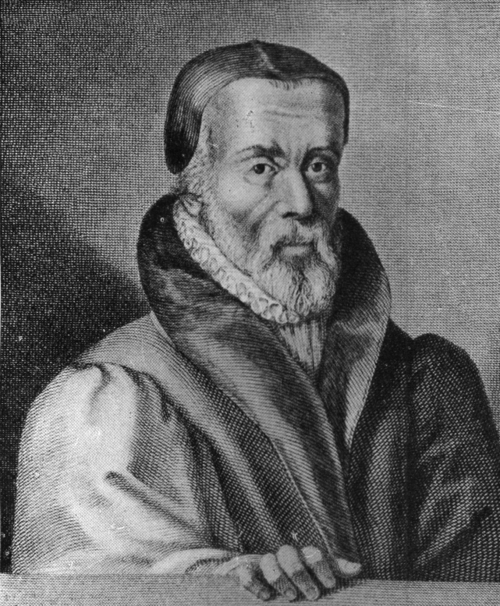
Via Daniel Stoddart comes this article on the effect of William Tyndale’s Bible translation upon the English language. David Daniell has a wonderful treatment of this in his tome, The Bible in English.

Not only did Tyndale’s solitary work of Bible translation decide, in the words of Bishop Westcott in 1868, ‘that our Bible should be popular and not literary, speaking in a simple dialect, and that so by its simplicity it should be endowed with permanence’: Tyndale clarified the English language. Since the early eighteenth century, the greatest praise has been heaped on the language of the King James Bible (the ‘Authorised Version’), made in 1611. Yet over four-fifths of the New Testament of that version is simply Tyndale’s work of eighty years before. In 1611, one of the last years of Shakespeare’s writing life, the English language was at a peak. It surprises nobody that the Bible from that time has immortal glory. Yet it should surprise everyone. The work of Tyndale that was taken over in 1611 was done three generations before, when the English language was a poor thing indeed, almost dead at the bottom of the pond.

What English there was in Tyndale’s day – Latin was the language of academia, government, religion, and the professions – lived in the shadow in Latin and Anglo-Norman. English writers adopted heavily Latinized styles and relied heavily upon non-Saxon vocabularies. Tyndale resisted the high Latinate register, which would be aspired to by many of his successors, adopting a simple and powerful style, using monosyllables, a straightforward and clear syntax, generally avoiding dependent clauses and participles, and sentences fashioned to the ear, calculated to settle firmly upon the memory. His style was only slightly elevated above everyday speech. He also proved very able in his adapting of his style to the various Hebrew and Greek styles of the Old and New Testaments books and narratives.

Tyndale, in his Bible translations – including all the historical books, printed after his death – made for the Bible not only a strong direct short prose line, with Saxon vocabulary in a basic Saxon subject-verb-object syntax, but also showed a range of English styles which, coming out of the 1530s, astonishes the knowledgeable reader. No one else was writing English like this in the 1530s.

In discussing Tydanle’s distinctive style as illustrated in his translation of particular passages, Daniell highlights several examples of some of Tyndale’s powerful phrases and expressions: ‘For the day present hath ever enough of his own trouble’, ‘which chop and change with the word of God’, ‘my soul is heavy even unto the death’, ‘not as I wilt, but as thou wilt’, etc.

Tyndale understood the real source of power in the English language, which is a plain Saxon base in vocabulary and syntax, within which, not on top of which as decoration, great suggestibility is possible. Shakespeare also understood this, as in Hamlet’s ‘This fell sergeant, death, / Is strict in his arrest.’ Good English syntax, which is Saxon syntax, is logical in its subject-verb-object formation…. Verbs are at the centre of verbal power in both senses. So, in Tyndale, Jesus says not as it might be, albeit absurdly, in Latinate English, ‘The elevation of thy recliner and perambulation imperative is’, but ‘Take up thy bed and walk’. Saxon words are short. So too are Saxon sentences, in which short phrases are joined by ‘and’.

Posted in Bible | 3 Comments

‘Symbol and Sacrament’ Chapter 6: Scripture and Sacrament

Symbol and Sacrament Posts: IntroductionChapter 1Chapter 2:IChapter 2:IIChapter 3Chapter 4:IChapter 4:II, Chapter 5, Chapter 7

Having established a model for the structure of Christian identity in the previous chapter, Chauvet proceeds to explore the interrelationships of the various elements of the structure. Within this chapter he examines the manner in which the Scripture grows out of the liturgy of Israel and the early churches, finds its place within the liturgy, the sacramentality of Scripture, and the manner in which Scripture ‘opens up sacramentality from the inside’.

The Bible Born of the Liturgy

The Jewish Bible and the Liturgy

Chauvet claims that the earliest patriarchal traditions were transmitted and collected in the context of cultic centres. The texts that we have were in large part conserved on account of their use in the liturgy: the biblical corpus is formed ‘in connection with a communal proclamation and listening’ (192). He quotes Paul Beauchamp’s formulation approvingly: ‘That is canonical which receives authority from public reading.’

The ‘great founding events of Israel (precisely because and to the extent they are recognized as foundational) are presented to us in the Bible through liturgical recitations.’ For instance, passages such as Exodus 12:1-13:16 are presented less as straight historical accounts than as guidelines for future liturgical memorialization, a fact that shows the great significant of the events. Something similar can be recognized in many of the passages in Exodus. ‘The authentic point of departure for the story is the celebrating assembly in its present reality’ (193).

[T]he great foundational moments of Israelite identity are recounted in liturgical terms. If the liturgy is not apparent in the text itself, it is because it is its pre-text. One does not tell the liturgy; one liturgically tells the story that one memorializes. The “liturgification” of the telling of stories about the early times is the best way to manifest their continuing foundational role in the identity of Israel. (194)

Chauvet also draws attention to the covenantal liturgies that appear at key junctures in Israel’s history, suggesting these were archetypal. These covenantal liturgies would have lesser analogues performed at various points in Israel’s life. These liturgies reveal ‘the essential dimension of the Bible, which is the confession of faith in Yahweh and, through this mediation, the very identity of Israel.’

None of this is to claim that the liturgy produced the traditions itself but that ‘it left its imprint upon them and played a decisive role in their being preserved as the “Word of God”’ (195).

The Christian Bible and the Liturgy

‘The Christian Bible is nothing else than a rereading of the Hebrew Bible in the light of the death and resurrection of Jesus Christ, of the rereading of these as accomplished “according to the Scriptures.”’ Chauvet argues that the oral context of the liturgy and the synagogue is crucial for understanding the way that texts, scriptural and otherwise, functioned within the early Church. ‘The Christian assemblies, Eucharistic and baptismal, seem to have functioned empirically as the decisive crucible where the Christian Bible was formed’ (197).

This can especially be seen in something such as the Last Supper accounts which presented themselves as historical narratives, but actually what they ‘narrate directly is the way the Church re-enacts the last meal of the Lord’ (198). The liturgical assembly is the source of these accounts. The fact that we have the Gospels in the form that we do results from the fact that the stories that they narrate were not merely of some departed beloved teacher, but of a living Saviour, and not of a tragic death of a leader, but of a death for us. This faith found its primary context in the liturgy.

It was the confession of faith in act in liturgical practice that ‘seems to have functioned as the catalyst allowing the different factors (doctrinal, apologetic, moral, liturgical) and the diverse agents (the Christian communities themselves with their concrete problems, internal and external; their various ministries of government, prophecy, teaching, prayer, and so forth) to come together in order to flesh out little by little these Gospels confessed as the gospel of the Lord Jesus’ (200). As in the case of the Jewish Bible, it was the authority recognized from public reading that provided the basis for the determination of canonicity.

The Place of Scripture in the Liturgical Assembly

Chauvet distinguishes between ‘canon 1’ and ‘canon 2’. Canon 1 denotes the ‘corpus, first oral, then written, which already functions as a practical canon of the traditions in which a clan, a tribe, or a group of people recognize and identify themselves’ (201). ‘In its final form, this canon 1 corresponds to the canonical Bible.’ Canon 2 is the instituting tradition, which ‘designates the hermeneutical process of rereading-rewriting canon 1 in relation to constantly changing historical situations.’ There is a ‘pheno-text’ (the apparent text of canon 1) that is ‘woven secretly’ by a hermeneutical ‘geno-text’ (‘hidden and creative text, canon 2’), a hermeneutical process that although unwritten, is obviously canonical (202).

The relationship between the instituted and the instituting tradition ‘depends on a third element: the events recognized as foundational.’ The confession is founded upon a narrative (our Christian creed is also a narrative embodying a theology). In many respects the Hextateuch can be regarded as the ‘theological unfolding’, the ‘transcription into capital letters’ of the events confessed as foundational (203).

The Law is first of all about stories, because these narratives from the ‘proto-historical period that the Torah covers act as the law for the identity of Israel.’

[T]he frontier of the Jordan and the death of Moses have a metaphorical significance: they separate irreversibly the historical types of the proto-historic period from all the future history of Israel. By this metaphorical separation, they are lifted out of their status as simply ancient events and promoted into meta-historical archetypes of Israel’s identity in the future. The original proto-history becomes thereby origin-giving meta-history, that is to say, always contemporary. Thus, for Israel, to live is to relive the journey of its origin by replunging itself into these memories again and again with each generation.

The same thing applies to Christians, the difference being that the ‘barrier’ that separates later history from proto-history is the resurrection of Christ.

The Book and the Social Body

Taking aim at classical theories of interpretation, and employing the work of Roland Barthes, Chauvet argues that every text is written and read from a particular world, rather than from ‘a neutral place that sovereignly transcends all socio-historical determinations’ (205).

Everything is interpretation. This does not mean that all interpretations are equal; a reading which can handle more aspects of the textual material is more faithful than another.

Chauvet distinguishes between decoding and reading.

Decoding is a technique of analysis, whether it be historical-critical, semiotic, or “materialist” … As necessary as decoding is for the reading to be faithful to the text, such a decoding is only a preliminary step in the service of the reading, for reading is the symbolic act of producing a new text, an original word, on the basis of the rules of the game decoded from the texts.

In reading, the reader and his world are engaged and they speak, which leads to the same text inspiring different readings. The decoding of the meaning of, say, a Shakespearean play is only the first step: the main task is found in creation of a new performance in which the Shakespearean text engages the interpreters and their world. On such an approach, meaning cannot be mastered. Rather we must submit to the ‘difference’.

The text comes into existence through the departure of its writer – the death of the author – becoming other to him, and being delivered over to the readers as a testament. The operation of reading is ‘essential to [the text’s] very constitution’ (206). Although we are inclined to think in terms of reading having to adapt to a normative writing, Chauvet suggests that we reverse this relation: reading ‘prescribes to meanings the general guidelines which they can and must follow’ (207).

We can draw distinctions between two different kinds of books, with many levels of gradation between them. On the one hand, there are ‘books requiring hermeneutics’, such as books of literature, religion, poetry, and philosophy. On the other hand, there are books concerned with disciplines of knowledge, such as scientific texts. The operation of the sort of reading that we have been discussing is far more noticeable in the case of the former than in the case of the latter.

Chauvet speaks of different levels of canonicity: ‘the more the social body recognizes itself in a text, the more the text manifests its essence as a text, in the sense explained above’ (207). There is the level of implicit canonicity that great literary texts can achieve, or that a work can enter for a time through winning a prestigious prize, or being the focus of an intellectual or cultural fashion. After this comes an intermediate level of canonicity, when a text surrounds itself with various normative interpretations (readings not always in agreement) as it is taught or discussed in academia, for instance (Plato is an example of this). The third level of canonicity, now completely explicit, occurs ‘when a corpus of texts is officially the subject of a global orthodox interpretation’ (208). ‘This canonicity is linked to the fact that the social body recognizes itself, consciously or not, officially or not, in the texts.’

In availing ourselves of J. Kristeva’s distinction between “geno-text” and “pheno-text”, we may say that the definitive setting of the canon of “holy books” is the ultimate unfolding, at the level of the pheno-text, of a process of canonicity constitutive of the geno-text, a process which manifests the essential relation of the reading body to the text.

For Chauvet, the book and the community are inseparable:

The norm is thus not the Book alone, but the Book in the hand of the community. The Church thus represents the impossibility of sola scriptura. (209)

It is from the encounter between the text and the reader that meaning arises. ‘Hermeneutics, although unwritten, is also canonical.’ This hermeneutical process of re-reading the Scripture in our world, of ‘drawing something new out of the old’ demands faithfulness in our situation to ‘the same process that brought about its production’ (the geno-text).

The Bible is formed through the process of selection among texts and in the process of integration, whereby ‘all parts of the book eventually converge toward the unity that is Christ’ (210). Chauvet concludes that ‘the Bible exists, as the Bible, only in the hands of the ecclesia.’ This does not mean that the Church is justified however it treats the Bible:

For our canon 2 has meaning only in relation to canon 1. And the Church itself has not always been faithful in its interpretation of the meaning of the data of canon 1 to which it necessarily referred itself…

The Reading of the Bible in the Liturgy

There is a relationship between four elements in the Liturgy of the Word. First, ‘texts are read from the canonically received Bible.’ Second, these texts are proclaimed as the Word of God for today. The writing of the text and the voice whereby it is read aloud place limits upon each other: we cannot recapture the origin, but there also remains ‘more to be written’ in the present (211). Third, the texts are read to an assembly that ‘recognizes in them the exemplar of its identity.’ Finally, this process is lead by an ordained minister ‘who exercises the symbolic function of a guarantor of this exemplarity and, for us Christians, of the apostolicity of what is read.’

These four elements correspond to the ‘four constitutive elements of the biblical text as the Word of God’. The first element corresponds to canon 1. The second element corresponds to the hermeneutical process of canon 2. The third element relates to the agency of the reading community that ‘writes itself into the book that it is reading’ (212). The final element relates to the manner in which ‘this dynamic internal to writing renders itself visible in the institutional act of canonical sanction uttered by an authority recognized as legitimate by the group.’

Thus, the complex formed by the four elements of the Liturgy of the Word may be understood as the visible, “sacramental” manifestation of the complex formed by the four elements which went together in the production of the Bible. So true is this that the liturgical proclamation of the Scriptures is the symbolic epiphany, the sacramental unveiling, of their internal constituents.

The essence of the Bible is unveiled in the liturgical proclamation. It is at that point that the writing of the testament, the living voice, the community of persons, and the representation of divine authority in the Church’s ministry come together. The Bible is never so much what it is than it is in the context of the liturgy: ‘the liturgical assembly (the ecclesia in its primary sense) is the place where the Bible becomes the Bible.’

The Sacramentality of Scripture

Many are inclined to regard the public reading of Scripture as merely one way among many whereby the Scriptures create the Church and the believing subject. However, Chauvet’s contention is that this activity is one of a different order from others, and should not be grouped with them.

Chauvet refers to the traditional veneration of Bibles, veneration comparable to that directed at the Eucharistic elements. Beautifully decorated lectionaries, the procession of the text into the Church with candles, incense, and singing, and other such elements serve as the ‘concrete mediation where the theology of Scripture as the sacramental temple of the Word of God is embodied’ (214).

The letter of the closed canon is the ‘tabernacle’ of the Word of God. In order to discover the Spirit and sacramentality of the Word we must engage fully with the text as letter. The Bible resists all attempts to distil it to a ‘timeless truth’ that escapes its historical contingency. Such an approach presumes that the Spirit must be located outside of the particularity of the letter.

There is a constant tendency to ‘blunt the letter’s resistance as the indication of an irreducible socio-historical otherness’ (215). This can be seen in certain forms of typology that do not accord to the letter the primacy that it deserves, or recognize the resistance that it poses. The ‘vertical model of metaphysics’ can be projected ‘onto the historical axis of time’.

Chauvet discusses the possibility of an idolatrous attitude developing towards the ‘letter-as-sacrament’ (216). He follows Jean-Luc Marion in defining idolatry, not as the ignorant identification of a god with its image, but in ‘the subordination of the god to the human conditions for experiencing the divine.’ Under this definition, it can be seen that idolatry can exist in a potent form even in belief systems that are supposedly anti-idolatrous. He lists the examples of conceptual idolatry’s reduction God to our closed discourses, ethical idolatry’s attempt to have rights over God on account of one’s behaviour, and psychological idolatry’s reduction of God to our ‘spiritual experiences’. All of these are attempts to put God at our disposal. ‘This is precisely the process of idolatry: to attempt to blot out the difference between God and ourselves’ (217). Thus, the letter becomes an idol whenever its difference from us is denied, and the immediate present and its prejudices become that to which the text is subordinated.

The icon contrasts with the idol by the separation that exists between its representation of the divine and the divine itself. There is only one small step from an icon to an idol, yet ‘this short step spans an abyss’ (218). The letter is sacramental ‘from an iconic perspective’. The sacramental character of the text is seen in its forming of figures.

[T]he letter arises as figure – and thus as a sacramental mediation of revelation – only by splitting itself in two: a witness to the “has been” of the creation, the Exodus, or the manna, it is at the same time a witness to the “must be” of a new creation, a new exodus, a new manna, and so forth. As figure, it is an in-between, a passage, a transit toward something other than itself, something else which is the other side of itself.

The Word of God always ‘resists any gnostic claim to a full presence’ (219). The ‘present’ of the Word of God is one that preserves radical otherness, difference, and separation.

The Sacraments as the Precipitate of the Scriptures

The sacraments are received from a tradition that we cannot manipulate at will, which precedes us, and which holds authority over the assembly and its members. ‘To the resistance of the letter, the rites add that of the body; the letter-as-sacrament precipitates itself into the body-as-sacrament in the expressive mediations of the rites: gestures, postures, objects, times and places, people with different roles…’ (220).

The ‘sacramental moment is preceded by a scriptural moment.’ This holds in the case of evangelization, where sacramentalization of persons follows after their evangelization, and allows this preceding evangelization to ‘take hold’, as we see in the Emmaus narrative. In this sense ‘the liturgical and sacramental expressions of the faith are a constitutive dimension of evangelization itself’ (221). The Word thus ‘deposits itself in the sacramental ritual as well as in the Bible,’ suggesting that an opposition or dichotomy between Word and Sacrament is false and misleading. What we have is the liturgy of the single Word in two modes, which are inseparably connected.

The Word of God shows resistance: it can be ‘difficult to swallow’. Chauvet uses John 6 to illustrate his point. The bread of life discourse is primarily a ‘catechesis on faith in Jesus as the Word of God’ (225). However, this catechesis on faith ‘is expressed in Eucharistic language, characterized as it is from start to finish by the theme of eating.’ The chewing of the Eucharist ‘provides John with a privileged symbolic experience of what faith is all about.’ It is always as Word that Christ gives himself to be assimilated in the Eucharist, which is why the preceding Liturgy of the Word is so important, as it enables ‘spiritual chewing’ in the sacrament. For this reason, the sacrament cannot be allowed to close in on itself: ‘the efficacy of the sacraments cannot be understood in any other way than that of the communication of the Word’ (226). ‘In thus experiencing concretely the consistence and resistance of this compact food, we experience symbolically the resistance of the mystery of the crucified God to all logic.’

The letter of the Scriptures wishes to ‘take over the body of the people’ and it is the sacrament that is ‘the great symbolic figure’ of this.

The sacraments allow us to see what is said in the letter of the Scriptures, to live what is said because they leave on the social body of the Church, and on the body of each person, a mark that becomes a command to make what is said real in everyday life. Thus, they are the symbols of the integration of the writing into “life,” the transit of the letter toward the body. (227)


Posted in My Reading, Reviews, The Church, The Sacraments, Theological, Worship | 11 Comments

The Juvenilization of the Church

via Dr Jim West

Does anyone have any thoughts on his thesis?

Posted in Video | 2 Comments