
Retrospective on 2015

After a very pleasant extended break from blogging and Twitter, I am (temporarily) returning. Christmas has been thoroughly enjoyable so far, involving extended bouts of board gaming with family, lots of baking and cake decoration, debates about the merits of the new Star Wars movie, and the consumption of unnatural quantities of gingerbread!

The Christmas cake I decorated this year

2015 was a rather quiet year on this blog: beyond open mic threads, links to guest posts on other sites, and podcast episodes, I didn’t post much here. I did, however, have thirty-two guest posts published—not counting thirteen posts on Passing the Salt Shaker—and wrote over a dozen more that have yet to be published. I also participated in thirty-five episodes of Mere Fidelity.

A continued focus of much of my writing has been the changing character of Christian communication in the Internet age, our need to give consideration to the way online media subtly form us, and to be mindful about the way we forge our conversations and participate in discourse. In March, I wrote in defence of argument, but my most extensive explorations of this subject came at the end of July and the beginning of August, one of which—a 12,000 word treatment of the contemporary phenomenon of the extensive use of first person narrative in Christian theology among snake people—has yet to be published. The first was a rather hastily written blog post, within which I argued that the Internet has brought us too close together, and that we might learn some lessons from trolls (properly defined). The second was a lengthy defence of long blog posts and a discussion of the ways in which our forms of reading have changed by the Internet. The third, published on Mere Orthodoxy, was an extended discussion of the unhealthy character of the social hyper-connectedness of the Internet, developed against the foil of Jane Austen’s depiction of the village of Meryton in Pride and Prejudice.

Issues of gender and sexuality appeared in my writing in various ways. Over the course of the year I discussed intersexuality, the gendering of God, the ‘eternal subordination’ of the Son, transgenderism, and interacted with books on Christian masculinity and the sexual formation of contemporary society. In two guest posts on the Theopolis Institute, I discussed the challenge that the reality of sexual difference poses to liberal social and political thought and the social developments that led to the acceptance of gender neutral marriage in American society. I also participated in several discussions over on Passing the Salt Shaker, a blog devoted to the discussion of gender issues in the Church.

Guest posting over on the Theopolis Institute also gave me the opportunity to write on a subject that has been central to my thinking and study for the last decade. Within ‘Christians, Liturgy, and the Past’ parts one and two I reflected upon the way our relationship to liturgies of the past must navigate between dangers presented both by conservatism and progressivism. More recently, I wrote a three part treatment of the significance of the body within the rite of baptism: Sealed for Resurrection: Baptism and the Objectivity of the Body; Presenting Limbs and Organs: Baptism and Sacrificial Ethics; Embracing Embodiment: Baptism and the Nuptial Meaning of the Body. Watch this space: there should be more on liturgy and the sacraments in the near future.

Political theology has continued to occupy much of my attention this year, particularly on account of my involvement in the Political Theology Today blog. I’ve written twelve posts for that site this year (see all of my posts here) of which the following are some of my favourites: The Politics of the King’s Shepherd, The Politics of Making a Prophet, The Politics of the Death of the Nation’s Beloved, and The Politics of Hannah’s Opened Womb. I have also written (a rather controversial piece) on the refugee crisis and upon American debates surrounding the subject of abortion, here and here.

Once again, although biblical theology has been woven into so much of my writing, I have been disappointed that I haven’t been able to give much more time to it. One exception to this is my ten part series on the subject of the Transfiguration and Christian reading of Scripture, of which the first two parts have been published on Reformation21. I also enjoyed interacting with John Barclay’s recent big book on Paul’s theology of grace, which I reviewed for Reformation21.

Above all of the article writing and the exploration of the absorbing topics mentioned above, what I have most benefited from over the past year has been the opportunity to enjoy conversations with brilliant and amusing people in various contexts. In November, Mere Orthodoxy hosted two stimulating conversations I enjoyed with friends of mine: the first an interview with Brad Littlejohn and the second a discussion of moral sentimentalism and mechanized society with Jake Meador. However, it has been on the Mere Fidelity podcasts that I have enjoyed the gift of such conversation the most. Working with Andrew, Matt, and Derek has been an immense privilege and pleasure and I look forward to many more episodes of the podcast in the future. We have also been blessed to have some wonderful guests on the show: the episodes with J. Todd Billings, Karen Swallow Prior, and Rachel Wilson were particular highlights for me. I also especially appreciated doing episodes on the cross in the gospels and the Transfiguration.

More personally, some of the highlights of my 2015 have included getting an unconditional pass in my PhD viva and receiving my PhD in June…
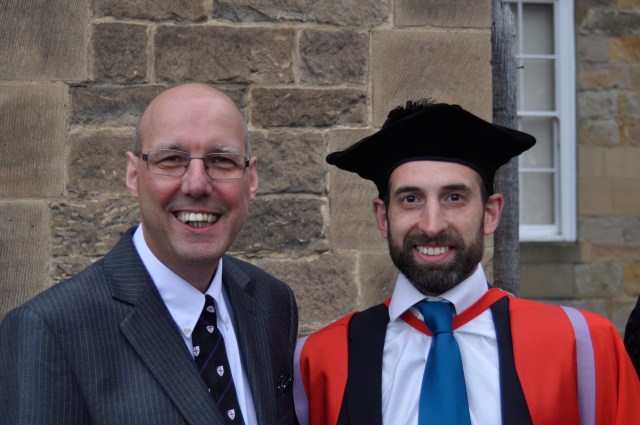
With my doctoral supervisor at congregation

With my doctoral supervisor at congregation

a glorious few days in Northumberland with my brother (#3) and a friend over Easter

Lindisfarne

Lindisfarne

…extended periods of cat and dog sitting…

DSCF3686

a weekend in Cambridge with my brother (#3)

Punting in Cambridge

Punting in Cambridge

…lots of knitting…

A baby blanket, one of this year’s creation

…being treated to tickets to a one day international match between England and New Zealand by my brother (#3)…

Final England vs. New Zealand ODI at Chester Le Street

Final England vs. New Zealand ODI at Chester Le Street

a holiday in Whitby, where we were joined by my brother (#1) and his family…

Whitby

Whitby

visiting my brother (#2) in the South of France

A beach where we swam in the Calanques

…the birth of my second niece…

…and making a wookie gingerbread church with a seven year old friend of mine!

A Wookie Gingerbread Church

Looking forward to 2016, I have some substantial writing projects that will demand my attention, which is why my return to blogging is only temporary. If all goes according to plan I expect that I will write well over half a million words for publication in some form or other during the course of the year. I am looking forward to a number of books that will be coming out during the year, perhaps especially to the first part of Peter Leithart’s commentary on Revelation. I expect to read over one hundred books next year, although, unfortunately, I don’t expect that I will have as much time as I would like for leisure reading. I am looking forward to many board games evenings, a lot of walking, some knitting, visiting a few cathedral cities with my girlfriend after a long time apart, a holiday over Easter with my brother (#3), and hopefully catching up with some friends in the US at a conference in June. I have had much opportunity to delight in God’s goodness in 2015 and look forward to the chance to make the most of his gift of another year!

What have been your highlights of 2015? What are you looking forward to in 2016?

Posted in Just for Fun, My Doings, Photos, Public Service Announcement, What I'm Doing, What I'm Reading | 14 Comments

Podcast: End of the Year

Mere FidelityOur final Mere Fidelity episode of 2015 has just been posted. Within it we discuss the highlights of our year, what we are looking forward to in 2016, and what we think about new year’s resolutions.

You can also follow the podcast on iTunes, or using this RSS feed. Listen to past episodes on Soundcloud and on this page on my blog.

*WE ARE CURRENTLY LOOKING FOR PEOPLE TO HELP US TO COVER THE MONTHLY EXPENSES OF THE PODCAST. PLEASE VISIT OUR PATREON PAGE*

Posted in Just for Fun, Podcasts, What I'm Doing, What I'm Reading | 1 Comment

Open Mic Thread 45

Mic

The open mic thread is where you have the floor and can raise or discuss issues of your choice. There is no such thing as off-topic here. The comments of this thread are free for you to:

  • Discuss things that you have been reading/listening to/watching recently
  • Share interesting links
  • Share stimulating discussions in comment threads
  • Ask questions
  • Put forward a position for more general discussion
  • Tell us about yourself and your interests
  • Publicize your blog, book, conference, etc.
  • Draw our intention to worthy thinkers, charities, ministries, books, and events
  • Post reviews
  • Suggest topics for future posts
  • Use as a bulletin board
  • Etc.

Over to you!

Earlier open mic threads:
123456789101112131415161718192021222324,25,26,27,28,29,30,31,32,33, 34, 35, 36, 37, 38, 39, 40, 41, 42, 43, 44.

Posted in Open Mic | 36 Comments

The Politics of Continual Thanksgiving

The Political Theology Today blog has been offline over the past week, so my latest post has gone up a week late.

To some, this defining Christian practice of thanksgiving may appear to be rather unpromising as a source of political challenge. Indeed, it may be at such points that the force of Marx’s designation of religion as the ‘opium of the people’ makes itself felt: continual thanksgiving prevents us from articulating and addressing our suffering and keeps us compliant with powers that bind us. Yet, as Peter Leithart observes in his recent book, Gratitude: An Intellectual History, the Christian approach to gratitude is profoundly subversive, especially within patronage cultures where political and social advancement and dominance arise in large measure through unilateral impositions of obligation and the gaining of honor by means of gift-giving.

Within the first century world, the New Testament’s teaching concerning gift-giving and reception was a threatening one, not least in how persistent it was in directing thanksgiving to God over all others. This determined rendering of thanks to God undermined the leverage of the powerfully obliging reciprocities that dominated social life and the hierarchies that they produced and sustained. It made possible the ‘ingratitude’ of departing from tradition, of leaving father and mother to follow Christ, and of reneging on the imposed social debts by which patrons and powerful ‘benefactors’ secured their power; by firmly directing gratitude to God it resisted the supposed entitlement of the wealthy to employ God’s gifts to them as means of accruing power by imposing debts upon others. The new form of gift economy established by Christ and the apostles led to the eschewing of honor competitions, to releasing others from debt, and to the replacement of the vicious asymmetries of hierarchical patron-client gift relations with those of mutual patronage.

Read the whole thing here.

Posted in Bible, Colossians, Culture, Ethics, Guest Post, NT, Politics, Society, The Church, Theological, Worship | 2 Comments

Review of Nate Pyle’s Man Enough

My review of Nate Pyle’s Man Enough: How Jesus Redefines Manhood has just been published over on The Gospel Coalition website.

Pyle’s discussion of “proving” manhood would’ve also benefited from more careful attention to the ways manhood can be defined in opposition to boyhood. Manhood is less about the traits that supposedly are or should be universally attendant upon maleness than it is about those characteristics that distinguish the mature man who has left boyhood behind him.

Pyle’s challenge to the direct pursuit of masculinity is in many respects salutary: manhood develops most appropriately when we pursue the kingdom of God rather than an idol of masculinity itself (and manhood differs from masculinity on account of its focus on maturity). However, the inadequacies of Pyle’s account—in part on account of his egalitarianism, in part on account of his focus on individual authenticity, and in part on account of his failure to attend closely to the form of maturity in and perfection of maleness—are most betrayed in its failure to give any shape to the concept of manliness. While, as Pyle argues, men and women aren’t called to different sets of virtues, their relation to and expression of these virtues do differ. Men and women may be compared to two different instruments playing the same notes, the difference between them immediately discernible by even the untrained ear, though often difficult to articulate.

What is “natural” to a human male isn’t simply what he does instinctively or spontaneously, but also those virtues in which male nature is perfected in his distinctive version of it. Pyle is right to oppose the hegemony of warrior manliness, but he errs in retreating from the concepts of male nature and corresponding manly virtues to the bare descriptive recognition that certain traits are more common among males.

Read the whole thing here.

Posted in Christian Experience, Controversies, Culture, Ethics, Guest Post, My Reading, Reviews, Sex and Sexuality, Society, Theological | 5 Comments

Podcast: The Christmas of History and the Christmas of Faith

In this week’s episode of Mere Fidelity, AnMere Fidelitydrew, Derek and I discuss the relationship between the Christmas of history and the Christmas of faith. Many of our carols and Christmas hymns, our retellings of the Christmas story, and our Nativity plays contain details and features that jar with the events as they are recorded in the gospels. Is there any way to reconcile the two? Can ‘contextualization’ excuse factual and historical inaccuracies? The sentimental portrait of the events of the first Christmas that we inherit from the Victorians also seems rather alienated from the heat and dust—or was it cold and snow?—of first century Israel. Can we connect our celebration to the events that actually occurred? Listen to the podcast to find out what we think and share your own thoughts in the comments!

You can also follow the podcast on iTunes, or using this RSS feed. Listen to past episodes on Soundcloud and on this page on my blog.

*WE ARE CURRENTLY LOOKING FOR PEOPLE TO HELP US TO COVER THE MONTHLY EXPENSES OF THE PODCAST. PLEASE VISIT OUR PATREON PAGE*


Posted in Bible, Controversies, Culture, Luke, Matthew, N.T. Wright, NT, NT Theology, Podcasts, Society, Theological, Worship | Leave a comment

Transfigured Hermeneutics—Part 2: Transfiguration and Exodus

The second of my ten part series of posts on the Transfiguration and Christian reading of Scripture has just been published over on Reformation21 (if you haven’t already read it, the first part is here).

Luke’s account of the Transfiguration is situated within a broader Exodus pattern in chapter 9. Signs and wonders are performed by Jesus and the Twelve, leading the Pharaoh-like Herod–who, like Joseph’s Pharaoh in Genesis 40:20-22, had just celebrated his birthday with an execution (Matthew 14:1-12)–to seek to see Jesus for himself. Jesus then goes out into the wilderness, where he is followed by a multitude (Luke 9:10-11John 6:1 refers to Jesus crossing a sea to do so).

The feeding of the five thousand in the wilderness is a food miracle with similarities to God’s provision of manna for the children of Israel during the Exodus. While within the gospel of Luke the connection is established chiefly by literary framing and echoes, John’s gospel makes the connection more apparent within the bread from heaven discourse that follows the miracle. Jesus’ delegation of the ordering of the multitude to his disciples is reminiscent of Moses’ delegation of the rule of the multitude of the Israelites to the elders in Exodus 18. In Mark 6:40, the people are described as sitting down in ranks, in fifties and hundreds, as if in military array. The numbering of the males and the division of the 5,000 into groups of 50 might also recall the numbering of the people in the wilderness (Numbers 1 and 26) and the departure from Egypt and entrance into the Promised Land in companies of fifty (see the Hebrew of Exodus 13:18 and Joshua 1:14).

Read the whole piece here.

Posted in Bible, Exodus, Guest Post, Hermeneutics, Luke, NT, NT Theology, OT, Theological | Leave a comment

Embracing Embodiment: Baptism and the Nuptial Meaning of the Body

The final part of my three part series on baptism and the body has just been posted over on the Theopolis Institute website.

Despite its familiarity, 1 Corinthians 6:19a is a scriptural text that retains much of its capacity to surprise: “do you not know that your body is the temple of the Holy Spirit…?” The body isn’t just claimed for God’s ownership or service, but is presented as a site of his personal residence and of our communion with him. While within my account the body has hitherto featured principally as the objectivity and givenness of the self or as the grounds of its agency, here the ‘exteriority’ of the body is seen to implicate and be entangled with our deepest ‘interiority’.

The Möbius strip-like unity between self and body to which we can be awakened in sexual relations is the basis for the profoundly personal nuptial union. It is not accidental that Paul treats the profound power of bodily union to effect personal union in the verses that immediately precede 1 Corinthians 6:19. As Paul argues in verse 18, sexual relations, as they directly relate to the fundamental reality of our embodiment—of our being and not just having bodies—implicate the whole person in an especially profound manner. To sexually unite with someone is to be personally united to them in an enduring fashion. The body isn’t just aninstrument of sexual pleasure, but a means of self-donation, personal union and communion. Because of the personal character of the body, through their bodily interactions persons can commune with and indwell each other.

Read the whole piece here. If you have not already done so, I recommend reading the earlier posts in the series first—Sealed for Resurrection: Baptism and the Objectivity of the Body and Presenting Limbs and Organs: Baptism and Sacrificial Ethics.

Posted in 1 Corinthians, Bible, Christian Experience, Ethics, Guest Post, NT, NT Theology, Sacramental Theology, Sex and Sexuality, The Sacraments, Theological, Theology | Leave a comment

Open Mic Thread 44

Mic

The open mic thread is where you have the floor and can raise or discuss issues of your choice. There is no such thing as off-topic here. The comments of this thread are free for you to:

  • Discuss things that you have been reading/listening to/watching recently
  • Share interesting links
  • Share stimulating discussions in comment threads
  • Ask questions
  • Put forward a position for more general discussion
  • Tell us about yourself and your interests
  • Publicize your blog, book, conference, etc.
  • Draw our intention to worthy thinkers, charities, ministries, books, and events
  • Post reviews
  • Suggest topics for future posts
  • Use as a bulletin board
  • Etc.

Over to you!

As I am currently taking a break both from standard blogging and from commenting, I won’t be participating in these threads for a few months.

Earlier open mic threads:
123456789101112131415161718192021222324,25,26,27,28,29,30,31,32, 33, 34, 35, 36, 37, 38, 39, 40, 41, 42, 43.

Posted in Open Mic | 12 Comments

Mere Fidelity Archives

Mere Fidelity

I have revamped the links to old Mere Fidelity episodes on this blog. Formerly, all of the episodes were on a single page, which took forever to load if one had a slower connection. Now you can get to past episodes easily by hovering over the ‘Mere Fidelity’ tab in the title bar above and clicking on the set of five episodes that you wish to see. Alternatively, you can click on the tab itself, which leads to a list of all past episodes and a link to the episodes that you want.

Posted in Podcasts | Leave a comment