Why We Should Be More Sceptical of Myers-Briggs

Mere Orthodoxy (which you really should be following) has guest posted a piece of mine entitled ‘The Dangers of Appealing to Personality Type’. Within it I make a case for a sceptical approach to personality tests such as Myers-Briggs.

Everyone wants to believe that the mere possession of a particular personality type gives them some sort of privileged access to or claim upon reality, society, or set of skills. Keirsey’s Temperament Sorter, closely associated with the MBTI, will assign you an identity on the basis of the result of your personality test. Here everyone’s a winner. It will designate you as an ‘inventor’, a ‘mastermind’, a ‘fieldmarshal’, a ‘champion’, a ‘healer’, or an ‘architect’ on no more sure of a basis than the fact that your personality skews in a particular direction. This is all entirely independent of anything that you have ever achieved or skill you have developed. ‘English major’ may not yet be one of Keirsey’s temperaments, but Guyton employs it as if it were. When I discover that I am an ESFP or an INTJ, I can enjoy a sense of an innate superiority, entirely independent of actual work and achievement, which the world must acknowledge and validate. I am here reminded of Lady Catherine de Bourgh’s remark concerning the piano in Pride and Prejudice: ‘If I had ever learnt, I should have been a great proficient.’

Psychometric tests such as the MBTI promise to reveal deep truths about our personalities. Like the Sorting Hat in the Harry Potter books, through some mysterious alchemy, they will discern our true nature and assign us a named identity accordingly. The scientific basis of the claims of many psychometric tests such as the MBTI is highly dubious and their effectiveness probably has more than a little to do with such things as the Forer effect.

Nevertheless, personality typing can easily become powerfully constitutive of people’s sense of identity, as they start to think of themselves as their personality type in a fairly uncritical manner. The appeal of such tests is quite explicable: they offer a measure of resolution to the existential discomfort of the question ‘who am I?’, a question which is probably pressed upon us with greater urgency than ever before. While such a test may be an improvement on diverting online quizzes promising to reveal which characters I might be in various fictional universes, at least I do not go through life believing that Gandalf-likeness is a crucial key to my identity.

Read the whole thing here.

Posted in Guest Post, The Blogosphere | 7 Comments

Can Evangelicals See Themselves in the LGBT Movement?

Over the weekend I was invited to contribute a piece to the Christ & Pop Culture site. I wrote a short article interacting with a recent Rod Dreher post, which you can read here. Within it I argue that there are some ironic affinities between the LGBT movement and many evangelicals, most particularly when it comes to their approaches to the formation of subjectivity.

Here is one quotation from the piece:

The governing story at the heart of evangelicalism is the conversion narrative. This may be a controversial claim to make about a movement that purports to be driven by the story of the gospel, but careful observation of evangelicalism’s dynamics provides much evidence for its truth. For evangelicalism, the ‘gospel’ is typically framed, not as Scripture frames it—as the historical story of God’s salvation accomplished in his Son through the public events of Christ’s incarnation, ministry, death, resurrection, ascension, Pentecost, and his return in glory—but as the ‘story’ of how the sinful individual can be saved in the present. It is a story of how Christ can become an active part of my personal biography, rather than an historical account that stands apart from my biography, which I must enter as I die to myself and my old biography and become a part of Christ’s life. The difference may appear subtle, but it is immensely significant.

Read the whole thing here.

Posted in Controversies, Culture, Guest Post, Sex and Sexuality, The Blogosphere, Theological | 16 Comments

Secularization in Christianity’s Opposition to Pornography?

Sociological Images (well worth following, by the way) has just posted this fascinating piece on changes in Christian discourse in opposition to pornography:

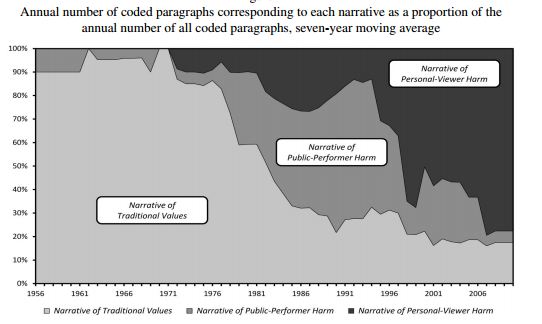
Sociologist Jeremy Thomas tested this proposition, looking at changes in how authors writing for the popular magazine Christianity Today frame their opposition to the use of pornography between 1956 and 2010 (articlesummary).  He compared three anti-pornography frames:

  • religious (e.g., against the bible, a sin),
  • harm to others (e.g., performers), and
  • harm to self (e.g., porn addiction, marital troubles).

Thomas found that the last frame — harm to self — had increasing come to dominate the discussion at Christianity Today.  This figure shows the proportion of paragraphs that make each argument.  The last frame clearly dominates.

10

Thomas calls this “outsourcing moral authority”: religious leaders are relying on other authorities to back up their points of view.  This suggests that even religion is undergoing secularization.

See the Sociological Images piece here. Read the original article here (if you are with an institution that gives you access).

Thoughts?

Posted in On the web, Sex and Sexuality, Theological | 14 Comments

Response to Hannon on Heterosexuality

Over on Mere Orthodoxy, Matthew Lee Anderson has written a helpful response to Michael Hannon’s recent First Things piece ‘Against Heterosexuality’.

I read Hannon’s piece over a week ago and had a number of concerns about it when I did so. While I share Hannon’s reservations about much orientation discourse, I was surprised to see so many people loudly praising his article, as it seemed to me that there were a number of serious flaws in it. For instance, even though Hannon observes the manner in which ‘orientation’ conversations shift ‘attention from objective purposes to subjective passions,’ it seemed to me that the article invited the notion of a sort of natural ‘queerness’, an ambivalence to our sexuality that is only settled as our sexual behaviours are related to some appropriate extrinsic end.

Identities and orientations are increasingly subjectivized, rooted solely in our passions and private self-understandings. The fact that, for instance, possession of a male body makes one a man and orients you to the other sex, irrespective of the—potentially disordered—orientation of one’s subjective desires and sense of one’s gender, is forgotten. The fact that being subjectively ordered in such a manner is normal and not merely common is also forgotten.

Matt writes:

Hannon’s claim emphasizes those who take ownership of the “heterosexual” label: his polemic is against those who are “self-proclaimed” as or people who are “identifying as” heterosexuals. But few heterosexuals think of their own sexual identity the way those with same-sex attraction tend to think of themselves *as* gay or lesbian. Their majority sexuality is simply the tacit backdrop on which people live out their lives rather than that-by-which they are differentiated.

My friend John Corvino will sometimes talk about heterosexual folks who take a line akin to “it’s fine if gay folks do their think, so long as they don’t flaunt it in public.” Only “flaunt it” happens to mean holding hands, or kissing, or doing what opposite-sex couples do in public all the time. Many heterosexual folks don’t feel the asymmetry, as we are unaware of the extent to which sexuality structures our lives outside the bedroom. But that also means the emergence of heterosexual desires in a person lacks the same kind of formative power that the emergence of opposite-sex desires often has. I doubt most “heterosexuals” would ever recognize themselves in the term, at least not without: they don’t need to, precisely because being a part of the “normal group” frees them from the burden of self-ascription.

In certain respects, these points tie in with my previous post about personal stories. The difference between orientation for a ‘heterosexual’ and a ‘homosexual’ could be described as the difference between two different types of stories. As Matt astutely observes, the cisgender ‘heterosexual’ doesn’t experience this identity as a self-ascription, as this identity is narrated for him from without and he merely enters into it. By contrast, the LGBT person locates their identity primarily in a story that they tell themselves about themselves. And that, as I suggested, can be problematic in a number of different ways. The inviolability of a person’s ‘orientation’ and ‘identity’ is not unrelated to a peculiarly contemporary approach to the status of the personal narrative, something which excludes any form of determination or challenge to our autonomy, including that of our very bodies.

While it is essential to recognize the pain and difficulty that can be involved in holding one’s identity in its most intimate dimensions exposed to judgment and questioning, and that this pain will be felt more keenly by some, this is a path that we are all called to take. We will best be equipped to bear the heavier burdens of others with them if we are walking the same way ourselves. One of the dangers in prevailing identity discourse is that Christians with different gender or sexual ‘identities’ or ‘orientations’, while appreciating the unique character of others’ struggles, may through an overemphasis upon this lose contact with those who would otherwise be known as examples, fellow-travellers, supporters, and friends in the common path of holiness.

Posted in Controversies, Sex and Sexuality, The Blogosphere, Theological | 11 Comments

Why We Shouldn’t Trust Our Stories

Earlier today, Derek Rishmawy posted a piece entitled ‘My Evangelical Story Isn’t So Bad (Or, a Ramble on Experience, Biography, & Theology)’. Within it he discusses his generally positive experience of growing up as an evangelical and how this colours his engagement with critiques and critics of the movement. He emphasizes the importance of recognizing that ours aren’t the only stories out there:

Often-times I’m so locked into seeing people as positions to be corrected, I forget that they are storied-people to be heard. People respond viscerally to words and concepts that have functioned fairly positively in my own life, many times because of our differing stories. My fairly positive Evangelical experience isn’t the only one out there, which is probably part of what accounts for the relative slowness with which I’ve embraced the theological changes I have made. I haven’t been in as much of an existential rush. If I don’t recognize that, I probably won’t be of much use to them as anything more than a sparring partner.

As we all appreciate that ours aren’t the only stories, we may also begin to realize that our story may be far from the whole story. This realization will have implications for all parties, challenging all of us to question what our personal experience may have led us to believe was an absolute. Derek proceeds to speak of the importance of Scripture in this area:

We need to see that in the Bible we have the normative, sacred story (made up of hundreds of little stories) of Creation, Fall, and Redemption that shines a light on all of our stories and experiences. Because we are sinful (fallen) and small (finite) we can’t even be sure of our interpretations of our experiences, but God gives us a new grid through which we learn to re-read our experiences properly. In a sense, when we submit to the Scriptures, what we’re saying is that God’s experiences and God’s story gets the final word over ours. It is the one story that we can trust because God’s perspective is not limited, weighed down with baggage, or ignorantly blind like ours tend to be. It’s the story big enough to encompass all of our stories without denying, or ignoring them.

Derek’s post is worth reading and thinking about. What I want to do here is to pick up on a key issue that surfaces within it, an issue which I have reflected upon at various points recently.

The point in question concerns ‘stories’. ‘Story’ and ‘narrative’ have been all the rage in evangelical circles for several years now, somewhat eclipsing aging categories such as ‘worldview’. The presence of ‘narrative’ and ‘story’ within Scripture can often be appealed to as proof of the importance of this category. Unfortunately, the way that ‘narrative’ functions within Scripture is seldom given the sort of close attention that it merits, nor is it permitted to provide the norm for our employment of the category. Instead, the newly baptized category, exiled from its biblical roots, is then typically put to service within a foreign land of existential self-accounting.

The fact that scriptural narrative, in contrast to much preaching upon it, is not typically focused upon the subjective states, inner lives, and autonomous identities of its protagonists is seldom properly recognized. While Scripture speaks of many particular persons, it does not share the type of emphasis that our culture places upon individuality and personal narratives. Where we have elevated ‘personality’, often to the neglect of ‘character’, Scripture presents us with limited clues to the ‘personalities’ of its characters and seems to have little interest in the matter. In God’s eternal wisdom, he did not choose to reveal Jesus’ MBTI personality type.

In Scripture, individuals find much of their significance within the larger stories to which they contribute and in terms of the typological roles that they perform. Biblical characters are pretty ‘flat’, rather than possessing the ‘rich internal life’ that the self-reflection encouraged by such things as widespread diary-writing and the modern novel has accustomed us to. First person autobiographical narratives are not the norm. Rather, biblical narrative situates people within a story that is not their own and speaks of them from a third person perspective that clearly relativizes their self-accounts.

The valorization of people’s autobiographical narratives in certain circles has attained such heights that some have even referred to them as ‘sacred’. A person’s self-account is increasingly treated as inviolable and beyond challenge. While the motives for this might be well-meaning and even laudable—typically characterized by a desire to empathize with people, to treat them with dignity and sensitivity, and to attend to where they are coming from—the results can often be dangerous and unhealthy.

The chief issue here is the failure to recognize just how limited and deceptive personal narratives can be. Slavoj Žižek writes (borrowed from this post):

The first lesson of psychoanalysis here is that this “richness of inner life” is fundamentally fake: it is a screen, a false distance, whose function is, as it were, to save my appearance. … The experience we have of our lives from within, the story we tell ourselves about ourselves in order to account for what we are doing, is thus a lie—the truth lies rather outside, in what we do.

A man with a rich internal life

Personal stories can have the most profoundly distorting effect upon our moral judgment. By playing up the ‘luxurious’ details of personality and the ‘depth’ of individual character, we can blind ourselves to the true ethical nature of actions. Žižek’s phraseology is important—‘the story we tell ourselves about ourselves in order to account for what we are doing’—and captures a number of important matters. First, ‘our story’ is not some eternal truth, but an account told by interested and unreliable narrators—ourselves—and should be handled very carefully as a result. Second, not only are we the narrators of our own stories but we are also the primary hearers—it is a story we ‘tell ourselves about ourselves.’ We are the ones most easily and typically deceived (usually willingly) by our own unreliable narration. Third, it is a story told ‘in order to account for what we are doing.’ As such it is a story typically designed to help us live with ourselves and our actions. It is usually a rationalization, an attempt to make sense of our actions retrospectively, in a manner that acts as a defence against the harshness of the ethical or rational judgment that they might otherwise provoke.

In short, we need to be a lot more critical of our own stories and a lot more cautious when it comes to those of others. We have been practicing our wilfully distorting and self-exculpating narrations on ourselves for our entire lives and are past masters at it. Žižek quotes Elfriede Jelinek, observing the broader ethical wisdom in his understanding of theatre:

Characters on stage should be flat, like clothes in a fashion show: what you get should be no more than what you see. Psychological realism is repulsive, because it allows us to escape unpalatable reality by taking shelter in the “luxuriousness” of personality, losing ourselves in the depth of individual character. The writer’s task is to block this manoeuvre, to chase us off to a point from which we can view the horror with a dispassionate eye.

How does all of this relate to the issues that Derek raises in his post?

We ought to be a lot less indulgent when it comes to personal stories more generally, a lot more alert to the ways that they are most fertile grounds for the deception of ourselves and others, and a lot more prepared to call them into question. Personal stories, while they should not be excluded, should not be treated as ‘sacred’, but subject to testing and judgment. This is a challenge to the way that certain quarters of contemporary evangelicalism increasingly advance their positions in the form of personal narratives, rather than in open and rational discourse and argumentation, and treat all criticism as if it were personal attack.

The elevation of the personal story to an inviolable status is related to a move towards a different understanding of truth and ethics, as I have remarked before:

[W]ithin such an ethic, we gradually become the measure of our own selves. As this occurs, we cease to be expected to act in accordance with higher norms, principles, and realities, which provide criteria by which our lives can be judged and by which we can be held accountable. As truth is increasingly situated within the incommensurable particularity of people’s subjective narratives, our moral principles become partial truths—true for me, but perhaps not for you—bespoke rules that will sit awkwardly on other’s shoulders.

With this ethic comes a new form of discourse, a greater dependence upon a conversational and self-revelatory style, and typically leads to an overflowing of mutual affirmation. Any truth that claims to be public or objective is treated with great suspicion. When truth is largely situated in the subjective narrative and the immediacy of the feelings that ground it, ‘objective’ truth could only be the tyrannical and power-hungry masquerade of an imperious subjectivity (typically perceived to be that of the privileged white male). In such a context, any impression that the subjective narrative might be invalidated, challenged, or subordinated to a greater narrative will typically be reacted to with outrage, especially if white privileged males are seen to be doing this.

Recognizing the way that the personal narrative can function, we should appreciate the pernicious way in which it can often be used as a trump card, to close down debate. The personal story, especially if it is a painful one, is immune to challenge and is thus a convenient way to advance positions in a manner that prevents others from calling them into question, for to do so would be cruel and insensitive (I have addressed some of the dynamics of this here).

The first and most important application of this questioning of stories is always to our own stories. For instance, those of us who experienced an evangelical upbringing in predominantly positive terms and in relation to people we love and care about should be a lot more sceptical of our stories. We should recognize the ways in which our stories can whitewash our own actions, or the actions of people we love, through ‘psychological realism,’ failing to attend to the actual damage that we may have caused (this ethically blinding effect can be most powerfully seen in the moral latitude that can be afforded to people with ‘big personalities’). If we were to examine our actions more objectively, apart from the lens of our own stories, the starkness of reality would present our characters and those of the people that we love in a much less flattering light. This is uncomfortable but necessary. Starting from a position where we are prepared to subject our own stories to external judgment and to seek and learn how imaginatively to step outside of our own experiences is a crucial stage of personal and spiritual development.

The second application is to be much less credulous in our handling of the stories of others. The fact that a person’s story is something about which they are highly sensitive and in which they are deeply personally invested doesn’t mean that their story is true or ‘sacred’. We are often the most sensitive about the very lies that we use to suppress unwelcome truths within ourselves. While we should engage with people’s stories, we shouldn’t always take them at face-value. Derek actually raised this in a post that proved rather controversial some time back:

Keller illustrated the point by talking about a tactic, one that he admittedly said was almost too cruel to use, that an old college pastor associate of his used when catching up with college students who were home from school. He’d ask them to grab coffee with him to catch up on life. When he’d come to the state of their spiritual lives, they’d often hem and haw, talking about the difficulties and doubts now that they’d taken a little philosophy, or maybe a science class or two, and how it all started to shake the foundations. At that point, he’d look at them and ask one question, “So who have you been sleeping with?” Shocked, their faces would inevitably fall and say something along the lines of, “How did you know?” or a real conversation would ensue. Keller pointed out that it’s a pretty easy bet that when you have a kid coming home with questions about evolution or philosophy, or some such issue, the prior issue is a troubled conscience. Honestly, as a Millennial and college director myself, I’ve seen it with a number of my friends and students—the Bible unsurprisingly starts to become a lot more “doubtful” for some of them once they’d had sex.

While we shouldn’t adopt a hermeneutic of extreme suspicion when anyone tells us about themselves, we should recognize that we are all unreliable narrators, most especially when we are unwittingly trying to rationalize our actions to ourselves, and should treat people’s narratives accordingly. There are occasions when, taking people’s narratives at face value, we can become complicit in their self-deception. This requires prudence and discretion: there are occasions when people should be told clearly that their story is ‘bullshit’ and others when we must be exceedingly gentle in unsettling people’s unreliable accounts of themselves.

Within the post that I am interacting with here, Derek is primarily dealing with painful narratives of mistreatment or abuse, which would definitely fall under the latter approach. However, even an autobiographical narrative of abuse needs to be held in question in certain regards. This needn’t mean denying that abuse occurred. However, it should involve preparedness to question the account that is given of that abuse in certain regards. The narrative that is given of the abuse is not the same thing as its objective historical reality: the first can be questioned without denying the second. For instance, as Derek argues, ‘abuse doesn’t take away proper use’ and many narratives of abuse generalize from experiences of abuse to condemn non-abusive practices or teachings that were misused or twisted in their experience.

What I am advocating here is a serious tempering of the current fixation upon personal ‘story’ in evangelical circles. I believe that the degree of emphasis upon them is ethically dangerous and biblically unsupported. I am arguing for greater awareness of the contingency and artificiality of our stories, that they are things that we are constantly telling ourselves, rather than the actual reality of our past experiences. I am calling for increasing alertness to the deceptive and illusory character of the ‘rich internal self’ that these narratives depend upon. I am encouraging questioning of the prominence of personal narrative as a mode of evangelical discourse. I am suggesting that other people’s stories should not be off-limits when it comes to challenge and disagreement. I am calling all of us to be less trusting of the stories that we tell ourselves, more prepared to subject those stories to external judgment and critique, and more practiced in imaginatively stepping outside of our own stories and experience to see how our actions might appear from other perspectives.

My story is a story that I tell myself about myself in order to account for what I am doing. My story is not myself, no matter how closely invested I might be in it. Often it may be a tissue of lies designed to protect me from the unwelcome reality of who I am. My story can be invalidated without my deepest identity being invalidated. The subjection of my life to the narration of Another, to a narration that unsettles and overturns my self-exculpations, to a narration that exposes my deceit and punctures the comforting delusions, is a crucial dimension of Christian faith.

In the judgment cast upon our personal stories, we discover that we are being given another, better Story. It is no longer the self-narrated ‘I’ who lives, but the ‘I’ who is, by the breath of the Spirit, being re-narrated in the form of the story of Christ. Through the assurance of this re-narration, we are freed to distance ourselves from our own old narrations, to confess sins, to admit fault, to acknowledge blindness and weakness, to request forgiveness, to know ourselves to be in the wrong, to hold ourselves and our stories open to question. None of these things can challenge our identity, but only secure it.

Posted in Controversies, The Blogosphere, Theological | 39 Comments

Priestly Service in Romans 6

Crossing of the Red Sea - Chagall

Crossing of the Red Sea – Marc Chagall

A few weeks ago I heard a sermon on Romans 6:15-23, during which a number of questions were raised in my mind about the way that the passage should be read. Seeing the second half of Romans 6 referenced in a piece I was reading this morning, I had cause to reflect upon it again. While I am not certain about whether the following is the correct way to interpret the passage in every respect, I think that it might help to provide a somewhat deeper reading than that which I have generally encountered.

The main detail upon which I am focusing is the theme of two ‘slaveries’ or states of ‘servanthood’. In the majority of the approaches that I encounter, it is the paradoxical dimension of this that is emphasized: the fact that we are released from slavery through slavery. While this paradox can be played up for rhetorical effect, I suspect that, on account of our particular cultural understanding of slavery, we are inclined seriously to misplace Paul’s accent here. As our focus is drawn to the paradoxical relationship between freedom and slavery within the passage (which is actually more of a set of contrasts than a genuine paradox), I believe that Paul’s primary point can be obscured. On account of how sharply the slavery/freedom contrast operates in our understanding, the contrast between the two forms of slavery and the fact that the ‘slavery of righteousness’ is a particular elevated status that we are more accustomed to speaking of in quite different terminology is not adequately recognized.

In moving towards a slightly different way of reading the passage, the primary clue that we can attend to is the fact that Romans 5-8 is rooted in the pattern of the Exodus narrative. As N.T. Wright argues in his article ‘New Exodus, New Inheritance’, a first century Jew hearing of liberation from slavery through water would have thought of the Exodus. Wright remarks of the larger pattern of Romans 5-8:

We could summarize the narrative sequence as follows: those who were enslaved in the “Egypt” of sin, an enslavement the law only exacerbated, have been set free by the “Red Sea” event of baptism, since in baptism they are joined to the Messiah, whose death and resurrection are accounted as theirs. They are now given as their guide, not indeed the law, which, although given by God, is unable to do more than condemn them for their sin, but the Spirit, so that the Mosaic covenant is replaced, as Jeremiah and Ezekiel said it would be, with the covenant written on the hearts of God’s people by God’s own Spirit.

The Spirit of God then leads the redeemed people of God to the Promised Land of new creation. As Wright argues, this pattern is homologous with the Old Testament narrative of the Exodus. Although I believe that Wright overstates how clearly apparent this pattern is, I believe that he is right to notice it.

Does this pattern cast any light on the meaning of the phrase ‘slaves of righteousness’ and upon why deliverance from slavery to sin should have the character of entrance into a new form of slavery? I believe that it does. Probably in large measure on account of the cultural understanding of slavery I have already mentioned, the story of the Exodus is popularly read in terms of a sharp slavery/freedom antithesis. However, the story of the Exodus itself is one of freedom from service in order to enter into another form of service (I’ve made this case in more detail in one of my 40 Days of Exodus posts).

The Exodus is framed by God’s insistence that Pharaoh release his people so that they can ‘serve’ him (Exodus 7:16; 8:1, 20; 9:1, 13; 10:3). In fact, in Exodus there is more reference to slavery/servanthood with reference to what the Israelites are moving to than with reference to what they are coming from. The book of Exodus is not chiefly framed by a slave/free contrast. In fact, Peter Williams argues that themes of slavery with reference to Israel’s state in Egypt are muted in Exodus. The book of Exodus (somewhat in contrast to Deuteronomy) speaks of bringing Israel out from bitter oppression, but does not typically characterize Israel as Pharaoh’s servants. Israel is God’s son and Pharaoh is wrongfully claiming and oppressing them.

When Egypt is spoken of as the ‘house of bondage’ (or the ‘house of servants’), it may well not be the Israelites to whom reference is being made, but rather the Egyptians. Throughout the narrative of the first few chapters of Exodus, consistent reference is made to the Egyptians as the ‘servants’ of Pharaoh (Exodus 7:10, 20; 8:3, 4, 9, 11, 21, 29, 31; 9:14, 20, 30, 34; 10:1, 6, 7; 11:3, 8; 12:30; 14:5). Israel is being delivered from the low status of cruel oppression by a land of servants (cf. Genesis 47:18-25) to consecration as the royal administrators of YHWH.

Entrance into this new service takes place at Sinai, where the covenant is made and where the tabernacle and its service are established. The setting apart of Israel as a royal priesthood at Sinai was their entrance into a new form of servanthood. As I wrote in my earlier post: ‘The story of the Exodus is the story of the movement from slavery to Pharaoh in the Egyptian house of bondage, building store cities, to service as royal priests in YHWH’s house and building the tabernacle.’

In summary, therefore, Israel didn’t cease to be servants in the book of Exodus (and the sharp linguistic and conceptual distinctions that we draw between ‘slaves’ and ‘servants’ are not present in the same way in Scripture). Framing the Exodus narrative in terms of our antithesis between slavery and freedom can cause us to miss or understate primary themes within the text, muddying the relationship between the second half of the book and the overarching movement of the narrative. The fundamental contrast in Exodus is not between slavery and freedom but between two types of service—service of Pharaoh and service of YHWH.

Peter Leithart, in this article, makes the case that the priest is a palace servant. The tabernacle/temple is the palace of God and the priest is the administrator of the royal household. What our focus upon the slavery/freedom antithesis and our casting of servanthood—which isn’t tidily differentiated from slavery—as a negative state causes us to miss is that being set apart as priestly servants of YHWH is a far higher status than mere freedom from Pharaoh. Thus, the true contrast should be between oppressive service under Pharaoh’s servants and elevation to the administration of the earthly palace of the Creator of the cosmos.

Returning to Romans 6, I believe that such recognition of the dynamic within the framing narrative can serve to bring the passage into a sharper focus. Now our reading of the passage will no longer be distracted by an undue emphasis upon a paradox of slavery and freedom, but will instead principally attend to the difference between two forms of service: the difference between cruel oppression under Sin and the exalted status of priestly service of God.

How might this enhance our reading of the passage?

The most significant change that it makes is that of bringing the world of the priesthood and the sacrificial system to the foreground of our imagination. Where our imagination would naturally reach to secular images of slavery (and, even then, most likely those of the antebellum American South than of the first century Roman Empire), we should now focus upon the tabernacle and temple and their service.

When thinking about the Law as it is discussed in the book of Romans, typically the focus is upon the Ten Commandments as the revelation of God’s will for all of humanity. Less attention is given to the importance of the Torah as that which established the service of the Tabernacle and the sacrificial system. As a result, we miss many of the key scriptural resonances of Paul’s language, not only of terms like ‘sin’, ‘death’, and ‘flesh’, but also of such things as ‘service’ and ‘holiness’.

If my suspicion is correct, then the theme of service that is introduced in chapter 6 provides a foundation upon which our reading of Romans 7 can operate, for instance. Romans 7 is describing Israel’s experience of priestly service under the Torah following Sinai. That priestly service revealed the Sin-Death-flesh nexus, primarily through the operations of death, uncleanness, and sacrifice within the Levitical system, rather than just on account of the reflexive knowledge of sinfulness as they looked at themselves in the mirror of the Ten Commandments. It is in the sacrificial system that Sin, Death, and the flesh truly reveal their character. While our salvation is homologous in many respects with Israel’s deliverance from Pharaoh and entrance into priestly service of God, within the new covenant recapitulation of the theme, the true priestly service that the Torah calls for will be rendered, not in the oldness of the letter, but in the newness of the Spirit of the risen Christ.

By bringing the world of the sacrificial system to the forefront of our minds, the subtle priestly themes of the passage start to emerge. When the passage speaks about ‘sanctification’ in verses 19 and 22, we should read this with a thicker sense: we are being consecrated for priestly service of God and access to his presence and ought to act in accordance with that fact. This consecration contrasts with the ‘uncleanness’ that previously characterized us. I also wonder whether the ‘lawlessness to lawlessness’ that Paul refers to in verse 19 might refer in part to the state of being without priestly status yielding action contrary to the will of God.

This, in turn, can strengthen the connection between the second half of Romans 6 and the first. This consecration for priestly service occurs definitively in the ritual of Baptism. As Leithart argues at considerable length in The Priesthood of the Plebs, the ritual of Baptism is patterned after the ritual of priestly installation in the Old Testament (cf. Exodus 40:12-15). Baptism ritually establishes us as priestly servants within the house of God, and now we must render the obedience of those who have received the honour of being consecrated for such service. While Leithart doesn’t draw the connection within the book, I believe that this passage reinforces his thesis.

Bringing the world of the priesthood, the tabernacle, and the sacrificial system to the foreground, we can also give more weight to possible sacrificial allusions within the text. When Paul speaks of ‘presenting’ and ‘offering’, it is the language of sacrifice. Coupled with this fact, it should be noticed that sacrifices were presented in the form of their members—separated into their constituent parts. As we present our members to God, we are being rendered a living sacrifice.

There is an analogy to be observed between the priest and the sacrifice. The priests and the sacrificial animals are consecrated to God in much the same way, becoming his possession. Priests had to be without disfigurement or defilement, like the sacrificial animals. They were brought near through a similar process. In Numbers 3, we see that God claimed the Levites for himself and in 8:11, we see that the Levites were all offered as a ‘wave offering’ to God. The priests were thus living sacrifices.

Priestly consecration also involved the presenting of members for service to God. As part of the rite of priestly installation, the priest had blood daubed on his right big toe, his right eye, and the thumb of his right hand (Exodus 29:20—as every Israelite male already had a blood rite performed on his penis, Leithart helpfully observes that this corresponds with the blood daubed on the four horns of the altar in Exodus 29:12). The ritual set apart the principal members of the body of the priest for divine service. Paul sees a similar thing occurring to the Christian. Having been washed with consecrating water (cf. Exodus 29:4), we must now present our members to God in service.

The themes that are more subtly present beneath the surface of the text in Romans 6 come to full and open expression in Romans 12:1: ‘I beseech you therefore, brethren, by the mercies of God, that you present your bodies a living sacrifice, holy, acceptable to God, which is your reasonable service.’ The priestly sacrifice of our bodies to God in consecrated service, enacted definitively in baptism, establishes the continuing pattern of our Christian life from that point onwards. As we are baptized into Christ and his priestly death, our bodies and the service of our members are rendered sacrifices that are well-pleasing to God. We once laboured under the cruel and death-bringing bondage of the reign of Sin, offering up to him the service of our members, but now we have been delivered from his tyranny, washed and consecrated for priestly ministry to the life-giving Lord of the universe.

Posted in Bible, Exodus, NT, NT Theology, OT, OT Theology, Romans, Soteriology, The Sacraments, Theological | 10 Comments

Continuing Discussion of Women, Theology, and Representation

A few days ago, I wrote a lengthy post entitled Women, Theology, and Representation, which discussed the place of female theologians in evangelical theology. The intention of the piece was to raise some issues for discussion and debate, presenting some of the concerns and tensions that I believe exist in this area.

Since writing that post, a considerable amount more has been written in the comments, and I have written several lengthy responses.

Among the issues discussed are the following:

1. The group traits that encourage theological discourse and how these can be gendered.
2. Whether women can create an ecosystem of theological discourse outside of the guild.
3. Whether there are women whose theological contributions are not fully recognized because their insights are associated with their male collaborators.
4. The importance of informal contexts of theological discourse and securing women’s access to these.
5. Whether female theologians risk violating the biblical prohibition of women speaking in church.
6. What men and women can gain from sharing theological conversations.
7. The place and importance given to women’s ministries in the Church more generally.
8. The way that the Internet changes and affects the sorts of conversations that women participate in and have access to.
9. Differences between the sorts of theological conversations that one finds among men and women.
10. Whether the lack of prominent women in evangelical theology results from the failure to legitimate their voices and to take them as seriously as men.
11. Whether the proper representation of women in theology would require a 50/50 gender split.
12. The way that principles of inclusion and principles of representation differ and how they shape the discipline of theology in quite contrasting manners.
13. Whether theologians are inescapably privileged and whether we need to stop seeing this as a problem.

Take a look at the discussion so far, and please share your thoughts!

Posted in Controversies, The Church, Theological | Leave a comment

The Davenant Trust

The Davenant Trust has just been launched. Its mission is described as follows:

We aim to equip evangelical and Reformed Christians today for church leadership, civic participation, and faithful discipleship in other vocations as responsible citizens, by encouraging scholarly research into the time-tested resources of early Protestant theology, philosophy, ethics, civics, and jurisprudence, and by putting these resources at the disposal of the contemporary church.

I have been looking forward to this ever since I first heard about the plans for the trust last year. I have interacted and enjoyed friendship with some of the people on the board of directors for a while now and would wholeheartedly recommend this project to you. Please consider supporting and following the work of the trust in whatever way you can. This is important work.

(For any of you who can make it to Biola University in California on April 29th, this will be especially exciting news.)

Posted in Church History, On the web, Theological | 1 Comment

Why Religious People Are Ashamed of Porn

Marc over at Bad Catholic has a great post discussing the claim that religious people’s shame destroys their experience of sexuality. Discussing the relationship between the fact that religious people feel more shame about pornography yet supposedly have greater enjoyment of marital sex, he suggests:

It is for the same reason the religious feel shame over things like pornography that they are more likely to end up having wonderful sex lives. Shame enables great sex, and our inability to grasp this fact is because we have equivocated the word “shame” with “a negative, guilty feeling attached to doing some perceived evil,” when shame is actually a fascinating, positive power of the human person.

Shame receives a lot of bad press, much of it on account of the poisonous forms of shame to which some people have been exposed. Nevertheless, it can be deeply healthy. He continues:

Shame directs our consciousness to ourselves, making us aware that we are what is at issue, not some image of ourselves, some limited or lesser version. This is why shame is so often misappropriated as a bad thing — the reminder of our own unique person can be uncomfortable, as when we make a mistake during a public address and turn inwards in shame, full of the painful awareness that we are not a “public speaker,” but ourselves — screw-ups, all. Scheler sums up shame as “a protective feeling of the individual and his or her value against the whole sphere of what is public and general.” In this view shame is a positive good, and the “bad feelings” associated with it are really the feelings evoked by those conditions which necessitate our blushing rush to protect our individuality — the objectifying gaze, the dirty insinuation, or the public insult.

Shame returns us to a whole view of ourselves, and this is most felt when we are wrenched from a limited view of ourselves. Shame is “a counter-reaction grown into a feeling; it is the “anxiety” of the individual over falling prey to general notoriety, and over the individual’s higher value being pulled down by lower values.” This, I would argue, is the basis for an original, natural feeling of shame in regards to pornography and masturbation, a shame shared by atheist and Christian alike.

Masturbation and pornography are activities in which we are reduced in our humanity to ‘an organism pleasurably aroused by visual stimuli.’ Shame alerts us to this fact, and to the fuller horizon of our sexual personhood against which we see that these acts debase us. This shame is natural and healthy:

Religion is not the cause of the feeling of shame over the use of pornography. One need only reflect on the first, childish experience of pornography or masturbation to see the rather obvious fact that shame exists prior to education, prior to an articulation of a particular religious doctrine concerning pornography or masturbation, prior even, to any understanding of sex — we were naturally ashamed “quite independent of an experienced reproach” in regard to libidinous indulgences. No, religion does not cause shame. It provides a framework for its growth. Our current culture, on the other hand, is about the business of repressing shame. The ideologues of modern sexuality work hard to rid us of our silly shame, thereby working against our natural drive towards the higher and the better. Religion provides a haven from modern ideology, allowing shame to be realized as a positive power within the human person.

Shame confronts us with the reality that we are so much more. By attending to shame in a proper manner, we can be guided towards a much richer form of sexual life in faithful marital relations, one in which we express our sexual personhood in a manner that affirms our humanity in its fullness.

He concludes:

No, shame is a wonderful power of the person, and true religion, in preserving shame, makes it possible for us to attain a total enjoyment of sexual life, even in a world waylaid by the easy, the instant, and ultimately dissatisfying. It does this by turning us inwards to regard the whole of our person, quite apart from the reductions by which we so easily view as ourselves as a sexual organ to be gratified. Shame waits for the better, and I kind of like the fact.

Read the whole piece here.

Posted in Ethics, Sex and Sexuality, The Blogosphere | 3 Comments

Women, Theology, and Representation

Perhaps one of the most striking features of the list of the sixty most influential evangelical theologians that was recently posted here (which I took from Gerald Hiestand, over at the Center for Pastor Theologians) was the virtual absence of women from the list. In the sixty names on the list, only one woman was mentioned: Nancey Murphy. In the follow-up discussion, forty-four further names were mentioned and only two women were among them: Morna Hooker and Marva Dawn. If the list had been ranked according to the level of influence, I doubt that any of these figures would appear in the top fifty.

Obviously this collection of names is far from scientific (and the cases for the inclusion of several figures have, rightly I believe, been called into question). Nonetheless, the list does a pretty good job of accomplishing its original purpose: that of presenting a general impression of what the contemporary world of evangelical theology looks like. One of the questions that this general impression leaves us with is: where are the women?

The absence of women from this list rightly raises questions. The purpose of this post is not to answer them, but to sharpen some of these questions, raise counter-questions, and to invite a conversation around the subject. I hope that some of my readers will continue this discussion in the comments. My participation will probably be limited, but I am interested to see what others have to say.

Woman as Theologians in Evangelicalism

At the outset it should be recognized that the opportunities for women to become active voices in evangelical theology are quite limited compared to those of men. Unlike her male counterpart, an evangelical woman who studies theology is much less likely to have openings for pastoral leadership or theological teaching within the church. She is also likely to experience a number of limitations upon her involvement within an evangelical academic context. As a result, devoting the time and money that advanced theological education requires will be much more of a risk for her.

The fact that theology is such a male field and will tend to gravitate to male patterns of discourse and behaviour will itself be a disincentive. She will be unlikely to have many female peers and will have to cope with a context within which her presence may be considered to be an unwelcome intrusion by many, with all of the wearying ‘micro-aggressions’ that that can produce.

She will probably not have the same opportunities to network or the same teaching openings as her male peers. When she attends the meeting of the Evangelical Theological Society she will probably find that over 95% of the presenters are men (this is probably a conservative estimate) and that she is often presumed to be the wife of one of the presenters, rather than a theologian in her own right. Her influence within the politics of the church may be constrained on account of her inability to hold certain forms of office reserved for men. She will probably also experience some sort of pressure to address herself to women’s interests in particular, especially feminism, in a way that might lead to the marginalization of her concerns within the broader guild. Even when she does not focus upon such issues, but addresses theological questions that bear no immediate relation to the fact that she is a woman, she will find that many assume that she must be narrowly concerned with theology conditioned upon her gender.

If she does make it into academia, she will find that world is not well designed for a woman. It will make it difficult for her to marry and have children. Unless she has a supportive spouse who is prepared to put her career before his own, she may find it hard to progress in the academic world. Even if her husband takes a more egalitarian approach to their careers, the fact that husbands are usually older than their wives, probably more advanced in their careers, and the fact that academic theology doesn’t pay especially well, will tend to mean that his career takes priority and limits her chances to progress in hers, for practical reasons alone.

The problems also extend back, before the beginning of any formal theological education. Contexts of theological discourse may be heavily gendered and even rendered inaccessible to her. While the men’s group in her church discusses some theological book, the women’s group may devote itself to a less theological and heavily gendered discourse about women’s roles. When men prefer to enjoy theological sparring within the context of a more typically masculine dynamic of interaction, she may find it difficult to break into the conversation and that its vigorous and charged dynamics tend to shift as she enters. To enter the theological conversation, she may have to distance herself from female peers and seek to find some way into heavily male contexts.

When she goes online, she will probably find that contexts of general theological discourse are overwhelmingly male and, even if they attempt to be welcoming and inclusive, not a place where she can easily feel at home. When she looks around for role models, she will probably be hard-pressed to find many female theologians in a guild that is predominantly male, especially at the top. People are much less likely to encourage her to go into theology, as it is not seen as something that women do.

Putting all of this together—along with several factors not already mentioned—it will be an exceedingly difficult uphill struggle for any evangelical woman who wants to be a theologian. While often characterized as injustices and impositions of the patriarchy, I would suggest that most of the difficulties that women will face in this area have to do with the deep ruts driven by conventions, expectations, habits, and presumptions over time. These ruts guide women away from theology and, when they do succeed in entering into it, obstruct or limit their progress.

Rather than presuming some dark conspiracy to hold women out (when it is often the case that many within the world are actively trying to get more women involved), it is probably more accurate to recognize that the world of theology has been generally constructed by men, designed around them, that they have been trained towards it, and that little thought or provision has been made for preparing women for it, accommodating them within it, or furnishing them with roles that they can be prepared for through it. The way that the world of evangelical theology and the institutions that surround it generally operate, their current composition, the habits and expectations of theological education in churches, and the male-dominated character of theological discourse are features of a situation that was not designed to keep women out, but which frequently has that effect.

Rather than rushing to apportion blame or accusations of misogyny (both of which are warranted in some instances), I believe that it is best to begin by appreciating that, even in the absence of animosity or antagonism towards women, a situation can be created in which it is difficult for them to feel welcome or included. A world designed by and around men and chiefly populated by men will be fertile soil for the formation of a ‘boy’s club’ environment.

Once all of this has been recognized and processed, I think that we have good reason not to be so surprised at the lack of women on the list.

Comparisons with Other Contexts

In assessing the gender imbalance of evangelical theology, perhaps it might be worth comparing it to other related contexts. These contexts have a number of similar obstacles to women’s progress, although not quite to the same extent as evangelicalism.

For instance, an apt comparison might be with the representation of women at the top of the field of theology more generally, not just evangelical theology. While I suspect that more women would be on a list of the top 100 theologians of the past fifty years than would be on a list of the top 100 evangelical theologians of the past fifty years, I doubt that the overall balance would be that markedly changed. There are obviously some incredibly brilliant female theologians working today (I am presently reading books by Sarah Coakley and Catherine Pickstock, for instance, both of whom are top notch theological minds), but the field is still male-dominated. Furthermore, the number of famous female theologians who are famous for contributions to the field beyond the area of feminist theology is much more limited.

Another apt comparison might be with philosophy. Both theological and philosophical discourse can tend to adopt similar rhetorical and disputational forms. There are many other overlaps between the interests and culture of the two disciplines. I suspect that, if you compiled a list of the most influential philosophers of the last fifty years, much the same pattern would emerge. It is interesting to notice that both theology and philosophy have about the same male to female ratio at the PhD level, both being around 70% male. Like many other disciplines, once you break down theology into sub-disciplines the imbalance is often even starker. As I mentioned earlier, women can often be channelled into feminist theology, which often strikes me as, if not a ghetto, more peripheral to the wider field.

Problems with Inclusion

The successful entrance of women into such a world will typically lead to a call for some significant readjustments in order to accommodate them, some of which will seem quite demanding for those within. Certain of these changes will likely face resistance. As theology has historically been overwhelmingly male, it has come to develop a strongly male atmosphere and culture, one which still pervades in the present. Once again, this isn’t designed to be exclusionary but is typically a way of enjoying togetherness. However, it is very difficult for any woman to break into.

As a challenge to this atmosphere and its dynamics may genuinely make the prevailing forms of community and interaction within many theological groups difficult to sustain, the inclusion of women may not always be welcome. People may rightly appreciate and fear that the changes being called for may come at a heavy cost. Some of these changes may irreparably alter the form of evangelical theological community and discourse, sometimes in ways that may not be for the better.

I do not believe that this concern should lightly be dismissed. Many of us have recognized the sorts of changes that have occurred in other contexts and fields as they have sought to be more inclusionary. We have seen the development of a preoccupation with identity politics in many circles, a preoccupation which tends to ghettoize fields of enquiry, foster hermeneutics of suspicion, and normalize ad hominems directed at critics. We have also seen the concern for inclusion and validation increasingly standing in the way of the sort of forceful but civil disputation and discourse that used to be more characteristic of academia. We have seen the way that punches must be pulled as sensitive subjectivities become widespread in fields. We have seen the way that offence-taking closes conversations down. We have also seen the hyper-politicization of discourse, where concern to get the politics of discourse begins to eclipse the quest for truth.

None of this is a new problem, of course. The place of women in public oral disputation has been regarded as a problem for millennia. While we could lightly dismiss such concerns as misogynistic, the fact remains that we are still uncomfortable with subjecting women to the sort of confrontational and agonistic discourse that has historically been characteristic of much of academia and of men’s interactions more generally. Just as many of us dislike the idea of women on the frontline, feeling an instinctive urge to protect and not to subject women to such conflict, so the urge to protect women and not to fight them tends to affect the way that academic discourse is engaged in. The resultant change in the form of academic discourse can make it much less effective at its primary end.

This should lead us to pose some counter-questions. To what extent should the absence of women in the field of theology be considered a problem? Is equal gender presence in every field of human activity really such a good thing? To what extent should the discipline adapt to accommodate women and to what extent should women be encouraged to accommodate themselves to the discipline in something fairly similar to its current form?

The Need for Representation

‘Representation’ is a word that is frequently introduced into such conversations. We are told that women are not ‘represented’ within theology. What I would like to see is a little closer discussion of what exactly representation means or entails. Despite the fact that the issue is so frequently raised, it is seldom unpacked or explored. Considering how many assumptions exist about the concept of representation in our culture and how powerful the influence of these assumptions can be, I would like to see a little more work done in unpacking them.

Perhaps the first question that must be asked concerns the extent to which the representation of women and minorities is relevant to the ostensive tasks of the discipline of theology. I think that most would agree that some degree of representation (whatever we understand this term to mean) is important here. What is less clear is how significant it is.

I have had extended conversations with some who seem to believe that the theological understanding of the Anglophone church is overwhelmingly conditioned by its whiteness and maleness and that all of our understanding is distorted as a result. I find such a position quite unpersuasive, as it seems vastly to overstate the degree to which one’s understanding of the realities under discussion in theology are conditioned by one’s gendered, racial, or economic vantage point (a vantage point within the life of the Church does, however, condition a lot). Exactly how my maleness leads me to misunderstand, say, the Eucharistic theology of Luke, the operation of the Levitical system, or the historical development of Trinitarian orthodoxy is far from clearly apparent to me.

Is the purpose of representation directly related to our achievement of the ostensive end of the discipline of theology? Is the discipline of theology as it currently stands in some sense invalidated by the absence of women? Do we need lots more women primarily because it means that we will understand God and his truth so much better? Alternatively, is it directed towards the more general end of making the discipline of theology something that the broader constituency of the church can more immediately identify with and to encourage a situation in which a wider pool of theological talent can be drawn upon?

Sharpening this point, to what extent does the discipline of theology need representation and could broader representation even be a liability? In order to perform its primary task, does it need people to identify with the race and gender of its primary practitioners? If we are speaking about representation in the sense needed for identification, is there a danger that a quest for such representation will distract theology from its primary object and draw it into a potentially narcissistic preoccupation with its own subjective vantage points?

A male preference for theology seems to be fairly consistent with the male preference for related subjects such as philosophy. Other disciplines exhibit significant gender imbalances, often in the other direction. As already suggested, one of the factors may be the mode of theological and philosophical discourse, which can be more combative and disputational, bad ideas being rooted out fairly aggressively. If the composition of the discipline of theology markedly changed, is there the potential that it would become less effective, as its very mode of discourse might start to shift?

Could this preoccupation with ‘representation’ also be a theological liability as the catholicity of Christian theology is compromised or abandoned? Instead of doing theology for the Church, we risk starting to do theology for our own identity grouping instead, corroding the unity of the faith. In place of theology for a whole community, community is fragmented into identities, between which no theological voice can truly mediate, but each must speak for themselves alone.

What is Representation?

What exactly is ‘representation’? This question isn’t asked enough. Is representation a matter of effective advocacy for viewpoints? If this is the case, then it should be noticed that the most effective advocate is often not someone who belongs to the group that is being advocated for at all. A trained lawyer would be a better representative of my position than I would be in a courtroom situation, for instance. Our political and legal system are built upon concepts of representation within which the need for subjective identification with our representatives is not traditionally given such an emphasis.

In this sense, ‘representation’ doesn’t demand that the group being represented need be an immediate party to the conversation. The more popular understanding of representation, by contrast, seems to proceed on the assumption that it entails the direct presence of the represented party within the conversation itself. However, this is more commonly assumed than argued for. To what extent do we need to identify in a more immediate and personal sense with our leaders in order for them to represent us?

Even in the more popular sense, what exactly counts as representation? For instance, do we need equal numbers of women to men in politics for it to be ‘representative’? Is this position not at risk of suggesting that gender is a category that takes precedence over all others and is absolutely integral to the interests that are being represented in our politics? A politician is far more than just their gender, but represents a vast array of different concerns and interests, most of which have no direct relationship to their gender, many of which belong to identities that are not their own, and some of which even belong to the other gender.

When it comes to representation, identification can even prove a liability. For instance, to what extent is a female politician typical of women more generally? When we presume that it is shared identity that qualifies us for representation, we can forget the gulf that can exist between us and other people who apparently share our identity. I am often made acutely aware of the fact that I am not a typical Christian nor am I a typical man in many respects (and that there isn’t even such a thing as a typical Christian or a typical man in most cases). Consequently, I must learn to sensitize myself to others, recognize their needs, and appreciate their sense of identity in order to represent them and to advocate for their concerns. My possession of a Y chromosome doesn’t automatically qualify me to speak for my sex. When we recognize our difference with other people and our need to listen to them and understand them in order to advocate for them we are often at an advantage when compared to people who presume right be virtue of shared gender.

In the field of theology, most of the questions that are explored are explored in a manner representative of more general Christian concern (or perhaps the concern of a particular denomination or tradition), not concern that is explicitly male or female. In fact, one could even make a case that, with the extensive work of feminist theologians and others, specifically female concerns may be far more widely and explicitly represented in many theological contexts and conversations than specifically male ones.

Like politicians who don’t just represent one gender, it seems to me that the calling of the theologian is to do theology for the whole church, while recognizing that there are particular localized concerns within that body. It is not my calling to do theology for white Englishmen, but to do theology within and for the catholicity of the Church. Much as the Jewish Apostle Paul could advocate for specifically Gentile concerns, there is no reason why the localized concerns of parties within the larger body of the Church can’t be represented and advocated for by some other party.

Representation at the Table

How much representation is enough? Is it sufficient that perspectives of women that might be relevant to a given theological issue be mentioned in a broader conversation, even if they are mentioned by a man? How many women need to be immediately present in order for the viewpoints of women that might be relevant to the theological conversations in hand be heard? If a group of theologians are aware of and alert to the concerns of women, is it necessary that women be among them? Is the fact that there is only one woman on the list of most influential evangelical theologians sufficient proof that the concerns of women are not being represented in the field? Besides, do the top figures in every field always reflect its broader composition? Is there really a straightforward way that we could ensure the presence of women or of minorities among the geniuses at the top of a discipline, even if we wanted to?

Besides, is it even desirable to have a representative of every ‘subjectivity’ present at the table? Theological discourse is an elite conversation. It is a conversation for privileged persons and, in many respects, it presupposes the privilege of its participants. Being a theologian presupposes immense academic privilege, a privilege that only a tiny fraction of the Church’s members enjoy. Given the measure of this privilege, it can be hard for others to identify with your subjectivity, but this doesn’t mean that you can’t represent and advocate for them. Recognizing our privilege should give us a deeper sense of our responsibility.

In order successfully to have a challenging and combative conversation, one must also have a certain sense of one’s own security, in order not to take it personally. Such a secure identity is, for the most part, a preserve of the privileged. This isn’t just academic privilege, but is also social privilege. A thick skin is not so easy to come by when you feel that you are under threat.

A corollary of the points previously made is that the lack of academic and social privilege can be a liability for the integrity of theological discourse. When people lack the training to think at the highest level, the theological conversation is held back. Likewise, when people lack the capacity to sustain forceful disputation, theological discourse is also limited as a result, positions being protected from challenge on account of the heightened sensitivities of their advocates.

We recognize the importance of privileged advocates in the realm of law: I believe that we should also recognize it in the realm of theology.

I would suggest that the sort of representation that we need may be less a matter of including equal numbers of all groups at the table of theological conversation. Rather it may be an issue of maintaining a ‘conversation between conversations’, ensuring that the discourse of theology is always attentive to and sensitive to the needs and concerns of those within the Church, whoever they may be. Like the politician, the theologian has a duty to get to know his constituency and its members. He needs to appreciate the gulf that can exist between him and some on whose behalf he speaks. The mere sharing of some feature of identity with some marginalized group can blind us to the scale of our privilege. Recognizing the gulf, he must then listen and be attentive to those on the other side. It is such attention and conversation that will make him effective in the conversation of academic theology itself.

This process of hearing and of advocacy doesn’t mean that everything that a disadvantaged or vulnerable group holds must be affirmed or validated. One of the purposes of such advocacy is to subject such positions to the sort of rigorous challenge by which they must be tested, without thereby directly attacking the vulnerable persons in whose name they are advanced. When sensitive subjectivities are directly present at the table, such necessary discourse tends to break down.

All of this, I believe, pushes us to recognize that the role of the theologian as an advocate requires him to have deep roots within the Church. Being a part of a church where you are regularly exposed to and sensitized to the concerns of women, minorities, the poor, and other nationalities can accomplish much of the necessary exposure to other viewpoints and checking of our own. This is the theologian’s ‘constituency’ and detachment from it is a great liability. The theologian is principally called to operate on behalf of this constituency as a whole, rather than merely an identity grouping within it.

What might the Greater Representation and/or Presence of Women in Theology Change?

I have suggested a distinction between representation and direct identification. I have suggested that women can properly be represented within theology without being equally present within it as theologians. What could the greater representation of women’s concerns within theology change? Here are a few suggestions:

1. If theologians started to speak on behalf of and to represent the concerns of women more, women might identify more with the realm of theological discourse, appreciating it more fully as something that is done in their name as members of the Church. This could lead to greater theological interest among women.

2. Certain blindspots in our theological visions might be exposed as we became more attentive to other viewpoints within the Church.

3. New areas of theological interest and enquiry might be opened up.

4. The weight of theological interest and enquiry might be shifted in some areas. A greater sensitivity to certain aspects of theology might arise (for instance, the theological importance of the body).

5. A greater realization of the degree to which our theological vision is contingent upon our identities might be encouraged.

If, in addition to the greater representation of their concerns in theology, women were also more present and active within the theological conversation itself, most of these effects would be heightened and a number of further things might follow:

6. There would be more role models for young women who might otherwise not get involved in theology or continue in it.

7. More female and female-friendly contexts of theological discourse would arise or be developed.

8. There might be an increased preoccupation within the discipline of theology with its own constituent subjectivities.

9. Some changes to the mode of theological discourse might occur.

Many of these things strike me as positive or even extremely positive. However, there are definitely areas of concern here, concerns that I have laid out in more detail above.

At this point I am going to throw it open to you. How do you think that evangelical theology—and theology more generally—could be more welcoming to women? If your daughter showed an aptitude for or interest in theology, how do you believe that you or your church could encourage her in her earliest theological interest and development? In what specific ways would you like to see the evangelical theological and church world change to accommodate her?

What are some of the ways that evangelical theology and the Church more generally could benefit from a greater involvement of women? Do you believe that there are any legitimate concerns that can be raised about the potential changes that might result from a greater inclusion of women? If so, what do you believe that they are? If not, how could the concerns that others raise be answered?

How ought we to understand the representative task of Christian theology? How best can we ensure that the concerns of all parties within the Church are represented, while securing the integrity of the theological endeavour?

I probably won’t be commenting much (if at all), but I would love to hear everyone’s thoughts on this.

Posted in The Church, Theological, Uncategorized | 37 Comments