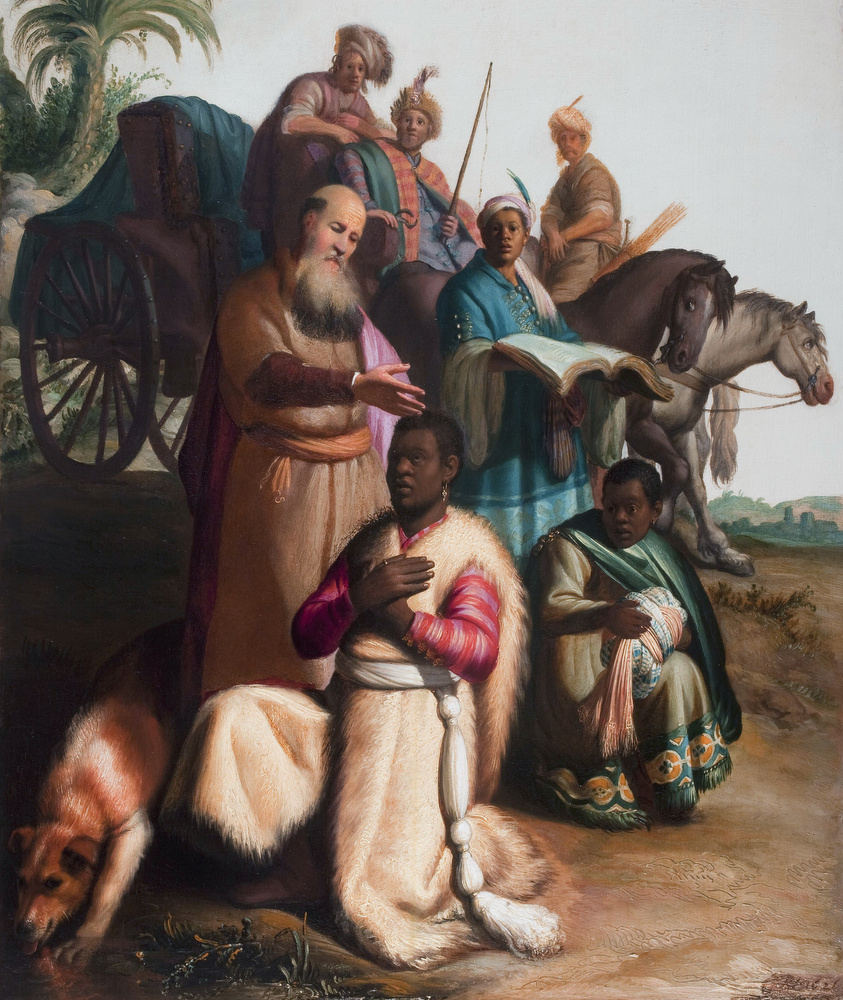
The Baptism of the Eunuch, by Rembrandt
In our latest podcast, we discuss intersex persons with Megan DeFranza, who recently wrote a book on the subject, Sex Difference in Christian Theology: Male, Female, and Intersex in the Image of God. Take a listen to the podcast, in which she articulates her position. DeFranza’s book has already occasioned quite a lot of discussion in various quarters. Matt Lee Anderson’s review of the book for Christianity Today provoked much criticism on Twitter and elsewhere (for instance, this post from Dianna Anderson). Steve Holmes has also recently posted on the book here.
The discussion is an important and neglected one and raises several issues worthy of close and careful attention and reflection, touching in some surprising ways upon core Christian doctrines as it proceeds. Even if intersexuality is not and would never be a live question in our immediate situations, the issue can be a worthwhile one to explore as a testing ground for broader theological understandings of issues such as theology anthropology, incarnation, and redemption. The following are some of the thoughts and questions that have been raised in my mind both by our podcast discussion and the wider Christian conversation on the matter.
Intersex and Sexual Dimorphism
Must the recognition of intersex persons involve denial that humanity is sexually dimorphic, or present resistance to that fact? Few of us would consider denying that humanity is a bipedal species on account of children born without a leg and persons who have legs amputated later in life. Medical science has acquainted us with processes of sex differentiation in the womb and, from its vantage point, most intersex conditions would seem to be appropriately classified as ‘disorders of sex development’. The natural purposes of the sex organs and the human reproductive system—of which male and female both possess a half—are not just dark and unknown mysteries to us and it would seem strange not to be able to speak of natural processes going awry in certain cases.
It seems clear to me, as it generally seems to be to medical science, that human bodies are structured to be sexually reproductive—to be male and female—and humanity is a sexually dimorphic species. There is clearly considerable natural variation consistent with humanity’s dimorphic form, but there is an obvious difference in principle between variation and defect, even if not always clear in the most marginal cases in practice, where, for instance, function may be retained in an abnormal or impaired form (abnormal forms are not necessarily defective forms, although they frequently are). Sexual organs with intersex conditions are typically characterized by defect—usually manifested in infertility, for instance—and can’t adequately perform certain functions that sexual organs are supposed to perform.
Intersex bodies and bodies with intersex conditions are not evidence of further sexes in addition to male and female, even though particular types of intersex conditions may possess distinct and identifiable characteristics. Their sexual organs of intersex persons are not ordered to some different sexual end of their own, but are abnormally and/or defectively lacking in the typical functional male or female form, imperfectly related to the ends of male and female sexual organs. Their abnormality is usually connected with evidence that the ordinary processes of sexual differentiation have gone awry in some recognizable manner. That they are generally considered defective doesn’t arise from the rarity of such conditions, but from the fact that they can’t effectively do what sexual organs are supposed to be able to do. They are disordered male or female bodies, or bodies that are neither male nor female. At the very least, to claim that they are a further sex would seem to require some far-reaching re-evaluation of how we determine bodily organs to be functional or not.
There may be some sort of an empirical spectrum between male and female, albeit one overwhelmingly populated at the poles. However, the existence of such an empirical spectrum is not proof against sexual dimorphism, because there remain only two functional forms of sex around which specific human beings are clustered. All intermediate forms are departures from these, without an integral purpose of their own.
Intersex and Gender
Whereas the sexed character of our bodies is subject to differing conceptual cultural constructions, this material basis of our sexed bodies—sex—doesn’t possess anything like the same ambivalence and openness to construction as the intentional and personal reality that (cor)responds to it—gender. The distinction between sex and gender—along with the denial of such a distinction (whether to subject all to the logic of ‘performativity’ or subject gender to the extreme determination of nature)—has been grossly misused by many. It may possess at least some heuristic value, however, for making such a distinction between the material basis provided by the body and the personal reality that answers to it. This distinction is, I believe, significant when speaking about intersex, for it maintains a conceptual gap between the body and the person, without requiring a denial that the former is in many respects the latter’s objective aspect.
Humanity isn’t just sexually dimorphic, but is also gender differentiated. Gender differentiation arises from the relationship between one’s self and one’s sex. Specific gender distinctions are usually fairly arbitrary, variable, and are socially constructed. However, gender differentiation as such is universal. Every human society recognizes the existence of distinct kinds or genres of persons—gender—as a fact somehow grounded in the sexual differentiation of bodies. ‘Man and woman’ as categories of gender—different genres of person—are widely perceived to correspond more or less exactly to ‘male and female’ as categories of sexed bodies. In biblical and Christian thought, this relationship between the bodily and material reality of sex and the personal, cultural, and intentional reality of gender is a strong one. Humanity isn’t just sexually dimorphic, but is also marked by the profound polarity of personal kinds named by ‘man and woman’.
Given the relationship between one’s sex and one’s self, it is not surprising that persons with intersex conditions should raise difficult questions about gender, nor that bodily defects in such cases should hold the potential of peculiarly acute problems of identity. Of course, such problems do not press themselves upon all with equal force. Having a body with an intersex condition need not mean that one’s sex is itself ambiguous, as one’s body’s sex may be clear in all other respects. In such cases, the intersex condition will probably be experienced in terms of one’s otherwise clear identity as man or woman. The distinctions between intersex bodies and bodies with intersex conditions and between bodies and persons may often prove important here.
Cases where the sex of a person’s body is truly ambiguous raise particular challenges, as identifying as either man or woman is difficult or impossible. Such exceedingly rare cases are particularly worthy of our reflection as they provide the most apparent exceptions to the gender differentiation of humanity. Yet this is, I believe, exactly how we should approach such cases—as exceptions, rather than as denials of the rule. Appreciating such cases as exceptions need not and should not entail a dismissal of them from significance for our reflection upon sex and gender. It is this category of exception that seems to be lacking in the conceptual frameworks of many people on both sides of such debates: for some, every exception undermines the norm; for others, every exception must be suppressed, pathologized, or forced to conform to the norm.
The distinction between bodies and the intentional and personal realities that correspond to them is important. The intersex person will quite likely be characterized both by a lebenswelt—a life world—and a sense of self that differs from those of men and women in certain respects. These will be exceptional and will correspond to bodily disorders and defects. However—and this point couldn’t be more crucial—the lebenswelt and sense of self that answers to a bodily defect should not be labelled defective or disordered on that account.
As sex and personhood correspond so closely, intersex persons’ bodily disorders will very closely relate to their distinct modes of personhood, the latter typically being an ‘owning’ of the former. Consequently, the language of disorder and defect applied to aspects of their bodies will often be felt to reflect upon their persons. I see no reason why this need be the case, however.
Intersex, Disability, Reparation, and Healing
There is no reason why someone ought to experience a bodily defect as a defect of, lack in, or brokenness of their personal mode of being in the world (although some might do so). Rather, it could be experienced as a blessed vocation (Kelby Carlson’s stimulating guest post on disability on my blog from a few years ago may be worth revisiting here). Bodily and mental defects and disorders can often serve as the preconditions for exceptional—in both primary senses of that word—modes of being in the world (I’ve long enjoyed Oliver Sacks’ work in this area), modes of being that need not require correction, as they never were ‘broken’ to begin with.
There is, I believe, an appropriate concern—a concern that I share—that much ‘corrective’ surgery upon persons with intersex conditions arises, not from medical necessity, nor from a desire or capacity to restore absent function, but from a pathologization of intersex modes of being in the world and abnormal bodies. This is more of a problem with us than it is with persons with intersex conditions.
This said, such disorders of sexual development may occasionally require medical treatment or intervention—even before a child has attained to an age of understanding sufficient to give consent—as they produce medically rectifiable health and fertility problems or have serious comorbid medical conditions or deformities. Here treating ‘intersex’ as a generic category may be unhelpful as we might need to treat specific intersex conditions in very different ways.
Although such modes of being may be exceptional, this exceptional character often principally arises from the distinct material and bodily conditions to which they answer. We should be wary of overemphasizing discontinuity here, as such personal modes of being exist in continuity with non-exceptional modes of being in many ways. As a result they can often declare truths that have extensive relevance to all of us, while doing so from a unique location. There are dangers in denying either part of this: of neglecting the uniqueness of the location of intersexed persons (as I fear Steve Holmes is in danger of doing), or treating intersex persons as if their experience was so distinct from our own that they have nothing to teach us.
Sexual Difference in a Fallen World
Steve Holmes’ claims that ‘we cannot specify with any exactness what it is to be male or female, theologically speaking … not because the binary is not a part of being human; it is because we have almost no access to what it is to be properly human.’ This statement—‘almost no access’—strikes me as theologically untenable. It is one thing to acknowledge that all of our knowledge is fallen, limited, and distorted by sin, quite another to adopt such a radical agnosticism.
That Holmes only ascribes knowledge of what is male or female—or properly human more generally—to theoretical reason is also a misstep, I believe. It is not only from Scripture that we derive knowledge of what is properly human, but also from the practice of the art of living well and the honing of the conatus—the innate and instinctive living principles of our human existence—associated with that. Our knowledge is always imperfect, but it is real. There is also no reason implicitly to deny any apprehension whatsoever of what is properly human to those who do not accept the word of Scripture.
It also seems to me that Holmes—as DeFranza does at points—is eliding the difference between knowing what is male and female bodily and knowing what is masculine and feminine in the personal realm of gender expression. That the foundational difference between personal kinds that generates the reality of gender is often opaque to us does not mean that the difference between a male body and a female body to which these kinds answer—the bodily issues that lie at the heart of the intersex discussion—isn’t clearly apparent. Intersex bodies may not always be immediately apparent, but we are generally quite capable of distinguishing them from bodies within intersex conditions. By conflating a wider discussion about gender with a discussion about persons with bodies that are in some respect or other ambiguously sexed, Holmes unhelpfully muddies the waters, disguising the distinct character of bodies with intersex conditions. As with his treatment of sodomy, he risks effacing the distinctness of LGBTI identities in his urge to highlight continuity and neglects several important conceptual distinctions along the way. The question of whether it is ever appropriate for a man to be financially dependent upon a woman really is a very different sort of question from that of how we are conceptually to understand and practically to respond to a person born with ambiguous genitalia.
I am also unprepared to grant that we cannot have genuine knowledge of what gender difference entails in many respects. Lewis’ ‘shadows’ and ‘broken images’ do not justify Holmes’ radical agnosticism: even shadows and broken images give some genuine intimation of the reality to which they correspond. That the full reality of what it means to be male and female and human far exceeds our present grasp, doesn’t mean that we are left without genuine apprehensions of the reality of male and female in our present experience.
Circumcision
It seems to me that circumcision poses genuine problems for any intersex theology. As I have observed before, the biblical narrative foregrounds the reproductive organs of many of its characters in a pronounced way—it is frequently a tale of circumcised foreskins and opened wombs. The sign of the covenant is placed upon the male sex organ. Unless we adopt a Marcionite approach, we must reckon with the peculiar significance that the God and Father of our Lord Jesus Christ gave to the male sex organ in circumcision. This poses problems for any position that wishes to negate the theological significance of sexual—and gender—difference and its relation to reproduction—even when we acknowledge that things have changed in the New Covenant. If the difference between the sexes and between persons with ambiguous and entirely unambiguous sexual characteristics is a matter of indifference, why did God institute a primary covenant ritual that was so overtly sexually differentiating? Such questions often expose or provoke huge theological divergences.
Incarnation
The suggestion that we should imagine an intersex Jesus—or a black Jesus, a queer Jesus, an English Jesus, etc.—strikes me as a theologically problematic potential obscuring of the particularity of the incarnation (different attempts theologically to justify such images fare differently in terms of their obscuring potential). As we are reminded in the Feast of the Circumcision, Christ came to earth in the fullness of time as a Jewish male, born as the male seed of a woman, under the Law, the son of David, and the heir of a particular lineage. The Jewish male body was the bearer of unique covenant meaning and Christ bore that meaning. This claim will obviously raise unsettling (and important) questions for many in other areas, but I believe other theological resources are available to us to answer such questions. The body in which Jesus came to us is not a matter of theological indifference.
Who is at the Table?
I think it is important to push back against the frequent contemporary insistence or assumption that we are never in the position to declare on anyone else’s identity or experience in any way and that such discussions are somehow the territory of those with the first person experience of the identity. Lest we forget, the first Christian council was a group of Jewish men deciding upon the status of Gentiles. Likewise, although it is important that we listen to the first person testimony of intersex persons—and I hope all of us engaged in these discussions have done and continue to do this—the issues under discussion will seldom be settled primarily by appeal to first person experience. While a court should listen to eye-witnesses, for instance, it does not follow that a court would be better off if it were run by eye-witnesses. That intersex persons need to be present in and attended to in the theological conversation as witnesses to the character of their conditions does not in itself equip them to settle the medical, philosophical, and theological questions associated with their conditions.
Proliferating Difference within Creation
DeFranza speaks about the fact that, although Genesis 1-2 describes the origins in a broad sketch, life proliferates in its forms beyond these origins. To the difference between male and female in Genesis 1 and 2, we later see the difference between the generations, between the nations, and between languages. Many more such differences develop over time. Some of these, she argues, find their origins in human sin and creation’s futility, such as the division of languages at Babel.[1] The status of these various differences is, however, something that needs to be considered carefully. Some differences, for instance, such as the covenant difference between Jew and Gentile, are divinely instituted but temporary in key respects. Not all differences are accorded the same status or significance either too.
More to the point here, though, there is a danger of regarding sexual difference as if it were merely a generic difference among others between persons. As I’ve argued at length before, sexual difference is not just difference from, but very much a difference for. The difference between male and female—between man and woman—is a sort of ‘musical’ difference, a difference within a relation. This difference in relation is the difference from which all of us find our origins and is a difference that is integral to selfhood. Once this unique relation is forgotten, it is easy to class the difference between male and female along with all other sorts of differences between individuals and to establish a symmetry between the differences named by male, female, and intersex. The difference between male and female is often interpreted in terms of autonomous individuals, whereas the true difference between male and female—as a difference for, rather than chiefly a difference from—only truly becomes clear as they live in deep and loving relation.
If we are to develop a robust theology of intersex, we must, I believe, resist the temptation to appeal to difference as such as its justification. Rather, we must focus upon the particular significance of its character(s), which places it outside or in an unclear relation to the particularly significant and fundamental human relational difference between the sexes. This requires reflection upon the precise significance of the difference between the sexes. What possibilities of vocation might existing without a clear place within this difference open up to people?
Much more could be said, but I will leave it there for now.
[1] I would be wary of placing the responsibility for the multiplicity of languages at the feet of human rebellion, for instance. The aim of Babel was to resist being ‘scattered abroad over the face of the whole earth’ (Genesis 11:4), precisely what God had called humanity to be. Babel was an attempt to secure the hegemony of a single empire and belief system and resist the natural differentiation between peoples that scattering over the face of the earth would entail. God’s confusion of their languages forced the builders of Babel to fulfil his will. I would suggest that diversity of languages was always part of God’s good intention for humankind and the ‘punishment’ of the confusion of languages was the breaking of humanity’s rebellion so that they had to fulfil God’s intention even though they didn’t want to. I’ve commented more upon the meaning of Babel here.