Podcast: The Post-Election Show

Mere FidelityOn this week’s episode of Mere Fidelity, Derek, Matt, Andrew, and I discuss the US election and its aftermath.

I’ve written quite a lot over the last few weeks on issues related to the election. Here are a few posts: 10 Sets of Questions to Ask Before Voting For Donald TrumpThe Social Crisis of Distrust and Untruth in America and EvangelicalismHow Social Justice Ideology Gave Us Donald TrumpFurther Thoughts: How Social Justice Ideology Fuels Racism and SexismA Crisis of Discourse—Part 1: Cracks in the Progressive Left, and A Crisis of Discourse—Part 2: A Problem of Gender.

You can also follow the podcast on iTunes, or using this RSS feed. Listen to past episodes on Soundcloud and on this page on my blog.

Posted in Culture, Ethics, Podcasts, Politics, Society | Leave a comment

The De-Condensation of Humanity

The Ribbonfarm blog has always been one of my preferred locations for imaginative societal analysis online. What Ribbonfarm offers, perhaps more than any other blog out there, is close attention to calibrating the lenses through which we can analyse the dynamics of our society. It is a blog that is frequently daring in its analysis, offering bold theories and frameworks where others give more predictable and unoriginal readings of our societal situation. For me, it is blogs such as Ribbonfarm that justify the continued existence of blogging as a serious medium.

Venkatesh Rao, the Executive Editor of the site, has a tremendous systematizing instinct and the ability to discern patterns and dynamics. I still refer to posts such as his ‘The Gervais Principle’, ‘Rediscovering Literacy’, and ‘Welcome to the Future Nauseous’.

However, more recently it has been the work of Sarah Perry, the site’s Contributing Editor, that has most attracted my attention. The following posts may help to explain why: ‘Gardens Need Walls: On Boundaries, Ritual, and Beauty’, ‘Weaponized Sacredness’, and ‘The Theory of Narrative Selection’. Perry’s work is characterized by a deeper attention to psychology and human nature and alertness to the ways in which social systems intersect with and engage with our psychology. In my estimation, both Rao and Perry rank up with Scott Alexander of Slate Star Codex as some of the most consistently thought-provoking bloggers out there.

Ribbonfarm is an example of the unique potential of blogging as a sort of sandpit of argument, a realm for more explorative thought to occur. In my own ways, I’ve often tried to take advantage of this same potential. At its best, blogging creates a space where ideas, understandings, and theories can be tried out, experimented with, and developed, without the same pressure of finality that comes with traditional forms of publication. It can be an intellectually lively and stimulating place as a result, encouraging readers to collaborate in a more open-ended process of thought and reflection. It is a site of creative, heuristic, and experimental thought, where readers can become active participants. Different participants can take the ideas being explored in rather different directions, but everyone benefits in their own ways from the collaborative space for imaginative and creative development of thought.

Sarah Perry recently wrote a fascinating post on the subject of technology as ‘de-condensation’. While I ended up demurring at her claims about our entering an ‘age of recondensation’, I believe the core thesis of the post provides an exceptionally useful lens through which to consider a number of cultural changes. The post also advances concepts that merit deeper consideration within the discussions around the phenomenon of ‘secularization’ in various quarters.

Perry argues that, in the past, ‘time, artifacts, institutions, and even people are more condensed.’ Entities within past cultures were bearers of multiple meanings, purposes, and functions and, as a result, were associated with deep values that often bordered upon or existed within the realm of the sacred. However, as human society became more settled and technologically advanced, the formerly highly condensed entities steadily lost their integrity as their purposes, meanings, and functions were separated and outsourced to various other technologies, domains, agencies, and entities. Perry writes:

Almost every technological advance is a de-condensation: it abstracts a particular function away from an object, a person, or an institution, and allows it to grow separately from all the things it used to be connected to. Writing de-condenses communication: communication can now take place abstracted from face-to-face speech. Automobiles abstract transportation from exercise, and allow further de-condensation of useful locations (sometimes called sprawl). Markets de-condense production and consumption.

Such de-condensing effects a breach or wound in the world order, which must somehow rebuild itself around this new de-condensed reality.

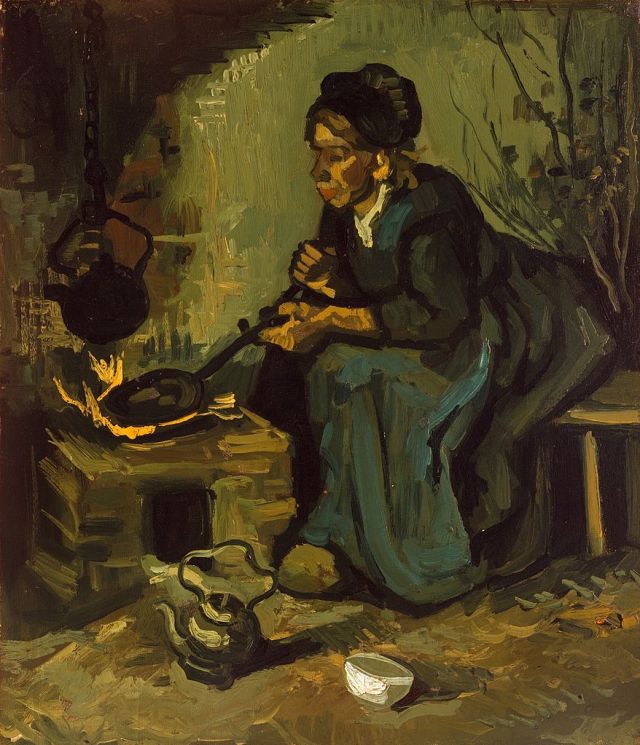
I am here reminded of Albert Borgmann’s discussion of the difference between technological ‘devices’ and more traditional ‘things’. For instance, the hearth represents the sort of ‘thing’ that has been displaced by technological devices such as central heating, cookers, and microwaves. These devices perform key functions of the hearth considerably better than the hearth ever could. However, it is easy to forget those things that were lost through the ‘de-condensing’ the hearth. The hearth was never merely a ‘device’ for producing heat. It was a focal point of family life, community, and practice, a site of often deep meaning. The hearth brought the family together. It represented their interdependence, as each family member had their own tasks of making and tending the fire, cooking with it, cleaning it out, gathering, buying, or chopping fuel for it. If a member of the family failed to play their part, all could suffer. It established shared daily rituals and structured the day. It required the development and passing on of skills and active involvement with nature.

It created a specific place, which ordered wider social spaces and itineraries (note that the hearth names the place primarily and the fire upon it only by metonymy). In many cultures the hearth had a deeply gendered meaning, being associated with the wife and mother at the very heart of the family. The hearth metonymically stood for the home and for domestic life and its relations as a whole.

Although people still have fireplaces in their houses, long after the development of central heating, these fireplaces are only a shrunken semblance of what they once were. No longer the site of condensed meaning and the necessary confluence of family activity, they now function chiefly as luxuries for our comfort and sentimental enjoyment. Freeing us from often onerous former necessities, the technological process of de-condensation gives us benefits of convenience, efficiency, ease, and comfort, but at the price of much meaning, purpose, social bonding, and embeddedness.

As Perry observes, technological de-condensing chiefly tends to address problems nearer to the base of Maslow’s Pyramid. However, the practices and entities that are displaced by the process of de-condensing typically addressed needs further up the pyramid too. For instance, Leon Kass writes of modern eating practices, which have often been technologically disembedded from former practices that addressed deeper hungers:

We face serious dangers from our increasingly utilitarian, functional, or “economic” attitudes toward food. True, fast food, TV dinners, and eating on the run save time, meet our need for “fuel,” and provide close to instant gratification. But for these very reasons, they diminish opportunities for conversation, communion, and aesthetic discernment; they thus shortchange the other hungers of the soul. Disposable utensils and paper plates save labor at the price of refinement, and also symbolically deny memory and permanence their rightful places at the table. Meals eaten before the television set turn eating into feeding. Wolfing down food dishonors both the human effort to prepare it and the lives of those plants and animals sacrificed on our behalf. Not surprisingly, incivility, insensitivity, and ingratitude learned at the family table can infect all other aspects of one’s life.

De-condensation can occasion the ‘dis-integration’ of meaning, or the reduction of meaning and purpose to shallow material functions and ends. Perhaps it could be argued that the process of de-condensation necessarily begins with a perceptual atomization of realities into discrete parts of which they can never exceed the sum or a reduction of them into simple functions, dismissing the wider reality they form around themselves. In particular, the integrating power of former practices and realities is dismissed, devalued, or neglected. The result of such a process of de-condensation can be a vague but pronounced sense of existential lack of value, self, agency, meaning, and purpose even in the midst of relative material plenty. While we are glad to be free of old necessities and their attendant hardships, their passing has often left us emptier.

The last couple of centuries in particular have witnessed the rapid de-condensation of key dimensions of human life. Yet the next century promises to take this process of de-condensation further than we may currently even imagine, with potentially dire consequences for humanity. While de-condensation has previously unsettled the realms of human relations and labour, it now threatens fundamentally to undermine them.

This recent essay is just one of a great many voices that have been declaring our movement into an age where human labour in general (and ‘male’ labour in particular), is increasingly redundant. As we move towards ever greater levels of automation, technologization, and artificial intelligence, human labour is worth less and less on the employment market. If you look at the most common job in each US state, you will notice that truck drivers are the most common in the majority of states: those jobs are going to start to disappear rapidly within the next few years as self-driving vehicles start to appear on the roads. Technology has already hit manufacturing and farming jobs: truck driving is next. Even if big manufacturing companies were to return to the US from overseas, they would only employ a small fraction of the numbers that they once employed. Nor is arresting the immigration of cheap labour going to prevent the steady collapse of the labour market.

The situation that we now face is due in no small measure to the extreme de-condensation of human work. Human work has always served a wide array of ends beyond those at the bottom of Maslow’s Pyramid. Work offers us a means of making our mark upon the world and of investing the self in objects of our creation. Work externalizes the human spirit and also gives us a stake in the future. Work has been a means of binding us to the natural world within which we live. We must learn to be attentive to the world and diligent in labouring upon and within it.

Work is a means of bringing people together in communities. In most human societies, work has served to affirm people in their sex and given them deep relationships with others of their sex. Work has enabled and trained people to exercise adult responsibility, agency, independence, and providence. Work has given people a deep sense of purpose and has structured their lives within sacred patterns of work and rest. Work has secured people’s place and status in society. Work is a means by which we can give of ourselves to others and a means by which we are dependent upon each other.

As we have sought to maximize the ends of production, efficiency, and profit, we have de-condensed work. Many of the purposes that work once served are now dispensed with or even directly undermined. In the modern economy, rather than serving to bind communities together, work tends to atomize them instead, as we are all uprooted and pushed to migrate within and without our countries to follow work opportunities. The more that machines and processes intervene between us and our creations, the harder it is to find meaning in our labour, or to feel that we are making a mark in the world. We may feel alienated from our labour. It no longer provides us with the rich forms of sociality it once did. Rather than affirming us in our sexed agencies and identities, the modern gender neutral workplace is often a stifling and emasculating environment for men and an oppressive and marginalizing environment for women. As work becomes rarer, the work that remains will probably also become less and less meaningful and fulfilling. For many, the minimal gains of precarious low paid work over unemployment benefits are simply not sufficient to compensate for the indignities it inflicts.

De-condensation tends to narrow or relocate ends. Work, which once served a more integrated human meaning, can now be reduced to the ends of production and securing the means for consumption. The economy and its growth can become an end in itself (perhaps even to a point where we could imagine human beings being cut out of the loop altogether!). However, the end of maximizing production can easily become antagonistic not only to human life and society, but also to the planet, which was not created to sustain unrestrained growth.

What happens when meaningful work no longer exists? Well, on account of welfare and charity, most people probably won’t starve. Indeed, there is growing support for a guaranteed income as a measure to stave off the worst prospects of a post-work world. Yet we can already see what happens to people, perhaps especially young men, when they lack a sense of meaning and purpose, meaning and purpose that work once supported. Their human spirit is starved and they can turn to forms of escapism—entertainment, sport, video games, drugs, promiscuous sex and porn, etc.—which at least offer weakly to scratch their deep existential itches.

Work is not the only realm under threat. Our fundamental human relations themselves are increasingly threatened. Marriage traditionally functioned as a socially integrating institution and has been regarded as sacred or holy by many societies as a result, right down to the present. Although the form it took could vary considerably from society to society, it generally served to unite or strengthen the bond between a range of different persons and practices. It bound the generations together. It bound different families together. It related the sexes together. It strengthened communities and cultures as marriages became the bearers of religious and social meaning. It connected sex with procreation. It connected private life with communal life.

The power of marriage and family as an institution arose in large measure from the vast array of functions that were condensed within it: provision, security, welfare, healthcare, education, investment, employment, public representation, community, religious practice, etc., etc. However, over the last few centuries marriage has been radically de-condensed, many of its former functions outsourced to other institutions or drastically reduced through new technologies. Whereas marriage was once a deeply meaningful necessity for people’s physical and social survival, now it is steadily reduced to a realm of sentimental community. Without the force of necessity holding people together, the deeper integrating goods that marriage once represented are harder to perceive and its meaning is drastically diminished. Marriage becomes much weaker as an institution.

Marriage once powerfully represented the condense and integrated meaning of human sexuality, a deep mystery of the union of man and woman, the wonder of the other sex and the deeper reality of our own, the most fundamental common project of all human society, the union of our most animal of drives with the highest of our ideals, the connection between our bodies and our deepest selves, the significance of the loving and committed sexual bond as the site where the gift of new life is welcomed into the world, the difference between human making and human begetting, the miracle of the development of new life, the wondrous natural blossoming of private sexual unions into public families, a bond that stretches over generations, the deep union of blood, the interplay and union of the sexes in all areas of human life and society, the maturation of man and woman together and in union through all of the seasons of their lives, until they cross the threshold of death.

This meaning hasn’t entirely disappeared, but it is fast fading. Through many and various developments, the meaning of marriage in relation to human sexuality has been slowly eroded. Human sexuality is being de-condensed. Contraception and prophylactics separate sexual relations from procreative potential and reduce the need for discriminating choice of partners, reducing sex to primarily genital stimulation. Porn offers to satisfy our unruly lusts, compartmentalizing our sexuality. Reproductive technology separates procreation from sexual congress. It abstracts bodily material from persons and biological parenthood from social parenthood. Surrogacy abstracts child-bearing from motherhood. The coming together of bodies is no longer presumed to necessitate a uniting of selves. Sexual reassignment surgery and hormone replacement therapy reinforce the abstraction of one’s gender from one’s natural bodily sex. Social science de-condenses the function of ‘parenting’ from the condense reality of being a mother or father.

Although male identity has historically been especially powerfully located in the realm of work within the world, the value and identity enjoyed by women in society has had much to do with the fact that they bear children and forge the most fundamental human bonds within their very bodies. As Ivan Illich once powerfully put it, women ‘leave behind a trail of new life.’ They do this as ‘condense’ and ‘integrated’ persons—as bearers of sacred meaning—not merely as an aggregation of discrete functions.

However, this is increasingly going to come under threat. When we can engineer artificial human eggs from men’s skin cells, grow the resulting embryos in artificial wombs, and men can have artificial sexual relations that cater to their every fantasy, what becomes of women? Will they represent something more to men than an outmoded sexual and reproductive ‘technology’? What sort of relation between the sexes will exist in such a world? What sort of bond will exist between generations when reproductive technologies and genetic engineering increasingly intervene? What becomes of parenthood in such a world, especially in relation to the state?

Here it becomes clearer that de-condensation is something that directly threatens human beings themselves. It isn’t just our tools, institutions, and societies that are being de-condensed, but our very selves. The humanity that will result will be much reduced in stature. What it means to be a mature human being, to be made in the image of God, is closely bound up with our creative and procreative activity and both of these dimensions of our humanity face imminent threats. Even if we survive such developments in relative material comfort, it will most likely be in a sort of puerile dependency on a stifling government.

As I have argued in the past, these de-condensing developments are already underway, driven in large measure by the desire to normalize such things as gender neutral marriage. Contemporary progressivism is, at heart, a transhumanist movement, a movement that necessitates the radical de-condensing and refashioning of the human being in order to achieve its ends. While often well-intentioned, it is imperative that we register the danger that it presents. The transhumanism it envisages has many appealing features, yet the de-condensation it necessitates will seriously reduce humanity in its dignity, severing the bonds of meaning that give us purpose, identity, and a place in the creation. As Oliver O’Donovan has maintained, the crucial difference between begetting and making human beings may seem small at points, yet is vast in its implications.

Behind the process of de-condensing is often the drive to overcome unwelcome necessity. The condense meanings we once enjoyed were typically preserved through hardship and suffering, through limits imposed on us by nature, through the lack of an alternative. Our society, however, is founded upon the value of ‘choice’ over all else and eschewing necessity and constraint wherever possible. The destructive power of the reality of capitalism lies precisely in the fact that it represents the destabilizing effect of the de-condensing maximization of choice upon all settled social realities. Given the choice between a difficult practice and an easy de-condensed alternative that relieves us of its burden, we will incline towards the latter almost every time.

Where choice is maximized, what were formerly virtues formed and meanings maintained through necessity now must be established through self-imposed discipline. We are creating a world where, as we no longer have a virtuous and strong humanity developed under the force of the gravity of necessity, we risk surrendering our very selves to the whims of petty and untamed vices. I will conclude with a lengthy quotation from C.S. Lewis’ The Abolition of Man, which expresses the problem well:

From this point of view the conquest of Nature appears in a new light. We reduce things to mere Nature in order that we may ‘conquer’ them. We are always conquering Nature, because ‘Nature’ is the name for what we have, to some extent, conquered. The price of conquest is to treat a thing as mere Nature. Every conquest over Nature increases her domain. The stars do not become Nature till we can weigh and measure them: the soul does not become Nature till we can psychoanalyse her. The wresting of powers from Nature is also the surrendering of things to Nature. As long as this process stops short of the final stage we may well hold that the gain outweighs the loss. But as soon as we take the final step of reducing our own species to the level of mere Nature, the whole process is stultified, for this time the being who stood to gain and the being who has been sacrificed are one and the same. This is one of the many instances where to carry a principle to what seems its logical conclusion produces absurdity. It is like the famous Irishman who found that a certain kind of stove reduced his fuel bill by half and thence concluded that two stoves of the same kind would enable him to warm his house with no fuel at all. It is the magician’s bargain: give up our soul, get power in return. But once our souls, that is, ourselves, have been given up, the power thus conferred will not belong to us. We shall in fact be the slaves and puppets of that to which we have given our souls. It is in Man’s power to treat himself as a mere `natural object’ and his own judgements of value as raw material for scientific manipulation to alter at will. The objection to his doing so does not lie in the fact that this point of view (like one’s first day in a dissecting room) is painful and shocking till we grow used to it. The pain and the shock are at most a warning and a symptom. The real objection is that if man chooses to treat himself as raw material, raw material he will be: not raw material to be manipulated, as he fondly imagined, by himself, but by mere appetite, that is, mere Nature, in the person of his de-humanized Conditioners.

Posted in Culture, Ethics, Sex and Sexuality, Society | 67 Comments

The Eternal Subordination of the Son Controversy: 8. κεφαλή in 1 Corinthians 11:3

1. The Debate So Far
2. Survey of Some Relevant Material
3. Subordination
4. The Need for Trinitarian Clarity (Part 1)
5. The Need for Trinitarian Clarity (Part 2)
6. The Tension Between Bible and Doctrine
7. Reconciling Scripture and Dogma

The eighth part of my treatment of the eternal subordination of the Son debate has just been published over on Reformation21.

The need for a sturdy proof-text pillar for complementarian theology can put considerable pressure upon a term such as κεφαλή. I believe that such scholars as Grudem unhelpfully downplay the multivalency of this term, a multivalency that is important to Paul’s argument in the immediate context (where more metaphorical senses of the term in verse 3 are purposefully brought into connection with literal senses of the term in the verses that follow). Literary word play and expansive breadth of meaning may not be especially welcome when we are looking for clear theological propositions. However, multivalency need not entail ambiguity: multivalency can bring a different sort of clarity, as it establishes illuminating relationships between concepts, realities, and images, rather than detaching them from each other and analysing them individually.

Read the whole thing here.

Posted in 1 Corinthians, Bible, Controversies, Doctrine of God, Guest Post, NT, NT Theology, The Triune God, Theological | 12 Comments

Durham Cathedral

If you’ve been a visitor to this blog for any length of time, you may have noticed that Durham Cathedral keeps making an appearance. During my time in Durham it has been so many things for me: a place of worship, a place of work, a place of study, a place of relaxation, a place of spiritual refreshment. Almost anywhere you go in Durham, the arresting landmark of the cathedral’s towers will be somewhere in view. The view from the central tower, unfortunately closed right now for restoration work, is also spectacular (here is one of my photos from it). There are 35 randomized header images on this blog, all taken within about a half hour’s walking distance of my house: 23 of them include Durham Cathedral. They are many more pictures of the cathedral among the photos that I have posted here at various points.

Some of you may be interested to find out more about the building. This video is a good introduction.

More recently, I have been a volunteer in the Open Treasure exhibition that was opened this summer. If you ever have the opportunity to visit the city of Durham, I highly recommend that you take the opportunity to visit it.

One of the best things about Durham Cathedral is that entry to the building is free to the public, something that the entry fee for Open Treasure makes possible (the cathedral is also looking for donations right now—if you donate £10, your donation will be doubled!). In the modern world, art and beauty are so often so closely associated with astronomical price tags, functioning chiefly as signs of status and affluence. ‘Pieces’ of art also often suffer a sort of alienation from the worlds to which they once belonged: they are fragments hinting at worlds now lost. They are often held behind closed doors, only accessible to those with the disposable income to pay for entry or the wealth and privilege to belong to particular classes and institutions.

However, in Durham Cathedral, beauty isn’t cut loose from its world, nor is access to it reserved for the privileged. Architecture, painting, song, woodwork, masonry, textile work, the creation of manuscripts, etc., etc.—within a place like Durham Cathedral they form an integrated world, a place still oriented by acts of worship and a place that still serves to give order to the small city around it. Through its historic social influence and power, one of the great things that the Church has been able to do is to create and maintain awe-inspiring beauty, beauty that belongs to and enriches everyone. Durham Cathedral preserves and continues this legacy.

Seriously, you should visit.

Posted in My Doings, Photos | 2 Comments

A Crisis of Discourse—Part 2: A Problem of Gender

An Elephant in the Room

In my previous post (which I have renamed so that this flows more clearly from it), I observed a growing crisis for progressivism, as people across the political spectrum are rejecting its form of discourse. Within this post, I will venture into far more controversial territory. I will speak directly about some issues that we commonly politely skirt. It is not my intent to give offence, although I appreciate that may easily be taken. For this reason, I request your patience and charity. If we never talk directly about such issues, we will forever be falling into the same problems and little progress will be made.

There is an elephant in the room of our social discourse, one salient fact that goes a long way to explaining the tensions between different forms of social and political discourse and their relative sites and means of power and influence. However, this fact is a fact that progressive discourse necessarily dissembles, because it is taboo:

Men and women are different and their differences have an immense impact upon the climate of our social and political discourse.

Jonathan Haidt, writing on Heterodox Academy, describes a striking experience he had when addressing high school students about the importance of open and challenging discourse in the educational environment.

[T]he discussion began, and it was the most unremittingly hostile questioning I’ve ever had. I don’t mind when people ask hard or critical questions, but I was surprised that I had misread the audience so thoroughly. My talk had little to do with gender, but the second question was “So you think rape is OK?” Like most of the questions, it was backed up by a sea of finger snaps—the sort you can hear in the infamous Yale video, where a student screams at Prof. Christakis to “be quiet” and tells him that he is “disgusting.” I had never heard the snapping before. When it happens in a large auditorium it is disconcerting. It makes you feel that you are facing an angry and unified mob—a feeling I have never had in 25 years of teaching and public speaking.

After the first dozen questions I noticed that not a single questioner was male. I began to search the sea of hands asking to be called on and I did find one boy, who asked a question that indicated that he too was critical of my talk. But other than him, the 200 or so boys in the audience sat silently.

After the Q&A, I got a half-standing ovation: almost all of the boys in the room stood up to cheer. And after the crowd broke up, a line of boys came up to me to thank me and shake my hand. Not a single girl came up to me afterward.

The gender divide startled him. After the talk, he led a discussion, within which he seemed to make some progress. In the article, he describes the fact that the boys experience immense social pressure to self-censor, a pressure exerted by the girls:

That night, after I gave a different talk to an adult audience, there was a reception at which I spoke with some of the parents. Several came up to me to tell me that their sons had told them about the day’s events. The boys finally had a way to express and explain their feelings of discouragement. Their parents were angry to learn about how their sons were being treated and… there’s no other word for it, bullied into submission by the girls.

It seems to me that, if we are to speak appropriately about them, the dysfunctional phenomena of our discourse that I have discussed in my previous posts are in large measure failures of healthy forms of gendered socialization. Incidentally, this is exactly the sort of problem we should expect to find in a society that ideologically resists the reality of gender and presumes that it isn’t an insistent natural reality that must be negotiated rather than dissimulated. Though we may hit the nerve of the sacred value of equality, homogeneous and indiscriminate inclusion in speaking of it, the integrity of our discourse itself depends upon careful handling of the relations between and within the sexes.

Men, Women, and Social Leverage

The bullying of boys into silence by girls might seem like an unusual phenomenon to those who have bought uncritically into certain prevailing notions of patriarchy and who are inclined to think in terms of a unilateral dominance of males in society. Yet, while men generally do dominate in positions of overt and direct public power and authority, women often exert considerably more indirect and relational power in their communities and societies. We just need to be more alert to the reality that is directly in front of us.

There is an anti-feminist trope that men who support feminism, especially stronger forms of it, just want to get laid. This is misleading and unfair, I believe. A minority of men genuinely do hold deep and sincere feminist convictions. This said, however, I think that most men rightly recognize their male peers’ expressed positions on the subject of feminism tend to shift considerably, depending upon the contexts that they are in and on the sorts of relationships that they have to women, and that males whose position in their particular social order is naturally precarious tend to be the most affirming of all. It should not be presumed that men’s disguise of their true sentiments arises from a manipulative hostility towards women on their part. Indeed, it is often quite the opposite: men hide their true sentiments because they care about women and don’t want to expose them to viewpoints that they might find threatening. Most men genuinely care about women, yet a great many are ambivalent about or unpersuaded by much of feminist thought.

Women may just be the most powerful force for preference falsification known to man, chiefly because what women think and feel towards them generally matters immensely to men, and by no means primarily for cynical sexual ends. Men know this all too well from their own and their peers’ behaviour and may distrust men who wholeheartedly adopt the favoured opinions of their partners or of women in their peer groups. They also know that preference falsifiers generally grow weary of their masks and appreciate candid contexts in which they can be relieved of their burden; these are typically male contexts, outside of women’s view. Seeing how men typically act in these less policed contexts, they are sceptical of those who insist they are not falsifying preferences in contexts where social expectations are heavily imposed.

When the chips are down in a gender-integrated society, men’s primary loyalties usually tend to default to women: to their mothers, to their wives, to their daughters, to their sisters, to their girlfriends, to their female friends. If a man feels that a woman in his life is threatened by another man, he will typically rally to her defence. And this is as it ought to be. Men are naturally highly protective of and closely bound to the women in their lives.

Women’s power is a social and associative power, one resulting from the fact that they have closer and more immediate relationships than men—not just with other women, but with men too. This gives them immense social leverage. Women are the glue of a society, the force that binds societies’ members together. Men tend to form larger, shallower, weaker, and looser networks, with more agonistic and combative interactions. Women, by contrast, tend to form stronger, more intimate, more emotional, and deeper bonds. Their relational bonds are far more load-bearing than men’s.

Women do have a very great deal of competition among themselves, but it is generally indirect and occurs beneath the radar. The combative form of male competition is overt and on the surface: men are rough with each other and engage in forms of ritual combat, often as a form of bonding. Women’s competition, by contrast, is largely carried out by such means as pressure to conform under the threat of social ostracization, leveraging male power to their advantage, recruiting males to attack people they dislike or rally to their aid, forming friendships or relationships with people of power or influence, gossip, cattiness, sassiness, sabotaging other people’s reputations, veiled antagonisms in friendships, etc. It is so successfully dissembled that remarkably little is said about the fact, for instance, that the majority of—and much of the most damaging—misogynistic abuse is instigated by women, even in cases where men are involved. Within a mixed group, men would rarely be able to bully a woman without permission from or the instigation of other women in the group.

Nosedive, the first episode of the most recent season of the TV show Black Mirror, depicts a dystopian world driven by veiled relational and reputational competition, illustrating the dynamic of a toxic form of feminine competition very well. As everyone rates their interpersonal encounters, producing a score which determines their social status and societal privileges, a desperate competition to gain and maintain one’s precarious place in the right crowds and the societal pecking order occurs, all veiled beneath the cloying yet entirely superficial niceness by which the battle is waged.

Compared to men’s intrasexual relationships, women’s relationships among themselves can have remarkable emotional and relational intensity, something perhaps most clearly seen in the ‘drama’ of their adolescent friendships. This subtle and fraught world of emotionally charged friendships is somewhat alien to most teenage boys, whose relationships with their peers tend to occur almost entirely on the surface, requiring little divining of the underlying emotional dynamics. Men are often fairly oblivious about how to handle emotionally intense relationships (a fact that may only become apparent to some after they marry) and, with their surefootedness in this rocky terrain, women can be both frustrated by men’s inability to function as nimbly as they can and also able to use their greater ability in this area to their considerable advantage.

As when people think about power they think primarily in terms of overt and direct power, it is easy to presume that men monopolize power. Yet, when one looks closer and deeper, the reality is considerably more complicated: the men may occupy most of the prominent positions of power, but their primary loyalties are often to the women closest to them. The man, as Chesterton observed, may be the head, but he may often only be the figurehead. He may have the direct power, but the woman may have most of the leverage.

Women’s Wit

In 2007, the late Christopher Hitchens wrote a provocative piece for Vanity Fair, entitled ‘Why Women Aren’t Funny’. Within it he argued that men were the funnier of the sexes and that it wasn’t even close. When it comes to being laugh-out-loud hilarious, men excel. Men need to excel, Hitchens argued, if they are to impress women. Men’s dominance in this arena arises in part from the fact that men are more prepared than the fairer sex to laugh at another’s expense, and to explore the ugly, unpleasant, and offensive dimensions of life that might offend a woman’s polite sensibilities, but which are a vast reservoir of fine comedic material. Unsurprisingly, male comedians dominate on the stand-up circuit, with relatively few women, disproportionately lesbians, to balance them out.

I believe that Hitchens was deeply mistaken in his judgment, though not entirely erring in his observations. Yes, men do naturally tend to dominate on the stand-up circuit. It is an aggressive and pugilistic context of discourse, played to a larger audience, with a significant element of risk involved, and typically involving frequent violations of the laws of politeness. Men will naturally come to the fore in such realms. However, the limited presence of funny women in that realm is a poor argument for the claim that women are the least funny of the sexes. Women’s humour is more likely to be encountered in the dense social environment than in the highly aerated arena of overt verbal combat. Women’s wit is generally played for much smaller audiences, and can display acuity of psychological perception and marked verbal adroitness. Indeed, those who are the objects of women’s humour may often be oblivious to the fact, as the wit is designed to be stealthy and recognizable only to the initiated. It is a means of managing and negotiating denser relational settings. It is hard to display on the stand-up stage, but is much more visible in the intimacy of prose or in the more private conversations at a social gathering. Hitchens was also mistaken if he thought that women are less funny out of niceness. Men may be the masters of insensitive and offensive comedy but few men can manage the exquisite cruelty of some women’s spiteful or snarky wit.

Jane Austen is a good example of a female novelist of comic genius, yet her more feminine cast of humour escapes many—especially male—readers who are inattentive to it. Her humour involves sharply observed social manners and relations. The comic voices in her work—the social satire of the veiled narrator, the gently deflationary characterizations, the sardonic humour of Mr Bennet and the vivacious wit of his daughter Elizabeth, the hilariously caustic remarks of a Lady Susan Vernon—are often subtle and sly, and occasionally merciless. Austen’s wit is about the shrewd observation and negotiation of the dense web of social relations in society. It puts people in their place, often gently, yet sometimes more forcefully. It can puncture prevailing social pretensions. She employs her wit as a subtle yet potentially devastating power. Peter Leithart’s description of her work is perceptive: ‘At her best, Jane Austen wrote out of laughter. Her art came from the impish glee of a precocious teenager amused by the follies of the world around her, wanting to get us in on the joke. Her final voice is modulated, deepened, matured by life and its losses; but it is still the voice of the Juvenalia, the joyous voice of Pride and Prejudice, the voice of the narrator of Emma and of the comic passage in the unfinished Sanditon.’

The giggling of teenage girls, who almost always seem to be sharing some silly private joke among themselves (a joke that the viewer may well fear to be at his own expense), can often be the target of the derision of those who deem this a childish behaviour. Yet it is here that the seeds of a mature feminine form of humour are often to be found. Such a form of humour can be acutely observant and slyly satirical of the social environment, and adept at manipulating and navigating it with verbal wit. Those who have mastered such wit are able to use it to bind people tightly together in the enjoyment of the private joke, to destroy the social power of an adversary, to put people in their place, to operate on two different levels of conversation, or to come out on top in the little conversational games whereby one can manoeuvre and gain social leverage. Where some men might throw a punch, many women know that the carefully engineered put-down can be far more shattering.

Manliness as Defence

On account of women’s closer bonds with their male peers in mixed groups, men recognize that any of their male peers is potentially a turncoat, someone who would willingly betray men and compromise his convictions in order to retain social standing in mixed society. One of several purposes that ‘manliness’ plays is that of signalling trustworthiness and loyalty to other men, assuring men that, although their primary loyalties are with the women in their lives, they will seek to uphold their loyalty to other men and to the greater demands of truth and justice. Their peers’ manliness provides assurance to men that they are dependable and trustworthy and that they will not betray them for the sake of their standing in mixed society, where men can be vulnerable.

Men cannot trust men whose primary concern is what women think, or who demonstrate little concern for what other men think. Such men will routinely falsify their preferences and betray other men and the male group in order to advance in the favour of women. Men like this cannot be relied upon to show appropriate loyalty to other men, nor to speak the truth when those actions might displease women.

Manliness signals trustworthiness to other men because manliness is about a man’s capacity, determination, and character as—and, most importantly, his commitment to be—a man among men. Manliness represents the traits that men desire and admire in other men. Manliness can’t really be cultivated in mixed company, but is learnt in male groups. Although women typically find masculinity desirable, they can find its strong expression in mixed company threatening to their status and so frequently discourage or proscribe it. Mixed company is a realm of politeness and niceness, where men have to rein themselves in and hold themselves back. If a man throws his weight around in mixed company, women will commonly expect other men to take him down for them.

Manly Society and its Code of Honour

Men and women don’t cease to act as men and women simply because we have subscribed to a gender-neutral ideology. Traditionally the academy and the world of politics were male worlds, operating according to the norms and the natural tendencies of male sociality. Even when women were involved, they were operating in a world that largely operated according to male rules.

As male realms, they were agonistic realms, realms of ritual combat and competition. The code according to which they operated was a manly code, a code that emphasized honour, assertion, confidence, agency, strength, and mastery. Other participants in these realms were expected to function as rhetorical, ideological, and political combatants, expected to fight their corner and challenge others, yet also to be subject to the rigorous stress-testing of the combative environment. For this you need to have strength and courage. You need to be assertive, forthright, and exhibit mastery of your subject and your own self. They were expected to function with honour and to respect the honour of other combatants, to be concerned for their reputation as men in the group. There was also a premium placed upon mastery. Such discourses are hierarchical in character, usually according the highest honour and prominence to those who most exemplify these virtues. If you can’t prove your mastery, you must yield to others who can. The most adept and able dominate in such realms.

It is often supposed that the concept of ‘being a man’ chiefly stands in contrast to that of being a woman. However, the greater opposition is probably that between the man and the boy or the unmanly. One must become a man through a process of socialization into strength, honour, courage, and mastery. This is not to suggest that weaker men do not have a place in such groups. Men typically want all of their peers to be socialized into a form of manliness, even though they often know that this manliness may well take a less pronounced form in some. There are a great many different varieties of manliness and its virtues and perhaps the majority do not require us to conform to the most stereotypical extreme male patterns of behaviour and appearance. Codes of manly honour often involve rejection of the practice of preying upon those weaker than oneself. Indeed, many male groups can be surprisingly sensitive to weaker members of the group. Having a strong and healthy bond of manliness is in all of our interests and men will often go out of their way to ensure that every boy is able to make the passage. Sadly, there are many cases where male groups are brutal towards those weaker members who are struggling to secure their place. One of the best ways to avoid such cruelty is to establish healthy intergenerational practices of socialization into manliness, rather than leaving boys to accomplish the transition alone.

On account of natural male instincts, male realms are exposed to several dangers. Perhaps one of the most extreme of these can be seen in the historic phenomenon of duels, whereby (overwhelmingly) men sought to defend their honour against perceived insults. While duels could be undertaken in response to things that seem to us to be the pettiest of provocations, it is important to recognize that the honour that was at stake really mattered, as it represented one’s standing in male society and helped to preserve the security of men and their families. If challenges to one’s honour were allowed to pass unchallenged one would render oneself and one’s family vulnerable to predation and assault. One’s honour and one’s willingness to fight for it really matter in a society without strong institutions of law and order, as it discourages people from mistreating or attacking you and those close to you.

Nevertheless, duels revealed men at their most hormonal and territorial. The stupidity of duels and their wastefulness of life needed to be escaped. Developing a culture of dignity to replace a culture of honour (see the discussion in this paper) was a necessary means by which the unruly tendencies were put in check. This culture of dignity required the establishment of institutions of law and order to provide security and resolution of disputes that didn’t depend upon one’s honour and capacity for vengeance. Likewise, institutions developed structures by which the benefits of combative male forms of discourse could be maintained, while placing checks to ensure that they did not collapse into violence. Interactions in the House of Commons, for instance, provide a good illustration of this. Discourse is mediated by the speaker and honorifics—‘the Right Honourable Gentleman’, etc.—are employed in order to guard against dishonour. Moderation of debates and discussions can also put a check upon the tendency of male conversation to fall into pointless ego battles. Masculinity needs to be housetrained for the sake of civilized discourse.

Despite these dangers, male contexts of discourse come with some very considerable advantages. A gendered manly code helps to regulate discourse. In the realm of discourse, a man is expected to have the strength to push his position and to weather challenges to it. For a man to use the ploy of weakness to escape honest and direct debate is dishonourable. Although it is dishonourable for a man to pick on the weak and on non-combatants, if you strongly assert a position you are to be regarded as a combatant and must stand up for yourself or find some advocate to do so. If neither you nor anyone else is willing or able to prove the strength of your position in argument, the position forfeits the right to public recognition and respect.

A man is expected to have the courage to be forthright, to speak his mind, and to expose himself to his opposition. He is expected to fight, to expose himself to risk, and to be prepared to sacrifice for the sake of something greater than himself. In argument, a man is expected to show the courage of assertion, to put himself on the line and genuinely to risk public loss. In discourse, a man is also to be held to a standard of mastery, to be tested and, if he should fail, to suffer some measure of a loss of standing.

Most importantly, manly discourse is governed by honour, which holds men responsible to display these manly virtues in argument at risk of losing face and standing among their peers. You must not ‘chicken out’ of an argument or shrink from engagement with a challenger. One must not use dishonourable ploys or means to avoid a direct encounter or defeat your opponent with underhand means. You must stand for your position when it faces really strong challenge, or both it and you will forfeit honour. In making an assertion you must submit to the rules of combat and accept the status of a combatant. You must recognize the honour of other combatants and not expect to misrepresent or mistreat others with impunity. When your very honour is challenged (for instance, when someone doesn’t just challenge a particular position that you make, but accuses you of academic fraud), it is essential that you stand for it. Now, all of this is moderated to some extent by structures of ‘law and order’ governing our various discourses that resolve certain disputes and challenges. However, for the most part, the culture of public discourse has operated according to a culture and code of manly honour.

This culture is particularly important when it comes to prominent leadership: a code of honour, calling for the virtues of manliness, gives force to our expectation that leaders in particular be exposed to challenge and prove the strength of their positions or forfeit their status. The authority of leaders cannot easily be abstracted from their demonstration of the virtues of manliness: strength, honour, mastery, and courage. Manly authority doesn’t reside simply in offices, but arises from the public perception that a man possesses such virtues, especially when they are exercised in the service of goodness, truth, or beauty. Where a leader clearly lacks such virtues, people will not regard him as having much authority, even though he may enjoy office. Office and command without the weight of some form of the traditionally manly virtues—whether the person exercising it is male or female—can seem bossy. It is the sort of leadership that is perceived to lack the strength to underwrite its claims to people’s submission.

This male culture I have described also tends to establish a sort of heterotopic location for its conflicts—an arena, a battlefield, the pitch, etc. The location is set apart from the more intimate locations of daily life and society. It is a realm of personal jeopardy into which only combatants can venture. In entering into this arena, everyone is expected to play by the rules, to put himself on the line, and to be able to give and to take fierce challenge.

A Shift in Our Culture of Discourse

This culture of agonistic discourse implicitly upheld by the code of manly honour has served us well in many respects. It is an integral element of our traditional culture of ‘free speech’. However, over the past few decades our realms of political and academic discourse have become mixed contexts, which has thrown a great deal into confusion and disarray. The fact that we have become ideologically hampered in our ability to talk about the differences made by sexual difference has greatly limited our capacity to deal with these changes.

Where the front lines of political and academic discourse have clearly been regarded as male worlds, women have generally, perhaps with minor accommodations, proved themselves using the same implicitly manly code of honour that men have. In the process, they have often brought their own particular strengths to the table, improving the quality of the discourse, pushed back against certain unhelpful male tendencies, and tempered the unruly excesses of manliness. The agonistic tendencies of male discourse, if not well tamed, can hamstring rather than empower our conversations. Instead of probing and testing discourse, we are left with blinkered and braying belligerence and tiresome games of one-upmanship. Instead of conversations that elicit the strengths of many different perspectives, a few bullying voices dominate the floor. A concern for the truth has on many occasions been eclipsed by the pursuit of ego. Our political and academic conversations have so often benefited and grown in their integrity from the ways in which women, while preserving the strengths of male modes of discourse and observing a similar code of honour, have pushed back against our less helpful tendencies and complemented more typically male models of discourse with more collaborative and inclusive forms of discourse.

However, with respect to the specific tasks of political and academic discourse, women’s more natural social tendencies do not merely add strengths, but have also introduced serious weaknesses. We should not expect that the realms of politics and the academy can introduce large numbers of women without undergoing more fundamental cultural and institutional change in the process. Women’s schools and women’s studies are ground zero for the current issues with free speech in the campus. This is not a coincidence.

The underlying problem is not primarily with the ideologies that are being taught in these locations. Rather, the ideologies often seem to function as a rationalization of more naturally female inclinations in discourse and socialization.

Women do not naturally gravitate to a manly code of honour. The social virtues that are elevated in women’s groups tend to be things like inclusion, supportiveness, empathy, care, and equality. Through his and his students’ research on the subject of ‘social justice warriors’, Jordan Peterson has identified that it refers to a real phenomenon in the world, but also suggests that it is specifically related to a maternal instinct: ‘the political landscape is being viewed through the lens of a hyper-concerned mother for her infant.’

This instinct causes all sorts of problems when expressed in an academic or political context. It infantilizes perceived victim, minority, or vulnerable groups (women, persons of colour, LGBT persons, disabled persons, etc.), perceiving them as lacking in agency and desperately in need of care and protection. When persons from such groups enter into the realm of political or academic discourse, they must be protected at all costs. Unsurprisingly, this completely undermines the manly code that formerly held, whereby anyone entering onto the field of discourse did so at their own risk, as a combatant and thereby as a legitimate target for challenge and honourable attack. The manly code calls us all to play to strength, whereas the maternal instinct calls us all radically to accommodate to weakness.

The opening up of the field of front line discourse to people with a non-combatant or non-manly status causes severe problems for men too. Men are naturally inclined to protect women and generally seek to please them. While men bond with their male peers through rough interactions, they do not generally do the same with women. Men spend their whole lives learning to hold themselves back in female company, learning how to pull their punches, how not to speak their full mind, how to avoid giving offence. This second nature can’t simply be put on hold, but must actively be resisted, if women are to be treated as full peers in such settings.

So many men who proclaim the equality of women instinctively resort to ‘white knighting’—rushing to women’s aid—when they see a woman being firmly challenged by a man. As C.S. Lewis once observed, ‘battles are ugly when women fight.’ Unless we are mindful in our handling of them and the men and women who are admitted to them, arguments can become ugly in such conditions too. Honour may be abandoned and matters can become bitter and personal. The eye is taken off the ball of truth and argument and men turn on other men, rather than allow another man to beat a woman. While men are expected to put themselves on the line in debate and risk significant loss, many have a visceral resistance to seeing women experience the same thing.

There is no ideological pill that will easily deliver us from such deeply rooted gendered instincts. Indeed, part of the irony here is that the men who are most stereotypically protective of women within such contexts are often the men who push the hardest for them to be included within them, lest they be wounded by the implication that they are weak. As I discussed earlier, men’s bonds to the women in their lives tend to take precedence over their relations to other men. Protecting women and their feelings frequently takes priority over truth and honour in argument.

Female Conflict in Discourse

Earlier on in this post, I discussed more typical female forms of conflict, whose less direct and overt character contrasts with male forms of conflict. Revisiting these forms of conflict at this point, I think that we can see that a great many of the issues complained about by those pushing for free speech on campuses have all of the hallmarks of female forms of conflict (perhaps especially their forms of intrasexual conflict).

People pushing for free speech complain about stifling climates of discourse on campuses, which dangle the threat of social ostracization over those who do not rigorously affirm and uphold politically correct values. They complain about the sacred status of those groups designated as victims and the way in which they are presented as immune to challenge and lacking in their own agency. They complain about the way that weakness and vulnerability are exaggerated and weaponized. They complain about the ways that people’s reputations are attacked and academics are blacklisted. They complain about the ways that speakers articulating unwelcome viewpoints are ‘no-platformed’. They complain about the ways in which values of safety and inclusion are used to rule out challenge. They complain about the way that the campus isn’t treated as heterotopic, as a realm set apart for ideological engagement and challenge. They complain about the ways that campus authorities are constantly appealed to for protection against others. They complain about the rise of a culture of victimhood, coddling, and the radical infantilization of perceived victim groups. They complain about the college’s loss of robust academic authority in the public’s perception and of the manner in which it has come to be perceived as morally hectoring.

Again, we should be paying attention to where this behaviour is especially concentrated: in contexts dominated by women and LGBT persons, contexts where the traditional norms of manliness are the least operative. This is not, I believe, principally some bizarre product of a radical Marcusian ideology. Rather, the ideologies are almost certainly rationalizations of the social dynamics that naturally characterize the dominant demographics in those realms. Conversely, women self-select into realms that are characterized by a lot of agonistic discourse at much lower rates (although, of course, the causality runs in both directions here: realms that are heavily male dominated will tend to be agonistic in their actions and marked by some code of manliness).

We should also recognize why so many men in particular instinctively react against this developing campus culture: not only is it perceived to be academically bankrupt, but it is also dishonourable, in flagrant and wilful violation of the tenets of manliness. It renders the campus a realm of the unmanly and emasculates the men within it. Even if it cannot be articulated as such, it is experienced as a gendered colonization of a realm that traditionally largely operated according to male norms in a manner that renders those norms inoperative.

Our negotiation of the reality of sexual difference will have immediate bearing upon the integrity of key social contexts of discourse. Of course, the intellectual work of the academy is by no means reducible to mere agonistic discourse, any more than the work of the courtroom is exhausted by vigorous cross-examination. However, the stress-testing of ideas through contestation and challenge is absolutely non-negotiable if we are to produce an academy with integrity and intellectual authority, an academy that will be regarded as suited to exert societal leadership. Just as the maximization of agonistic discourse is stifling of the intellectual life of the university, so its elimination will enable the metastasization of unchecked ideology throughout the organs of our social discourse.

Social Media and the New Context of Political Discourse

It is imperative that we take account of the cultural changes brought about by the rise of social media. I have written upon these at considerable length in the past. One of the central points that I have made is that social media bring us too close together. Traditional forms of public discourse are effective in large measure through differentiating their participants: through status, office, time, physicality, intermediation, ritual, place, position, etc., etc.

Public discourse traditionally occurred in highly aerated and differentiated discursive environments, such as courtrooms and debating or parliamentary chambers. Yet online we are all placed into a more immediate contact with each other, in a ‘saturated social environment.’ Within this realm we are all peers and contemporaries, without differences in rank or station. It is often a gender-neutralizing and egalitarian realm, where every voice is equally valid. Online we also all function on the crest of the latest breaking wave.

Millennials are often castigated as a generation for their narcissism, self-preoccupation, and other such traits. However, in our defence, it should be noted that we are the canaries in the coal mine of a new ecology of society discourse, especially younger millennials. Many of us have been using online social media since high school. The rise of social media is akin to the first introduction of a mirror to a society in which people had never properly seen their own faces. We are now existentially involved in an online spectacle on social media, where we must rigorously perform our identities, acutely aware of the fact that we are constantly exposed to judgment.

Existing in such a context elevates our social anxieties. It fractures or overwhelms former contexts of solitude and withdrawal from society. It creates a socially saturated order and limits the possibility of heterotopic discourse. When people complain about the need for a ‘safe space’, it is important to bear this new social reality in mind. Where there are few genuine sites of retreat from society and where challenging discourse no longer can be limited to a heterotopic arena, people will naturally feel much more threatened by people who strongly disagree with them. This is perhaps especially the case for young women, who are far more naturally attuned to and involved in the ‘social’ dimensions of social and connected media (for instance, generally sending considerably more texts than their male peers). Without a ‘safe space’, they are denied a realm of care and social conflict becomes total. Their concerns on this front should not merely be dismissed.

The Hyper-Connected Political Class

The mind of the new cultural elite is being formed in the echo chambers of Twitter and Facebook. Their culturally elite status isn’t a matter of wealth or even of class as traditionally defined, but is a matter of holding the prestige faith of progressive liberalism, something that is closely bound to college education. Many poor students and journalists nonetheless belong to this elite class.

Twitter is the small talk of an interminable fancy dinner party, the cultural terrarium within which an internationalist political class grows. On Twitter, what one says about things is the most important thing; substance dissolves into speech—unrelenting speech. On Twitter, real world events and realities exist chiefly as props whereby a privileged class can negotiate their internal relations, where news is fodder for phatic speech. Twitter brings this class so much closer together—into constant and incessant correspondence—yet thereby increasingly detaches them from the rest of the population.

The closer that Twitter and Facebook bring this internationalist progressive class to each other, the more that this class starts to function as a ‘dense society’, characterized by intense peer pressure and a fixation upon how one appears to others. It is a new ‘village’ where public shaming can nuke a person’s reputation and career, where the circulation of rumours and gossip holds immense destructive power, which can be strategically deployed as threat or sanction. It is also a site where the crowd itself serves as an agency that can be appealed to in order to intervene when someone feels threatened.

These dynamics will have the effect of turning the political classes in upon themselves in a profound self-absorption. The conversation will come to be dominated by those issues that are most serviceable for managing the political classes’ internal relations and self-expression and maintaining their standing, rather than by the issues that really are the most important and pressing in the wider society.

Symbolism will tend to replace substance. Given the choice between talking about the compounding crises of automation in the Rust Belt or transgender bathrooms, they will choose the latter. Given the political classes’ turning in upon themselves, it shouldn’t surprise us in the least that the last few years have been dominated by precisely the sort of primarily symbolic social issues that are most useful for virtue signalling within the elite class (same-sex marriage, fights over transgender bathrooms, getting the first female president, Black Lives Matter protests, etc.). Online we also have short attention spans, which can produce series of polarizing outrages and emotionally gratifying causes, few of which require any grasp of the larger picture.

Even when politicians aren’t themselves heavy participants in the Twitter conversation, the people who surround them will be. Unsurprisingly, many others can be profoundly alienated by the elites’ self-preoccupation and prioritization of symbolic issues that lend themselves to Manichaean posturing over complex and substantial ones that require sustained thought and intense concrete engagement in the outside world. Iain Martin, writing in Reaction, interviews one such person:

“I don’t like Trump, but look at what is happening in this country. People have had enough. Imagine you live in Michigan or Wisconsin, or Ohio, or Pennsylvania, or Florida, or North Carolina. You’re getting by ok but it’s fraught with worry and even the good months seem like a respite from it all going, what do you Brits say? tits up. One of you has two jobs. Your neighbour’s wife works at Walmart but that’s getting eaten alive by Amazon and delivery companies. What are your kids going to do for a living? College is expensive and then what? The companies they might work for won’t offer them anything like security. It’s tough out there. And what’s the biggest news story of the last year on TV here other than the election? Other than Black Live Matters protests.”

I shake my head. I don’t know.

“Transgender restrooms. Transgender bathrooms. All the time. Crazy protests on campus. All the time. Crazy, angry, entitled, spoilt people shouting on your TV about justice and trigger warnings and transgender stuff and hating America and how bad the country is when they’ve no idea what life is really about. While tens of millions of people in those states have real concerns about jobs, pay, about the economy, about their children. And this is the next battle that the radicals want to fight? Abolishing men and women? No. Equality yes. This crap? No. And eventually you think: what the hell is going on in this country? And you vote for the one guy that says enough.”

Bernie Sanders is correct: the progressive liberal elite is incapable of talking to the working class, and this is why. The working class may not be privy to the heart of this conversation on social media, but they see its effect on the national conversation in the newspapers, TV shows, and, most particularly, in the silence upon the issues that affect them the most. The more closely interconnected the political class is within itself, the more disconnected it is from the rest of the country. Twitter hogs the bandwidth of the political conversation, preventing other things from being talked about.

The Gendering of the Political Conversation

As social media changes the environment within which political discourse operates, the dynamics of the discourse shifts. Traditionally, political discourse occurred within the heterotopic arena of male agonism, a realm set apart from domestic and personal affairs, yet within which the wider reality of the society was debated. The relationships of this predominantly male group could be robust, but they were looser and aerated, involving conflict and dispute. They weren’t the more intimate and personal relations of closer social affinity.

For the elite who participated in this discourse, the agonistic male discourse was counterbalanced by the mixed social realm of polite society, where feminine social virtues principally prevailed, relations were much denser, dispute would be discouraged, and the conversation was often a form of social grooming and positioning. This was a realm where women’s social leverage and skills could come to the fore.

In Twitter, we are witnessing a collapsing of the traditional manly political discourse into a more feminine polite society, with considerable tensions on both sides. In dense societies, disagreement is a threat and conversation, while frequently demonizing and ostracizing other parties, struggles to deal with the sort of difference near at hand that rougher and more aerated agonistic discourse handles much more adeptly. The aggressive arguments of men on Twitter are taken considerably more personally by women (and by the men who care about them) and are generally perceived as far more abusive than they would be were they directed at men. On the other hand, many argumentative men chafe at the regime of politeness that tends to develop in social locations where large numbers of women are present.

When the world of politics starts to be dominated by the norms of polite society in the ruling classes, preference falsifications that may fly in the elite’s Twitter feeds will start to be imposed upon the population at large, with much less positive results. Preference falsification is one thing when it offers social advancement and privilege, quite another when it is experienced as a yoke of cultural subjugation to an elite class. The rubes outside of the enlightened bubble are also much more likely to be ridiculed and despised as the smugness of polite society becomes the operating tone of politics.

Places like Twitter are becoming our Versailles, establishing progressivism’s hegemony by creating a new stifling centralized polite society under its oversight, with everyone jockeying for position by cosying up to its values, yet alienating and disempowering the rest of the population in the process. Instead of disparate regional interests entering a heterotopic realm of agonistic contestation, many parties are gathered together in a shared socially saturated environment where they conform to powerful cultural norms for the sake of their social and political survival. They are gradually being detached from their locations of origin and the disparate interests for which they once advocated. In the process, the population at large is gradually cut adrift from the political classes. The feminization of the realm of political discourse will naturally risk the tendency of closing the political class in upon itself.

Mixed social company is typically a realm of heavily falsified preferences, a place where the call to be nice and polite prevents people from expressing their full mind. The norms that drive these falsified preferences are principally established by women, as their opinions carry the greater weight in this realm. Power in the dense social arena chiefly belongs to women, as they generally form much closer relations than men can. The core social group and its membership are largely determined by women and men really need to keep on the right side of women, as their peers typically prioritize the women in their lives over the men. Like the students Haidt described earlier in this post, within this realm, women can use their greater social leverage to ‘bully’ men into silence through the threat of social ostracization or marginalization.

Tensions on the Left

Some of these gendered tensions can already be seen between the old left and the progressive left. More traditional leftist supporters of Bernie Sanders, stigmatized as ‘Berniebros’ by feminists supporting Clinton, are making the most of their delicious side-serving of schadenfreude that comes with the large and bitter main course of our new political reality. Freddie deBoer had already written at length against the progressive left’s toxic ‘politics of deference’:

Left-wing critics of contemporary progressives have often struggled to find a term to describe rhetoric or tactics they find unhelpful. Terms like “political correctness” and “identity politics” are too deeply associated with conservatism, and too clumsy, to be of much use. I have personally taken to thinking of a particular kind of misguided progressive political engagement as the politics of deference—that is, the political theory that suggests that people of a progressive bent have a duty to suspend their critical judgment and engage in unthinking support of whoever claims to speak for the movement against racism and sexism. This is the common notion that allies should “just listen.” There are all manner of problems with that attitude, first and foremost among them the question of who, exactly, we should just listen to when different members of marginalized groups disagree, as they inevitably will. But more, the notion that we should just listen asks us to forego the most basic moral requirement of all, the requirement to follow one’s own conscience. Just listening is easy, and you will find many armies of privileged people in media, academia, and the entertainment industry who have made a career out of it, coasting along with whatever the day’s progressive fads are. But just listening leaves us bereft of the kinds of ruthless self-review that are a political movement’s only defense against drift, complacency, and corruption. Just listening is self-defense; just listening is bad faith.

Of course, there is a self-reflexive element that will surely come into play here: critics of this essay will no doubt accuse me of the very bigotries that I am arguing we should be more careful in discussing. This is the tail-swallowing aspect of today’s liberal spaces, not the noble and correct prohibition against engaging in racist or sexist behavior but the meta-prohibition against questioning whether any given accusation is credible or convincing. A political tendency that prohibits its members from questioning each other, or which treats critical examination of its beliefs about bigotry as bigotry itself, has sewn the seeds of its own demise.

Following the catastrophic failure of progressivism in the election, his criticisms have a renewed urgency and appeal. Together with figures like Matt Bruenig, deBoer has represented a push for a more aggressive form of discourse, and a turn away from identitarian deference (deBoer is pessimistic about things changing within the Democratic Party, but as the country increasingly turns against them, they may be left with little choice).

The gendered character of the growing conflict on the left regarding appropriate rhetoric was exposed in part through the kerfuffle that led to Bruenig being fired from the think tank Demos. On the one hand, some well situated women weaponize institutional power to shut down or close out aggressive challenging voices and practically protect their positions from vigorous interrogation. On the other hand, some belligerent men use hostile verbal argument in a manner that renders the online experience of women a deeply unpleasant one, not least by implicitly giving much less savoury followers permission to subject women with whom they differ to explicitly misogynistic attacks.

To such figures on the left, prominent Clinton supporters like Lena Dunham reek of narcissistic bourgeois feminism. This narcissistic feminism is not only dulled to class issues, but through its preoccupation with a petty in-group associative politics, intensifies them by stigmatizing and disassociating from those outside of its class. Like the selfish housemate who leaves their computer downloading several movies while they are out and you need to make an important video call, this self-obsessed feminism also hogs the political bandwidth, preventing serious conversations from taking place.

The New Feminist Politics

As I have already emphasized, men and women don’t cease to behave like men and women simply because we have declared ourselves to be living in a gender-neutral society. If we are to understand the current shape of politics, it is imperative that we take gender seriously. We must also recognize that resistance to a woman like Hillary Clinton in power is neither unrelated to her sex, nor necessarily irrational and misogynistic.

A great many experiments to identify sexism in hiring begin with identical CVs, yet with the genders of the job applicants switched. The implicit assumption here is that, once differences in skills, aptitudes, and attainments are ruled out, two such applicants are essentially interchangeable. Of course, this is a huge assumption. For it to hold, one would have to deny the existence of any probabilistic differences between the sexes as groups in pertinent criteria, as knowledge about groups is relevant even when we are making decisions about individuals about whom we have information. As a culture we have determined that sexual difference is an irrelevancy at most, relating only to genitalia.

However, as I’ve already argued, men and women can form strikingly different forms of social relations and these different forms of social relations produce different cultures of discourse, thought, and politics. The form of feminist politics is one shaped by particular patterns of female sociality.

Feminist politics takes a more typically feminine form, majoring on the use of social leverage for feminist ends. If you think about it, the typical feminist political victory takes the form of persuading some other agency to do something or intervene on their behalf. It is a politics of empowerment and empowerment almost invariably rests upon the existence of some more fundamental power that acts as one’s patron and comes to your aid against other parties.

A politics of empowerment will differ sharply from the more historically male and oppositional cast of politics. The very nature of a politics of empowerment demands the growth of patron agencies, which accrue ever greater powers to themselves. The great gains of feminism have expanded such agencies. The expansion of the franchise was also an expansion of government’s power to act without the mediation of the family and to deal directly with new classes of dependent persons. The rising entrance of women into the workforce increased the power of capital and made the workforce more biddable and conformable.

As feminism is wedded to these agencies, it cannot very effectively stand over against them. Also, the more such agencies ‘empower’, the more they establish dependence and the greater their grip upon society. Such agencies are also frequently called to act against lesser agencies that don’t ‘empower’ women in the desired way, strengthening their dominance and enabling them to close down opposition ever more effectively.

Feminism’s logic is a great way to establish a docile workforce. It switches a more oppositional master-slave model for something closer to a mother-child model. Our sense of any underlying struggle for power between labour and capital or society and government is dulled as our problems are reframed as an issue of capital and government just not empowering us enough. However, capital and government are for the most part very happy to ‘empower’ us and give us many of the trappings of power, while keeping actual power for themselves (and gaining more power as we become more dependent upon them for our ‘empowerment’). Understandably, the character of feminist politics will cause problems for the traditional left, for whom class oppositions are important.

The more empowering patrons prevail, the more that they will tend to close down those who seek to exercise power and agency directly. This, I suspect, is disproportionately restrictive for men, in large part because the new authorities act in a more maternalist manner, smothering and pathologizing the more typical disruptive and oppositional modes of male agency. It seems to me that many of the puerile modes of male rebellion that we encounter today need to be understood against this background.

The Queen Bee

A politics of empowerment founded upon social leverage will also have the effect of dissembling power. Power becomes diffuse and unaccountable. In the more overt form of male power, there is typically a head, a prominent and exposed figure, who is held to the standards of manly agency, being personally and directly responsible and accountable for that which occurs under him and honour-bound to face and defend himself against challenge. This figure is expected to be strong, to put himself on the line, to exhibit mastery, and to act with manly honour and responsibility. This is what gives weight to his authority. He must face direct conflict and challenge and prove his suitability for office by weathering that which is thrown at him.

Hillary Clinton, however, represented a different sort of politics: the politics of the queen bee. The power of the queen bee is not the direct and accountable power of the manly leader, but a more feminine power of extreme social leverage. This power is not inconsistent with an extreme vulnerability. When people see someone challenging their queen bee, they will rapidly rally to her and fight off the threat. The queen herself is inapproachable. Her power is the hive that surrounds her, the power of her immense social leverage.

One of the reasons that many people disliked and resented Hillary Clinton was because they felt that she was being ‘forced on the public.’ This perception merits examination. Clinton was not believed to be a powerful candidate (unlike a woman such as Margaret Thatcher, who earned her epithet of the ‘Iron Lady’). Rather, she was perceived to be a candidate who was weak in terms of the conventionally manly criteria of politics, yet with immense social leverage within the Democratic Party. The power of Clinton is the power of the great Washington hive: she is the queen bee around whom they will all rally. The power of Clinton is the Democratic Party’s undermining of Sanders’ candidacy. The power of Clinton is the Clinton Foundation’s power as a concentration of political and moneyed interests. People resented Clinton because they knew that she represented and secured the unaccountable power of a hive of insider interests behind her.

Political queen bees have some considerable advantages. The diffuse character of their power means that they cannot easily be challenged or held accountable. As soon as one challenges the queen bee, people will rally around her, cutting off any direct attack. The sort of direct challenges that are part and parcel of traditional manly political engagement are perceived to be sexist when directed, even in the mildest of forms, towards women. People will not permit their queen bee to be treated as a combatant, nor to put herself on the line.

Leaders who do not exhibit traditional manly traits can be politically suspect. Their power, such that it is, must lie elsewhere. The pushing forward of women in politics can often engender suspicion in many in the population—especially among the male working classes—who recognize that the power of such leaders increasingly lies in the networks that put them forward, surround them, and protect them from direct challenge.

Men, in particular, are far more likely to trust an assertive leader who clearly demonstrates an independent strength. Such a leader can be dealt with directly. Men may find unmanly leaders emasculating, because they no longer even have the ability to look at the power that is oppressing them directly in the face or to challenge it directly. The power that holds them down has hidden itself behind the soft face of a weak leader. It shouldn’t surprise us that many women also found Clinton alienating too. The power Clinton represented to them was less the power of women as such as the power of her particular hive.

The language that surrounded Clinton’s candidacy is illuminating in several regards. Themes and sentiments of solidarity with Clinton as an individual (e.g. ‘I’m With Her’) and—now wounded—entitlement (e.g. it was her time but she was robbed) are often prominent. The queen bee’s advancement is owed to her by others, rather than something that she must obtain or fail to obtain for herself. This is because the power of social leverage is in large measure a power established by the obligations that can be placed, or the duties that lie, upon the shoulders of others.

Progressive women were profoundly emotionally invested in Clinton’s candidacy, much as many other women are emotionally invested in ‘Queen Bey’. The queen bee becomes the vehicle for her adorers’ own psychodrama. They are fixated by her and identify with her on an intimate level. Her success is inseparably intertwined with their own sense of well-being. The policies of Clinton were quite incidental to this identification: the bond with Clinton was with the very intimacy of her womanhood. Like the female worker bees in a hive who do not reproduce but raise their sisters from the queen, the feminist sisterhood can rally around and support the queen as the one who will give value to their own identities.

The Feminist Society

A politics of empowerment and a culture of victimhood go hand in hand. Just as the kid that bursts into tears and runs to their mother at the slightest provocation can use parental sanctions to empower them against others, so the feminist elevation of the rhetoric and ideology of victimhood serves to increase their social leverage (one thinks of the new mansplaining hotline that has just been set up in Sweden!). Exaggerated vulnerability can be exploited as a means to gain power. The term ‘crybully’ has been coined to describe such weaponized victimhood and vulnerability.

It also creates a context that radically stifles strong and independent agency. The more that we privilege dependency and reliance upon third parties to intervene, the more we will start to resemble infants and the more those parties will adopt a smothering hyper-maternalism. Unsurprisingly, in those places where feminist theories and practices are most influential—on college campuses—we encounter the most stifling and neurotically protective institutions of all. The feminist rhetoric of strength is almost invariably allied to a rhetoric of vulnerability and victimhood. Strength is something that must constantly be externally affirmed and validated, rather than demonstrated through confident and robust assertion (as Margaret Thatcher once remarked, “Being powerful is like being a lady. If you have to remind people you are, you aren’t.”).

This stifling of agency doesn’t only occur in women who must conform to the model of the victim, but in men who must constantly affirm the strength of the women around them, while never developing or exerting their own manly strengths that might threaten them. In such contexts, the natural male instinct to protect women can result in an emasculated variety of male feminist. Such a person, concerned to validate the strength of women, will push for their indiscriminate admission to all of the traditional realms of male agonism, while holding them to much lower standards and seeking to restrict any expressions of manliness that might expose the inconvenient truth.

This also poses problems for women, who often have very conflicted feelings about the new feminist male. Such a man’s care and concern for her and protectiveness of her sense of self-worth are rightly appealing and such men can definitely be a welcome presence in the coeducational environment of the college, or the modern gender-neutral workplace. Yet, the fact that such men are all too often stunted in their development of robust manliness, not least because they have been denied homosocial male places within which to play to and grow in their strengths, is deeply unattractive. The conflict between the desire for the docile feminist man and desire for the feral manliness of men whose masculinity has developed, though never been cultivated by virtue, is a tragic one (Robert Stacy McCain’s recent review of Jessica Valenti’s memoirs really exposes this ugly dynamic).

Within a feminist society it is also incredibly difficult to engage in honest and fruitful discourse. The proclaimed vulnerability of women and the unwelcome character of certain statements underlie a profound social pressure to shut down unsettling or threatening discourse. Men must self-censor, come to women’s aid by closing down non-cooperative men, establish institutions to police permitted expression, and play their part in the propagation of obliging falsehoods.

It must be stressed that the rise of feminism is in large measure in reaction against deep and sustained injustices to women and that much that it brings to the table is essential. It is also a diverse movement, which includes many voices that express similar concerns for free speech that I am articulating here. However, in its currently prevailing forms, especially on college campuses, it has introduced a number of serious problems.

The gendered relational logic that undergirds the practice of the sorts of male and female discourse I have been describing differs in crucial respects. On the male side, the manly practice of agonistic discourse upholds a standard of honour within a rule-bound exchange. The goal of the exchange is to gain honour and one gains honour by winning by the rules. Men must put themselves on the line and win by playing by the rules of discourse if they are to gain honour. Honour is lost by breaking the rules, taking unfair advantages, avoiding direct engagement, failing to present a defence for your position, and other such behaviours. One gains honour through engaging in the rule-bound encounter. If the rules are well-defined and the encounter is well ordered and refereed (ensuring that wrath or ego do not take over), the manly drive for honour can be powerfully harnessed for the service of truth.

The primary gendered virtues of typical female social interaction don’t, however, so readily lend themselves to agonistic engagements over truth. Male social values tend to affix themselves chiefly to agency (strength, mastery, honour, etc.), which can more easily be abstracted from the immediacy of persons and must be proved through struggle. Female social values (care, empathy, equality, inclusion, etc.), by contrast, tend to focus chiefly upon persons. Agonistic engagement can often be perceived as an immediate contravention of these values and truth itself can be perceived as threatening. When this occurs, all rules of engagement can be abandoned and it is the person, rather than the argument, that is attacked.

It is important that we recognize how certain prevailing forms of feminism have exploited male (protection and concern for women’s opinion) and female codes of behaviour (care, equality, empathy, etc.) to establish a context of discourse that is resistant to the operations of challenging truth. Threatening claims can be dealt with by denying the speaker a platform, by appealing to third parties for assistance in removing them, by attacking reputations and poisoning the well, by demonizing or encouraging extreme suspicion of people outside of the group, by attacking a person’s presumed tone, by characterizing all rhetorical actions as veiled and illegitimate power ploys, by getting patron parties to police the discourse so that threatening positions can’t be voiced, by using the threat of social ostracization to get people to self-censor, etc. All of these are classic feminine modes of handling social conflict.

Feminism, gender, and race theory have also become human shields that prevent us from challenging key persons, agencies, social realities, and ideas directly. These theories serve to elevate and mobilize unhelpful instincts and to close down the discourse. The ad hominem character of much feminist argumentation is a result of the failure to manage and effectively to direct or restrict natural feminine social instincts for the purpose of effective discourse. When natural instincts have not been harnessed in the service of truth, not only have they been unbroken, they have also trampled over all of the rules of reasonable discourse.

Alt-Right Masculinism

When we start to take gender seriously again, I think that we will also begin to find some clues to the psychological appeal of the alt-right. Once again, the most important thing is to pay close attention to what is right in front of us. The alt-right are, in many respects a feral masculine reaction to the stifling and emasculating culture of political and academic discourse created by feminism.

I would be interested to know more about the demographics of the alt-right. My strong suspicion is that they are predominantly college-educated men with considerable knowledge of the inner world of our polite society, but who feel suppressed and marginalized by it, perhaps especially in their masculinity. They are probably not generally rural white people, but people on the periphery of the inner circles (the regime of political correctness, for instance, is largely focused upon elite colleges), people who chafe at the progressive values they encounter there. In any society where sanctioned forms of masculinity are emasculating, there will be a tendency for young men to pursue unsanctioned and destructive forms of masculinity. The alt-right is the dysfunctional masculinity movement that the stifling maternalism of progressivism has brought upon itself.

The alt-right are attracted to journalistic organs such as Breitbart, because they have the balls to tell offensive truths. The offensive character of the truth is desirable in itself, because this serves their acting out against progressivism’s hyper-vigilant maternalism. Violating the taboos and attacking the virtues of progressivism gives them a sense of liberation from its shackles. It once more brings them into an exhilarating relation with a masculine realm where dangerous truths exist, where civilization itself is at stake, where strength and courage are imperative, where non-combatants should get off the field, where we must put ourselves on the line. Where people cannot speak openly and fearlessly about difficult truths, and favour obliging lies or self-serving half-truths instead, there will come a point when certain people will start to react the stifling of truth for the sake of niceness and safety by throwing themselves into the pursuit of the most hateful truths they can find. Favoured terms of the alt-right such as ‘cuckservative’ reveal something of the psychology of the movement. Other conservatives are cuckolds, men who have consented to their own emasculation.

Although not straightforwardly a member of the alt-right himself, within the dense social world of Twitter, Milo Yiannopoulos was their queen bee. Milo’s gay flamboyance and narcissistic fabulousness was integral to what enabled him to work. In the socially saturated world of the new online Versailles, there must be the arresting spectacle of a Sun King to command our gaze.

Nor should it surprise us that Europe’s immigration crisis swiftly became the favoured Rorschach Test for this movement. To the sentimental maternalism of progressivism, immigrants appeared purely as vulnerable victims, their eyes attracted to the young women with their terrified children. Just as a mother may fancy her infant to be incapable of any wrong, so progressives constantly resisted the idea that the new arrivals on Europe’s shores might contain a significant criminal, violent, fraudulent, and terrorist element. The alt-right, however, saw a mass of young men like themselves, a population with a similar demographic composition to an army. They saw them being welcomed into European cities by women waving affirming banners, as if they were frightened toddlers. Breitbart delivered a steady drumbeat of stories of deception, rape, violence, and terrorism by new immigrants largely unreported in the mainstream press, with their regard for the ideological taboos of effete polite society. The young male readers of the site heard a summons to a reactive masculinism, to the rejection of the norms of polite society and a return to a baser tribalism.

Conclusion

Once again, the cracks of the current order are becoming apparent. The maternalistic order of feminized progressivism is provoking a counter-reaction and resistance even in its own ranks. However, the forms of this counter-reaction are unsettling. Rather than a wise and measured response to a dysfunctional situation, the alt-right all too often functions as if the passenger of untamed masculine instincts.

If we are to make progress, it will not be through submission to raw and antagonistic masculinism, but in the prudent, careful construction of societies and communities of discourse that harness both male and female social strengths, while counteracting their respective weaknesses and dangers.

An important part of this development, I believe, must be found in resistance both to complete gender integration on the one hand and to extreme gendered segregation on the other. We must recover the values of manliness: the future of a truthful and free society depends upon them. We must cultivate virtuous and honourable manliness in young men and save them from the clutches of feral masculinity. This requires the establishment and preservation of realms of male homosociality, where men are cultivated into mature masculinity, not least by members of an older generation. Such realms must be jealously guarded against intrusion by those who will not acknowledge and uphold their norms (C.S. Lewis has a fascinating discussion of the danger of the colonization and eradication of male community by women in his chapter on friendship in The Four Loves). In contrast to the puerility of much male homosociality today, we must value and restore forms of male homosociality that are productive, creative, thoughtful, and holy.

Each sex needs to learn how to create a space for the other. While agonistic discourse, for instance, may represent a social location primarily created and maintained by men, chiefly operating according to male rules, it should not be an exclusively male location. Rather, men should hold this space open for women to learn this pattern of discourse and to bring their own strengths to this arena, while tempering men’s weaknesses. The same can be said of the more collaborative forms of discourse in which women can excel. Both of the sexes must become the appreciative guests and students of each other.

We must teach both men and women to value the strengths and instincts of the other sex and to accommodate themselves to each other. We must teach men to understand, to honour, and to make space for women’s social instincts and expressions and vice versa. We must restore a posture of wonder towards the other sex in their subtle yet profound differences and eschew the posture of envy. Men and women can both easily fall into the error of disdaining those behaviours and instincts in the other sex that most contrast with their own. This must be firmly resisted. Both the giggling teenage girls with their relational dramas and the belligerent and tribal boys with their various obsessions are making their first faltering steps towards what may become noble virtues and aptitudes that can serve both them and society at large greatly in the future. Both should be celebrated and taken seriously.

However, in our society, as in so many previous ones, the failure to establish a just, equitable, and good harmony between the sexes has produced crises of truth and community. Unfortunately, we largely lack the voice or the vocabulary with which to speak of our problem. Perhaps in our current fraught social and political moment, we can begin to work to restore it.

Posted in Controversies, Culture, Ethics, Philosophy, Politics, Sex and Sexuality, Society | 85 Comments

Can Social Justice Be Distinguished From Social Justice Ideology?

In response to my recent posts, a couple of commentators were concerned that the exact target of my criticisms was unclear, and that some readers might be left with the impression that I was challenging the cause of social justice more generally. It is incredibly important for my argument that its true target be understood and, as I seem to have failed to convey it adequately in my earlier posts, I wanted to post some brief remarks here (cannibalizing a comment I made earlier) for the purpose of clarification.

Work for social justice is a central and necessary part of the calling of the people of God, a task to which all of us owe our labours. My issue is entirely with social justice ideology, which is, I believe, a serious threat to actual social justice. While it is appropriate and important that we think rigorously about social justice—and not merely tactically, but also more systemically—social justice ideology has established a particular framework of thought and pattern of reasoning that creates some deeply unhelpful dynamics.

Social justice, of the kind that we should be involved in, for instance, calls us to be committed to the concrete work of providing for women and girls in positions of need, for single mothers, abused wives, girls with particular educational requirements, and to the work of ensuring the dignity and flourishing of every girl and woman in society. It is also essential to reflect carefully upon the structures and beliefs of our societies, and the ways in which they may lead us to mistreat or marginalize girls and women. Such study must be deeply receptive and attentive to the particular character of our reality.

Social justice ideology—which I am challenging—takes a different character. For instance, as related to the interests of women in society, it can be seen in an approach that views the entirety of reality through the lens of concepts such as ‘the patriarchy’, ‘male privilege’, ‘toxic masculinity’, the ‘male gaze’, etc., etc. and various other concepts of feminism and gender theory.

It can be seen in the ideological predetermination of reality, whereby we cease being attentive and receptive to reality (for instance, to the natural differences between the sexes in preferences and interests) and start to force the square peg of reality into the round hole of our theories. When this doesn’t have the results we desire, we just push harder and complain about how deeply embedded the structures of oppression are, how sexist and opposed to change men are, and how much women have internalized the patriarchy.

Those who resist the theories of social justice ideology and oppose the measures that are undertaken to put it into practice are all too frequently pathologized, presented as hateful, evil, or ignorant, in need of censoring or some form of re-education. Social justice ideology also frequently encourages cultures of grievance, resentment, victimhood, and balkanization. To oppose the ideology is supposedly to oppose the good of the people the ideology claims to serve.

Social justice ideology can encourage a radical suspicion of those outside of favoured groups. So, for instance, when I challenge feminism as a man, I may be presumed to be doing so in order to reinforce my male privilege. My argument cannot be about truth, but only about pursuing power and cementing my social advantage. Because people who resist the theories or key dimensions of them are pathologized, the idea of finding and pursuing common cause, values, and goods with them is out of the question. They are a negative force in society to be marginalized or ostracized.

All of this, I believe, is profoundly and, when followed consistently, unavoidably at odds with a genuine commitment to the Christian task of pursuing social justice. The actual work of social justice requires us to be deeply attentive and receptive to reality, even though it may threaten our theories. It calls us to recognize that people with ideological differences from us aren’t to be simply pathologized (and, yes, there are things to be learned from social justice ideology too, if it is approached carefully), and that we can often work with and alongside them in the cause of justice.

True justice requires us to be closely attentive to the very concrete needs of our actual neighbours and communities, rather than trying to force them into an ideological slot. For instance, if women, when given the choice and when provisions and a healthier work environment are ensured for them, still do not want to go into STEM subjects in large numbers, we should be more concerned to ensure that they flourish in those areas of society that they are principally involved in, rather than speaking about systemic discrimination against women in such fields. Our concern is not some ideologically predetermined ideal of equality (for instance, premised upon the notion that any difference in outcomes or representation in various areas must be a result of injustice and discrimination), but that our neighbours rise to their full stature as the particular people that they have been made to be in the image of God.

Posted in Controversies, Culture, Ethics, Politics, Society, Theological | 14 Comments

Podcast: Richard Hooker

Mere FidelityFor some time I’ve wanted to discuss Richard Hooker on the podcast, not least because we seldom speak about the continuing importance of figures from church history on Mere Fidelity. This week, while the other crew members were away, I took the opportunity to invite Brad Littlejohn and Michael Lynch on the show for a discussion of the topic. We explore the historical context and some of the themes of Hooker’s work, before discussing his relevance to the contemporary social and political situation.

Brad Littlejohn is the author of an introduction to the work of Richard Hooker (which I interviewed him about on Mere Orthodoxy). Within the episode, we also discuss Brad’s work with the Davenant Trust and upon their recent modernization work on Hooker’s Law of Ecclesiastical Polity (although written in English, Hooker’s prose is like a vast cathedral of argumentation that is difficult for most readers to take in). The following is a video of Brad reading a section from the modernization of the preface.

You can also follow the podcast on iTunes, or using this RSS feed. Listen to past episodes on Soundcloud and on this page on my blog.

Posted in Church History, Controversies, Culture, Ethics, Podcasts, Politics, Scripture, Society, The Church, Theological | 1 Comment

A Crisis of Discourse—Part 1: Cracks in the Progressive Left

Wall crack with fissurometer, to gauge the relative movement of the two parts of the building. Photo: Joe Mabel

Wall crack with fissurometer, to gauge the relative movement of the two parts of the building. Photo: Joe Mabel

I’ve renamed this post so that the post that follows will represent a smoother transition from it, but no content has been changed.

My Pre-Election Reflections

Over the last week or two, in the run up to the American election, I wrote a number of pieces analysing the social phenomena that gave rise to a Trump presidency. I suggested that prominent evangelicals’ excuses for and celebrations of Trump leave evangelicalism facing a crisis of moral credibility and that we might need to reassess the movement and our places within it. I discussed the breakdown of trust that has produced a crisis of truth and authority, providing the context in which a figure such as Trump could emerge. I called upon Christian voters considering voting for Trump to step back from the polarized and polarizing discourse and, rather than letting the rhetoric and behaviour of Trump opponents drive them into his camp, converse with their own consciences and come to a self-defined morally responsible decision, rather than—what I still very much perceive it to be—an irresponsible socially reactive one.

I gave this counsel to those considering voting for Trump prior to the election because I felt many were being pushed in Trump’s direction by the behaviour of the progressive left. When other parties adopt polarizing behaviour and rhetoric and our own groups are becoming polarized and reactive, it is all the more important that we pursue self-defined and responsible behaviour, resisting the dynamics on both sides.

I did not want to foreground the responsibility of the progressive left prior to the election, because I felt it important to avoid fuelling any of the reactivity that was driving people towards Trump. However, after the election, I saw an alternative danger. In my immediate context of vocal #NeverTrump people, I feared that the response to the election risked slipping into narratives of evangelical guilt a little too completely. While evangelicalism undoubtedly bears its measure of responsibility, and must openly acknowledge this, it is no less important that we refuse to be the scapegoat that the progressives want us to be.

Politics of Guilt and Deference

The current politics of the progressive left is a politics of guilt and deference. In the hands of the progressive left, guilt is a tool for social dominance. The more that you can instil guilt and shame in your adversaries, the more you can crush their cultural spirit and render them abject and craven. People’s inability to deal with and atone for guilt renders it an immensely powerful instrument of control. Once a person who cannot appropriately deal with guilt has some guilt placed on their shoulders, the person to whom they owe a debt can act as a usurer, compounding that burden, unjustly laying on ever more guilt, until they are utterly ruined. The one who owes the debt entailed by their guilt can become the slave of their victim. It is imperative that Christians learn to live as a people who are not in the grip of and at the mercy of guilt. If we do not, we will swiftly be reduced to dhimmitude.

Part of the process of resisting the politics of guilt is to refuse the unjust assignment of guilt and shame to us. We definitely bear a burden of guilt, but we must not allow ourselves to become scapegoats, a means by which other guilty parties can displace their own guilt. Guilt must be assigned truthfully and justly. This means, in particular, that we must completely refuse to bear the guilt of progressive liberalism and must, rather, place the burden firmly at its door. We must throw a spanner in the operations of their politics of guilt and moral purity. For instance, we must not allow culturally privileged white progressive liberals to discharge the burden of guilt of the nation’s historic and continuing forms of racism upon the scapegoat of the white working class. They largely brought the election of Trump upon themselves and they were the oppressors.

As a tangential point here, it is sometimes speculated that the Reformation doctrine of justification is much less relevant in the current context. However, once we recognize that the political power of progressivism and its politics of deference to those designated as victims is founded upon the power of guilt, we may discover that, five hundred years after the Reformation, the doctrine of justification is more socially emancipating a truth than ever before. The doctrine of justification means that we can truthfully acknowledge and repent of our sin, without selling ourselves into the cruel slavery of those who would mercilessly exploit and leverage our guilt for social dominance.

This Christian response to guilt, it must be stressed, is no less radically opposed to the politics of guilt immunity and shamelessness practiced by those who acknowledge neither sin nor guilt or who revel in the sin. Racists, for instance, who acknowledge neither historic crimes and injustices, nor present and continuing ones, may refuse all guilt as a means of resisting the cultural dhimmitude brought about by the politics of guilt and deference. However, they ‘deal’ with guilt by lying about and perpetuating sin and injustice. A people that can speak truthfully about sin and guilt without being crippled by it can only exist if some just way has been found to deal with guilt, as it has in our Saviour. We are freed to question claims to victimhood and to refuse to accept unjustly assigned guilt and shame, while also being freed to speak truthfully about the wrong that we have indeed done and the culpability that we do bear for sin.

Posts Following the Election

In light of all of this, I wrote a series of three posts after the election, presenting a case for the progressive left’s responsibility for Donald Trump: ‘How Social Justice Ideology Gave Us Donald Trump’, ‘Further Thoughts: How Social Justice Ideology Fuels Racism and Sexism’, and, finally, ‘In Which A Man Explains Things’. Within the posts, I argued that the progressive left’s ideology of social justice had created a polarized and stifling context, disconnected from both natural and social reality, with a Manichaeanism ideology producing a cultural total war, and tragically radicalizing ugly new strains of nihilistic opposition to it.

Although I think it was already apparent within the posts, I was not arguing against a concern for social justice, but, rather, against the unhealthy way in which such an important concern has been refracted on the progressive left. I was arguing against identity politics, the politics of deference, the politics of guilt and fear, ideological Manichaeanism, and the illiberal closure of discourse. It is imperative that we are people who are practically committed to tackling racist, sexist, and other forms of injustice and not react against the core Christian concerns that are at stake here, simply because they are twisted by those who oppose us. As in the case of our voting, we must be self-defined in our action and not reactive, driven by well-formed consciences rather than by antagonism with others. Racist and sexist forms of injustice remain ugly realities in society, in the church, and in our own hearts and minds and need to be rooted out. However, the way that we handle these things must be markedly different from progressives. As we eschew the politics of guilt and deference, we can speak truthfully about these realities in ways that will directly contradict certain of the claims made by feminists and race theorists, while finding clear common cause with them in others.

Apocalyptic Political Events Change the Climate

Writing my comments, I firmly believed that Scott Alexander’s point that the election result shouldn’t change the narrative was an important one. In most respects, I still do. We should not allow the unilateral character of an election win to dull us to the fuller story: the majority of those who turned out to vote still preferred Clinton over Trump. America is divided and its people are deeply conflicted, both among themselves and within themselves. There is a resurgent form of populist nationalism, but it is nowhere near becoming a consensus. Racist elements have become more prominent in political debate, but the vast majority of people on both sides of the political aisle firmly reject racism. If we forget these things, we are in danger of suggesting that certain positions have a mandate that they don’t possess. Bearing these points in mind, within my post-election reflections I largely developed points that I had already articulated in other contexts.

However, while one can rightly argue the election result merely brought existing reality to light, I didn’t pay enough attention to the fact that ‘apocalyptic’—in the original ‘unveiling’ sense of the term—events such as a surprising election result always change the narrative. It makes a huge difference when a reality that has been largely hidden from people’s eyes suddenly becomes exposed, when a reality that has been denied suddenly becomes undeniable. Apocalyptic events are vast bursts of light upon a gloomy landscape, whose true features are suddenly exposed. After the apocalypse brings reality to light, some parties will necessarily be vindicated and others may be condemned.

Things such as authority, cultural dominance, credibility, and popularity are largely about perception, perceptions that shape the political reality. The emperor was wearing no clothes all along, but something needed to puncture the collective illusion. When the unveiling occurs and perceptions change, the political reality changes with them. The perceptions that prevailed before the election were of the progressive social justice left’s invincible cultural and political dominance, a dominance utterly unassailable by a candidate like Trump who so strongly defied its orthodoxies. The inexorable progressive movement of history was going to continue as it was finally proved that the presidency could come in pink as well as in blue.

Progressive liberals truly believed that they had their finger on the pulse of the country. Other groups on the left were also convinced of their dominance and so went along with them. Conservatives were convinced of their dominance and felt unable to push back against them. Tuesday changed all of this. It was revealed that progressive liberals were out of touch with the country, unable to mobilize key groups behind their vision, and devastatingly alienating for certain others.

The wind has changed.

Not paying enough attention to the importance of unveiling events and the way they change the social reality, I wrote my original piece without having closely followed many of the responses to the election from across the spectrum. My concern was not to allow the ‘weather forecast’ of the result to affect my read of the climate that gave rise to it. However, such a result is the sort of thing that can change the climate.

Elections are a great way to expose preference falsification. Within this essential article, Sarah Perry describes the phenomenon:

Preference falsification is an information theory term for the tendency for people to express a public preference that is different from their private, interior preference. For various reasons, certain preferences may not be publicly acceptable to express; they may be punished by execution, or labor camps, or exile, or social exclusion, or at the very least suspicion and a risk of some of these things. When people do not express their true preferences, they are deprived of the opportunity to coordinate with each other to create a more preferable outcome for both. Preference falsification is not just a political phenomenon, but a product of our dual nature, experiencing ourselves on the one hand from the privileged first-person perspective, and on the other hand from the imagined perspective of others. Pretending to have different preferences than one really does may be necessary to maintain a sense of safety, social belonging, and status.

An election can reveal the level of preference falsification in a society, help people to recognize when it is reaching critical levels and the systems encouraging it are vulnerable to direct assault, tempt dissidents out into the open and thereby enable them to coordinate their forces in a way that they hadn’t been able to do previously.

It is crucial to bear in mind that the power of the progressive left rests in large measure upon perceptions. Upon perceptions of its moral superiority and authority. Upon perceptions of its social invincibility and historical inevitability. Upon perceptions of its widespread appeal and influence. Upon perceptions of the intellectual credibility of its academic output. Upon perceptions of the desirability of membership in its in-groups. Upon perceptions of its immunity from ridicule. These perceptions are reinforced by extensive preference falsification on the part of the population.

Remove these perceptions (not least by weakening the effectiveness of preference falsification) and much of the progressive left may start to look fairly feeble and filled with fainting victims, morally noxious, pathetic and uncool, hypocritical in its sanctimony, ridiculous, and on the verge of academic bankruptcy. The cracks have been appearing for some time but few felt safe to draw attention to them. The progressive left has been exposed to increasing levels of mockery, satire, and parody from across the political spectrum. Fewer and fewer people take it or its culture of exaggerated victimhood seriously any more. Unfortunately for the progressive left, its power is almost wholly dependent upon people taking it seriously.

In short, the progressive left is tremendously vulnerable to apocalyptic events.

The Progressive Left Under Assault

Writing my original post, I thought I was writing a relatively original and independent take, putting forward an opinion that people wouldn’t encounter elsewhere. Perhaps especially on the left.

I was severely mistaken.

In the days after the election, people have turned on the progressive left, for precisely the reasons that I challenged it. Although the progressive left has resolutely pointed its finger at ignorant and hateful white voters and the spectres of racism and sexism, the facts simply don’t fit their story. A great many of the same people who voted for Obama, and have voted for women and LGBT candidates down ticket, supported Trump. A large minority of Hispanics voted for Trump. A comfortable majority of white women voted for Trump. Across the political spectrum people are now blaming the progressive left itself.

Many of these voices are entirely predictable ones, some are more surprising, although the fact they are converging on such a consensus in their interpretation of the situation is important. Most of the people in question were merely continuing analyses that they had advanced before the election, but at this point a determined movement against progressivism is coming into the open on both sides of the political aisle. In a characteristically insightful reflection, Roger Scruton draws attention to the alienating demonization of the white working classes and the way in which their sentiments have been suppressed through stigmatization by smug and morally superior academic and cultural elite. Peter Hitchens maintains that progressives are suffering the consequences of their smug and moralistic dismissals of reasonably voiced dissent and that the future they have invited is an ugly one. John Milbank argues that oppressive left wing identity politics has played a part in producing a movement in reaction against it.

Jonathan Haidt calls the left to retreat from the illiberalism of its identity politics, which merely makes the situation worse.

https://twitter.com/JonHaidt/status/796271461551968256?s=03

David French argues that identity politics are tearing us apart:

Since my law-school days, the problem has only gotten worse. Now the true cultural and historical demons are white—gasp!—“cisgender” males, and any white cisgender woman who doesn’t appropriately check her privilege. The ticket to white acceptability in progressive politics is a form of self-loathing: a constant attitude of repentance not just for the sins of the past but also for the benefits of the present, which are presumably enjoyed only or mainly because of the plunder and exploitation of “brown bodies.”

Oddly enough, this self-loathing doesn’t diminish the power of the white progressive. The movement is still chock-full of rich white men and women. Indeed, they mainly lead the American Left. They simply purport to hate and mock “white males” with the same intensity as do their black friends.

But while there’s no price paid by Harvard Law students who “check their privilege,” or by Silicon Valley execs who enthusiastically embrace the latest trends in identity politics—they and their families will do just fine—the rest of white America is not so fortunate. We’re left with the odd reality in which white kids who live in trailer parks are “privileged,” while the sons and daughters of wealthy black doctors are “oppressed”—in which the legitimate concerns of white working-class and middle-class Americans are dismissed as misguided at best (after all, they’re privileged) and racist at worst.

Ed West writes:

Trump seems to have survived by refusing to submit when his opponents took offence and attempted to shame him into backing down, a tactic that has been hugely successful against conservatives in the past.

But Trump is also the triumph of identity politics. For years the punditry have been saying that the GOP is finished because America is becoming more diverse, failing to see that since the Democrats win through identity politics, then Republicans could also play that game.

As he observes, people’s sense of progressivism’s asphyxiating regime leads them to self-censor to a degree that makes their true sentiments impossible to read. The more frequently that the progressive left has weaponized its orthodoxies to drive opponents and their viewpoints out of public life and discourse, the academy, their jobs, and their livelihoods, and forced them to act against their consciences, the more that people resent them and the pressure of resistance will build beneath the surface.

Nassim Nicholas Taleb challenges and ridicules the stupid and effete academic expert—the Intellectual Yet Expert (IYI)—and their failure to grasp that their small-minded but oppressive orthodoxies will be defied when people are offered an unpoliced context where their true sentiments or preferences can be expressed:

Cathy Young writes:

The standard explanation for Trump’s success is the economic anxiety driving the backlash from the “forgotten” white working class. But Trump voters were also driven by anger that their beliefs and values were held in contempt by the elites. Resentment of “political correctness”—which encompasses everything from rhetoric that demonizes whites and males to intolerance toward dissent from progressive dogma—undoubtedly played a role as well.

Noah Rothman:

Trump’s voters have a point. They contend that political correctness is a cudgel used by the left only to silence the demographically undesirable (white, male, and rural). They chafe as the selfless members of law enforcement and the military are denigrated by the influential. They see their livelihoods choked off by regulation and they see their communities transformed by those who do not share their culture or values. What’s more, they are told that all these concerns and the associated sense of estrangement are bigotry for which they must be punished.

Sam Harris argues that the disingenuousness of the progressive left led to Trump. Americans in their masses rejected political correctness, the policing of discourse that stifled honest conversation about issues such as Islamic terrorism and immigration, which deeply concerned them and whose insistent and ugly reality in the news, repeatedly exposed the mealy mouthed inability of progressives to be voices of difficult truths.

Sohrab Ahmari takes aim at identitarian warfare’s provocation of a backlash:

https://twitter.com/SohrabAhmari/status/796271501397921792

Clive Crook over on Bloomberg:

Apparently it takes more than four years of college to understand this: You don’t get people to see things your way by calling them idiots and racists, or sorting them into baskets of deplorables and pitiables (deserving of sympathy for their moral and intellectual failings). If you can’t manage genuine respect for the people whose votes you want, at least try to fake it.

However, forgive me if I go further. It really ought to be possible to manage some actual respect. The complaints that Trump is addressing deserve better than to be recast in caricature then dismissed with contempt.

A number of people have observed the impotence and the growing counterproductivity of progressives’ favourite shaming words:


https://twitter.com/Ziggomattic/status/797304850576998400


https://twitter.com/Toni_Airaksinen/status/797305212142809088


https://twitter.com/YeyoZa/status/796731354008481796


https://twitter.com/YeyoZa/status/796653584259616772?s=03


Resistance to the social justice left’s language is increasing. John McWhorter writes:

IN OUR MOMENT, my comments will elicit from many the question as to whether I consider Donald Trump a racist. The answer is yes—his feigning lack of familiarity with the opinions of David Duke and his explicit statements about black people’s purported laziness decide the case rather conclusively for me, and I am revolted that he will be our president for this and countless other reasons. However, the problem is treating Ellen DeGeneres, Hillary Clinton, or even Trump voters as if they deserve being discussed in the same vein as he does.

They don’t, and only the mission creep the word racism has undergone lends any impression otherwise. Meanwhile, the melodramatic quality in designating well-meaning people who slipped up a bit as “racists” is clear to most observers, and it dulls their receptiveness to genuine, serious accusations of bigotry. Rather, “racist” starts to come off as a mere angry bludgeon used by a certain set of people committed to moral condemnation and comfortable with shutting down exchange. A common idea among Blue Americans is that the people “out there” shirk the racist label out of what could only be naïve denial. That happens—but what if a lot of them get weary of being commanded to pretend that Ellen DeGeneres is a bigot?

Social justice is about being honest and outwardly focused. Our language must encourage us in that. The way we currently use the term racism does not.

Over on Reason, Robby Soave remarks:

[C]ampus progressives have willfully pushed race-based and identity-group-based classifications: calling for segregated safe spaces and programs for students of color, LGBTQ students, Native American students, Latinos, and so on. At the same time, they have assailed white privilege and white fragility, treating white people like the enemy. In electing Trump, whites may have lived up to their expectations, but I can’t help but wonder whether that was a foreseeable consequence of the left’s campaign to demonize them.

In a very important piece over on Quillette, Uri Harris makes similar points to me about the moralism and the taboos of the progressive left leading it towards intellectual bankruptcy, unable to speak honestly and descriptively about realities of human nature. His argument deserves to be quoted at length:

Consider the values Trump has been promoting throughout his campaign. When he promises to make America great again and complains that America doesn’t win anymore, when he promises to reduce government, when he aggressively goes after his opponents, and when he refuses to couch his words in equivocation, he is not just offering a new political direction, he is thumbing his nose at contemporary moral beliefs, and many people are responding to it, especially men.

People have been taught for years that traits such as competitiveness, individualism, aggression, confidence, and national pride are morally suspect, and here comes a figure who is unafraid to challenge that. I’ve heard mentioned that Trump is tapping into many people’s disdain for political correctness, but that’s just the tip of the iceberg, in my opinion. I think he’s tapping into a broad resistance to contemporary moral beliefs, beliefs that have become increasingly institutionalised over the past fifty years.

The problem is that these are precisely the beliefs that are held above inquiry in the social sciences. Under normal scientific conditions, scientists would simply say ‘oh, it looks like we underestimated the extent to which these values are drivers of human behaviour, let us adjust our models’. But social scientists can’t do that, so all they can do is declare them immoral, whether it be Brexit, or Trump, or the movements in France and Germany and many other Western countries that are currently building.

It isn’t just that social scientists disagree on the details of how important this behaviour is to people, but that even discussing it in anything other than strongly moralistic terms is discouraged. And so, social scientists face a dilemma. Treating individualism, competitiveness, confidence, aggression, and national pride as behaviour worthy of description dilutes the power of ideologies to moralise against them. And this threatens the left, which dominates the social sciences and whose ideology is based on declaring these behaviours immoral. It’s hard for social scientists in this environment to remain objective, and since there are virtually no social scientists with opposing views, the science suffers.

Harris’ registering of the gender dimension here is important. I will return to this in the post that follow this one.

Charles Camosy, in an article well worth reading in its entirety, writes about the failure of the academic left’s mind and imagination:

Religion in most secular institutions, for instance, is at best thought of as an important sociological phenomenon to understand—but is very often criticized as an inherently violent, backward force in our culture, akin to belief in fairies and dragons. Professors are less religious than the population as a whole. Most campus cultures have strictly (if not formally) enforced dogmatic views about the nature of gender, sexual orientation, a woman’s right to choose abortion, guns and the role of the state as primary agent of social change. If anyone disagrees with these dogmatic positions they risk being marginalized as ignorant, bigoted, fanatical or some other dismissive label.

Sometimes the college-educated find themselves so unable to understand a particular working-class point of view that they will respond to those perspectives with shocking condescension. Recall that President Obama, in the midst of the 2012 election cycle, suggested that job losses were the reason working-class voters were bitterly clinging “to guns or religion or antipathy to people who aren’t like them.” The religious themselves, meanwhile, likely do not chalk their faith up to unhappy economic prospects, and they probably find it hard to connect with politicians who seem to assume such.

Thus today’s college graduates are formed by a campus culture that leaves them unable to understand people with unfamiliar or heterodox views on guns, abortion, religion, marriage, gender and privilege. And that same culture leads such educated people to either label those with whom they disagree as bad people or reduce their stated views on these issues as actually being about something else, as in Obama’s case. Most college grads in this culture are simply never forced to engage with or seriously consider professors or texts which could provide a genuine, compelling alternative view.

As one commentator on Twitter observes, the Democratic Party has increasingly become The Party of the enlightened social elite, with membership in or the semblance of support of The Party steadily becoming a social prerequisite for inclusion in polite society, public life, and much of the employment market.

Douglas Murray in Foreign Affairs:

Nor did either [Cameron nor Clinton] sufficiently address the fact that voters have not been moving to the political left in any large numbers—not least because in the United Kingdom and the United States, the left loathes talking about the identity and immigration concerns of the public and prefers to lecture on why the public is wrong to feel the way it does.

Social liberals have spent years scolding and lecturing conservatives without listening to what the other side has had to say. Rarely did they consider the possibility that the public did not need to be corrected, because the public was not necessarily wrong. Recognizing the existence of the people who have been “left behind” is not the same as doing something to help them. Finding them work may prove difficult. But castigating them for racism and other assorted bigotries is rubbing salt in their wounds.

It is true that Trump used inflammatory language against minorities and women, but liberals should not have attacked his supporters by portraying them as racist, misogynist, and homophobic fascists. Supporting border control or conservative values should not automatically earn one such a violent label. The correct response would have been to acknowledge the legitimacy of concerns over the free market and immigration. The incorrect response was to name call, which Clinton resorted to when she said that many of Trump’s supporters belonged to a “basket of deplorables.”

The status signalling of progressive elites is killing the left (along with the incessant window-dressing of its symbolic identity politics), rendering them incapable of engagement with a population that is turning its back on them.

https://twitter.com/clairlemon/status/796458134566936576?s=03

Many of these concerns are also being reported on the ground. People have had enough of being moralized to and demonized by the priests and priestesses of the prestige faith of progressivism and now those denied cultural status by it are turning against it (this Tweet thread registers the educational dimension—it can’t be reduced to money or power—but misses the way that progressive academic elites have denigrated others through their moralizing prestige virtue cult). Henry Kissinger suggests, ‘The Trump phenomenon is in large part a reaction of Middle America to attacks on its values by intellectual and academic communities. There are other reasons, but this is a significant one.’

Joan Williams, in the Harvard Business Review, recognizes the failure of elite hauteur and how it registers with people outside of their professional class:

Hillary Clinton, by contrast, epitomizes the dorky arrogance and smugness of the professional elite. The dorkiness: the pantsuits. The arrogance: the email server. The smugness: the basket of deplorables. Worse, her mere presence rubs it in that even women from her class can treat working-class men with disrespect. Look at how she condescends to Trump as unfit to hold the office of the presidency and dismisses his supporters as racist, sexist, homophobic, or xenophobic.

Trump’s blunt talk taps into another blue-collar value: straight talk. “Directness is a working-class norm,” notes Lubrano. As one blue-collar guy told him, “If you have a problem with me, come talk to me. If you have a way you want something done, come talk to me. I don’t like people who play these two-faced games.” Straight talk is seen as requiring manly courage, not being “a total wuss and a wimp,” an electronics technician told Lamont. Of course Trump appeals. Clinton’s clunky admission that she talks one way in public and another in private? Further proof she’s a two-faced phony.

Again, the gender dynamics are extremely important here and will have bearing on some of my later points.

The ‘smug style’ in American liberalism is alienating the nation, something Will Rahn is scathing about in an article on CBS News. The coded venom directed at ‘white people’ by (largely white) progressives, which treats the white non-college educated persons as scapegoats for white supremacy, and which is coupled with frequent celebrations of the steady collapse of their demographic into minority status, has the effect of driving them towards stronger forms of nationalism and racism:

https://twitter.com/SeanMcElwee/status/797572029469917184?s=03


https://twitter.com/SteveStuWill/status/797674538183970817?s=03

Opposition to the behaviour of the progressive left is starting to be voiced in surprising places. Frank Bruni writes in the New York Times:

Other factors conspired in the party’s debacle. One in particular haunts me. From the presidential race on down, Democrats adopted a strategy of inclusiveness that excluded a hefty share of Americans and consigned many to a “basket of deplorables” who aren’t all deplorable. Some are hurt. Some are confused.

Liberals miss this by being illiberal. They shame not just the racists and sexists who deserve it but all who disagree. A 64-year-old Southern woman not onboard with marriage equality finds herself characterized as a hateful boob. Never mind that Barack Obama and Hillary Clinton weren’t themselves onboard just five short years ago.

Political correctness has morphed into a moral purity that may feel exhilarating but isn’t remotely tactical. It’s a handmaiden to smugness and sanctimony, undermining its own goals.

When positions one associates with Heterodox Academy start to be articulated in the Harvard Crimson, one gets the sense that something might be changing for the better:

The causes of this ideological imbalance [in the Harvard ‘bubble’] are likely as varied as the reasons people choose to attend Harvard in the first place, and it would be unrealistic to expect our campus to exactly mirror the political divisions of the country at any given moment. But when the disconnect has grown to such proportions, diversifying political expression in all settings ought to become an administrative priority. The pursuit of “Veritas” which undergirds our intellectual life demands not only that each member of our community be able to debate politics freely, but also that we attend to the multitude of political views that exist in our nation. Stifling this discussion on campus is a disservice to our peers in the campus political minority, and to our own educational growth.

In the same vein, administrators and faculty should take active steps to ensure that students of all political stripes feel comfortable voicing their ideas, especially in the classroom. Concretely, this effort will likely involve actively encouraging the airing of different views, and curtailing unnecessary or inappropriate expressions of political favor by professors. Guaranteeing that more conservative professors teach in subject areas that clearly lean liberal, like the humanities, is also crucial.

Nick Cohen in the Guardian:

It is a myth that Trump and Brexit won because of overwhelming working-class support. Nevertheless, they could win only because a large chunk of the white working class moved rightwards. Debates about how to lure them back ought to reveal the difference between arguing with and arguing against your fellow citizens, which most middle-class leftists have not even begun to think about.

You can only argue against committed supporters of Trump. If they believe all Mexicans are rapists and Muslims terrorists, you cannot compromise without betraying your principles. Fair enough. But before you become self-righteous you must accept that the dominant faction on the western left uses language just as suggestive of collective punishment when they talk about their own white working class. Imagine how it must feel for a worker in Bruce Springsteen’s Youngstown to hear college-educated liberals condemn “white privilege” when he has a shit job and a miserable life. Or Google the number of times “straight white males” are denounced by public-school educated women in the liberal media and think how that sounds to an ex-miner coughing his guts up in a Yorkshire council flat.

Emotionally, as well as rationally, they sense the left, or at least the left they see and hear, is no longer their friend. They are men and women who could be argued with, if the middle classes were willing to treat them decently. You might change their minds. You might even find that they could change yours. Instead of hearing an argument, they see liberals who call the police to suppress not only genuine hate speech that incites violence but any uncouth or “inappropriate” transgression.

For too many in the poor neighbourhoods of the west, middle-class liberals have become like their bosses at work. They tell you what you can and can’t think. They warn that you must accept their superiority and you will be in no end of trouble if you do not.

Finally, the satirist Jonathan Pie delivers a blistering and profanity-filled rant that mercilessly eviscerates the progressive left:

I take this emerging criticism as a sign that things are changing and indicative of the possibility of a new multilateral movement towards open and pluralistic discourse and away from the discourse of progressivism. The progressive left, though still overwhelmingly powerful in many contexts and institutions, is gradually losing its power, something revealed by the fact that so many people are no longer falsifying their preferences. Its opponents are starting to emerge from their boltholes and to organize against it.

Posted in Controversies, Culture, In the News, Politics, Society, Theological | 36 Comments

In Which A Man Explains Things

The following is a comment I posted on an online friend’s blog. I posted a comment pushing back against the idea that Trump supporters were largely driven by misogyny and racism, suggesting that a more charitable and optimistic construction of the situation was possible. In response, another commenter claimed that I had been ‘mansplaining’. I wrote the lengthy comment below in response. I thought I would reshare it here, as it develops, unpacks, and concretizes some of the issues raised in my earlier two posts.

I have changed the names of the two people concerned.


Samantha, I want to thank you for raising this, because it is an important point.

Do you want to know why I am here?

I am here because I read everything that Julia posts on her blog and have done for a very long time. I am here because she is a smart and a good woman, and because I think that it is important that I listen and think about what she has to say. In following her blog, I can hear perspectives that I might not directly encounter in my day to day life.

I chose to comment because I know that Julia is the sort of person whose love for women doesn’t entail a hatred for men, and whose commitment to listen to and believe women doesn’t entail a shutting out and refusal to consider the voices of men. I chose to comment because I have seen over many years of interacting with her that Julia is someone who listens to what I have to say, thinks carefully about it, and responds. I have also seen her willingness to shift her position in response to what I have to say. Much of the time she will disagree with me. However, I respect that disagreement, because I know that it is a thoughtful and considered disagreement, not a reactive and dismissive one.

I commented here because she is the sort of person with whom I can have a conversation that challenges both of us and leaves both of us considering perspectives we might previously not have reflected upon. I respect her deeply for that, as experience has sadly taught me that these traits are very rare in some feminist quarters.

I first came across the word ‘mansplaining’ several years ago, not long after Solnit’s essay that introduced the notion appeared. After encountering the word, I looked for her essay and read it. My reaction to it wasn’t unmixed. I think Solnit’s concept of mansplaining was limited by her lack of exposure to all male contexts. Had she had such exposure, I suspect she would have appreciated something of what Deborah Tannen has spoken of as common but not universal sex differences in conversational styles (men tend to spar with each other and establish a generally playful back-and-forth game of conversational dominance, while women are more likely to focus on empathizing with each other and are less likely to challenge people or force them to fight their corner as men are). Some of the things Solnit experiences as ‘mansplaining’ might, in the context of a male conversation, more likely function the opening gambits in a fun and bonding game of conversational dominance. Neither conversational dynamic is wrong, but we need to be much more considerate of each other.

However, by far my most dominant reaction to the essay was one of recognition. She gave a name to something I had often seen and also done on a number of occasions. Her opening anecdote was truly laugh-out-loud hilarious, but the essay moved into far more serious territory, as it revealed men’s failure to attend to and to trust women’s reporting of their own experiences.

Although I wasn’t prepared to give the sexism dimension quite as much weight as Solnit wanted—the problem, I suspect, is in some measure one of clumsy failure to appreciate and negotiate differences between the sexes—my principal response to the essay was to take two extremely important points more fully on board. 1. I saw how women could find the ‘mansplaining’ that Solnit described deeply annoying and insulting and determined to be more careful and considerate in the future. 2. I saw how the failure to take seriously women’s self-reported experience and knowledge wasn’t just a matter of rudeness in conversations, but could fatally undermine processes of truth and justice in society. Appreciating Solnit’s wit and insight, when her book, Men Explain Things to Me and Other Essays, came out I bought a copy and read it.

Unfortunately, since first coming in contact with Solnit’s argument, I have had the depressing experience of seeing a very helpful and important concept, a concept that helped me come to some awareness of things that I should have recognized before, mangled beyond recognition.

Feminists recognized the power of the concept of mansplaining to name a particular type of engagement that frustrated them. It produced recognition on both sides of a great many conversations. The power of the name and the concept served as a sort of antibiotic by which certain unhealthy conversational dynamics could be effectively treated. Employed with wit and care, women could help men to see that what they were doing wasn’t cool and that, if it became deeply engrained, it could be profoundly dangerous. The great many decent men in society are good people whose behaviour will gradually change as they are shown what is wrong with it. As decent people they feel embarrassment when they recognize that they haven’t been considerate towards others, and this embarrassment leads them to treat problems in their behaviour and ways of thinking.

The problem was that the concept was so effective that many feminists started to use it for every conversational dynamic that frustrated them. When they saw that they could get the upper hand in frustrating conversations and interpersonal interactions by embarrassing decent men for disagreeing with them and problematizing men’s typical behaviour, they started to use it all of the time. ‘Mansplaining’ started to be used, as you have used it here, Samantha, to dismiss and embarrass men who simply dared respectfully to express a different opinion than a woman. It typically had the desired effect: it shut the men up and gave women a sense of righteous superiority.

Seeing the success of the term mansplaining, feminists started to introduce a whole raft of portmanteau words—manspreading, manterrupting, bropropriating, manslamming, etc. Everything that irritated a woman about men’s behaviour was given a term with man- or bro- attached, even when the men’s behaviour wasn’t entirely unreasonable and a little more consideration on the woman’s side would have improved things greatly. This sludge of clumsy neologisms (the French term ‘mecspliquer’ was always the best) swamped conversations and feminists started to use shame and embarrassment to win in every interaction with men. They failed to recognize that what they were doing was akin to using antibiotics when someone gets a scrape on the knee.

Just as overuse of antibiotics to kill bacteria can eventually lead to the production of antibiotic resistant strains and to the increased obsolescence of many antibiotics, so the overuse of shaming on men will produce shame-resistant men and lead to the shaming words and concepts becoming altogether powerless. If you want to understand why America has a President-Elect who is shameless and guilt-free, perhaps you should take a look at yourself. Many people are fed up of the way that people on the social justice left have so overused the antibiotics of political correctness, feminist thought, gender theory, and race theory to shame them, dismiss them, lock them out of the conversation, and stigmatize them. They derive a sort of schadenfreude from seeing the social justice left slowly coming to the realization that their antibiotics of shame aren’t working anymore. People just don’t care.

The more that feminists and social justice activists just dismissed them and their concerns (many of them quite valid), the more that they just stopped listening to, caring about, or taking on board what feminists said. They shut the voice of the feminists out from their conversations. They saw that the antibiotics of shame were being used to protect ideological systems that were without an immune system of their own.

Much contemporary feminist thought wouldn’t be able to survive in the harsh climate of open discourse and argument. Many feminists fail to recognize that by relying upon the antibiotics of shame to deal with external challenges, their thinking never developed a resilience of their own, the sort of resilience that develops when our bodies fight off infections themselves. Exposure to challenge makes you stronger, but feminists have increasingly shielded themselves from challenge. They so often act like fainting Victorian ladies when people disagree with them. They shut down college debate, they no-platformed speakers who disagreed with them, they claimed to be triggered by everything.

Now we are all reaping the consequences. Feminists have things to say that need to be heard. Careful prescription of shame and embarrassment to men who don’t treat women as they ought is very important for society’s health. However, feminists don’t seem to get that they are now viewed as irrelevant by most of the population and that an openly shameless form of male identity is increasingly arising in response to them. They now operate as if in a closed terrarium in their social media bubbles, where fragile and exotic flowers bloom, but where they are no longer deeply and meaningfully engaged with the broader environment. The rest of the world is starting to ignore them, most women refuse to identify with them, and the election of Trump is one symptom of their growing lack of traction in the public conscience. They have used shame, not to help people, but to establish their own cocooned communities of moral superiority.

Thank God for feminists like Julia, who are still prepared to listen to and engage with different opinions and not dismiss them with shame tactics. The fact that I am expressing difference in this comment thread at all is a sign of my respect for her, an indication that I don’t believe that she is a weak, thin skinned, and hyper-emotional woman (like far too many contemporary feminists, to be honest) to be protected from disagreement, but an smart and reasonable interlocutor who is well able to think, engage, reason, persuade, and be persuaded. That I am here is a sign that I haven’t left the room where the feminists are talking and closed the door behind me, leaving them to it.

This openness to argument, if you want to know, is the only way that the feminist movement will have a meaningful future of moral credibility within the wider culture. Even on the left, among the people who are most inclined to listen to the feminists and social justice crowd, there is a huge reaction against and increased dismissal of them (see here for an important rant). You will make a difference when you reject the politics of deference and shaming and once again learn how to listen, how to engage, how to argue, how to persuade. Feminists did it once—and a number still do—so I see no reason why they cannot do so again.

Finally, let me take issue with the accuracy of your use of the term ‘mansplaining’. I don’t think that you know what it means and, in case you think I am being oblivious to some irony in the situation here, let me explicitly point out that a man correcting a woman on the definition of the term ‘mansplaining’ is not the sort of thing that is covered by the concept. Have you read Solnit’s essay? If you haven’t, you should. It is brilliant and perceptive. I have read it, so I know what it says and am in a position to explain it to others. Yes, even to women.

One of the crucial statements that she makes is the following: ‘I love it when people explain things to me they know and I’m interested in but don’t yet know; it’s when they explain things to me I know and they don’t that the conversation goes wrong.’ I highly recommend that you reflect upon the sorts of conversational behaviour that statement challenges and the sorts of conversational behaviour that it doesn’t challenge. Many feminists could do well in following Solnit’s example here in expressing openness to learning from others: yes, even men. They could also benefit from reflecting upon Solnit’s focus in this statement. Note that she doesn’t focus on and fetishize her personal feelings of offence. No, her primary concern is that the conversation goes right. Good for her. We can all learn from that.

Posted in Culture, Ethics, Politics, Society | 4 Comments

Lessons from the Collapse of American Protestantism

The main sanctuary of the Woodward Avenue Presbyterian Church (photo: http://detroiturbex.com)

I’ve written a piece for The Gospel Coalition on the collapse of American Protestantism and what we should be braced for in the future.

It’s also noteworthy that almost all the Christian intellectuals Jacobs discusses, whether historic or contemporary, belonged to the Protestant mainline rather than evangelical denominations. Outside the context of the mainline, evangelicals never enjoyed the status of public intellectuals, even as they often functioned as important figures in populist and mass movements and accordingly enjoyed a measure of political influence (à la Billy Graham).

I suspect the twin movements of anti-intellectualism and anti-populism in the United States cannot adequately be told without reflecting on the split of mainline Protestantism into, on the one hand, de-institutionalized fundamentalist and evangelical movements and, on the other, a culturally elite yet increasingly faithless institutionalism.

Jake Meador has discussed this breach in American society in terms of culturally and institutionally sequestered intellectuals and a populism fuelled by mass media. Although a radically transformed media ecology has much to do with the American public’s realignments and reconfigurations, the fracturing of the Protestant mainline remains an essential part of the picture if we want to understand intellectuals’ separation from the public.

Why? Because mainline churches were the primary institutions that held these parties together. Yet as believing congregants abandoned mainline institutions for more populist movements, and as the mainline vanished into a post-Christian cultural elite, American society was riven apart—and a deepened antagonism between intellectuals and the public arose.

Read the whole piece here. It may be helpful to read it in dialogue with this piece I wrote a few weeks ago.

Posted in Church History, Culture, Guest Post, Politics, The Church | 6 Comments