New Book on Charles Taylor with an Essay of mine on Liturgy in a Secular Age

A new book edited by Collin Hansen on the tenth anniversary of Charles Taylor’s A Secular Age has just been released by the Gospel Coalition. There are a number of thoughtful and stimulating essays within the volume, which would be very rewarding of your attention, even if you haven’t yet read Taylor’s book yourself (if you haven’t done so, you might find James K.A. Smith’s introductory book a helpful companion).

I have a chapter within it, in which I discuss the significance of liturgy in a secular age:

At the heart of Taylor’s work in A Secular Age is the question of the “whole context of understanding in which our moral, spiritual or religious experience and search takes place.” Although Taylor foregrounds the conditions and framing of unbelief, the cultural shifts he identifies are also critically important for understanding contemporary forms of Christian faith and practice. If the social imaginary of paganism framed much of the Constantinian reception and development of the liturgy, the secularism Taylor’s work explores plays a corresponding role in our own social environment.

You can buy copies of the book for yourself and for all of your friends and family members here.

Posted in Christian Experience, Church History, Culture, Ethics, Liturgical Theology, My Books, The Church, The Sacraments, Theological | 8 Comments

People of the Promise Released!

People of the Promise, in which I have an essay, has just been released by Davenant Retrievals. You really ought to buy a copy for everyone you know, because, whoever they are, they could probably benefit from thinking more about ecclesiology!

A number of smart people have already said nice things about it. Here’s Kevin Vanhoozer:

“I believe in the church.” You might think this is the easiest article in the Creed to affirm because we see and experience it, but you would be mistaken. It is precisely because we are familiar with the phenomenon that its reality eludes us. The fact that there are so many theories as to what church is and what church is for only complicates the matter. I therefore welcome this first installment of the Davenant Retrievals for its fresh and often illuminating presentation of the magisterial Protestant position to these questions, particularly their insistence that the church is a people assembled by God’s Word and Spirit. The authors use exegesis, church history, and systematic theology to make a compelling case that the church is the people who trust the promise of the gospel of Jesus Christ and the fellowship of all who, through the Spirit, live out their “in Christ” reality together.

The essays contained in the book are as follows:

  1. “The Church Question in a Disoriented Age,” Joseph Minich
  2. “The Protestant Doctrine of the Church and its Rivals,” Bradley Belschner
  3. “Finding Zion: The Church in the Old Testament,” Steven Wedgeworth
  4. “Excursus: What is the Church? Etymology and Concept in Classical Antiquity, the LXX, and the New Testament,” E.J. Hutchinson
  5. “Pentecost as Ecclesiology,” Alastair Roberts
  6. “Simul Justus et Peccator: The Genius and Tensions of Reformation Ecclesiology,” Bradford Littlejohn
  7. “‘A Heavenly Office, A Holy Ministry’: Ordination in the English Reformation,” Andre A. Gazal
  8. “Excursus: Church Discipline as Public Good,” Jordan J. Ballor
  9. “Protestant Ecclesiology as Good Theory,” Andrew Fulford
  10. “Protestant Ecclesiology Among Contemporary Political Theologies,” Jake Meador

Buy your copy here!

Posted in My Books, Public Service Announcement, The Church, Theological | 4 Comments

Answers to Unusual Questions

Over the last few days, I have answered about a couple of hundred questions on Curious Cat, on a host of different topics. I’ve particularly tried to answer questions on various issues that are taboo or difficult to discuss in many fora, especially on the subject of sex and race. I’ve also tried to answer a few unusual questions. Here are a few examples:

What were you impressions on the different parts of the US. Were some regions weirder than others? To which do you plan to eventually move? [Answer]


Why are you an Anglican? [Answer]


Why are you Anglican rather than Presbyterian? [Answer]


Is it okay to be bored by theology? This isn’t a wind-up, I just don’t know whether it’ll make me a better Christian. I try to follow the commandments as best I can. [Answer]


Following up on a previous question about baptism, I’m interested specifically in your formulation of the relationship between paedobaptism and faith. Does your position have affinities with the “presumptive regeneration” stream in Reformed thought? And how does your understanding of the (dis)continuity of the covenants shape your reflection on the practice of paedobaptism? [Answer]


Can you define patriarchy and if/how it differs from complementarianism? [Answer]


Much of the scientific literature around gender suggests that there are real differences between men and women when considered broadly, but that there is some diversity within the genders when considering particular individuals. You’ve used the analogy of “family resemblances” to describe how people of the same gender are both similar to each other but can also be different.

How do we understand the relationship between the particular differences between individuals of the same gender and the universal commands to men and women in the Bible? Does the Bible call men and women to strive towards a kind of archetypal man or women or are the Biblical commands (like the scientific literature) speaking in generalities as well? Ie. women shouldn’t be in leadership “in general” but there may be outliers and exceptions? Curious to hear your thoughts! [Answer]


You argue that “Men and women are different kinds of persons, the bearers of different symbolic and relational meaning.”

What symbolism and relationships are you referring to? (Between God and humanity? Between Christ and his church? Within humanity? Within marriage?)

What are some of the key characteristics for each of the sexes? (I’ve heard you mention things like forming, naming and combat for men and filling, giving life and communion for women.)

What grounds can be used to identify appropriate characteristics? [Answer]


Benefited from your labors on work and gender (e.g., Davenant lecture). You’ve mentioned Luce Irigaray before, and I’m wondering if any of her oeuvre would tie into your comments on creational gender differentiation in Gen 1-2 or the fragmentation seen in modern economic approaches (such as her work in je, tu, nois and her writing against some streams of capitalist feminism, if I read her correctly)? Apologies for the longform question! [Answer]


How does the Evangelical church decide what is appropriate male and female behavior? For example, I can do construction type work, and I mow the lawn and know more about what’s under the hood of vehicles than a guy might. Do evangelicals relegate women’s roles to that of Suzy Homemaker? Seems to me that a woman who isn’t quiet and in the kitchen making homemade bread would be excluded from evangelical community. [Answer]


Alastair, do you agree that procreation is a fundamental purpose of marriage, and secondarily, that there is something lacking in marriages without children? [Answer]


A recent Duke dissertation complains of the Christian “tendency to sexualize women’s bodies far more than men’s bodies.” This is a common complaint; I feel there is something underneath it that I cannot cut down to. What is that thing? =) [Answer]


Why do gay people ‘look’ gay? (Serious question I’ve always had, reminded of it by the recent face scanning article) [Answer]


Is onanism a sin? [Answer]


What do you think about the concept of “rape culture”? On the one hand, there have been numerous scandals in the church of sexual assault allegations being hushed up and handled inappropriately, but at the same time the language of rape culture comes out of an unchristian ethical system where consent is the only thing that matters. How can we humbly accept outside criticism of the church without unconsciously adopting unbiblical categories? [Answer]


Is the manosphere / red pill view of male-female religions correct? Do women crave control from their men? [Answer]


Why are a substantial minority of women attracted to psychopaths and men of violence? What is the theological purpose of this? For context, I know someone who use to deal with Ian Huntley and he apparently would receive hundreds of letters a year begging for sex / maintaining that he was innocent. [Answer]


Is there an alternative to capitalism that Christians can support? [Answer]


Any thoughts on what governments, institutions, and individuals should do about the (probable) coming mass displacement of workers via automation? [Answer]


What advice would you give to an orthodox Christian man aged 30 who is (almost) exclusively same-sex attracted, who has stayed completely ‘in the closet’ about this fact and remained celibate, but who is increasingly finding the isolation and the lack of any sense of meaningful vocation despair-inducing? Should such a man disclose these attractions to his family and friends? And is it wrong for a man in this situation to seek marriage (with a woman, obviously) and fatherhood, despite the lack of instinctive physical attraction to women? [Answer]


If God wants men to remain virgins, why would he make male virginity so unattractive to women? [Answer]


Thanks for the long answer on virginity. But what about men who are too ugly or idiosyncratic to find a wife? [Answer]


Would, uh, would you mind giving the single guys some advice–practical or other–about “how to master oneself and be chaste”? [Answer]


Is ethnic nationalism incompatible with Christianity? [Answer]


Are jews culture annihilators? [Answer]


Do you accept the HBD premise that certain racial groups are genetically more intelligent than others? [Answer]


Is there any sort of Christian position against race-mixing? I would really like my grandchildren to be white, and I would regret if my son marries his Chinese girlfriend, as they will look nothing like me, or any of our ancestors for thousands of years. [Answer]


Is western civilisation a product of the white race? [Answer]


But why isn’t race decisive in forming western civilisation? Of course, I wouldn’t regard myself as simply a deracinated white man: I am English. But it is obviously the case that, for instance, you and I are white. An Italian is white, a German is white, a Frenchman is white. The white race is the soil out of which western civilisation sprang. [Answer]

Follow-up to those questions here, here, and here.


What do you make of Chesterton’s contention in chapter 5 of Orthodoxy that suicide is “the ultimate and absolute evil”? [Answer]


Is lifting a Christian thing? [Answer]

I have a huge backlog of questions that I’ll probably never get to answer, but ask any question you’d like answered here!

Posted in My Doings, Questions and Answers, Sex and Sexuality, Society, Theological, What I'm Doing | 17 Comments

Navigating and Celebrating the Complexity of Scripture: A Conversation with Richard Hays

I’m rather excited to share this interview with a ground-breaking scholar who has long been an inspiration to me, and one of the most influential figures in my own theological development: Richard B. Hays. I reviewed his recent book, Echoes of Scripture in the Gospels, a few months back. He kindly agreed to an interview, within which we discuss his approach to the figural reading of Scripture and several other matters.

Should Christians advance figural readings of the OT beyond those explicitly set forth in the NT? I would say yes, for two reasons. First, in the last chapter of Luke’s Gospel, in conversation with the despondent disciples on the road to Emmaus, the risen Jesus himself “interpreted for them the things concerning himself in all the Scriptures (Luke 24:27). This extraordinary (and tantalizing!) narrative suggests that the OT contains far more latent Christological material than can be delineated within the bounds of Luke’s narrative, or in the relatively concise pages of the NT. (For a lovely illustration of a Christological reading of the story of Joseph, see Gary Anderson, “Joseph and the Passion of Our Lord,” in E. F. Davis and R. B. Hays, eds., The Art of Reading Scripture.)

The second reason why fresh figural reading can be welcomed is found in the Gospel of John, where Jesus promises that the Spirit of truth will come to the community of Jesus’s followers after his bodily departure and continue to lead them into deeper understandings of the things about Jesus (John 16:12–15). The caveat, of course, is that fresh figural readings must demonstrate consistency and theological coherence with the readings already exemplified in the NT.

Read the whole thing here.

Posted in Bible, Guest Post, Hermeneutics, Interviews, John, Luke, Mark, Matthew, NT, NT Theology, Reviews, The Gospels, Theological | 5 Comments

Ask Me Anything

I have a Curious Cat account.

Ask me anything.

Today I answered 42 questions, but will generally limit myself to no more than five a day from now on.

Posted in Public Service Announcement | 3 Comments

Podcast: Orthodoxy and Ethics

Mere Fidelity

Mere Fidelity is back after a long summer break, with an episode on the subject of orthodoxy and ethics. We discuss the recent debates about the relationship between orthodoxy and sexual ethics and then talk briefly about the Nashville Statement.

You can also follow the podcast on iTunes, or using this RSS feed. Listen to past episodes on Soundcloud and on this page on my blog.

Posted in Culture, Ethics, Podcasts, Scripture, Sex and Sexuality, The Church, Theological | 1 Comment

The Politics of the Watchman

I have posted a reflection on Ezekiel 33:7-11 over on the Political Theology Today blog:

In a society despairing of hope of change, the watchman alerts people to the remaining yet shrinking windows of opportunity and the fact that, even still, the lifeline of God’s grace is extended to us. In a society that takes its life and security for granted and is complacent in its sins, the watchman warns of the potential imminence of judgment, the perils to which we have blinded ourselves, and the imperative of a change of course. In performing this task, watchmen express their own responsibility to and membership of the society to which they are delivering their warnings.

A combination of fatalism and short-termism renders the task of contemporary ‘watchmen’ especially frustrating: either we are presumed to be inescapably caught up in the inexorable flow of a doomed outworking of inevitable disasters, like a slow-motion car crash, or the extreme cluttering of the foreground of our attention obscures any further horizon. Whether people are warning about the necessity of immediate action to mitigate the effects and the degree of anthropogenic climate change, challenging us to attend to the deteriorating state of our public discourse and political culture, alerting people to the rapid rise of toxic political movements and to the existence of profound social injustices, or exposing the moral, social, and ecological unsustainability of our decadent hedonistic individualism, the response almost invariably seems to display unconcerned indifference or abject futility.

Read the whole piece here.

Posted in Culture, Ethics, Ezekiel, Guest Post, OT, Politics, Society, Theological | 3 Comments

On the Nashville Statement and My Signing of It

I’ve posted some thoughts here.

The Nashville Statement is a reassertion and defence of the creational reality of humanity, of the basic anthropological difference: that humanity is created and divinely blessed with fruitfulness as male and female. It is this reality that is under assault today on various fronts, as the natural order of creation is challenged by those who variously deny this difference, whether they reduce the sexed body to a superficial façade that can be changed, abandon substantive sexed selfhood for radical gender performativity, studiously downplay the ways in which the sexes are naturally physically and psychologically ordered to each other, or detach marriage from any procreative end or form. In standing against these developments, we aren’t expressing some peculiar or eccentric claims of Christian theology, but upholding creational realities that have been generally recognised across human ages and cultures.

Read the whole article.

As I suggest in the article, the Nashville Statement is far from perfect in a number of respects and various critical pieces have been written about it by writers who hold to firmly orthodox positions on sexual ethics (see Matt Lee Anderson’s remarks here, for instance). There are a number of things that I would have liked to have seen in it, including:

  1. A much more robust account of the grounding of sexual ethics in creational reality, making clear that this isn’t just a matter of biblical revelation and that explicit scriptural teaching isn’t the only way to arrive at a basic understanding of marriage or the problems with same-sex relations and transgender ideology.
  2. A clearer admission of the many ways in which evangelicals themselves have been complicit in or compromised by the shifts being challenged. The ways we have participated in a culture of divorce, the normalization of a contraceptive approach to marital relations, our downplaying of the procreative calling of marriage, and widespread use of pornography among Christians are all sins we must openly confess and address if we are to have any real success in dealing with the issues that the Statement highlights. These things are all connected: same-sex marriage was a fairly direct outgrowth of cultural trends that we are all fairly profoundly compromised by.
  3. A much firmer statement about the ways in which relations between men and women have been disordered by the Fall, with the result that natural differences are twisted towards mutual frustration, oppression, and destruction.
  4. A better framing of the seventh article, whose denial seems to push back against groups such as the Spiritual Friendship crowd, but which lacks the clarity it really needs to do this well. In my reading of it, I think it allows—perhaps unwittingly, I don’t know—for the accommodation of some of their concerns and positions as potentially orthodox, while firmly resisting certain of their ways of framing things. I think such challenge is needed, but I fear some signers and framers of the Statement will have dismissed the Spiritual Friendship position without adequately understanding what they are presenting. It is important to recognize that male androphilia and female gynephilia are naturally disordered and that the significance of nature isn’t negated by grace: that naturally, in the good and proper functioning of creation, men are sexually attracted to women and women to men. It is also important, however, to appreciate that the ‘homosexuality’ of gay and lesbian persons is typically merely one aspect of broader experiences of selfhood and lebenswelt that, though perhaps atypical for their sexes (remember, sexuality is a gender difference—men are gynephiles and women are androphiles), can often find legitimate expression in ways that aren’t sexual, and which can be very good and praiseworthy. The Spiritual Friendship crowd, whatever their faults, are actually trying to forge a positive vision of what faithful Christian discipleship looks like for persons in such a position. I fear that, if we aren’t careful, we will be trying to beat something with nothing.
  5. A strong word against the vicious animus against LGBT persons that has far too often infected Christian contexts, rendering an orthodox stance on sexual holiness odious to those who cannot separate it from the personal hatred that they have experienced from Christians on account of their sexuality. The radical loss of the credibility of Christian sexual ethics in society has many causes, but this must be placed near the top. It is great to see the call to present the truth in a loving way, but without a direct condemnation of the hatred for and unhealthy obsession with LGBT persons that exists in many quarters of society and the Church, we won’t really be addressing our own sins.

The credibility of the Statement has also been harmed by many factors, including:

  1. The fact that leading signers of the document have also been leading advocates of profoundly unorthodox understandings of the Trinity (Wayne Grudem and Bruce Ware, in particular), which they have developed in close connection with their understanding of gender relations.
  2. The lack of humility and attentiveness in dealing with orthodox critics.
  3. The culture warrior mindset and high reactivity that has been in evidence among various supporters of the statement, producing an attitude dulled to valid criticism and overly driven by fighting cultural enemies, rather than by well-differentiated confession of the truth.
  4. The insensitive timing of the release, during the extreme flooding of Houston.
  5. The compromised nature of CBMW, with its failure adequately to address and repent of Trinitarian error among its leading members, or the ways that its particular forms of ideologizing and prescribing gender roles have been experienced as deeply damaging for many who have lived in communities and marriages shaped by them.
  6. The fact that it emerges from a context with a pronounced good ol’ boy network where much peer pressure, arm-twisting, and other forms of subtle coercion occur behind the scenes to ensure compliance and enforce consensus. The destructiveness of this culture is increasingly recognized, most particularly in the context of church abuse scandals, which have revealed lives destroyed by cover-ups.
  7. The general sense that the network of leaders is detached from and unsensitized to the concerns of the actual people who the articles of the statement will most weigh upon. The fact that they have long been fairly inattentive to the critical voices of conservative Christian women hasn’t helped either.
  8. The fact that some of signers were vocal supporters of President Trump or are otherwise involved with him (Richard Land, James Robison, Ronnie Floyd, Jack Graham, Wayne Grudem, etc.).
  9. The perception that the signers of the document don’t strongly oppose each other on their obvious points of error, which leads to skepticism about their commitment to speak the truth in love: is there a ‘no enemies on the right’ attitude at play here?
  10. The relative silence of the same conservative evangelicals on important issues where their own sins and compromises and those of their constituencies would have to be faced more directly—racism chief among them.

In signing the Statement, I do not dismiss these concerns or deny these failures. Rather, I stand as a deeply flawed Christian with other deeply flawed Christians in upholding Christian truths of deep consequence. In standing with them at this point, I do not abdicate my duty of loving truthful speech to them as my Christian neighbours. Nor do I believe that co-belligerency should cover over errors and sins. Quite the opposite: it is to our neighbours, to those to whom we stand most closely, that we have the most immediate duty of truth-speaking.

I recently wrote about the importance of ‘responsible engagement in a reactive age.’ I argued for the necessity of engagement without reactivity and the extreme intensification of party spirit that typically entails. The whole context of the gender and sexuality debates, especially in the US is toxic in its reactivity, with parties constantly reacting against each other, rather than overcoming the urge to react in a well-differentiated and non-reactive commitment to the truth. Both sides of the discussion of the Nashville Statement has swiftly been overwhelmed by this poisonous reactive environment, with people’s thinking and positioning driven by personal animus, party spirit, and reaction against others, rather than by non-reactive commitment to the truth. Whether it is people on the left being pushed driven into profound error by the kickback from the shots they reactively fire to their right or people on the right allowing people’s commitment to their side of the culture war to blind them to their damaging and destructive errors, this is deeply saddening to witness.

In signing the statement, like a number of Christians I admire and greatly respect who did the same, I wanted to stand for the truth that I believe it contains. I did this, well aware that it would expose me to attacks and criticisms from both friends and hostile opponents. I wanted to resist my natural urge to play a reactive and partisan game and I wanted to encourage others, to the small degree that I can, to do the same. In our context the offence of the truth has become entangled with the perceived (and sometimes real) unpleasantness of certain parties. People seeking to dissociate themselves from the latter can unintentionally strengthen the cause of those reacting against the truth itself and many will discredit the truth by the shrewd demonization of its advocates.

While I have genuine concerns about and strong criticisms of the positions and behaviour of a number of people who signed with me, I also recognize the godliness and spiritual wisdom that is much in evidence among my fellow signatories, and have been and continue to be greatly blessed by the witness and ministry of no small number of them. I also recognize, for instance, that some of them have been resolute, despite being embattled, in their vocal criticisms of President Trump’s behaviour. Others have strongly opposed the Trinitarian errors that have arisen in complementarian circles.

In signing the statement, I am not committing myself to walk in lockstep with a particular party, but am joining with fellow flawed Christians in bearing witness to what I believe to be essential Christian truth. In signing the statement, I assume a measure of responsibility for the people to whom I am joining myself. This is not the responsibility of complete identification, but a responsibility discharged in faithful Christian neighbourliness, in speaking the truth in love to each other, resisting every temptation to find community in lies, cover-ups, or cowardly silence.

Disengagement, purposeful dissociation, or lack of engagement were all open options for me. I am an Anglican in the UK, largely outside of the politics and intense interpersonal dynamics of the US evangelical scene. In signing the statement, I wanted to pursue the path of responsible and differentiated engagement (read more about the ideas informing my posture here). I am writing a book on the subject of a Christian account of the sexes and I believe that it is particularly important for me to practice and encourage such differentiated engagement in the context of disputes that have so often been profoundly lacking in it. Rather than articulate my own vision in some great isolation that would morally quarantine me from the messiness of the actual politics of the gender debates, I wanted to be firmly engaged in them.

However, it is imperative for me that this engagement is responsible and differentiated, rather than reactive and partisan. I don’t want to see truth effaced by partisanship and will try to take the side of truth, even when I may be uncomfortable about some of my companions, or may have to take stances up against my friends. This same commitment to truth will lead me to firm but loving criticism of close Christian neighbours with whom I differ. My hope is that through this behaviour I will be a faithful servant of and witness to the truth, rather than holding it the prisoner of party spirit. I also hope that I will be an example to others and that, as a non-reactive and loving critic, I will be able to play some small part in moving my Christian neighbours away from reactivity and further towards the truth. Nothing will change if we just dissociate from each other. My intent is to adopt a better way, to be prepared to make the first move, to exhibit the mastery of self that helps to defuse contexts of explosive reactivity.

As I seek to commit myself to such responsible and differentiated engagement, I stand in great need of others’ responsible and differentiated engagement with me. I have been challenged and helped by various people who have thoughtfully criticized the statement over the last few days and by others who have aligned themselves with it. In addition to their counsel, I also value people’s prayers for prudence in such difficult matters. I respect and appreciate the personal friends who have privately and publicly criticized my decision to sign the statement: their concerns are not invalid and it took courage for them to subject the bond of our friendship to the testing of candour. I hope that I will manifest the same courage to speak the truth in love that they have demonstrated with me, especially as, in aligning myself with others in such causes, I have assumed a greater responsibility in this regard.

Posted in Controversies, Culture, Ethics, Guest Post, Sex and Sexuality, Society, Theological | 77 Comments

Responsible Engagement in a Reactive Age

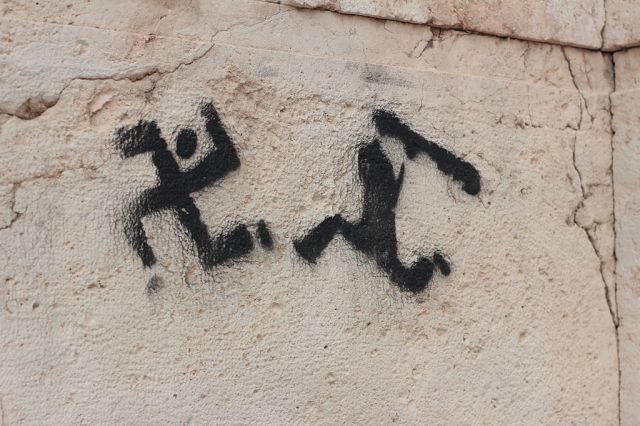
Anti-Nazi Graffiti (Photo: Cogiati)

Over a week ago, I tweeted on acting and thinking well in a fraught political context. Twitter is a limiting medium for extended trains of thought, so, in response to a request and for the sake of a broader readership, I thought I’d gather together and slightly elaborate upon my tweets in a post.

Now, perhaps more than ever, we need to resist the natural human tendency to reactive engagement, when all our media are fueling it.

Reactive people seek—and often establish—enemies to define themselves over against, rather than defining themselves on their own terms. Everything gets caught up in escalating games of ‘us vs. them’: people begin to attack everything their opponents stand for, while becoming ever more like them in their methods, behaviour, and disposition.

If we are playing the reactivity game, we will be making things worse. It doesn’t matter if we are ‘opposed to fascism,’ for instance: if we are acting and thinking reactively, we will be giving strength to it.

President Trump is a cautionary example of how the reactivity game leads people to assume the defence of the indefensible. Instead of a clear and uncompromising word of truth addressed to the evils of racism and white supremacy within society, he has pursued the path of reactive recriminations. His judgment in the matter has seemingly been undermined by the partisan dynamics of the present conflicts, by the fact that there is a perceived alignment between him and the identitarian right and that the radical left strongly opposes him. This has led him to measure groups with whom some of his sympathies lie by the behaviour of those groups that are hostile to them—and him—and to use such comparisons—‘many sides’—to exculpate or mitigate guilt.

Of course, in such situations each side will invariably perceive the other as the wrongful aggressor and truth and justice will wind up as the victims. Even when it may be granted that there is blame enough to go around, when we measure ourselves by and compare ourselves with each other, we will routinely avoid accepting the responsibility that belongs to us. When all that we are concerned about is appearing more righteous in our own eyes than our opponents appear to us, we have abandoned any actual commitment to righteousness.

The fact that extremists on the left tar all conservatives with the brush of racism and fascism shouldn’t make us at all sympathetic to actual racist and fascist movements. If it does, we are just playing reactive politics. If we permit our position to be determined by polar opposition to our ideological antagonists—by a fixation with some demonized opponents—we can thoughtlessly become their facilitating and validating obverse.

The rise of neo-Nazi movements is a serious threat to society. We must clearly present them as completely outside of the bounds of social acceptability, but we must do so non-reactively. We must never fight fire with fire.

We should condemn the lawless vigilantes on the left, in Antifa and other such movements. We must do so because we are people on the side of justice, truth, and law, not because we hold any sympathies for racists and neo-Nazis.

In such days we will be challenged to respond to the ‘which side are you on?’ question by voicing a commitment to one or other polarized party in an increasingly belligerent political and social environment. The situation, it is assumed, is one of a few directly opposed sides, with no real ground for neutrality. Anyone not aligning themselves with the anti-fascist left, for instance, will be reckoned to have chosen their side by virtue of their failure to take a moral stand when the stakes could not be higher.

Yet the common assumption that is operative here is that moral engagement in a situation can only take the form of alignment with one party or other in their reactive antagonism with each other. This assumption is widely held and consequently has a superficial appearance of truth, as both engagement and disengagement from moral issues in society typically proceeds according to it. Either people will engage by assuming a reactive alignment with a party, or they will, by washing their hands of the situation and wishing a pox on both of the antagonistic houses, disengage from the moral issues entirely.

What has been neglected is the possibility of what Edwin Friedman has called ‘well-differentiated’ engagement, of non-reactive moral concern and involvement and responsible and morally invested agency that isn’t merely driven by emotional instinct and herd dynamics. The person who has such self-differentiation can resist the emotional contagion that moves throughout the social organism and makes it function like a stampeding herd. They can take a strong stance without simply aligning with a side. They possess the ability to respond—‘responsibility’—because they have overcome their instinct to react.

This does not mean that those invested in matters of moral concern in a society should not form groups and alliances to pursue shared interests, nor that all parties are reactive in character. However, it does mean that we must be vigilant against the reactivity that commonly operates in such situations, the reactivity that blinds us to the truth on the side of our opponents or to the errors on our own, the reactivity that tends to treat truth and justice as if they were the possession of a particular side, rather than a higher standard by which we all must be tested.

For instance, in the current situation we must be able to recognize the many ways in which our own positions and camps are deeply compromised by historic and ongoing forms of injustice and oppression. We must learn to tell the truth about ourselves, without becoming the abject playthings of every accusation of guilt that is cast in our direction. We can only do this well as we resist reactivity.

We must recognize truths even when they are found in extremist camps and not let truth become the victim of our partisanship. For instance, there are statues that really must be torn down, and we can and should say this while also resisting the broader iconoclasm of many on the extreme left.

Reactivity further robs us of our ability to respond, of the essential interval preceding action that is required for reflection, meditation, and deliberation. As we function in terms of reactive antagonisms, we can also be blinded to the fact that many of our social problems are most prudently tackled, not by raising the level of our political conflicts, but by the intelligent pursuit of non-antagonistic means or the shrewd use of pressure at carefully chosen points. The reactive person, thoughtlessly reacting to social stimuli, cannot appreciate that few social problems are best addressed through the exertion of a directly opposing force, indeed that such an approach typically exacerbates our difficulties.

Nor does this mean that our visceral reaction to perceived injustice in society isn’t important or something to which we must attend. Such a reaction can often give us a pronounced sense of injustice, allowing us to enjoy some measure of an instinctual attunement to good and evil. As something that informs and colours our reasonable response to evil, it is immensely valuable and important. However, the power of such reactions, when poorly managed, can be a very dangerous obstacle to right and just action. It can overwhelm our ability to determine justice and a wise response, producing a profound moral shortsightedness in the emotionally reactive person.

Resisting reactivity isn’t just something that we can lightly will ourselves into, especially in the age of social media. As we are brought ever more close together, it becomes harder and harder to have robust self-defined identities of our own, rather than the sort of fragilized, polarized, and reactive identities which are tossed to and fro on the waves of mass emotion and reaction.

If you want to be non-reactive, you will need to commit yourself to practices protecting you from it. Firmly ground yourself in non-reactive contexts. Do most of your thinking and reading in private and on your own terms, away from the social saturation of online media. Turn off your phone. Set aside time to deliberate, reflect, and meditate. Form deep real world friendships with people who disagree with you. Commit yourself to local community work and volunteering, where common goods beyond partisanship are often apparent. Pray for your neighbours and pray for our leaders. Recognize any addiction to media that keeps you anxious, or which gives you the thrill of shallow emotion. Learn to recognize the presence of acedia in your life. Don’t mistake merely online community for the real thing.

We face immense social dangers and evils in our day and age. We have many battles to fight. The most important one remains the battle for ourselves.

“Whoever is slow to anger is better than the mighty, and he who rules his spirit than he who takes a city.”

Proverbs 16:32

Posted in Culture, Ethics, In the News, Politics, Society | 26 Comments

A Remark on Creedally-Defined Orthodoxy

The question of the definition of orthodoxy has been a live one, since James K.A. Smith posted on the subject in relation to debates surrounding sexuality. The following is a remark on the question of ‘orthodoxy’ as defined creedally.

For Smith’s argument, which presents the boundaries of orthodoxy in a fairly minimalistic manner, to work, he needs to make some crucial and fatally misguided assumptions about the way that the creed works (he also needs to overlook the Council of Jerusalem in Acts 15, whose decree condemns the practice of sexual immorality). While Smith can speak of the creed as the ‘grammar of “right belief”‘, for the purposes of his argument, the creed seems to function as a stand-alone document presenting us with a minimal list of what needs to be affirmed to mark one out as nominally ‘orthodox’.

This is where Smith goes wrong. The proper place of the creed could helpfully be compared to that of the Ten Commandments. The Ten Commandments don’t stand alone, but are a condensation of a broader body of scriptural material, a condensation that orients the student of the Torah to the proper use and understanding of the body of law. Likewise, the two great summary commandments—or the principles of justice, mercy, and faith—serve the same unifying and coordinating purpose. These condense statements give one a proper purchase upon the wider body of the Law’s teaching. They enable Jesus, for instance, to expose the unlawfulness of the Pharisees’ legalism in Matthew 23.

However, this relationship works the other way too: the Ten Commandments are expounded in the wider body of the Law, most notably in the book of Deuteronomy, which fleshes out what obedience to their commandments means in practice. This expounding of the Law gives clearer content to terms that might otherwise be unclear in their meaning.

One cannot truly affirm the Law without affirming it in relation to this illuminating exposition. In providing them with both the condensation and the exposition of the Law, God enables his people to attain to a sort of ‘literacy’ in the Law that they couldn’t achieve otherwise. The presence of both condensation and exposition of the Law alongside each other makes possible an understanding of its ‘moral grammar’. Without this literacy, the Law could be distorted in many ways, twisted into legalism or moralism, or frustrated in a license advanced through hermeneutical gerrymandering. The Ten Commandments expose the inner grammar of a body of laws whose content is fleshed out elsewhere.

Likewise, the creed doesn’t stand alone, nor do its statements interpret themselves. Terms such as ‘judgment’, ‘Scripture’, ‘holy’, and ‘sins’ aren’t empty terms, permitting us to fill them however we might please. Rather, their content is extensively unpacked in the Scriptures themselves, apart from which the creed cannot have its proper sense. The creed is never intended to function as a de-focusing of unwelcome scriptural teachings so that error can take refuge in vague terminology, nor is it a lowest common denominator.

When Smith complains about the danger of reducing Christianity to a morality, he is identifying a real problem. However, in denying the place of the creed in teaching us Christian morality, he is failing to practice his orthodoxy as he ought. The creed isn’t a self-contained document presenting the sum total of ‘orthodox’ Christian ethics. Rather, the creed gives us the grammar by which to articulate Christian ethics aright.

The creed guards against the moralism that Smith is rightly concerned about. It does so by framing the Christian life by the fundamental truths of the faith. The newness of life to which the Christian is called is defined by true confession and worship of the Triune God, over against all idolatry. It is made possible by the salvation from our sins that is achieved by Christ, a salvation according to the reliable testimony of the Scriptures. It occurs against the horizon of the future advent of Christ to judge all flesh. It is formed within the holiness of the one catholic and apostolic Church that is established and given its life by the work of the Spirit. It is grounded in the free remission of our sins that is declared in baptism. It is lived in the certain hope and anticipation of a new heavens and a new earth in which righteousness dwells. It upholds the truth of God’s intimate claim upon each of our bodies, manifested in the assurance of future resurrection.

The creed is the touchstone of Christian ethics, the document disclosing its true grammar.

And it is precisely in the character of the creed as a document revealing and confessing the grammar of the scriptural content of Christian faith that it reveals the fundamental unorthodoxy that lurks at the heart of the new sexual morality and of those who affirm or practice it, while ostensibly professing the faith. This unorthodoxy is not merely a matter of denying the content of the creedal terms that the creed’s grammar operates upon, but in its failure to honour the grammar itself.

Posted in Church History, Controversies, Ethics, Scripture, Sex and Sexuality, The Church, Theological | 26 Comments