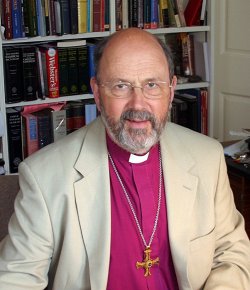
Nicholas Thomas Wright was born in Morpeth, Northumberland in 1948 and was raised in the context of middle Anglicanism. From before the age of seven or eight he already felt called to go into Christian ministry. Growing up, Wright had an interest in music and sports, interests that he retains to this day. He is a gifted pianist and also plays other instruments, such as the jazz trombone and guitar. Educated at Sedbergh School, then in Yorkshire, he specialized in Classics. As an undergraduate he studied Classics at Exeter College, Oxford. During that period he heard John Wenham give a talk on the need for Christians committed to the authority of Scripture in the world of theological scholarship. Prior to this point Wright had been heading in the direction of parish ministry. After listening to Wenham’s talk, Wright knew that God wanted him to be an academic.
During this period, Wright was very much operating within the context of theologically Reformed Anglican evangelicalism and he speaks of the way in which he regarded any books not published by very conservative evangelical publishers as suspect. Wright was an office-holder in the Oxford Inter-Collegiate Christian Union and, together with three others wrote a book that was published by the Banner of Truth Trust with the title The Grace of God in the Gospel, articulating classic five-point Calvinism. Wright recently commented that he was learning about the compatibility of divine sovereignty and human responsibility at that time, but that he wouldn’t write the same book again today.
After graduating, Wright went on to train for the ministry at Wycliffe Hall, Oxford. It was around this time that Wright married his wife Maggie. In 1973 he gained a first class honours degree in Theology and in 1975, an M.A. and was ordained as a deacon. In 1976 he was ordained as a priest.
Wright remarks that, when he began his theological studies, he presumed that he needed to read the right books in order to come up with the correct answers. However, as he immersed himself in the biblical text itself he was ‘so gripped with the excitement of exegesis’ that he began to be less concerned about always coming up with the expected ‘sound’ evangelical answers. He began to come to the conviction that his evangelical background was often characterized by sloppy thinking, despite all of its claims to be biblical and that the questions that the Scripture is primarily concerned with are not always the same as those which have preoccupied the evangelical tradition. He writes:
I continue to respect the Reformers, and men like Charles Simeon, of 200 years ago, John Stott, Jim Packer and Michael Green, at whose feet I was privileged to sit, and whose work in a variety of ways created space for me to do things differently. Where I disagree with them it is because I have done what they told me to: to read Scripture and emerge with a more biblical theology. The evangelical tradition at its best encourages critique from within. It sends us back to the Scripture which stands over against all traditions, our own included.
Concerned that evangelicalism was far too driven by historical debates and party lines rather than by Scripture, Wright became more concerned with arriving at biblical answers than with arriving at traditional evangelical answers. Without turning his back on evangelicalism, Wright came to believe that the evangelical tradition was in need of re-examination in the light of Scripture on a number of issues.
As one reads Wright’s works one will soon recognize that Wright’s chief aim is not that of voicing a traditional evangelical party line. Whilst Wright speaks out strongly against liberalism and against a number of aspects of Roman Catholicism — his book For All the Saints? Remembering the Christian Departed, being a good example of the latter — one also finds that Wright is frequently critical of evangelicalism, claiming that it has failed to do justice to the text of Scripture. One also finds Wright openly advocating as biblical positions that conservative evangelicals have traditionally strongly opposed, such as the ordination of women priests and bishops.
Wright is particularly critical of evangelicalism’s tendency to equate justification by faith with justification by inner personal religion to the exclusion of the Church and the sacraments, and its opposition of inward faith to outward performances. He argues that evangelicalism has all too easily read Paul’s teaching on justification through the lenses provided by existentialism and romanticism. The faith/works opposition becomes a matter of inner feeling over outward ritual, or sincerity over conformity to external rules.
From his earliest writings Wright has made clear that he believes that the tendency of evangelicalism to adopt a merely functional ecclesiology is deeply at odds with the Scriptures, constitutes a betrayal of the teaching of the Reformers and that it has led to misreadings of Paul on a number of issues. For example, Wright has long argued that the Scriptures teach that Baptism genuinely unites us to Christ and grants us a new status in Him. Even though Wright qualifies such statements in various ways, and seeks to maintain the necessity of faith, this still troubles many evangelicals, many of whom are wary of attributing too much to the sacrament. In adopting this position Wright sees himself as struggling to be faithful to Scripture, even when this necessitates swimming against the flow of much traditional evangelical thought on this issue. He is also convinced that evangelical convictions are quite congruent with a robust doctrine of the Church and the sacraments. While Wright strongly resists any suggestion that Baptism converts or automatically grants possession of eternal life, he insists that Baptism is nonetheless an event in which God is at work, delivering people from a realm of bondage and graciously knitting them into a new family, setting them apart with a new role to play in fulfilling God’s purposes for His creation.
Wright has had an interest in ecumenical dialogue for many years. In 1975 he was a delegate at the Assembly of the World Council of Churches. He writes of the experience:—
…if we are to come together as Christians it will not be by watering down everything until there is so little left that we can all agree on it. It will be by all of us learning more and more of Christ, and of the truth about him, so that we can grow closer to each other because we are closer to him.
I have seen this work out in practice. When I was a delegate at the 1975 Assembly of the World Council of Churches I found over and over again that it was when we said what we really meant, expressing ourselves and our viewpoints most clearly, that real fellowship and trust came about — not when we hid the light of truth under a bushel of tolerance. [Small Faith—Great God, p.80]
Wright has long been convinced of the need for ecumenical dialogue and believes that Catholic and Protestant debates have tended to be framed in terms of an unhelpful and ‘simplistic polarization’. The following quote is from a booklet entitled ‘Evangelical Anglican Identity’, written by Wright in 1980.
For the moment we note that the ‘spectrum’ which places Catholics and Protestants at poles apart from one another is potentially misleading: for as soon as we ask ‘what is it that you are attempting to safeguard’, both sides (at any rate, those who know their onions) will reply ‘genuine, biblical, God-centred Christianity’. It is a curious fact, which first came to the notice of many people with the publication of Growing Into Union, that ‘Catholics’ and ‘Protestants’ have each traditionally suspected the other of Pelagianism.
It is therefore imperative to distinguish between the biblical insights of Catholicism and Protestantism and the purely polemical positions which either side has felt obliged to construct, over and above biblical evidence, to safeguard those insights from attack. And, having made that distinction, it is important to bring together the biblical insights of each side with a larger framework that will do justice to each. This enormous task, I believe, is of considerable urgency for the church, though the present essay can do no more than point in a few directions in which the task might be accomplished.
At the same time, we will want to insist that some positions taken up not for polemical but for devotional or dogmatic reasons are simply wrong; examples might include Mariolatry or ‘Benediction’ on the Catholic side and the doctrinaire insistence on the Textus Receptus and the Authorized Version which is becoming common on the Protestant side. In other words, we must work towards a framework of thought within which the strong points of both sides can be included and from which the weak points — symptoms that understanding has been distorted, or has not been complete — can be excluded. It will no longer do to work with the assumption that Protestant principles by themselves — or Catholic ones, for that matter! — will automatically safeguard the gospel. We cannot assume, as some do today, that our problems are an exact ‘action replay’ of the sixteenth century, calling simply for a few modern Luthers to stop the Pope and all his works. On the contrary, to become more ‘Protestant’ may in fact mean becoming more man-centred, not less, as we shall see presently. We must beware too of the non-theological reasons often underlying polemical positions. Rome is often seen by Englishmen as the foreign invader, now happily repulsed but always threatening to return: and Catholics often base their picture of Protestants on American ‘hot-gospellers’ and Ian Paisley.
Our earlier remarks about nature and grace suggest that the church must be marked both by historical continuity and by a readiness to submit to God’s judgment, to admit error, to sit under the Word and learn fresh truth from it. This is, of course, a programme for large-scale ecumenical thought and action: for our present purposes we note that it is also a call for evangelical Anglicans to rethink traditional attitudes about the church, and bring them more into line with the Bible and the Gospel.
Wright frequently presents his theology as a means by which we can move beyond old debates and do justice to the biblical concerns of both parties. Whilst he is quite critical of a number of positions found within Roman Catholicism, he is prepared to enter into appreciative dialogue with Roman Catholics and believes that Protestants have much to gain from such theological engagement. Due to Wright’s ecumenical approach and his willingness to question traditional evangelical positions in the light of Scripture, many of his readings of Paul and the gospels are surprising and fresh and do not fit tidily into any side of traditional debates.
Wright is a very Anglican type of evangelical, believing that a high view of the institutional church is not merely compatible with evangelical convictions, but also the most consistent way of upholding those convictions. Wright is not just an evangelical who happens to be Anglican. He does not sit loose to his Anglicanism. He comments that he ‘wobbled once or twice’ as a student and wondered whether he ought to be elsewhere, but he was soon persuaded that he was in the right place.
In the context of the seventies, the tension between Anglican and nonconformist Reformed evangelicals was becoming quite pronounced. There was a crisis in conservative evangelical identity and Wright situated himself firmly on the Anglican side of the growing divide. On the one side of the divide there were men like Martyn Lloyd-Jones, who looked for evangelicals to separate themselves from doctrinally mixed denominations and come together. On the other side there were men like J.I. Packer and John Stott who opposed this movement and believed in the importance of developing a wider fellowship of Christians.
J.I. Packer’s involvement in ecumenical dialogue with Roman Catholics particularly troubled many nonconformist evangelicals. For Wright and other Anglican evangelicals such ecumenical dialogue was an important element of evangelical mission. These diverging visions for evangelical identity provide an important background for understanding some of the problems that nonconformist evangelicals have with the work of Wright. Both sides of the evangelical divide were concerned that the other was compromising evangelicalism. For many nonconformist evangelicals the ecumenicalism of Packer and others and their refusal to abandon a compromised institutional church was threatening the gospel. For many Anglican evangelicals it was the separationism and low view of the institutional Church among nonconformist evangelicals that was the real threat to the gospel.
These tensions within evangelicalism can be seen in a number of Wright’s works prior to 1980. In his article ‘Justification: The Biblical Basis and its Relevance for Contemporary Evangelicalism’, Wright warns of the ‘watery semi-Baptist theology which has been creeping into evangelical Anglicanism over the last decade or two.’ Wright also criticizes the doctrine of separation in this quote from his 1978 book, Small Faith—Great God:
You see [walking by sight] in many people’s attitude to the church. I don’t find in the New Testament any suggestion that the visible church ought to be composed of guaranteed one-hundred-per-cent soundly converted keen Christians. If it had been, half of the epistles would not have been necessary. Yet people are always hankering after a false security, such as you would get from belonging to a church that could be seen to be all right, seen to be ‘sound’…seen? We walk by faith, not by sight. Any attempt to get a purer church, or Christian life, than we have been promised this side of heaven, runs the risk of attempting to base security, assurance of salvation, on something other than the free grace and love of God. [104]
Whilst there were deep differences of vision for evangelical identity between Anglican and nonconformist conservative evangelicals at this time, it should not be presumed that this was always accompanied by personal animosity. Wright speaks warmly of people such as Martyn Lloyd-Jones. On one occasion in the seventies he was asked to review one of volumes of Lloyd-Jones’ Romans sermons. Having read the book, he contacted Lloyd-Jones to inform him that he was writing a review and had some disagreements with him and asked if it would be possible to discuss them with him in person, before he wrote the review. They met and Wright describes Lloyd-Jones as being very gracious in his interaction.
Wright has sought to engage with a wide range of conversation partners, both within and without the Church. Wright sees this broad engagement as part and parcel of the evangelical vocation. The Church must not regard itself as having already arrived, but must bear its witness to Christ in the world in such a way that it is open to learn new things from others, both within and without the Church. Christians must also discover points of contact with the world and develop its Christian witness on such a basis. Wright seeks to find common ground with people from all sorts of backgrounds and seeks constructive dialogue on this basis. The fact that Wright engages with many different audiences and seeks to work on the basis of the common ground that he shares with each can lead many evangelicals to perceive him as fuzzy, non-committal or ambiguous on certain important truths.
Wright has consistently refused to limit his audience to a select few genuine believers within the Church. Consequently much of his work reads very differently from the works of his Reformed and evangelical counterparts. In training for the ministry, Wright was advised to choose between pastoral work and scholarship. He was not prepared to do this. He tries to hold the world of the academy and the world of the Church together, believing that both have suffered from being separated from each other. He sees Christian engagement in scholarship as part and parcel of the Church’s mission to the world.
As Wright’s work addresses a broader audience, he cannot always assume the same shared convictions of his audience that conservative evangelical biblical theology and dogmatic theology do. The type of historical writing that Wright produces should not be confused with the biblical theological writings that many of his conservative readers are more familiar with. This is particularly significant in regard to his work on Jesus. When Wright does not explicitly base his arguments on the authority of Scripture, we should recognize that this is not a luxury that he has as an historian; it is not an indication of weakness of conviction on this issue. For instance, some have read Wright’s treatment of the virgin conception in dialogue with Marcus Borg and have concluded that he is being purposefully evasive, as they did not hear the sort of affirmation that they are accustomed to hearing from the conservative biblical and dogmatic theologians. Wright still believes and openly affirms the truth of the creed, but when writing as an historian he cannot provide the assertions that such people are looking for, nor can he take the absolute authority and reliability of the Scriptures as a methodological presupposition.
This is not unrelated to the different visions that Anglican evangelicals and nonconformist evangelicals have for evangelical identity and mission. Wright is concerned that some Christians so emphasize Christian distinctness that they can no longer communicate in the public square of the wider culture. On the other hand, he is aware of the danger merely submitting to the assumptions of the culture and failing to maintain a critical distance. In seeking to minister both within the context of the wider Church and the context of the academy, Wright addresses audiences that most nonconformist evangelicals have separated themselves from.
We should be aware of the manner in which Wright’s more scholarly work is shaped by this. Things that evangelicals take for granted cannot be taken for granted in the public realm of theological scholarship. For example, many scholars have questioned the degree to which we can rely upon John’s gospel in forming a picture of Jesus. Many academics also doubt the Pauline authorship of books such as Ephesians and the pastoral letters, and these books are generally downplayed to some degree or other when people are exploring Pauline theology.
Wright knows that, if he is going to address the academic world of theological scholarship, he must do so with one arm tied behind his back. Whilst he frequently questions the assumptions that result in the sidelining of books such as John’s Gospel, he feels that he must work within the limitations of the discipline as it currently stands. Consequently, his major work on Jesus primarily rests upon the synoptics and his scholarly work on Paul generally gives greater weight to the testimony of the works that are widely accepted as Pauline. His work also uses a lot of inter-testamental and extra-canonical sources. I think that it is important that we question whether this weighting of sources has led to any distortion in Wright’s portrait of Jesus and the theology of Paul. Perhaps one of the things that will most concern many evangelical readers of Wright is his willingness to accept widespread critical theories in biblical scholarship concerning the dating and authors of such books as Daniel and Isaiah.
From 1975 to 1978 Wright was a Junior Research Fellow and College Tutor in Theology in Merton College, Oxford, later becoming Junior Chaplain and Acting Lecturer in Theology. From 1978 to 1981 he was a Fellow and Chaplain at Downing College, Cambridge and College Tutor in Theology. In 1981 received his doctoral degree for his thesis, entitled ‘The Messiah and the People of God: A Study in Pauline Theology with Particular Reference to the Argument of the Epistle to the Romans’, his thesis supervisor being Professor G.B. Caird.
This period was a very important one for the development of Wright’s view of Paul. By the end of 1980 the heart of his reading of Paul that we will be studying in the next lecture was already present in broad outline. Over the years prior to his doctoral work, Wright had been coming to the conviction that the Apostle Paul’s agenda was quite different from those which motivated many evangelicals in their reading of him.
Wright comments that he first approached Romans 9-11 to address predestinarian controversies, but was soon persuaded that Paul’s concern lay elsewhere. A similar thing happened with Romans 7. Wright came to believe that Paul’s concern was not that of taking sides in a debate about sinless perfection, but that Romans 7 was chiefly about the state of Israel under the Law, or the Torah. As Wright’s work led him to closely examine the argument of Romans he increasingly realized how central the issue of Israel was to the entire work. Wright describes the development of his thought as follows:
I grew up as a somewhat typical middle-Anglican with a strong dash of evangelicalism, or put the other way around, I grew up in a Lutheran evangelicalism which left me with a strong antithesis between law and grace. I found this all profoundly unsatisfying until I met Calvin and Calvinism. I began to think, “Whew…the law is a good thing. It is holy and just and good. It is right and it has been fulfilled, not abrogated, in Christ.” All of that is right. So, if you are faced with a choice between Luther and Calvin, you simply have to choose Calvin.… What I then found, and believe me I tried very hard to do this, was that I couldn’t make the Calvinist reading of Galatians actually work. I was reading C.E.B. Cranfield on Romans and trying to see how it would work with Galatians, and it simply doesn’t work. Interestingly, Cranfield hasn’t done a commentary on Galatians. It’s very difficult. But I found then, and this was the mid-seventies before E.P. Sanders was published, before there was such a thing as a “new perspective,” that I came out with this reading of Romans 10:3 which is really the fulcrum for me around which everything else moved: “Being ignorant of the righteousness of God and seeking to establish their own.”
In other words, what we have here is a covenant status which is for Jews and Jews only. I have a vivid memory of going home that night, sitting up in bed, reading Galatians through in Greek and thinking, “It works. It really works. This whole thing is going to fly.” And then all sorts of things just followed on from that. I mean Sanders was a great boost but he didn’t start this for me and he hasn’t given direction to what I did or was doing. It was more like Sanders was saying, “Actually first-century Judaism never was like what Luther said it was.”
Central to Wright’s doctoral thesis was the concept of the Davidic representative Messiahship. Jesus is the Christ, Israel’s representative king, the Messiah. This theme, explored in detail in works such as The Climax of the Covenant, is a very important one for our reading of Wright. In his thesis Wright presents this Christology as central to his new reading of Romans, a reading in which the question of Israel is at the heart of the whole book and cannot merely be reduced to a marginal concern of chapter 9-11.
In 1981, after he finished his doctorate, Wright went to Canada to teach NT at McGill. He was also involved in the Anglican College in Montreal. Wright speaks of this time as one in which he came to a deeper awareness of the importance of the Eucharist and begun to experience a powerful and fruitful relationship between his devotional life and involvement in the worship of the Church and his academic studies. This is a relationship that Wright has commented on within his works and in various interviews, arguing that he regards his devotion and intellectual study to be inseparable.
Wright’s time in Canada was a significant period of spiritual growth for him. He writes:
During my second year at McGill, I plunged into the deepest depression I’ve ever known. I wrestled in prayer, searched the scriptures, examined my conscience, and fell apart. I told my wife about it one night; the next morning, a letter arrived from a Christian psychotherapist who had felt an inexplicable but irresistible urge to write. I still have that letter. Over the next year I learned more about myself and my emotions than I had thought possible. If today I manage to function as a pastor, it is not least because I know something about pain. I know, too, that healing of memory and imagination is not just wishful thinking.
Six years later, as I prepared to teach a course on Jesus in his historical context, I realized what else had been happening. I combed through my notebooks for all my old jottings. All the most significant insights about Jesus I had ever had, particularly my deepest reflections on the crucifixion, were dated in that period of depression.
During Wright’s time in Canada he was also an observer and participant in ecumenical debates with Roman Catholics and worked on a commentary on the book of Colossians. It was through working on this commentary that Wright underwent what he describes as ‘the most significant change of my theological life’. Prior to that point Wright had claimed that Jesus was Lord of all, but had not applied this to the larger world of creation, culture and politics. From that point onwards Wright paid far more attention to the political dimensions of the gospel message.
Wright had already begun to have doubts about the simplistic divisions between politics and religion established by modernity before he ever got into NT scholarship. His first research project was on the early English Reformer, John Frith, who saw political and theological reformation as going hand in hand (Wright later edited the first full edition of Frith’s works). The politically-charged character of the Christian gospel is a prominent theme in many of Wright’s works. This theme has become even more pronounced in Wright’s works from the late 1990s onwards, through the influence of writers such as Richard Horsley.
In 1986 Wright returned to Oxford, where he was a Lecturer in NT Studies and a Fellow, Tutor and Chaplain of Worcester College. He remained in this position until 1993. In this context Wright was once more able to enjoy a close relationship between study and worship. He was also had pastorally involvement with students from a range of different backgrounds. He also found himself drawing on traditions outside of his own, from the charismatic tradition on one side, to the Orthodox tradition on the other.
At Oxford Wright was able to interact with some of the most profound theological thinkers of our time. He taught on the subject of Jesus alongside Rowan Williams and has a strong friendship with him. He was also able to interact with Oliver O’Donovan, an old friend, who later delivered the sermon on the occasion of Wright’s consecration as Bishop of Durham. It was during Wright’s time in Oxford that The Climax of the Covenant: Christ and the Law in Pauline Theology, which is still his most significant book on Pauline theology to date, at least for another couple of years. Much of the material in the book is the flowering of ideas that had been developing in Wright’s mind since the late seventies.
The Climax of the Covenant was published in 1991. The next year The New Testament and the People of God was published. The New Testament and the People of God is the first volume of a projected six volume series entitled ‘Christian Origins and the Question of God’, designed to give a consistent portrait of Christian origins, ‘with particular relation to Jesus, Paul, and the gospels’. Wright’s project is incredibly ambitious. The attempt to present a comprehensive picture is one that is fraught with difficulty and seldom attempted on such a scale. This series is of great importance. To date, the first three volumes have been produced: The New Testament and the People of God, Jesus and the Victory of God and The Resurrection of the Son of God.
In 1994 Wright became Dean of Lichfield, a position which he held until 1999. During this period he wrote a number of devotional and popular works and completed the second volume of the Christian Origins and the Question of God series. It was during this time that he wrote What St. Paul Really Said, the book which has particularly sparked off the debate over Wright’s view of justification. Whilst Wright’s position on justification is fundamentally the same in this work as it is in books published back in the early 1980s and as that found within his doctoral thesis, these earlier treatments did not reach as wide an audience.
Towards the end of his time in Lichfield Wright was also involved in the writing of the libretto for an Easter Oratorio, based particularly on the final chapters of John’s Gospel. Wright has often addressed the issue of the Christian imagination in his writings and lectures. Given his lifelong love for music and the arts, it is an issue that is very close to his heart. He argues that the creation of beauty is an essential element of the human vocation and speaks of the power of the arts to communicate the truth of God to our contemporary culture. Wright also regards the imagination as essential to the true interpretation of Scripture. As interpreters of Scripture we are more like actors improvising a final act to an incomplete Shakespearian play than we are detached and objective scientific exegetes. Our imaginations must be rekindled by the rich symbolism of Christian Scripture and liturgy, so that we can produce works of beauty that stand as witnesses to the Great Artist that we serve.
From 2000 to 2003, Wright was the Canon Theologian of Westminster, where he completed his work on the resurrection, The Resurrection of the Son of God and wrote the Romans commentary, within the New Interpreters Bible series. The first few volumes of Wright’s For Everyone series of popular NT commentaries were also released during this period. Wright describes these commentaries as being aimed at the ‘12 year old confirmation candidate’ and the 70 year old within the congregation who has never read a commentary before.
Throughout his scholarly career, Wright has been concerned to relate his theology to the person in the pew and has produced a steady stream of devotional works, popular commentaries and works on discipleship, worship and popular theology. This, coupled with his great gift of communication, has led to his works being read by lay people, clergy and scholars alike.
Wright has written of the need for the Church to always be brought under the authority and judgment of Scripture. He argues that the role of the Church’s appointed leaders is particularly important in this respect. They should be both scholars and teachers of the Scriptures, something that is lost when Church leaders get caught up in administrative tasks. Wright laments the current situation where Scripture is chiefly taught by professional academics, whilst the Church is led by clergy who rely upon secondhand and often deficient understandings of Scripture. He believes that the authority of God exercised in the Church does not primarily consist in legal structures, but that it is ‘a matter of proclaiming the word in the power of the Spirit.’
In July 2003 Wright was consecrated Bishop of Durham, one of the highest positions in the Church of England. Wright continues to write voluminously and give many visiting lectures. He is a member of the Society for New Testament Studies, the Society of Biblical Literature, the Institute for Biblical Research, the Tyndale Fellowship for Biblical Research, and the Anglican Association of Biblical Scholars. He has often appeared in the media and has devised and presented a number of radio and television programs for the BBC and been consulted for many others. His outspoken opposition to homosexual priests is one thing that has resulted in a lot of publicity in recent years. As Bishop of Durham, he is a member of the House of Lords and has spoken in the House on the subject of moral climate change and freedom of speech.
Convinced that the gospel speaks to the political questions of our day, Wright has long been outspoken on a number of current issues. He received a lot of publicity for his strong criticism of the handling of the Iraq war by Mr. Blair and President Bush, arguing that they did not have the credibility necessary to deal with the problems in Iraq. Wright has also long campaigned for debt-relief for third world countries, devoting much of the final chapter of his book The Myth of the Millennium to promoting the Jubilee 2000 project. He is a strong critic of the ‘dualism’ of Left Behind theology, which he claims leads to a lack of concern for issues such as the environment and the need for social justice.
Wright is concerned that a reaction against the thin and unbiblical gospel of the social gospel movement will lead us to believe that the gospel does not address social issues. He has an active interest in issues of contemporary macroeconomics and globalization and regularly argues that America in particular and the West in general need to be regarded as exercising a form of economic and political ‘imperial’ power, casting America in the position of Caesar relative to the claims of Christ. He is deeply disturbed by what he regards as the confusing of an American way of life and a Christian way of life in the US, believing that it is the duty of the Church to call the powers to account. Wright regards the established position of the Anglican Church as something that facilitates the conversation that needs to take place between Caesar and Christ.
Wright’s political concern is not merely occupied with national and international issues. After a week-long pilgrimage of his new diocese in Durham, Wright spoke of the deep financial difficulties of many of the local farmers and of the problem of widespread unemployment. Many of the parishes in Wright’s diocese are in very deprived areas and, as their bishop, Wright is concerned that local churches be involved as forces for good in their communities. He is excited by many of the projects that churches in his diocese have undertaken to help people with literacy, financial advice and in providing childcare for single parent families.
The position of Bishop of Durham is a demanding one. There are 250 parishes in the diocese and each day is different from the last. Many days he doesn’t finish work until later in the evening. Within this busy schedule Wright has said that he sees his daily time of prayer and Bible study in the morning as his ‘sheet anchor’, claiming that the task of prayer for the diocese is central to the task of any bishop.
Since coming to Durham, Wright has completed a number of other works. He has produced a two volume popular commentary on the book of Romans, a book on the authority of Scripture and a devotional work entitled The Scriptures, the Cross, and the Power of God. He also wrote a book entitled Simply Christian, which is in a similar mould to C.S. Lewis’ Mere Christianity. Wright has explained the aim of the work as that of describing ‘what Christianity is all about, both to commend it to those outside the faith and to explain it to those inside.’
Throughout his ministry Wright has been supported by his wife Maggie. They have four grown children, two sons and two daughters, and some grandchildren. They live in Auckland Castle in historic Bishop Auckland. Wright lists music, the classical world, golf, hill walking, poetry and pastoral psychology among his leisure interests.
[Edited 11th June 2007]