
Ad`ver`sa´ri`a
n. pl.
A miscellaneous collection of notes, remarks, or selections.-

Recent Comments
-

Friendship
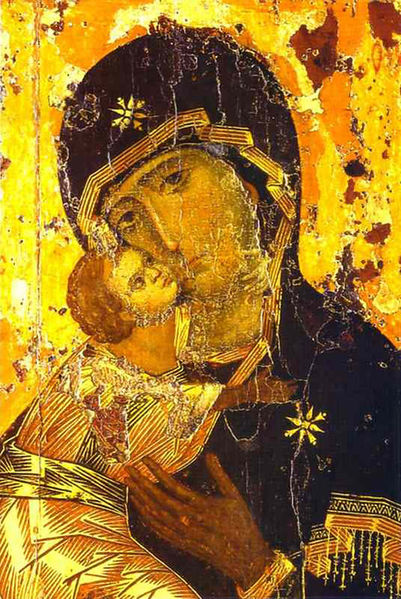
A few days ago, I listened to a typically thought-provoking talk by Richard Bledsoe, in which he remarked on the place of friendship in the biblical narrative, especially within the gospel of John. It was in conversation with John H and Jeremy Abel concerning a post on the Faith and Theology blog that his thoughts came to mind again. In the Faith and Theology post, Ben Myers gives his thoughts on the Virgin of Vladimir icon:
The theological intuition underlying the whole tradition of Russian iconography is that there are, really and essentially, only two human faces: the face of Christ, and the face of his Mother. All other human persons have their own peculiar distinctiveness, their own particular faces, to the extent that they participate in these forms. For the Orthodox, it is not Adam and Eve who are the prototypes of humanity, but the New Adam and the New Eve – so that the fundamental human relationship is not that of man and woman (Karl Barth) or husband and wife (John Paul II), but of mother and child. The single form of Virgin and Child is the prototype of every human form: “The divine image in humankind is disclosed and realised … as the image of two: of Christ and of his Mother” (Sergius Bulgakov).
I initially took issue with the notion that there is a single ‘fundamental human relationship’. Different relationships come to the fore at different stages of the biblical narrative. The first stage is often the relationship between the father and the son, followed by the relationship between siblings, with the relationship between wives and husbands finishing the cycle. These cycles map onto gradually increasing spheres of influence. For instance, in Genesis we begin with the negative cycle of the relationship between God and Adam in the Garden, move to the relationship between Cain and Abel in the land, and then to the relationship between the sons of God and the daughters of men (or perhaps Lamech and his wives) in the larger world. The later part of Genesis involves the outworking of a positive cycle, as Abraham obeys God (Father-son), Esau and Jacob reunite and make peace (siblings), and Joseph’s marriage to an Egyptian represents the bringing of God’s grace to the wider world (husband-wife).
Of course, there is much missing from this cycle, not least the elevated status that the mother-son role has in the biblical narrative. The very protoevangelion places the mother-son relationship at the centre of redemptive history. (Quite literally) at the crucial moment the mother and her child face the threat of the serpent together, and all other parties fade into the background. When history breaks down, it is out of God’s working with the woman and the bringing forth of the seed that new life emerges. It is through the faith and determination of Ruth that the Davidic line is brought back from the dead. When Israel reaches its nadir, it is out of the tears of Hannah and God’s opening of her womb that the prophet who establishes the kingdom is born. It is in the womb of the virgin that God’s Son is conceived. The great struggle of the cross is a place where Christ is left alone by almost all but his mother and the other women: the birth pangs of the new Man and new creation are the pangs of women. One can definitely argue that this human relationship has a worthy claim to be the most fundamental.
Important as this relationship is, however, other proposed fundamental human relationships could make many of their own claims to match these. The husband-wife relationship case could argue that the whole biblical narrative works towards the eschatological point of the great Marriage Supper and coming together of bride and bridegroom. One could also observe the degree of ambivalence that Christ seems to have had towards his relationship with Mary ‘according to the flesh’ (Matthew 12:47-50; Luke 11:27-28; John 2: 3-4). If the relationship between child and mother is the fundamental one, then its character must be defined with some precision.
It is at this point that friendship is worth bringing into the frame. Throughout the Old Testament, blood and kinship are central to the picture. It is only at a few odd points in the narrative that friendship comes into the foreground, most notably in the story of David. However, in the New Testament and especially in the gospels, friendship is suddenly front and centre. Human father-son relationships disappear pretty early on, as Zecharias vanishes from the narrative, Joseph is put in a secondary place (Luke 2:48-49) and also disappears, and the disciples leaves their father to follow Jesus. Husband and wife relationships are also hardly visible: we are taken aback when we realize that Peter has a mother-in-law, as his wife is never once mentioned. Sibling relationships definitely have far more of a presence (James and John, Peter and Andrew, Mary, Martha, and Lazarus), but, once again, they are not the central ones. The central relationship is that of friendship, a relational bond that can be stronger than that of brotherhood, the love of which can be more wonderful than the love of a man for a woman. Sexual difference, generational difference, and blood relationship are no longer prominent factors determining the character of interpersonal bonds.
People have wondered how Jesus of Nazareth, who never married or fathered children, could embody perfect humanity. Jesus may not have been a husband or a father, but he exemplified a sort of relationship that speaks beyond all of these roles and can transform them: Jesus was the Friend. While this fact is often presented in the trivializing fashion of Jesus as the ‘life and soul of the party’, this falls so far short of the truth. Jesus had an unparalleled capacity to give himself to other people in a manner that brought freedom, health, life, comfort, forgiveness, and joy. People wanted to be with Jesus. No human being has been a friend like Christ. As Bledsoe observes, perhaps the best place to see Jesus the friend is in the gospel of John. If John reads so differently from the other gospels, surely it is because it was written by one who was Christ’s best friend – the disciple he loved – one who could tell the story from the ‘inside’.
Jesus’ friendships broke boundaries between the sexes, and between social insiders and outsiders. In the realm of true friendship we are all equals and contemporaries. Generational differences no longer matter and the differences between the sexes need not be a divide. Jesus had close friendships with both men and women, including forms of friendship that can be very rarely practiced in certain contexts today, such as profoundly homoaffective but non-sexual friendships and unsexualized friendships with the other sex.
The Church is a place where Christ’s practice of friendship is to be lived out. The Church is a place of friendship, of bonds that can traverse all divides of social status, gender, nationality, blood, and generation. In Church fictive kinship and friendship eclipse and transform all natural bonds, making friendship central to their existence. Within the Church, friendship infuses all other bonds. The Christian faith has had no small influence in encouraging the idea of companionate marriage, making friendship a core ideal for marriage partners. Whatever else it ought to be, marriage should be a place of profound friendship between the sexes. Parents should also seek deep and lasting friendships with their children.
Generational divides will not persist into the eschaton. In the resurrection, there will be no marriage or giving of marriage. Yet as those temporary and passing bonds of flesh are translated into the realm of Christian friendship, they will persist in that rich mutuality for all eternity. As these bonds of flesh are transformed in the life of the Church, the way that we perceive them will change. Friendship becomes the lens through which we see all else. In friendship we are all equals and contemporaries. Parents learn to raise their children as those with whom they will enjoy eternal friendship on equal terms. Wives and husbands learn to see their marriage as but a short chapter in and expression of a friendship that will survive the fleshly parting of death. In the process earthly divisions, distinctions, and differences are surpassed in a lasting equality of eternal mutuality.
John H suggested that perhaps this should provide us with a new reading of the Virgin of Vladimir icon: what it portrays is not merely or primarily the human maternal relationship between Jesus and his mother, but the raising of that bond into the eternal bond of friendship that exists between them. The icon is a representation of an intimate connection between two persons that transcends all earthly bonds. Mother and child are completely given over to each other, yet in a manner in which the wonder of Mary’s maternity is revealed as the manifestation of a much greater bond between the two, whose depths even it cannot fathom, and in the eternal aspect of whose unwavering mutuality, even it must retreat from view.
The various vocations we have as individuals are nothing but innumerable different species of friendship, conjugations of that more fundamental relationship. Perhaps this is especially important when it comes to such subjects as ‘single’ people in the Church. ‘Single’ people are consistently defined in terms of what they lack, or fail to participate in (single, abstinent, etc.), but celibacy is an especial form of the ministry of friendship. The celibate person is freed to practice a form of friendship in which he gives of himself freely to many others, without in any way binding them to himself. Forgoing the promise of ‘romantic bliss’, sexual union, and offspring, celibacy is akin to a heresy in terms of the values of most human societies, yet by this means bears powerful testimony to the bonds that outlast all others. Of course, marriage and celibacy are unique and special forms of the flowering of friendship, so we need not play them off against each other.
In the contemporary Church, I wonder whether our incessant focus upon the categories of marriage, singleness, and sexuality is bound up with a myopic failure to see the deeper category of friendship, which both relativizes and transforms them. In the midst of the innumerable theological works that are written on the subject of sexuality, one could be forgiven for forgetting that the Bible really has hardly anything to say about what we call sexuality and that, when it does, it is accorded only a marginally important significance. In a like manner, the centrality of family and marriage in the contemporary evangelical church and awkward place of singles seems somewhat strange when perceived against the background of a New Testament in which families are most noticeable by their absence and where familial, marital, and blood bonds are consistently transcended. A thoroughgoing theology of friendship has the potential to puncture numerous myths and radically to reorient our understanding and vision. A Church that spoke far more about friendship than sexuality, for instance, would have a far more challenging message to present to a sex-obsessed age. A Church that unapologetically proclaimed that a celibate person embodied perfect humanity, and carefully articulated the consequences of this belief, would strike at the heart of some of the greatest idols of our age. The fact that this is seldom done is perhaps evidence of the fact that we are also enthralled by them.
Posted in Theology
10 Comments
What Does It Mean To Be ‘Biblical’?
Richard Beck and Scot McKnight raise the question of what it means to be ‘biblical’. Beck questions the degree to which the Bible can create anything resembling a consensus:
Here’s my basic observation: Whatever biblical means it doesn’t mean biblical.
What I mean is this. Are Catholics biblical? Methodists? Pentecostals? Amish? Presbyterians? Episcopalians? Baptists? And on and on? It seems everyone would own the word biblical. And if that’s the case, if biblical can embrace all this diversity, then I struggle to understand how, when I gather to discuss a “biblical” approach to a controversial subject, that anything other than a diversity of opinions will emerge. Strictly from an empirical standpoint, the bible doesn’t produce homogeneity of opinion. Rather, it produces heterogeneity of opinion. That is a fact. The bible does not produce consensus. And if you think that it could or should you’re just not a serious person.
Rather than leading to a single position, Beck argues, a conversation about a ‘biblical’ position will rather produce ‘a diversity of views that share a family resemblance.’ So what exactly is does the word ‘biblical’ mean?
This is what I think it means. Biblical is a word Christian communities use to describe their hermeneutical strategies. Biblical is a word that is used to describe how a particular faith community reads the bible. What this means is that the word biblical is a sociological label, a way of describing the interpretive strategies of a particular community.
Consequently, when a faith community gathers to discuss if a view is biblical or not they are asking how a particular view sits with their hermeneutical history and norms. The issue isn’t if a position is biblical or not (because, as I noted above, no one is being biblical) but if a position would cause a sociological rupture, a tear in the hermeneutical fabric that has held this community together. If the position can be woven into the hermeneutical web then it is declared biblical. But if the rupture is too great then the view is declared unbiblical.
In summary, this is my definition of biblical:
Biblical is a sociological stress test
While, on a purely descriptive level, it may often be the case that the term ‘biblical’ functions in this way, the notion that it must always function in such a manner strikes me as rather cynical (if unwittingly so).
Does the fact that there is plurality of interpretation really mean that Christ cannot communicate to his Church through the Scriptures in a manner that breaks through prevailing cultural and communal hermeneutical habits? Does the existence of numerous interpretations really undermine the notion of the perspicuity of the text? I am really not sure that the one follows from the other.
Naturally, correctly interpreting the Scripture is not always straightforward. Faithfully interpreting the Scripture requires a Spiritual attunement to them, an attunement that I believe is located primarily in the life of the faithful congregation. A faithful interpretation arising from profound Spiritual attentiveness and attunement to the text can be hard to arrive at for various causes, many of which are powerfully operative in the Church today. Among these reasons one could list a limited knowledge of or exposure to the whole body of the biblical text, the absence of exposure to the broader hermeneutical ministries of the body of Christ (including such things as the life of the liturgy), sinful resistance or a slothful inattentiveness to the text.
The fact that those who hardly know the Scriptures at all, handle it very selectively, avoid the contexts in which its meaning is revealed, fail to make diligent use of the means of interpretation provided to them, come to the text unwilling or unprepared to be attentive on account of a prior agenda, or do not consistently expose themselves to the ministries of faithful interpretative communities arrive at radically different understandings of the text tells us nothing whatsoever about the perspicuity of the text itself. Given the levels of biblical literacy in the Church today, should interpretative pluralism really surprise us at all? I would suggest that, before questioning the perspicuity of the text, we should be far more suspicious of ourselves.
Faithful and attentive interpretation is not always demonstrably correct interpretation, and so such interpretation can seldom easily command consensus. God does not generally communicate his truth to us in a manner in which things could not be interpreted otherwise, should we desire it to be. Powerful though it is, in important respects God makes his Word vulnerable to us: faithful interpretation must develop a deep sensitivity to the text, inclining our ears to it. Correct interpretation is a discipline of deep Spiritual sensitivity to the text, not something that can be arrived at through some certain and scientific method and demonstration. We are to be like the servants who can read the slightest hand gestures of their masters (to borrow an illustration from James Jordan).
In their use of the Scriptures, both Christ and the apostles consistently point, not to the fact that the heterogeneity of the Bible dooms us to divergent opinions, but to the fact that people have failed to hear the clear word of Scripture on account of their false tradition, sin, Spiritual blindness, or lack of faithfulness in the practices of scriptural study. In a Church where so few people have extensive and intensive knowledge of the biblical text, and where wider cultural trends are so influential, it seems to me that this should be the place where we start too.
Moving on, one might also ask whether Beck’s suggestion reduces the term ‘biblical’ merely to describing a sort of generic conservative hermeneutical impulse in the community. For me this raises the question of why the appeal to the ‘biblical’ reading so often functions as a radical one, the appeal for the reading that ruptures the hermeneutical fabric of the community, the appeal to the text against the community. As I read the Bible’s use of itself, I am certainly not struck by its hermeneutically conservative character relative to the wider community. The text is rather treated as the voice of God that can break through the false consensuses and hermeneutical strategies of the tradition and lead to the creation of a new order, as light pierces darkness. I think that there is a real danger of viewing the text as being entirely at the mercy of the interpretative community, and not often serving as a site of protest against it.
In studying the manner in which Christ and the apostles spoke of and employed the text, I don’t believe that we really witness the ambivalence to the perspicuity and unity of the text that is so common today. The fact that interpretative pluralism is so characteristic of our personal experience, and we doubt the power of the text to puncture our interpretative traditions and consensuses, strikes me as more telling an indictment against us as interpreters and as Christians. We are often more certain of our own capacity to interpret than we are of God’s capacity to communicate.
So how do I understand the term ‘unbiblical’?
The Bible isn’t a homogeneous text. However, it is not presented as a disunited text. There is a profound unity in its plurality. Its unity is not that of the monologue, but of the conversation, whose voices wrestle with each other, even though in the final analysis they do not ultimately disagree. It seems to me that the ‘unbiblical’ reading is the reading that extracts itself from wrestling with the wrestling internal to the Scripture, dismissing or failing to uphold some of its voices in favour of others.
In seeking to be faithful and biblical the Church has consistently needed to protect biblical tensions (faith and works, OT and NT, Christ as man and God, unity and plurality in the Trinity, etc.), arguing for their fundamental unity, even when the exact character of this unity cannot always be fully or clearly articulated. Being biblical is about not removing difficult canonical voices from the conversation, but giving them a faithful and receptive hearing. Being biblical is about making sure that we are constantly confronted with our ‘problem texts’ and that we never silence them.
I tend to regard a lot of denominational differences as attempts to protect either the conversation or particular voices within it. Where the conversation is constrained and biblical voices abandoned, denominations can often form around those abandoned voices. Sadly, this often results in a neglect of other voices. Dialogue between Christians from different denominations can often alert us to some of the voices that we have abandoned. I suspect that we should see God’s providential hand in this and not constantly bemoan the numerous denominations that exist. Where the Church is not yet ready to hold many voices together in a united and single conversation, it is for the best that God preserves different voices at some distance from each other, in preparation for the time when we might be more able to hear.
As I remarked earlier, I would sooner blame the clarity of my hearing than the clarity of God’s voice. I believe that such a conviction can serve as a basis for unity. When we have more faith in the perspicuity of God’s Word, but less in ourselves as its interpreters, interpretative disunity is no longer treated as if it were absolutely unavoidable on account of the character of the text, but as a temporary state arising from the incomplete character of our sanctification. The more that we commit ourselves to being attentive to the text, and to the practices of interpretation, the more that we believe that disunity will be overcome. A greater confidence in the text will recognize its capacity to shake us out of our slumbers and bring us to our senses, treating God’s Word not merely as a passive victim of our interpretations, but as a living voice in the life of the Church, the sword of the Spirit by which God is preparing us to become living sacrifices on his altar. I wonder whether our belief in unavoidable interpretative plurality on account of the nature of the text itself has produced a sort of laxness when it comes to our commitment to studying it, serving to exacerbate the very problem that it claims as its basis.
Posted in Bible, Theology
3 Comments
The Glory of Kings
 I read The Glory of Kings a couple of weeks ago, and just wrote the following review, which I thought that I would also post here.
Having been an appreciative reader of James Jordan for over a decade, the prospect of this festschrift was an exciting one. This book is a wonderful showcase of the fecundity and breadth of Jordan’s theological and biblical vision, with stimulating essays covering a wide range of subjects.
Although a few of the essays will contain material that may be quite familiar to those who are deeply acquainted with the work of Jordan and Biblical Horizons, even those who have such an acquaintance will be impressed by the amount of new exegetical and theological insight that they encounter in these pages.
Rusty Reno, in his foreword, characterizes Jordan’s vision as one of ‘scriptural realism’, one which attends to the concrete particularity of the biblical text, most especially the biblically articulated cultic life of Israel, producing a powerful antidote to abstract theologies that hover a few feet over the text. Anticipating a point concerning particularity and universality that Richard Bledsoe makes in his essay, Reno’s observation here gets to the heart of the power of Jordan’s approach. The essays in the book itself are testament to the way in which Jordan’s theological vision inspires readings of the text that are all the more universally relevant on account of their close attention to the particularity of the text.
The main body of the book is split into four sections, devoted to Biblical Studies, Liturgical Theology, Theology, and Culture. The first and, by some distance, the longest of the book, I found the Biblical Studies section the most rewarding. Since my first reading of a couple of the essays within it, I have found myself returning to them to assess their claims more closely. Tim Gallant’s essay on Romans 11, questioning Jordan’s preterist reading of the passage (although Jordan takes a preterist reading of this passage, Jordan is a partial, rather than a full preterist), is a very strong and original contribution to the discussion, raising a number of issues that I will be pondering for some time. Peter Leithart’s theological reading of the incest prohibitions of Leviticus 18 is typically thought-provoking piece, suggesting a number of connections that I suspect that I will explore in the future, not least of that between the pattern of sacrifice and that of marriage. Perhaps one of my favourite chapters in the volume, Toby Sumpter’s essay explores the father-son and sacrificial themes in the book of Job. Perhaps the greatest strength of Jordan’s work is not in his interpretation of particular passages, but in the manner in which he alerts you to themes, symbols, structures, types, and motifs that enable you to read the Bible more deeply for yourself (it is not without good reason that his most important book is called Through New Eyes). While there are many exegetes and biblical theologians who have given me greater insight into particular passages, no other theologian has had as profound an effect on the way in which I read the whole Bible. The essays in this section both clearly exhibit Jordan’s influence in this respect, and continue his work, highlighting themes that unlock far more than the passages whose interpretation was primarily in view.
Perhaps my only significant disappointment with the volume was that the section on Liturgical Theology is so brief. It is my conviction that it is in this area that some of Jordan’s greatest contributions to Reformed theology are to be found, and it would have been good to see it receive more attention. However, when presented with such a rich banquet it seems rather ungrateful to complain about the smaller size of one of the courses.
Jeffrey Meyers’s chapter on the Reformed confession of the doctrine of election in the sixteenth century is a brilliant and able study. I hope that it is extensively read. In the final section, devoted to Culture, Richard Bledsoe’s essay relating the thought of Jordan and Eugen Rosenstock-Huessy was a pleasure to read. Even though few if any readers will agree with everything that Bledsoe suggests, there is ample food for thought here, and much to spark the reader’s imagination. Once again, as with much of Jordan’s work, the great value of Bledsoe’s approach lies less in the particular suggestions that are made than in the way that it provides us with means by which we can learn to read history for ourselves.
There were a couple of points where I was a little disappointed not to encounter more probing engagement. For instance, C. Kee Hwang’s essay raised the very important issue of the relationship of Christ to eschatology, yet I feel that it missed the opportunity to probe the particular character of Jordan’s eschatology in its relationship to his Christology. While most eschatologies that stress the Christological connection tend to present Christ as a figure who profoundly disrupts the linear character of history, Jordan’s eschatology does not do this to anything like the same degree. I would have loved to have seen this explored a little more. I was also slightly disappointed that Jordan did not put up more of a defence for the position of his that Douglas Wilson questioned in the final chapter on sports. While sports in general may be worthwhile and valuable means of character formation, there are several aspects of particular prevalent sports cultures and of the supposed masculinity that is associated with these that I find deeply troubling. I would have liked to see Wilson or Jordan challenge some of these more directly, especially as they have significant influence in certain ‘Reformed’ (in the broadest possible sense of the word) contexts.
Perhaps one of the greatest evidences of my enjoyment of this book is that it prompted me to invest in three other books (Jordan’s The Handwriting on the Wall, Johan Huizinga’s Homo Ludens, and Peter Leithart’s The Four) and a complete 4 DVD set of James Jordan talks on MP3. I highly recommend this book and suspect that I will not be only one whose interest in the thought and influences of Jordan is either greatly reinvigorated or initially sparked by its reading.
Have you read the book? If you have, I would be interested to hear your thoughts.
Posted in Bible, My Reading, Reviews, Theology
2 Comments
Other People’s Mail
 Over the weekend I spent a very enjoyable and memorable few days at a celebratory get together for my mother’s side of the family. Yesterday, after most of the relatives had returned to their various parts of the country, my uncle showed us some of the inventions of my great-grandfather’s, A.C.W. Aldis (1878-1953), that he has stored in his attic, along with some of his files of old letters and photos from within the family.
My great-grandfather did a lot of work in optics, inventing such things as the Aldis signalling lamp and an overhead projector. We saw a signalling lamp, along with several overhead projectors, a number of cameras, and an epidiascope. A steampunk enthusiast would have a field day with some of the items – lots of brass lenses and fine late Victorian or Edwardian engineering.



 The inventions may have been fascinating, but the old letters were equally so. A.C.W. seems to have had a sense of humour, and penned the following letter to his young sister-in-law, containing some of the earliest instances of ‘text speak’ that I have yet encountered.
The letter dates from 1906, and is addressed to ‘Miss’ ‘Dollie’ ‘Smith’:
 I will leave it to you to decode the letter’s contents:

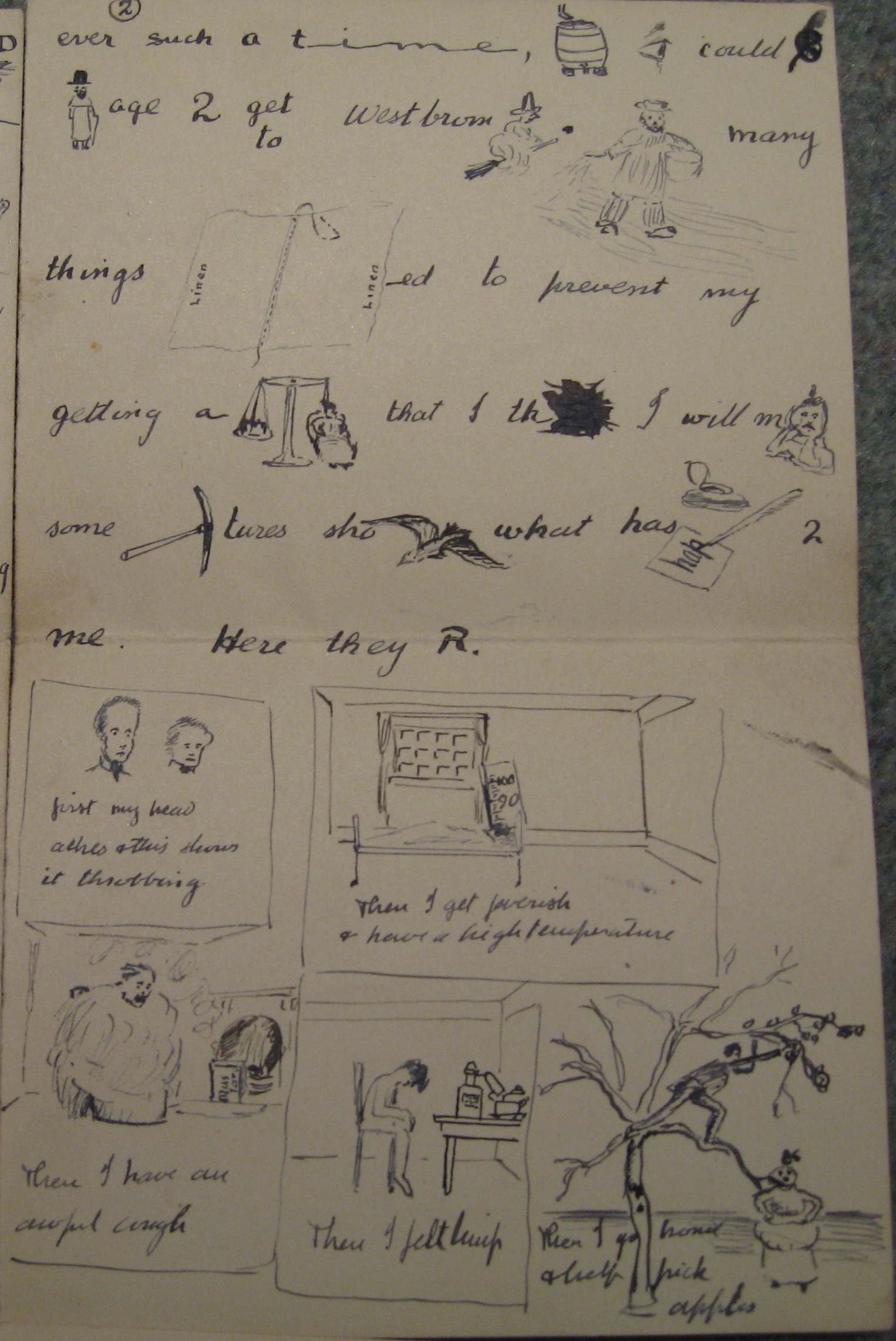
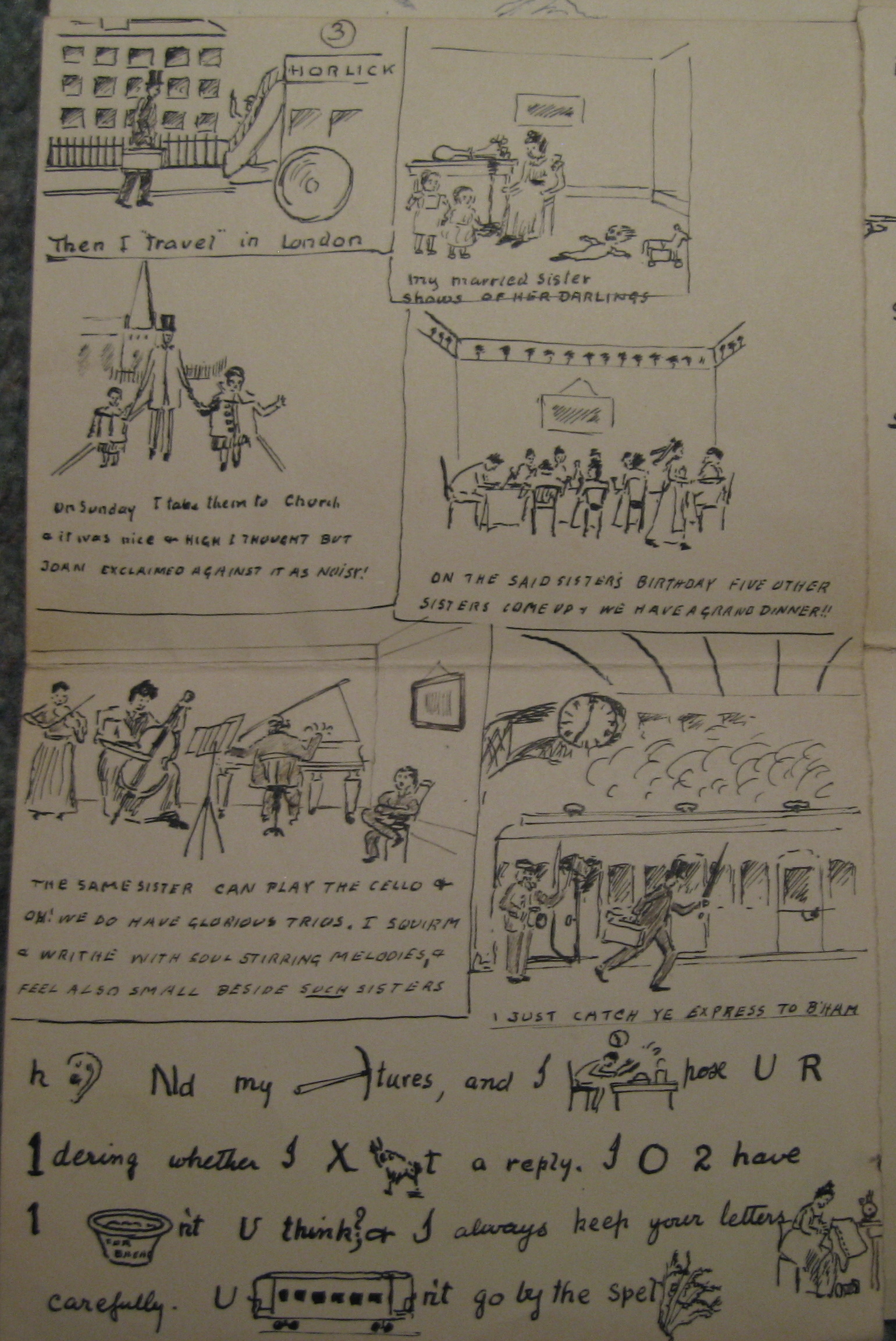
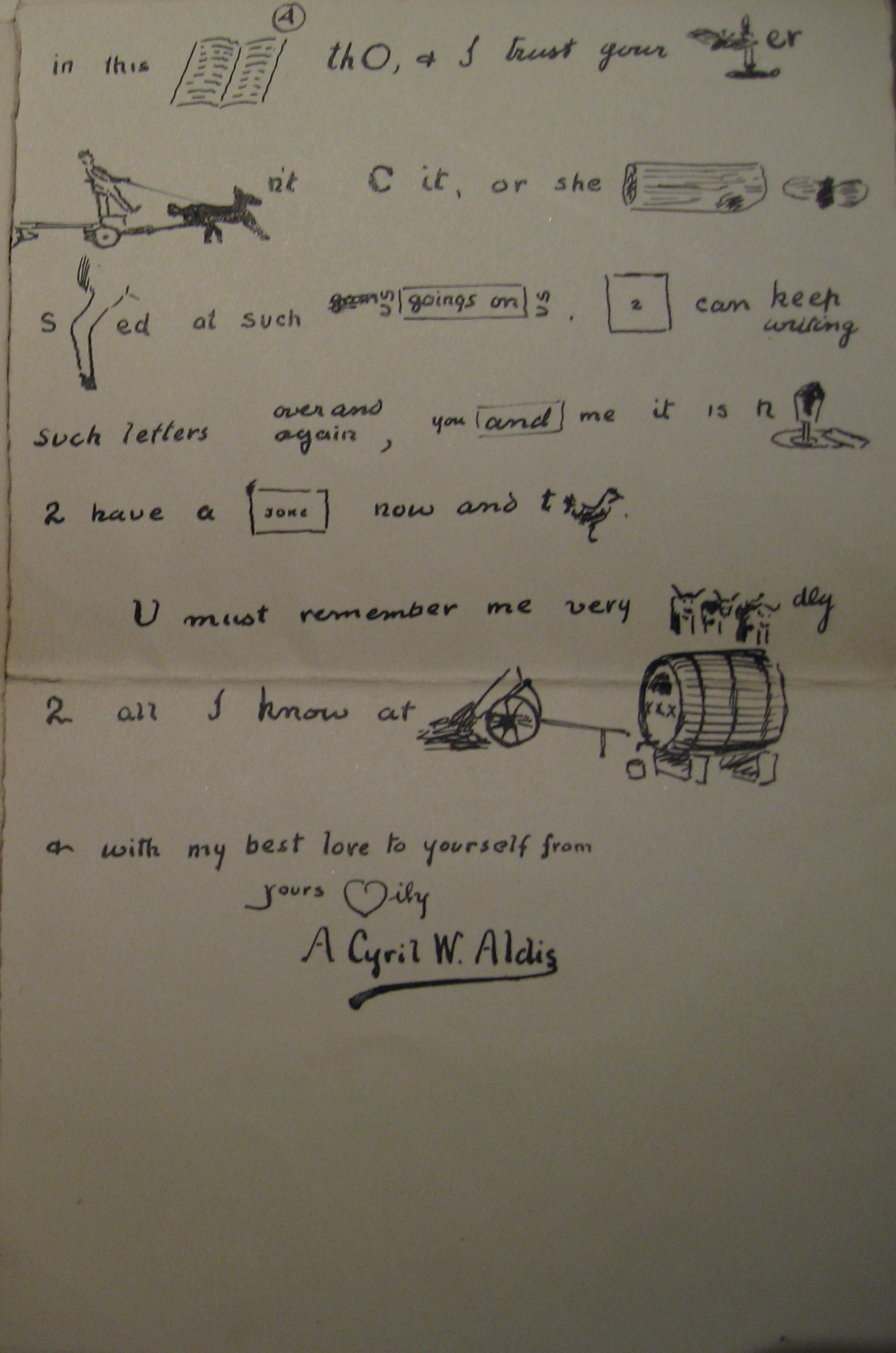 There were a few other gems, including this one, dating from WWII in which A.C.W. writes on the subject of one of his brother’s patent disputes:
 Those Germans – constantly getting away with exploiting the original work of the Britisher!
The following letter was also a very interesting read, in which my grandparents write back to the supporters of their work in Nigeria, announcing their engagement, and explaining the rather unconventional feelings and circumstances around it. It is also amusing to see how certain traits have remained in the family!

Posted in My Doings
4 Comments
Chariots and Water
There are occasions when one is struck by the extent to which a biblical motif to which one had previously not attended is present within the text. I recently had the experience when considering the significance of chariots within the biblical narratives. Perhaps one of the most memorable appearances of chariots is with the drowning of Pharaoh’s chariots at the Red Sea in Exodus 14-15. However, as one looks further afield there are hints of a more intense employment of this imagery from the Red Sea crossing in various places. For instance, a surprising number of the biblical references to chariots occur in the context of water deliverances, judgments, or washings, and closer inspection may reveal a more developed typology.
In keeping with the Exodus imagery that one finds in the Elijah and Elisha narrative, the alignment of Ahab with Pharaoh may be subtly suggested as Ahab is pursued on his chariot by the winds, black clouds, and heavy rain that ends the drought, while Elijah runs ahead of him by the power of YHWH to Jezreel (1 Kings 18:44-46), and also when, in 1 Kings 22:31-38, the dead Ahab’s chariot ends up being washed in a pool, his blood licked up by the dogs. In 2 Kings 5:9-10 the Syrian official, Naaman comes to Elisha on a chariot, and is immediately sent to wash himself in the Jordan.
Although the chariots of Pharaoh are those which are principally associated with the Red Sea crossing, later references suggest an underlying biblical juxtaposition between the throne chariot of God and the chariots of the nations in connection with water deliverance imagery. The chariot symbolism that becomes associated with water becomes more expansive, as divine chariots – and YHWH’s throne chariot – are included in the picture. In 1 Kings 7:23ff. we see ten ‘water chariots’ (cf. v.33) leading from the Bronze Sea in Solomon’s temple. In 2 Kings 2, directly after miraculously crossing the Jordan in a manner reminiscent of the Red Sea crossing, Elijah is caught up by a chariot of fire. Various psalms speak of the winds and cloud as the chariot of YHWH (2 Samuel 22:8-12; Psalm 104:3-4), from which he battles against the sea, in ways reminiscent of or alluding to the Exodus account (Habakkuk 3:8-15; 2 Samuel 22:14-17). The association of the cloud and wind with the chariot of YHWH would naturally have shaped the reading of the east wind and the cloud in the Exodus account (cf. Psalm 77:16-20; Habakkuk 3:15). The close association between YHWH’s glory presence and the ark of the covenant, and the description of the mercy seat as a ‘chariot’ (1 Chronicles 28:18), is also suggestive for our reading of the Jordan crossing in Joshua 3, where the ark of the covenant and its bearers play a central role. Such early descriptions would later acquire more explicit form in the merkabah vision of Ezekiel 1.
Perhaps most intriguing of all is the possibility that such chariot imagery is employed within the New Testament. In Acts 8:26-40 a number of elements of the narrative recall events that we have already mentioned: the running prophet who overtakes the chariot, as Elijah outran Ahab’s chariot, the foreign official being instructed to wash, as Elisha instructed Naaman, and the prophet being taken up by the Spirit/throne chariot after coming out of the water (v.39-40; 2 Kings 2:9-11, 16; Ezekiel 3:12-14).
This multi-faceted imagery of chariots is also taken up in the Christian tradition. Jean Danielou studies the manner in which early Christian writers developed the relationship between the merkabah, the chariot of Elijah, and baptism. Highlighting Tertullian’s identification of the primordial waters as the ‘vehicle (vectaculum) of God’ and Cyril’s description of Christ as a ‘charioteer’ as he walks on the waters, he proceeds to demonstrate the relationship between this theme and that of Elijah’s chariot that ascends to heaven. For Cyril and other early Christian writers, Elijah’s ascent in the fiery chariot is an image of the grace of baptism, whereby the baptizand is washed and raised up to heaven with the gift of the Spirit. The figure of Elijah’s chariot is explicitly related to the Red Sea crossing by Gregory of Nyssa. Having identified the power of YHWH exercised at the Red Sea as ‘horsemen’, and associated it with the horses and chariot by which Elijah ascended, he writes: ‘It is not possible to be made like to the horsemen which submerged the chariots of the Egyptians in the deep if one has not been freed from slavery to the Enemy by the sacramental water.’
One of the things that this suggests to me is that baptismal ‘vehicles’ (Noah’s Ark, Moses’ ark, the belly of the great fish of Jonah, etc.) may be a lot more integral to the symbolism than often supposed.
Posted in Bible, NT, OT, Sacramental Theology, Theology
6 Comments
Adversaria Redivivus
It has been some time since I last blogged seriously, so please be patient with me if it takes me a while to warm up. While I doubt that I will post as heavily here as I have done elsewhere in the past, I hope to blog at least a couple of items every week.
Posted in Uncategorized
Leave a comment
On Making a Prophet: Pentecost and the Church’s Mission, Part 2
Now when the Day of Pentecost had fully come, they were all with one accord in one place. – Acts 2:1
In setting the scene for the events of Pentecost, Luke immediately draws our attention to the fact that all of the disciples are assembled together in one place. Remarking on the ‘togetherness’ of the disciples, Richard Thompson observes:
Although Luke does not explicitly state why this corporate quality is important or how these believers concretely demonstrate such a quality, such an emphasis suggests that this characteristic is critical both to the narrative and potentially to what follows.[1]
What are we to make of the corporate character of the events of Pentecost?
A Community of Prophets
Pentecost (re)constitutes the community of the early church in a powerful way, representing an event of decisive importance for its formation and identity. For this reason it is perhaps significant that we find a number of possible echoes of the events of Sinai in the immediate context. Sinai was an event of immense importance for Israel in its life as a nation, being the occasion of a group theophany, their reception of the Torah and their entrance into a covenant with YHWH. Kenneth Litwak writes:
There are several striking elements which suggest that Luke shaped his account on the basis of the Sinai tradition. Acts 2 opens with a theophany, which includes fire and a loud sound (Acts 2.1-4; cf. Exod. 19:16 [sound of a trumpet] and Exod. 19.18 [YHWH descended upon Sinai in fire]). At Sinai God spoke to Moses, and in Acts 2.11 the people hear the disciples speaking of the mighty works of God. On a broader level, the theophanic event in Acts 2.1-4 is formative for the first followers of the Way, just as the Sinai theophany was formative for God’s people in Exodus.[2]
In Exodus 19:1 we read that the children of Israel arrived at Sinai three months after leaving Egypt, where, after a few days of preparation, they received the Law. As the feast of Pentecost occurred 49 days after the Feast of Firstfruits (Leviticus 23:15-16), which took place in the latter half of the first month, the possibility of a chronological connection between Pentecost and the giving of the Law and forming of the covenant in Sinai is raised.[3] This connection did not go unnoticed by the rabbis, who identified Pentecost as the feast celebrating the gift of the Law. Whether such a connection was established by the time that Luke wrote the account of Acts 2 is uncertain and continues to be a matter of debate among scholars.
Taken by itself this connection between Pentecost and Sinai may appear rather slight, but it is given more weight when we consider it alongside the presence of the other echoes of the Sinai account in the early chapters of Acts.[4] At Sinai Israel was set apart as a ‘kingdom of priests and a holy nation’, giving the children of Israel a special role to play within God’s purposes for the wider creation. The parallels to the event of Sinai are important chiefly on account of the way in which they frame the event as one through which the disciples are set apart as a people with a new vocation.
In contrast to the examples of prophetic succession that we previously observed, the example of Sinai involves the reconstitution and setting apart of a whole people and not just of one person. The events of Pentecost are not of mere private significance to those involved, but herald the establishing of a new reality in the realm of history. Sinai inaugurates a new era and not merely a period of leadership limited by one man’s lifespan. Consequently, the event of Sinai has much light to shed on Luke’s account of Pentecost. Stronstad writes:
…[W]hat is happening on the day of Pentecost is not only as dramatic as, but also as significant as what happened at Mt Sinai. In other words, the creation of the disciples as a community of prophets is as epochal as the earlier creation of Israel as a kingdom of priests.[5]
The Distribution of the Spirit of Jesus
A number of commentators have argued for some form of connection between the narrative of Numbers 11 and that of Acts 2, a connection that can illuminate certain dimensions of the church’s prophetic character.
In Numbers 11 Moses appeals to YHWH to ease the burden of leadership that he is bearing. Responding to his plea, God instructs Moses to gather seventy of the elders of Israel and bring them to the tabernacle of meeting. There God will take of the Spirit that is on Moses and give it to the elders, so that they can share the task of leading the people with him.
Following a day of preparation, the elders are gathered together and the Spirit rests on them. They then begin to prophesy, although they never do so again (Numbers 11:25).[6] Two of the seventy elders—Eldad and Medad—were not present at the tabernacle of meeting at the time, but received the Holy Spirit nonetheless and began to prophesy in the middle of the camp. Joshua, Moses’ assistant, concerned by this, asks Moses to instruct them to stop. Moses, however, was unconcerned: ‘Are you jealous for my sake? Oh, that all the Lord’s people were prophets and that the Lord would put His Spirit upon them!’ (verse 29).
There are a number of echoes of the theophany at Sinai in the account of Numbers 11, including: (1) the granting of a new vocation to a body of people (Exodus 19:5-6; Numbers 11:16-17); (2) the command for the people to sanctify themselves for the coming day when YHWH will act decisively (Number 11:18; cf. Exodus 19:10); (3) the gathering of the people around a particular location, Mt Sinai in the Exodus account and the tabernacle in that of Numbers (Numbers 11:24);[7] (4) a theophany in which God comes down in the cloud and speaks with Moses (Exodus 19:9; Numbers 11:25).
Although some might argue that the ‘spirit’ given to the seventy elders is Moses own spirit, rather than YHWH’s, a reading of Numbers 11 that understands the ‘spirit’ as YHWH’s own Spirit seems far more satisfactory (cf. verse 29). Nevertheless, it is important that we recognize that the Spirit that is given to the seventy elders is spoken of as the Spirit that is upon Moses himself (Numbers 11:17, 25). Although we are not here dealing with a ‘sacramental transfer’ in which Moses is active, Moses is seen as the one who mediates the elders’ reception of the Spirit. The elders do not receive the Spirit as a direct bestowal from God, but with ‘Moses as the intermediary’.[8]
Williams contrasts this with the case of leadership succession that occurs when Joshua receives authority to lead and the ‘spirit of wisdom’ through the imposition of Moses’ hands (Deuteronomy 34:9). In Numbers 11 Moses does not abandon certain aspects of his leadership to others. The elders are rather empowered to help fulfil Moses’ task of leading the people. Their ministry does not displace that of Moses, but involves a partaking in Moses’ ministry.[9]
At Pentecost Jesus mediates the gift of the Spirit to the church (Acts 2:33), and, much as the elders’ reception of the Spirit in Numbers 11 gave them a share in the Spirit of prophetic leadership that belonged to Moses, so Pentecost brings the church to participate in the prophetic authority of Jesus, an authority that never ceases to be the exclusive possession of Jesus himself.
At this juncture a further dimension of the ‘baptism’ imagery (cf. Acts 1:5) may come to the fore: baptism does not merely initiate into office, it can also fulfil an incorporative purpose, bringing people to participate in the life, authority, status or privileges of another (Romans 6:3-5; 1 Corinthians 10:1-2; Galatians 3:26-29). Just as Israel was led by Moses prior to being ‘baptized’ into a greater union with him,[10] so the disciples were led by Jesus prior to the baptism of Pentecost. What Pentecost effected was the disciples’ reconstitution as the church—the body of Christ—bringing them into a new relationship with their master. They now shared in the power of his Spirit, being bound to him by a bond of relationship far stronger than any they had previously enjoyed.[11]
The temporary and unrepeated character of the elders’ act of prophesying merits closer examination. While we have good reason to believe that the Spirit remained with the elders, enabling them to fulfil their role, the fact that they did not prophesy again suggests that prophesying was not necessary for this. The initial ecstatic manifestations were not normative for the ongoing performance of their duties. A similar occurrence can be found in 1 Samuel 10:10-13, where the Spirit comes upon Saul, causing him to prophesy. It is through this experience that Saul is set apart and personally prepared for leadership (1 Samuel 10:6). Apart from one other exceptional occasion,[12] we never read of Saul prophesying again. The prophecy was an effect and an authenticating sign of the Spirit’s coming upon him; the continuance of the Spirit with him did not necessitate repeated occurrences of prophetic manifestations.
There is a strong analogy to be observed between the prophesying of the elders and the glossolalia of the disciples, and a few writers (Gordon Wenham, for instance) have even suggested that we equate the two. As Dunn observes, Luke does not share Paul’s sharp distinction between speaking in tongues and prophesying. In his use of the passage from Joel in his sermon, Peter appears to equate the tongues-speaking of the disciples with the prophetic speech which the prophecy promises. In light of this OT background, it seems that the purpose of the glossolalia in the context of Acts 2 was primarily that of serving as an authenticating sign of the Spirit’s coming upon the disciples. There is no reason for us to believe that glossolalia would continue to be practiced by all of the disciples present at Pentecost. Tongues-speaking primarily served as a temporary authenticating sign.
The passage from the prophet Joel that Peter uses in his sermon is strikingly parallel to the wish of Moses that all of the people were prophets (Acts 2:17-18; Numbers 11:29).[13] This connection between the prophecy of Joel and Numbers 11 is also found is rabbinic midrash texts. If, as Litwak maintains, the Joel prophecy provides a ‘programmatic text’ and lens for Luke’s understanding of Pentecost, it is also a lens through which passages such as Numbers 11 illuminate the text. The ‘prophethood of all believers’ that is desired in Numbers, is prophesied in Joel and receives a form of fulfilment in Acts.
Perhaps we can even hear echoes of Eldad and Medad when we read of the Gentiles who received the Spirit in Acts 10. Eldad and Medad were outside of the group of elders at the tabernacle. Nonetheless, they still receive the anointing of the Spirit just as the others. In a similar manner, the Gentiles may have appeared to be outside of the gathering to which the Spirit was specially promised, but they received the Spirit in much the same way, in a sort of aftershock of the original event. By giving Cornelius and his household the Spirit before they had become members of a Jewish church, God demonstrated the freedom of the Spirit and the fact that Jews and Gentiles were accepted on an equal footing.
Endnotes
[1] Richard P. Thompson, Keeping the Church in its Place: The Church as Narrative Character in Acts (London: T&T Clark, 2006), 38
[2] Kenneth Duncan Litwak, Echoes of Scripture in Luke-Acts: Telling the History of God’s People Intertextually (London: T&T Clark, 2005), 165-166. Roger Stronstad, The Prophethood of All Believers: A Study in Luke’s Charismatic Theology (Sheffield: Sheffield Academic Press, 1999), 58-59 highlights a number of further common features of the Sinai and Pentecost narratives, including the days of preparation and the occurrence of the theophany in the morning.
[3] A number of writers reference Jubilees 6:17-21 in this context. Others have observed the connection that Jubilees draws between Pentecost and covenant renewal.
[4] Besides those already mentioned, there are a number of further echoes of Sinai narrative in Acts 2. The ascension of Christ into the cloud (Acts 1:9) might be an echo of the ascension of Moses onto Mount Sinai. The number added to the church (‘cut to the heart’) in Acts 2:41 may also echo the number slain by the sword at Sinai (Exodus 32:28). Wedderburn argues for a connection between the events of Sinai and those of the Day of Pentecost as they are recorded in Acts, but claims that this connection was not made by Luke, but by some of his sources. Hovenden has a very helpful discussion of some further possible literary connections, including that of a Lukan allusion to Psalm 67:19 (LXX) in Acts 2:33, a verse applied to Moses at Mount Sinai by some of the rabbis. Johnson highlights the similarities between the statement concerning Moses in Stephen’s speech in Acts 7:38 and that of Peter concerning Jesus in Acts 2:33.
[5] The Prophethood of All Believers, 59
[6] The meaning of the phrase ולא יספו is not entirely clear. In light of the similar phrase used in Deuteronomy 5:22, we have opted to understand it as a denial of their continuance in prophesying.
[7] The possibility of the disciples being gathered around the temple on the Day of Pentecost will be discussed in a later post.
[8] David T. Williams, ‘Old Testament Pentecost.’ Old Testament Essays, 16:130-1
[9] Ibid, 132
[10] As we shall later see, one dimension of this ‘baptism into Moses’ was Israel’s entry into Moses’ own experience.
[11] The incorporative purpose of the baptism of the Spirit is explored in such places as 1 Corinthians 12:12-13.
[12] 1 Samuel 19:21-24. This incident occurs after the Spirit has departed from Saul (1 Samuel 16:14).
[13] John Barton, Joel and Obadiah: A Commentary (Louisville, KY: Westminster John Knox, 2001), 95 relates Joel 2 and Numbers 11 together, claiming that Joel’s prophecy ‘reads almost as a fulfillment of Moses’ hope expressed in Num. 11:29.’
Posted in NT Theology, OT Theology, The Church, Theological
5 Comments
On Making a Prophet: Pentecost and the Church’s Mission, Part 1
The following is the first in a series of several posts, exploring the prophetic role of the church and the meaning of the Baptism of the Spirit.
The first chapter of the book of Acts presents us with both an ending and a beginning. Bringing to a close the period of his earthly ministry, Jesus’ ascent into heaven also marks the beginning of a new act in the drama of the NT, that of the public mission of the church.
The exact nature of the relationship between the ministry of Jesus and the ministry of his church is a matter that I will explore in some depth in the posts that will follow this one. In particular, I will be attempting to demonstrate that the events of Pentecost set the church apart as a prophetic community. Bringing the text of the opening chapters of the book of Acts into conversation with particular texts within the OT, I hope to explore the manner in which accounts of prophetic call, anointing and succession can provide a helpful lens through which to view the events of Pentecost. In making this case I will be devoting considerable attention to a closer analysis of Acts 2:1-4. Having established this exegetical groundwork, I hope to proceed to make some observations about the way in which I believe that the event of Pentecost should shape the Church’s self-understanding. While my focus will be on constructing a positive account of the significance of this event, I will also be entering into critical dialogue with alternative understandings.
A number of writers have explored the subject of prophetic anointing in Acts 2. In The Prophethood of All Believers, Roger Stronstad devotes a chapter to the event of Pentecost, which he claims inaugurates ‘the prophethood of all believers.’[1] The theme is also highlighted by some commentators in the course of their treatment of the passage, and in wider treatments of Luke-Acts. Within Echoes of Scripture in Luke-Acts, Kenneth Litwak identifies a number of the OT passages that the narrative of the early chapters of Acts evokes, unearthing some neglected allusions to prophetic call and succession narratives in the process.
Building upon the foundation that these writers have established, and entering into constructive conversation with them, I hope to probe deeper into the OT background for the prophetic themes that surface in Luke’s account of Pentecost. Attempting an intertextual reading of Acts 2, I want to prove the theological and exegetical value of understanding the account in terms of OT accounts of prophetic call, anointing and succession.
Jesus and the Church in Luke-Acts
For Luke the ministry of the church is inseparably connected to Jesus’ own ministry, something highlighted by the resumptive character of his introduction to the book of Acts. As Ben Witherington argues, Luke situates his account of Jesus within a ‘wider historical framework’, giving considerable prominence to the events preceding the birth of John the Baptist at the very outset of his narrative and closely following the subsequent growth of the church in the second volume of his work.[2] Remarking on the limited attention that Luke gives to Peter’s confession in his gospel, in contrast to the accent placed on the accounts of the commissioning of the Twelve and the Seventy between which it is sandwiched, Witherington writes:
Nowhere is it made more apparent than in this sequence that Jesus is the initiator of a series of events and proclamations that his disciples undertake during and then after his time. The focus is not just on Jesus but on the historical Jesus movement of which he was the catalyst and focal point.[3]
In adopting a narrow focus on the identity and personal ministry of Jesus we are in danger of failing to appreciate the degree to which the Lukan treatment of the early church is driven by more than a merely biographical or historical interest. For Luke the church plays a key role in the drama of God’s salvation, both as the place where that salvation is realized and as the agency through whom it is borne witness to and spread.
Baptism, Ascension, and Elijah Typology
Immediately prior to his ascension, Jesus promises his disciples the gift of the Holy Spirit, a gift for which they must wait in Jerusalem. Recalling the contrast drawn by John the Baptist in Luke 3:16, Jesus speaks of the reception of the Spirit in terms of the language of baptism. By describing the church’s forthcoming reception of the Holy Spirit in such a manner, Jesus presents the event that is about to occur to the church as somehow analogous to the type of event that John’s baptism represented. The baptism with water administered by John the Baptist will now be followed by a baptism with the Spirit that Jesus will perform on his disciples.
Within Lukan theology, John’s baptism is presented as playing a preparatory role (cf. Acts 19:1-6). It prepared the people for the coming kingdom of God and also served as the ‘launching-pad’ for Jesus’ own work. In Luke’s gospel we see that Jesus’ own baptism by John the Baptist marked the beginning of his public ministry (Luke 3:20-22), a detail that is given significance in the first chapter of Acts (Acts 1:21-22). In the narrative of Luke’s gospel, John’s baptism of Jesus also marks the end of John’s place in the foreground of the gospel narrative. Once the ministry of Jesus has got off the ground, the purpose of John’s ministry has more or less been accomplished.[4]
Within the gospels John the Baptist is presented ‘as in some sense Elijah redivivus.’[5] In an allusion to the prophecy of Malachi 4:5-6, the angel Gabriel declares to Zecharias that his son John will go before the Lord ‘in the spirit and power of Elijah’ (Luke 1:17). Elsewhere, Jesus declares that John was the Elijah that was promised to come (Matthew 17:10-13). The description and narrative of John the Baptist is also replete with allusions to the description and narrative of the prophet Elijah.[6]
Perhaps it is significant that John’s baptism of Jesus takes place on the far side of the Jordan: this was the place where Elisha succeeded Elijah (2 Kings 2) and Joshua took over from Moses (Joshua 1). In all cases the succession involves a crossing or coming out of the river and a reception of the Spirit (Deuteronomy 34:9; Joshua 1:10-18; 2 Kings 2:9-15; Luke 3:21-22).
At Jesus’ baptism by John, the Spirit descends upon him in the form of a dove (Luke 3:22), fills him and leads him into the wilderness (Luke 4:1). Within Lukan theology, there is a very close connection between filling with the Spirit and prophecy (Luke 1:15, 41-45, 67; Acts 2:4, 17-18; 4:8, 31; 7:55-56; 13:9-11).[7] Jesus’ characterization of himself as a prophet in Luke 4:24, in the context of his reading of Isaiah 61:1-2 is significant. It is the descent of the Spirit upon Jesus at his baptism that sets him apart as a prophet. The connection between baptism and investiture is an important one for our purposes:[8] the church’s reception of the Spirit in the ‘baptism’ of Pentecost needs to be understood as an ordination for prophetic ministry.
Luke does not limit his deployment of Elijah imagery to his treatment of John the Baptist. As N.T. Wright observes, there is strong evidence to suggest that the synoptics also understand the work of Jesus in terms of Elijah typology.[9] It is at the point of Jesus’ ascension that this imagery assumes a greater prominence. Commenting on the ascension account in Luke 24:50-53, Kenneth Litwak writes:
If Luke’s audience encountered a story of someone approved by God ‘going up’ to heaven, they would surely have thought of Elijah’s ascension … since his is the only ascension account in the Scriptures of Israel. The statement in Lk. 24.49 that the disciples would be empowered by the Spirit recalls Elijah’s bequest of his ‘spirit’ to Elisha (4 Kgdms 2.9-10). The use of ενδύσησθε in Lk. 24.49 may also be an allusion to Elijah’s mantle which was passed on to Elisha (2 Kgdms 2.13)…[10]
The OT speaks of the future return of the ascended Elijah to restore all things (Malachi 4:5-6; cf. Sirach 48:10), a theme that also appears in the NT (Mark 9:12; Matthew 17:11). Significantly, Luke ascribes to the ascended Jesus that which was traditionally ascribed to Elijah: in Acts 3:21 he speaks of Jesus as the one ‘whom heaven must receive until the times of restoration of all things’ (Acts 3:21; cf. Acts 1:11).[11]
Given the dominance of such Elijah imagery in the context of the ascension, Jesus’ promise of the Spirit immediately prior to his rapture must take on an added significance. The Elijah imagery provides the typological adhesive binding together ascension, Pentecost and parousia. Within the frame provided by the Elijah typology, an intimate connection is seen to exist between the ascension and Pentecost narratives. Consequently, any attempt to understand the events of Pentecost must begin by giving attention to the Lukan ascension accounts.[12]
The Ascension and the Prophetic Anointing of the Church
Just as Jesus’ baptism by John marked the beginning of his prophetic ministry and his succession from John’s own ministry, so the ascension and Pentecost mark the time when the church is anointed for its prophetic ministry and the transition from Jesus’ public earthly ministry to that of the church.
The two most important prophetic succession narratives of the OT involve the transition from the leadership of Moses to the leadership of Joshua (Numbers 27:12-23) and the transition from the prophetic ministry of Elijah to that of Elisha (2 Kings 2:1-15).[13] In both of these cases the mission started by the first prophet is completed by his successor.[14] Moses’ mission to lead the children of Israel out of Egypt and into the Promised Land is only fulfilled in the ministry of his successor Joshua. Similarly, the mission that Elijah is charged with in 1 Kings 19:15-17 is only completed in the ministry of Elisha (2 Kings 8:13; 9:1-3).[15]
Elisha is a new Elijah (2 Kings 2:15), just as Joshua is a new Moses (Numbers 27:20; Joshua 1:5). The parallel between the ministries of Joshua and Elisha and the ministry of Jesus’ disciples is worth highlighting. Both Joshua and Elisha serve as apprentices to prophets, whose ministries they inherit following the time of their masters’ departures. The same pattern holds in the case of Jesus’ disciples: having left their work to follow Jesus as disciples, they receive their master’s Spirit following his departure and continue his mission.
The relationship between the prophet and his apprentice is akin to the relationship between a father and his son. In Numbers 13:16 we see that Joshua’s name was given to him by Moses. Moses also lays his hands on Joshua (Deuteronomy 34:9) in a manner reminiscent of the patriarchs’ blessings on their sons (Genesis 48:13-20). A similar relationship exists between Elijah and Elisha. Elisha receives a ‘double portion’ of Elijah’s spirit, the inheritance appropriate to the firstborn (Deuteronomy 21:17),[16] and, as Elijah is taken into heaven, Elisha addresses him as his ‘father’. Jesus’ farewell discourse and blessing of his disciples (Luke 24:51) belongs within this pattern of prophetic succession.
Zwiep notes the parallel between the stress on the visibility of the master’s departure in both the account of Elijah’s rapture and that of Jesus’ ascension.[17] Seeing Elijah taken up was an indispensable condition for Elisha’s right to succeed him. Moberly explains the logic of the test: ‘…it is the responsibility of the prophet to be able to see God, and if Elisha cannot see God in this critical instance, then he is not able to take on the role of one who sees God in other instances; Elisha cannot be a prophet like Elijah unless he has the requisite spiritual capacity.’[18] The Lukan stress on the disciples’ witnessing of Jesus’ ascension might serve to underline their suitability for prophetic office.[19]
Elijah and Moses typology is multilayered within the Lukan literature. However, in the critical movement in the narrative with which we are concerned, the disciples are typologically related to Joshua and Elisha. As their master departs, they will inherit his Spirit and continue his mission. The Spirit that the disciples will receive is the Spirit of Christ, the Spirit that supervised and empowered his own mission.[20]
Endnotes
[1] Roger Stronstad, The Prophethood of All Believers: A Study in Luke’s Charismatic Theology (Sheffield: Sheffield Academic Press, 1999), 70
[2] Ben Witherington III, The Acts of the Apostles: A Socio-Rhetorical Commentary (Grand Rapids, MN: Eerdmans, 1998), 21-24
[3] Ibid, 23-24
[4] A point made more explicitly in the fourth gospel (John 1:29-34; 3:27-30).
[5] N.T. Wright, Jesus and the Victory of God (Minneapolis, MN: Fortress, 1996), 167
[6] John the Baptist is an ascetic and peripatetic prophet who, like Elijah, calls Israel to repentance in light of coming judgment. He dresses like Elijah (Mark 1:6; cf. 2 Kings 1:8) and, like Elijah, is associated with the wilderness. Like Elijah, his ministry is opposed by a tyrant with a manipulative wife (Herod & Herodias / Ahab & Jezebel). Significantly, John the Baptist’s ministry begins at the geographical location where Elijah’s ministry ended (Matthew 3:1; Mark 1:4-5; cf. 2 Kings 2:4-11).
[7] James D.G. Dunn, The Christ and the Spirit: Volume 2 – Pneumatology (Grand Rapids, MN: Eerdmans, 1998), 11-12
[8] Although its focus is on the connection between baptism and priestly ordination, much of Peter Leithart, The Priesthood of the Plebs: A Theology of Baptism (Eugene, OR: Wipf and Stock, 2003), 87ff is relevant to our case.
[9] Jesus and the Victory of God, 167
[10], Kenneth Duncan Litwak, Echoes of Scripture in Luke-Acts: Telling the History of God’s People Intertextually (London: T&T Clark, 2005), 147
[11] A.W. Zwiep, The Ascension of the Messiah in Lukan Christology (Leiden: Brill, 1997), 114-116
[12] There is also a sacrificial pattern to be observed in this movement. Leithart observes [1 & 2 Kings (SCM Theological Commentary on the Bible: London: SCM, 2006), 176]:
The story of Elijah’s departure into heaven follows the sequence of a sacrificial rite (Lev. 1). By their mutual journey around the land, Elijah and Elisha form a unit, a “two of them” (2 Kgs. 2:7). They cross the Jordan, as parts of a sacrificial animal will be washed before being place on the altar. Fire descends from heaven, dividing them in two, one ascending in fire to God, as the altar portions of the animal ascend in smoke to heaven. In the ascension (or “wholly burnt”) offering, the skin of the sacrificial animal is given to the priest, and the mantle-skin of Elijah, the hairy garment of the “baal of hair,” is left for Elisha. Through this human “sacrifice,” Elisha becomes a successor to Elijah, and a new phase of prophetic history begins. In this sense too the story is a type of the sacrifice of Jesus, who is washed in the Jordan, gives himself over to be cut in two, ascends into a cloud, and leaves his Spirit and his mantle with his disciples.
[13] Peter Leithart, A House For My Name: A Survey of the Old Testament (Moscow, ID: Canon Press, 2000), 170-171, and John I. Durham and J.R. Porter, Proclamation and Presence: Old Testament Essays in Honour of Gwynne Henton Davies (London: SCM, 1970), 119-121n62 observe some of the parallels between Moses and Joshua and Elijah and Elisha.
[14] Joshua’s succession from Moses is presented as a prophetic succession in Sirach 46:1.
[15] 1 & 2 Kings, 213
[16] Elisha is thus given the pre-eminent position among the ‘sons of the prophets’.
[17] The Ascension of the Messiah in Lukan Christology, 116, 194. Observe the repeated use of verbs of visual perception in Acts 1:9-11.
[18] R.W.L. Moberly, Prophecy and Discernment (Cambridge: Cambridge University Press, 2006), 135
[19] Luke Timothy Johnson, The Acts of the Apostles (Collegeville, MN: Liturgical Press, 1992), 31. The encounters with the risen Christ as recorded by the gospels might also be worth considering in this context. Delayed recognition of—or failure to recognize—the risen Christ is a recurring feature in the post-resurrection narratives (Matthew 28:17; Luke 24:13-35; John 20:14-18; 21:12; cf. Mark 16:12). The liturgical structure followed by the Emmaus road account of Luke 24:13-35, accompanied by the disciples’ initial failure to recognize their companion on the road, might suggest that, although firmly embodied and visible as such, the identity of the body of the risen Christ is something that can elude mundane perception and is only truly accessible to those granted spiritual vision (Hans Urs von Balthasar, Mysterium Paschale: The Mystery of Easter (San Francisco, CA: Ignatius, 2000), 218-219).
[20] Yves Congar, I Believe in the Holy Spirit (New York: Crossroad, 1983), 45.
Posted in NT Theology, OT Theology, The Church, Theological
8 Comments
René Girard

A week ago I graduated from the University of St. Andrews. The graduation ceremony was very enjoyable, but was made far more memorable on account of the fact that René Girard was being presented with an honorary doctorate.
I have long been a huge fan of the work of René Girard. In contrast to many other thinkers, Girard is renowned, not for many insights in various areas of study, but for a singular idea of profound explanatory potential, a simple insight that illuminates innumerable otherwise perplexing questions. Girard’s great insight is that human desire, far from being purely individual and arising within us apart from external influence, is imitative and ‘inter-dividual’ in its constitution. From this single insight great light is shed upon social and interpersonal dynamics, religion, mythology and culture.
Girard claims that we learn what to desire by imitating the desires of others. This form of behaviour is easiest to observe in the case of children. Put two children in a room with a hundred toys and it is quite likely that they will end up fighting over the same one. Rather than arising spontaneously or being fixed on predefined objects, each child’s desire for the object is mediated and reinforced by the desire of the other. Girard argues that desire is ‘mimetic’ in character; our desire does not directly fix itself on objects, but is mediated by the desire of others for certain objects. Invested with the aura of the other’s desire, certain objects can become suddenly greatly desirable to us.
The relationship of imitation (often mutual) between the desiring person and the mediator of their desire is deeply important. Objects of desire are largely interchangeable, but the bond between the individual and the mediator of his or her desire is far stronger than this. This relationship of imitation can be manifested in a deep attraction between the top mimetic partners, an attraction that can transform into antagonism with incredible ease. Both the attraction and the antagonism find a common source in the imitative relationship that exists between the two partners. In such a mimetic relationship the one who desires wants to be like the model of his or her desire in all things, to occupy their position (Girard’s account of the Oedipus complex follows this line).
As they both seek the same object of desire and cannot share it, it is not surprising that rivalry develops. Girard finds this dynamic in much great literature. For instance, two friends desire the same woman and become each other’s rival. For Girard, the most important relationship in this classic love triangle is the relationship between the two friends. In such a relationship the woman may well be interchangeable with almost any other woman. What makes her significant is not what she is in herself, but what she is as surrounded by the aura of the other’s desire. She is desirable because she is desired by the other. Girard observes the way in which such mimetic rivalries escalate and how ‘scapegoats’ serve as lightning conductors for the violence that these rivalries breed. Warring parties can be reconciled through the scapegoat mechanism, as they join together in venting their violence on a third party.
The fact of imitative desire helps to explain the contagious power of certain evil actions. After the first stone has been thrown, each following stone becomes progressively easier to cast, having a model to follow. Imitation and the scapegoat mechanism illuminates the manner in which evil reports and false accusations can gain virtually unstoppable momentum; the initiation of such a report is like the first fall of stones down a mountainside, which starts the landslide. The guilt of the scapegoat is everywhere presumed and no fair hearing is given. As a single false report is repeated and parroted enough, it gains in credibility with each repetition, until the unanimity created by the contagion of imitation makes its truth appear undeniable.
Girard’s insight concerning mimetic desire can help us understand some of the mechanics of dysfunctional relationships and psychologies. For instance, the masochist is someone who desires the unobtainable, or always thwarts his own attempts to gain the object of his desire. He desires the failure of his desire to reach its supposed object, subconsciously aware of the fact that, if the desire were to achieve its object, it would merely have secured its own death. If the masochist were in fact to gain the object of his desire, it would cease to be desirable to him. The thing that makes the object desirable is the obstacle (whether the prohibition or the person) that obstructs the way.
Masochism is central to the psychology of sin. Sin is aroused by the Law, because the Law sets up a system of prohibitions, which invests the transgression with the aura of desirability for it. Apart from the Law sin lacks this degree of desirability. In the temptation of Adam and Eve in the Garden of Eden we see such a dynamic in operation. The fact that the fruit is forbidden is used by Satan to excite the desire of Adam and Eve. Satan portrays God as a model-obstacle to Adam and Eve: God places a taboo on the Tree of the Knowledge of Good and Evil because he wishes to prevent Adam and Eve from achieving the self-sufficiency that he enjoys. Satan thus twists the natural relationship of imitation that mankind should have with God into a perverted and masochistic one. Rather than the positive imitation of God’s desire that mankind should display, Satan presents God’s desire as an obstacle.
It is this sort of logic that Slavoj Žižek appeals to when he observes that, with the ‘death of God’, far from everything being permitted, nothing is permitted. The perverted desire of sin depends on God for its survival. Where there is no God left to prohibit, everything ceases to be desirable. Sin is drawn to death. It desires that which is forbidden, but it cannot satisfy that desire. Every forbidden fruit will turn to dust in its mouth. Sinners desire the death of God, but this death of God leaves them further from satisfaction than they were beforehand.
Mimetic desire can explain why we often chose as models of desire people who are indifferent to us or despise us (unsmiling models create the aura of desirability that goes with top brand products). Their indifference is seen to be indicative of a self-sufficiency that we lack. We desire to be self-sufficient like them and so we desire the objects that they desire.
Our sense of self-worth is not unaffected by mimetic desire. Our self-worth can often involve imitation of how others value us. This can produce ugly relationships on occasions. The girlfriend who keeps returning to the abusive boyfriend can be hooked on him like a drug. As he continues to mistreat her, her sense of self-worth plummets and becomes increasingly dependent on any displays of affection that he might give her. Far from undermining his role as a model of her self-valuation, the abuse of the boyfriend may actually serve to reinforce his role. A person in such an abusive situation may well reject the very people who most care for her (their care and love being taken as a sign of their insufficiency), while being irresistibly drawn to the one who despises and abuses her. The violence of the boyfriend reinforces her belief that beyond this violence lies the promised land of self-worth. However, deep down she knows that this is an illusory promise; if the violence were to cease, she would not enjoy the self-worth that she seeks. Ultimately it is the violence that creates the illusion; were the violence to end the illusion would disappear too.
Girard’s insight into the mimetic character of desire challenges us to ask questions about the reasons why we desire and don’t desire certain things. For example, do we pay a high price for items because we value them, or do we value items because we pay a high price for them? I know a bookseller who sends out a regular mailing list. If one of the books doesn’t sell after a number of mailings he will, counter-intuitively, raise the price of the book in question. The book almost invariably sells in the next mailing. Supposing the price tag to be an indicator of the desire of the other, we can invest certain objects with an aura of desirability that they might otherwise lack. Girard also helps us to uncover the hidden causes of our rivalries and exposes the manner in which we have unwittingly used others as our scapegoats.
Posted in Uncategorized
5 Comments





 Alastair's Adversaria