
 James Jordan has some talks up on SermonAudio.com, which can be accessed here.
Peter Leithart also has more talks than when I last checked, including some on the book of Kings, the subject of his forthcoming commentary from Brazos Press.
James Jordan has some talks up on SermonAudio.com, which can be accessed here.
Peter Leithart also has more talks than when I last checked, including some on the book of Kings, the subject of his forthcoming commentary from Brazos Press.

We are gradually being wiped out of Iraq. Our people are fleeing. Powerful men who claim to be fighting in the name of our Leader are not terribly interested in protecting us. These men say ‘peace, peace’, but there is no peace for us. They are paying little heed to our continued suffering.
I first mentioned this almost a year ago and the situation, if anything, seems to have gotten worse since then. Read all about it here. [HT: Dr. Jim West]
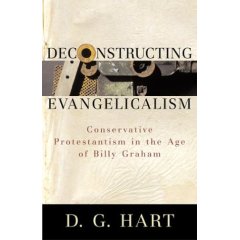 The last few days have been quite unproductive. I have found it very hard to get into a good working routine since returning to St. Andrews. Hopefully this weekend can represent a turning point in this respect. There are so many books that I am itching to read, but I have spent so little time in focused reading over the last few weeks. I started reading Deconstructing Evangelicalism yesterday, which I am enjoying so far. I also received a copy of Yves Congar’s I Believe in the Holy Spirit in the post yesterday and can’t wait to get my teeth into that.
Reading for honours level study is quite a bit more intense, but there are a lot less classes. Over the last few days I have had to read a lot of Barth and quite a bit of Aquinas on the issue of the analogia entis. I far prefer Aquinas to Barth on the subject, for a variety of different reasons. The fact that I am currently reading and enjoying Truth in Aquinas may have something to do with it. Over this weekend I have to read a lot of commentaries for Biblical Exegesis, something which I am quite looking forward to.
I have also arranged to start Chinese lessons. These begin next Tuesday, which will probably lead to a decrease in my blogging output (a matter of quantity over quality of late, for which I apologize). I have three hours’ worth of lessons each week and, I would imagine, a lot of further work outside lessons. The fact that I also have to find time to revise my Greek and keep my Hebrew well-oiled means that I will have to begin to organize my time more effectively.
I have heard the Super Mario theme song played on a number of different instruments, but I must confess that this is a first for me. [HT: Jason Blair from BHT]
My brother Peter links to the work of this artist. I really like some of his papercut works.
This book does sounds interesting.
The BBC reports:
Catholic experts are expected to advise Pope Benedict XVI that the traditional state of limbo – somewhere between heaven and hell – should be abolished.
This statement does read a bit strangely, almost making it sound as if limbo is a real place that the papacy created many years back and have finally decided to empty of its occupants, having no further use for the realm. Of course, limbo is nothing of the kind. It is just a speculative and unbiblical notion and we should be encouraged that Pope is possibly going to decisively reject it. Let’s hope that purgatory is next on the list.
So what might the rejection of limbo for unbaptized children mean for the Roman Catholic practice of infant Baptism? Hopefully it will encourage a popular movement towards a more biblical understanding of the place of infant Baptism. Kurt Stasiak, a Roman Catholic theologian, puts the issue well:
Our discussion here emphasizes that the primary motive for baptizing our infants should not be our fear of what might be denied them should they die unbaptized but, rather, our hope of whom through baptism they will become. Through baptism the sons and daughters of our flesh become sons and daughters of God and are brought into new life in Christ and his Church. We baptize our children because we hope that as the grace of their baptism unfolds, they will mature as adult sons and daughters of God, ever-learning how to walk according to the Spirit.
Baptism overcomes the power of original sin. The connection between infant baptism and original sin, however, is not theological speculation as to how God can receive an unbaptized infant. It is, rather, the challenge of how the Christian community can receive the infant in such a way so that he will learn from the beginning the community’s ways and means of overcoming the effects of original sin that linger stubbornly in the lives of all. Baptism is the pledge and promise that infants are delivered from original sin—not by slow trickles of water, but by the flood of grace which rushes forth as they are transformed and brought into the family of God and the Church. Infant baptism does not mean the child is “home free” because limbo is no longer a possibility. It means the child is brought into a home—into a Christian environment—in which the Word of God is proclaimed from the beginning. Children learn how to be part of the family by being part of the family. Infant baptism proclaims how an infant is to live and be formed. If there is a limbo that needs to be addressed in our baptismal catechesis, it is not a hypothetical limbo between earth and heaven but, rather, the spiritual limbo that still exists in quite tangible form in far too many homes today.
In his superb treatment of the subject of infant Baptism in his book Return to Grace, Stasiak observes that many Christians leave infants in a form of suspense, waiting for the time when they can come to a more explicit form of faith. The impression given is that God views the infant more as a potential adult and believer, rather than as one to be brought into His family and to be valued for what they already are as infants (I have dealt with some of these issues in an older post). Stasiak writes:
The “point” of infant baptism—it is the point of adoption, of taking the initiative on behalf of another—is that neither God, nor Church, nor parents, keep the child “in limbo” until some future time when the child is able or willing to respond to the love already present and presented. Parents love their infants because of who they are now, not because of who they might eventually become. And if the precautions many parents today take even as the child is being “knit together in the mother’s womb” is any indication, they love their child “before now”: before the child from their flesh becomes their child in the world.
Tim Gallant‘s new website project. I look forward to reading the articles on the site.
Dr. Jim West asks why Wright is so famous and gets so much attention whilst other insightful scholars are overlooked. In a slightly uncharitable (but humorous) assessment, Dr. West comments that Wright “reads, he regurgitates it into the open mouths of the waiting, joyously anticipating flock of hatchlings huddled together in his safe, warm, dry, nest of exegetical certainty, and he makes an awful lot of money doing it.” There is more truth in that characterization of Wright’s followers than some of us would like to admit (even though the characterization of Wright himself seems to me to be trifle unfair). Hopefully most of us read relatively widely in other scholars and do not take Wright on board uncritically.
So why does Wright get so much attention and other thought-provoking scholars so little? I have given some brief thoughts that immediately came to mind in the comments on Dr. West’s post. Does anyone else have any thoughts?
[And on the subject of Wright, I was intending to post my next audio talk yesterday. That didn’t quite work out, but I will do it as soon as I can.]

n. pl.
A miscellaneous collection of notes, remarks, or selections.